Living
Which is better with kids?
The Mastiff, rated very high (5/5) versus the Chihuahua's low (2/5).

Quick answer
Which is better with kids?
The Mastiff, rated very high (5/5) versus the Chihuahua's low (2/5).
Chihuahua or Mastiff (English Mastiff)? On paper they differ most on barking, and on the scales Mastiff (English Mastiff) is the heavier at 120–250 lbs. Here is how the two compare on everything that shapes an ordinary week.
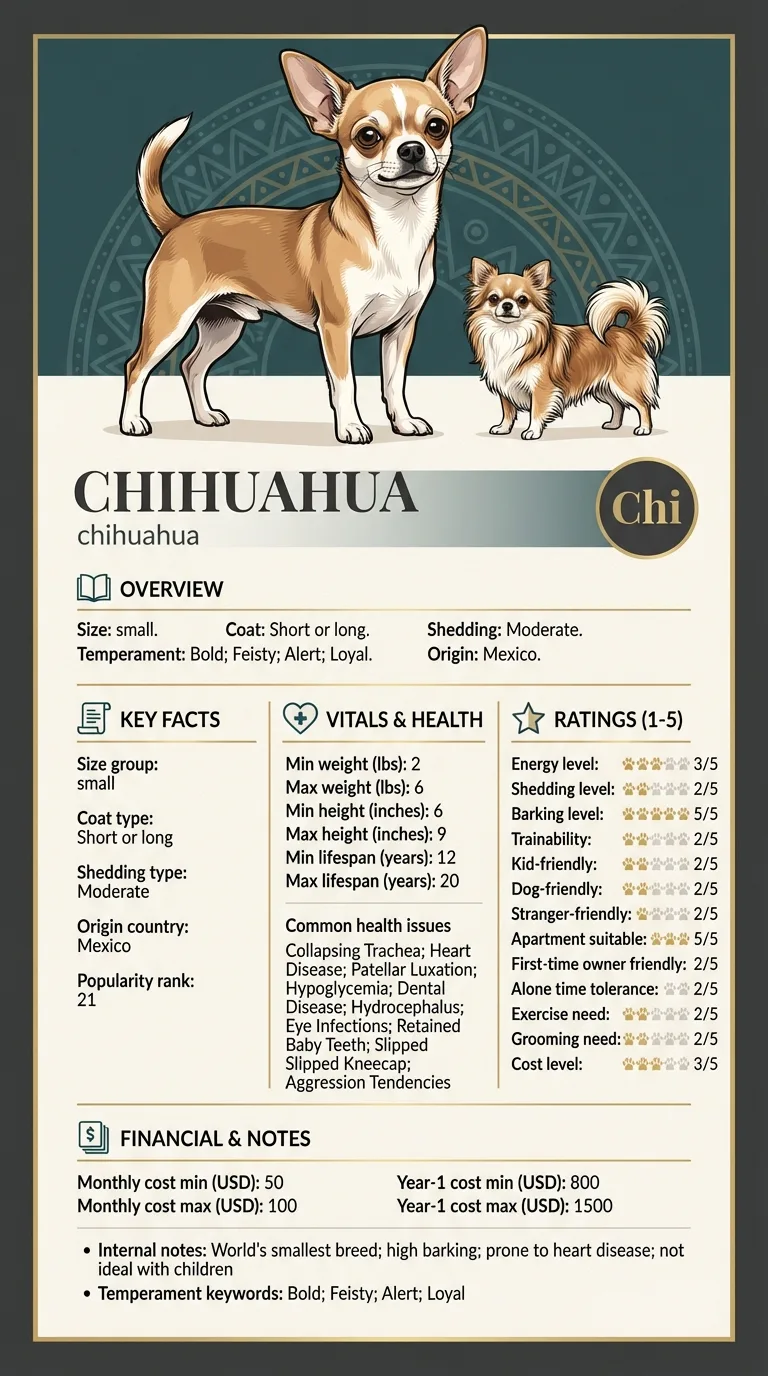
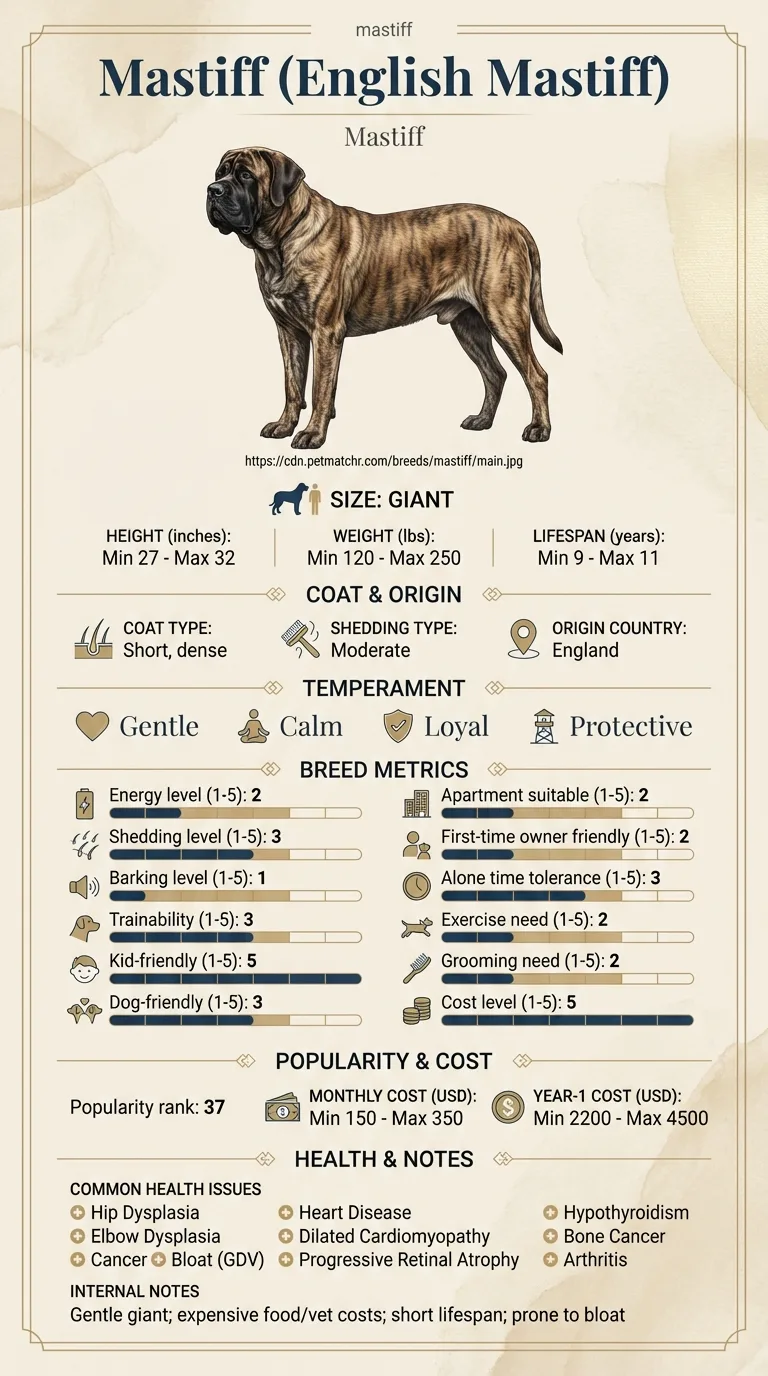
This is for someone already down to Chihuahua and Mastiff (English Mastiff) and deciding between them. For this pair the decision usually turns on barking and apartment suitability, so those are covered first and in most detail. Anyone choosing from a flat has a clear answer here: Chihuahua rates 5/5 against 2/5. The focus throughout is on daily consequences rather than breed background.
Between Chihuahua and Mastiff (English Mastiff), barking is what separates them, and Chihuahua is the lower-effort dog of the two to keep.
Choose Chihuahua if you are in a flat or a smaller home, shedding is a problem in your house and a smaller dog suits your car, your home or your back.
Choose Mastiff (English Mastiff) if the dog will be alone during the working day, there are young children at home and you already have another dog.
| Feature | chihuahua | mastiff | Winner |
|---|---|---|---|
| Size class | small | giant | Equal |
| Weight | 2–6 lbs | 120–250 lbs | Equal |
| Height | 6–9 in | 27–32 in | Equal |
| Lifespan | 12–20 years | 9–11 years | chihuahua |
| Exercise need | Low (2/5) | Low (2/5) | Equal |
| Grooming need | Low (2/5) | Low (2/5) | Equal |
| Shedding | Low (2/5) | Moderate (3/5) | chihuahua |
| Energy level | Moderate (3/5) | Low (2/5) | Equal |
| Barking | Very high (5/5) | Very low (1/5) | mastiff |
| Apartment suitability | Very high (5/5) | Low (2/5) | chihuahua |
| Good for first-time owners | Low (2/5) | Low (2/5) | Equal |
| Tolerates being alone | Low (2/5) | Moderate (3/5) | mastiff |
| Trainability | Low (2/5) | Moderate (3/5) | mastiff |
| Good with kids | Low (2/5) | Very high (5/5) | mastiff |
| Good with other dogs | Low (2/5) | Moderate (3/5) | mastiff |
| Friendly to strangers | Low (2/5) | Moderate (3/5) | mastiff |
| Cost level | Moderate (3/5) | Very high (5/5) | chihuahua |
| Coat | Short or long | Short, dense | Equal |
| Origin | Mexico | England | Equal |
| Typical monthly cost | $50–$100 | $150–$350 | Equal |
| Typical first-year cost | $800–$1,500 | $2,200–$4,500 | Equal |
Few breed match-ups show a gap this extreme: a fully grown Chihuahua tops out around 6 lbs and 9 inches, while an English Mastiff can reach 250 lbs and stand 32 inches at the shoulder, a weight difference that can exceed 40-to-1. The Mastiff's giant frame means doorways, car seats, and even a couch need reconsidering, while a Chihuahua can travel in a bag. That size gap carries into daily handling too: a Mastiff leaning against your leg can knock over a toddler, while a Chihuahua underfoot risks being stepped on. Neither size is inherently better, but they demand opposite kinds of physical accommodation at home.
Despite the size gap, exercise needs land close together: both breeds carry a low (2/5) exercise rating, and the Mastiff's low (2/5) energy level actually falls a notch below the Chihuahua's moderate (3/5). A Mastiff is a famous couch companion, content with a couple of short walks and long naps, while the Chihuahua's spurts of moderate energy show up as brief indoor zoomies rather than a need for miles. Owners expecting a giant breed to require marathon exercise are often surprised; the real physical demand of a Mastiff comes from managing its bulk on leash, not from burning off energy.
Grooming effort is rated identically low (2/5) for both breeds, since the Mastiff's short, dense coat needs only routine brushing despite covering a much larger animal. The real difference is shedding: the Chihuahua sits at low (2/5) while the Mastiff climbs to moderate (3/5), meaning more total hair volume simply because there is more dog to shed from. Mastiff owners also contend with drool and the deep facial wrinkles common to the breed's short coat, which the smooth or long-coated Chihuahua never presents. Neither breed demands a groomer's table, but the Mastiff leaves a bigger physical footprint of loose hair around the house.
Living space flips the expected script. The Chihuahua rates very high (5/5) for apartment suitability and can thrive in a studio, but it also barks at a very high (5/5) rate, making it the noisier neighbor. The 120-250 lb Mastiff rates only low (2/5) for apartments, since its sheer bulk needs room to turn around, yet it barks at a very low (1/5) rate, described as gentle and calm rather than reactive. On being left alone, the Mastiff's moderate (3/5) tolerance edges out the Chihuahua's low (2/5), so a working household may find the giant, quiet Mastiff the more forgiving roommate despite its size.
Neither breed is rated ideal for first-timers, both scoring low (2/5), but the reasons differ sharply. The Chihuahua, described as bold and feisty, resists training more, holding trainability at low (2/5), out of stubborn independence, while the Mastiff's moderate (3/5) trainability is limited less by willfulness and more by sheer physical strength; a gentle, calm, protective 200 lb dog that hasn't learned leash manners is genuinely hard to control. First-time Mastiff owners need confidence handling size and early socialization to channel that protective instinct, while first-time Chihuahua owners need patience for a small dog with an outsized, feisty personality that doesn't back down.
For families, the data points firmly toward the Mastiff: it rates very high (5/5) with kids against the Chihuahua's low (2/5), reflecting the Mastiff's gentle, protective nature versus the Chihuahua's reputation for feistiness around rough handling. The pattern repeats with other dogs, moderate (3/5) versus low (2/5), and with strangers, moderate (3/5) versus low (2/5); the loyal Chihuahua tends to bond tightly to its own people and stay wary of everyone else, while the Mastiff's calm, protective temperament makes it steady around visitors it has met. Households with young children or a busy front door will find the Mastiff's profile the easier fit.
Lifespan is the sharpest contrast in this comparison: the Chihuahua's 12-20 year range can nearly double the Mastiff's 9-11 years, a gap typical of extreme size differences in dogs. The Chihuahua's health list, including collapsing trachea, hypoglycemia, patellar luxation, hydrocephalus, and retained baby teeth, reflects small-breed and toy-skull risks, while the Mastiff faces classic giant-breed conditions: hip and elbow dysplasia, bloat (GDV), dilated cardiomyopathy, and a notable cancer and bone cancer risk. Both share a heart disease risk. Prospective owners should weigh a Mastiff's shorter, joint- and heart-focused health horizon against a Chihuahua's longer life clouded by dental and airway fragility.
Cost scales with size here. The Chihuahua runs $50-$100 a month and roughly $800-$1,500 in year one, rated a moderate (3/5) overall cost level. The Mastiff, rated very high (5/5), runs $150-$350 monthly and $2,200-$4,500 in the first year, driven by the food volume a 120-250 lb dog requires, larger-dose veterinary care, and bigger everything from crates to medication. Over a decade-plus, the math shifts further: the Chihuahua's extra years of ownership add up, but the Mastiff's per-year spend is consistently higher throughout its shorter life. Budget-conscious owners should plan around the Mastiff's roughly triple monthly cost.
Chihuahua weighs 2–6 lbs and lives 12–20 years; Mastiff (English Mastiff) weighs 120–250 lbs and lives 9–11 years. The two diverge most on barking, apartment suitability and good with kids and 1 other rated axes. They are level on exercise need, good for first-time owners and grooming need, so those cannot decide it. The table below marks a winner only where one breed is genuinely easier for a typical owner; size and origin are facts rather than merits and stay level. Ratings come from one source applied to both breeds, so they are meaningful against each other rather than as absolute scores.

Not comfortably. The Mastiff rates only low (2/5) for apartment suitability due to its 120-250 lb size, while the Chihuahua rates very high (5/5) and suits small spaces well.
The Chihuahua, rated very high (5/5) for barking versus the Mastiff's very low (1/5); despite its size, the Mastiff is the quieter of the two.
Yes, it rates very high (5/5) for compatibility with kids thanks to a gentle, protective temperament, well above the Chihuahua's low (2/5).
Neither is ideal since both rate low (2/5), but the Mastiff's challenge is managing size and strength, while the Chihuahua's is managing a stubborn, feisty temperament.
Substantially more. The Mastiff runs $150-$350 a month against the Chihuahua's $50-$100, roughly triple.
The Chihuahua, with a 12-20 year lifespan versus the Mastiff's 9-11 years, a gap typical for toy versus giant breeds.
No. The Chihuahua sheds low (2/5) and the Mastiff moderate (3/5); neither is a heavy shedder despite the size difference.
The Mastiff, rated very high (5/5) versus the Chihuahua's low (2/5).
The Chihuahua, with very high (5/5) apartment suitability.
The Mastiff, rated very low (1/5) for barking.
The Chihuahua, at $50-$100 a month versus $150-$350.
Secure checkout on Stripe. We never see your card.
7-day money-back guarantee. Instant access.
Health information here is general and is not veterinary advice. If your dog shows pain, sudden behaviour change, or worsening symptoms, consult a licensed veterinarian.
Some links on this site are affiliate links. We may earn a commission at no extra cost to you, and we only suggest products we believe are helpful for dog owners.
We research and check what we publish, but we do not warrant that any figure, date, price, or statement is accurate, complete, or current, and we accept no liability for any loss, cost, injury, or other harm arising from the use of this site. Use it as one reference among several. You remain responsible for your own decisions and for your dog's care - confirm anything that matters with a licensed veterinarian or another qualified professional before you act on it. Full disclaimer.
Match your lifestyle to the right dog.
Take quizNot sure which breed is right for you? Take our 2-minute quiz to find out.
Take the quiz