Health
Does a heart murmur mean my Chihuahua is seriously ill?
Not by itself. A murmur measures turbulence and loudness, not severity. The stage of disease, which needs imaging, is what matters.

Quick answer
Does a heart murmur mean my Chihuahua is seriously ill?
Not by itself. A murmur measures turbulence and loudness, not severity. The stage of disease, which needs imaging, is what matters.
A murmur is a noise, not a diagnosis. It tells you turbulence exists. It says nothing about whether the heart is coping, and in a breed that may live to twenty, many Chihuahuas carry one for a decade without ever needing treatment.
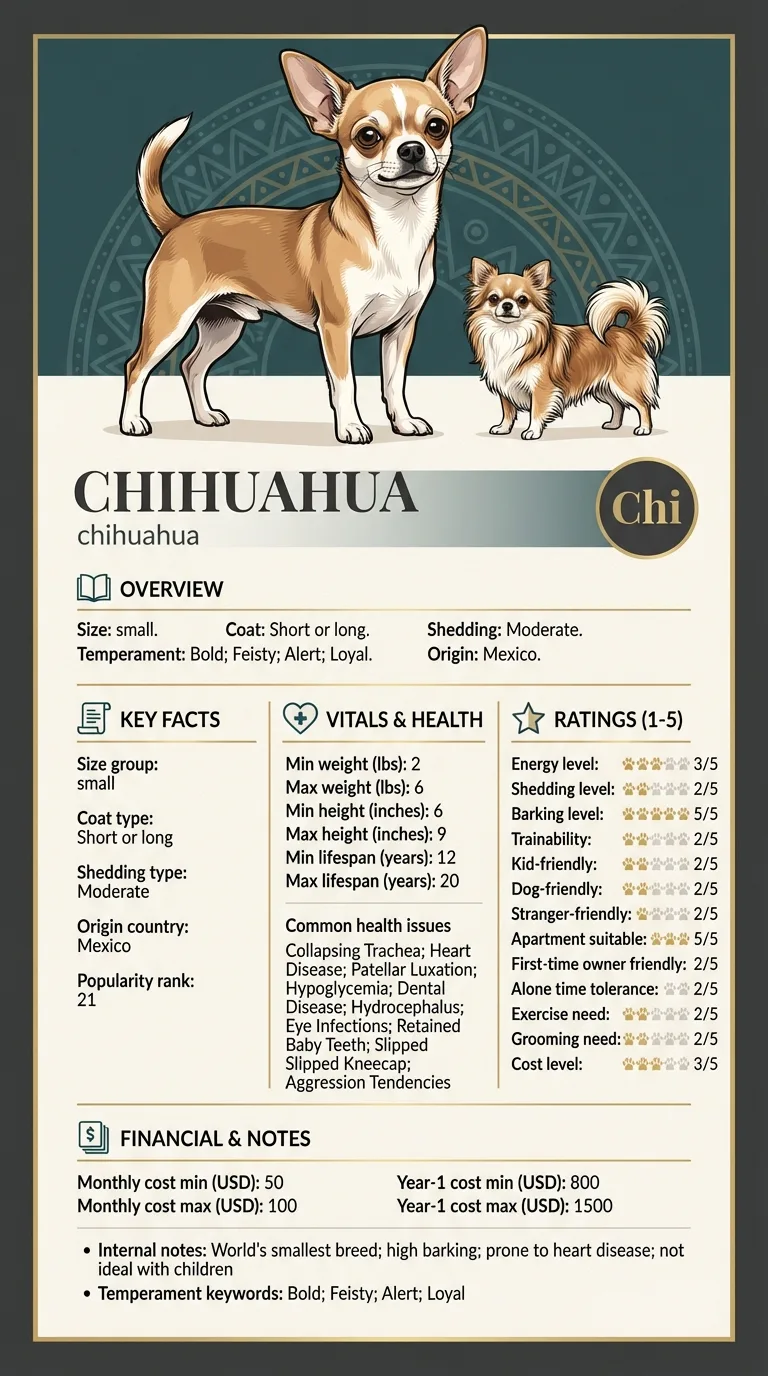
Owners who have just been told their Chihuahua has a heart murmur and want to know how frightened to be, and owners of a dog already on cardiac medication who want to understand what the vet is watching for at each recheck.
This guide is not medical advice. If your dog shows pain, sudden behavior change, or worsening symptoms, consult a licensed veterinarian.
Some links may be affiliate links. We may earn a commission at no extra cost to you. We only suggest products we believe are helpful for dog owners.
We research and check what we publish, but we do not warrant that any figure, date, price, or statement is accurate, complete, or current, and we accept no liability for any loss, cost, injury, or other harm arising from the use of this site. Use it as one reference among several. You remain responsible for your own decisions and for your dog's care - confirm anything that matters with a licensed veterinarian or another qualified professional before you act on it. Full disclaimer.
Heart disease is documented among the Chihuahua's common health problems and in this breed usually means progressive degeneration of the mitral valve. Thickened valve leaflets stop sealing, blood leaks backward with each beat, and the resulting turbulence produces a murmur that is often detected years before any symptoms. Over time the left side of the heart enlarges to compensate, and eventually fluid backs up into the lungs. The disease is staged from A to D, and the stage determines everything about management.
Common, and increasingly so with age. Heart disease sits explicitly on the Chihuahua's documented health list, and degenerative valve disease is the single most frequently diagnosed cardiac condition in small breed dogs generally. Because this breed regularly reaches fourteen to sixteen years and sometimes twenty, a large proportion of Chihuahuas will have a murmur detected at some point, though many never progress to heart failure.
Toy breeds are strongly predisposed to degeneration of the mitral valve, and the Chihuahua is squarely within that group, with heart disease listed among its documented problems. The valve leaflets develop nodular thickening and lose their smooth sealing edge, so a fraction of each heartbeat's output leaks backward into the atrium rather than out to the body. The heart compensates by enlarging, which works for years and then stops working. The breed's exceptional lifespan of twelve to twenty years contributes directly, because valve degeneration is cumulative and time is the main ingredient. Concurrent tracheal collapse, also on the breed list, frequently coexists and makes the respiratory picture harder to read.
The controllable factors are weight, teeth and monitoring. Even a few extra ounces on a two-to-six-pound dog increases the volume of blood the heart must move, and obesity is one of the few genuinely modifiable loads on a leaking valve. Chronic periodontal disease, near-universal in this breed, keeps a low-grade inflammatory and bacterial burden circulating. Hot weather and high arousal both raise cardiac demand in a dog with a top-of-scale barking drive. Most importantly, a household that does not weigh the dog or count its sleeping breaths loses the early warning that makes timely treatment possible.
Go to an emergency clinic immediately for breathing difficulty at rest, for gums that look blue, grey or unusually pale, for collapse, or for a sleeping breathing rate substantially above the threshold your vet has given you. Congestive heart failure is a genuine emergency and a small dog decompensates quickly. Book promptly for a new cough, particularly one that is worse at night or on lying down, for reduced tolerance of normal short walks, for restlessness overnight, for a swollen abdomen, or for any fainting episode. Attend scheduled rechecks even when the dog seems perfectly well, since the transition from B1 to B2 is silent.
See all Chihuahua health problems, which breeds are prone to cardiac disease, or the full Chihuahua breed guide for temperament, exercise needs and ownership costs.
A murmur detected in middle age may remain at stage B1 for years, and some dogs never progress beyond it. Progression from B2 to congestive heart failure is typically delayed by appropriate medication, often by a year or more. Once a dog has been in failure, management is measured in months to years rather than weeks, with rechecks every three to six months. Nothing here is curable, and the valve does not repair itself, but the timeline is often far longer than the diagnosis initially suggests.
Success is a Chihuahua that stays comfortable, keeps a stable sleeping breath count, maintains its weight and continues to want its short walks, on medication that is reviewed rather than set and forgotten. It also means catching the transition to an enlarged heart at a recheck rather than discovering it during an emergency at two in the morning. For an owner, success is knowing your dog's stage, its baseline breathing number and the threshold at which you pick up the phone.
Owners frequently leave an appointment holding a number and unsure what it measures. There are two scales in play and they answer different questions.
Murmur grade runs from one to six and describes loudness only. A grade one is barely audible in a quiet room; a grade six can be felt through the chest wall with a hand. Loudness correlates loosely with severity but is not a measure of it, and a Chihuahua can have a loud murmur with a heart that is coping perfectly well.
Disease stage is the scale that matters. Stage A means a dog at risk of heart disease but with no murmur and no abnormality. Stage B1 means a murmur is present but the heart has not enlarged. Stage B2 means the heart has begun to enlarge in response to the leak, and this is the point at which medication is usually started, because starting it here has been shown to delay the onset of heart failure. Stage C means the dog has developed congestive heart failure at some point and is being treated for it. Stage D means failure that is difficult to control with standard treatment.
The distinction between B1 and B2 cannot be made with a stethoscope. It needs imaging, usually radiographs and an echocardiogram, because the question is whether the chambers have grown. That is why a vet who hears a murmur will often recommend a scan rather than simply monitoring.

Sleeping respiratory rate is the single most valuable thing an owner of a cardiac dog can track. It is free, takes thirty seconds and detects fluid in the lungs before you can see the dog struggling.
If you think your Chi has cardiac disease, the plan is three steps: write down what you have seen and when it started, book a veterinary appointment rather than waiting for the next flare, and take video of the behaviour or symptom before you go — the thing you are worried about rarely happens in the consulting room. Screening in the parents covers collapsing trachea, heart disease, patellar luxation.
What the vet visit should produce is a diagnosis and a written plan, not just reassurance: what is being ruled out, what the monitoring interval is, and which signs mean you come back sooner. Ask what the treatment costs across a year rather than per visit, because that is the number that decides whether you are managing this condition or reacting to it.
Between appointments, keep a short log — dates, what you saw, what changed. It is the single most useful thing an owner brings to a follow-up, and for cardiac disease it is often what separates a clear pattern from a guess.
Nino, a ten-year-old, 5-pound Chihuahua in Glasgow, had a grade three murmur picked up at a routine vaccination appointment. He was bright, ate everything and had no symptoms at all, and his owner Ailsa found it hard to accept that anything was wrong. Her vet arranged radiographs and an echocardiogram, which showed a normal-sized heart. Nino was staged B1 and no medication was started. Ailsa was given one job: count his sleeping breaths a few evenings a week and write them down. His baseline settled around eighteen. Two years later the number began drifting into the low twenties over about ten days. Nothing else had changed and Nino seemed his usual self. She rang anyway. Repeat imaging showed his heart had enlarged, he was restaged to B2, and medication was started before he had ever coughed. He is fourteen now and has not been in heart failure.
Key takeaway: The murmur was found by a stethoscope, but the moment that changed his treatment was found by an owner counting breaths in her living room. Thirty seconds a few times a week is the most valuable monitoring available for a cardiac dog.
In toy breeds the dominant pattern is degeneration of the mitral valve, the valve between the left atrium and left ventricle. The valve leaflets thicken and stop sealing, so blood leaks backward with every beat, producing the murmur. This is a slow, progressive, age-related process, quite different from diseases of the heart muscle itself, and it is what heart disease on the Chihuahua's health list usually refers to in practice.
Very much so, and it is the usual situation. Murmurs are typically detected years before any symptoms appear, and a dog at stage B1 may remain there for a long time. That is not a reason to ignore it. It is a reason to establish where the dog is on the staging scale and then to recheck on the schedule your vet sets, because the useful moment to start medication is one you can only find by looking.
Because evidence in dogs with an enlarged heart from valve disease supports starting treatment at that stage to delay the onset of congestive heart failure. It is preventive rather than symptomatic. This is exactly why the distinction between stage B1 and B2 is worth imaging for, since it changes what should happen now rather than describing what has already happened.
A rising resting breathing rate is usually first and is why the count is worth doing. Then a soft persistent cough, particularly at night or on lying down, reduced tolerance for the short walks this breed normally manages easily, restlessness at night, fainting, or a swollen abdomen. Any of those warrants a call, and breathing difficulty at rest warrants an emergency visit.
Collapsing trachea is also on this breed's health list and also causes coughing, which makes the two easy to confuse. A tracheal cough is dry and honking, comes with excitement, exertion or collar pressure, and stops when the dog calms. A cardiac cough is softer, more persistent, worse at night, and comes with a rising sleeping breathing rate. Many older Chihuahuas have both.
It can, but the timescale is often longer than owners fear. Many Chihuahuas are diagnosed with a murmur in middle age and live years more without ever reaching heart failure, in a breed whose lifespan commonly runs to sixteen or beyond. Where failure does develop, treatment frequently gives good quality months to years rather than weeks.
Not by itself. A murmur measures turbulence and loudness, not severity. The stage of disease, which needs imaging, is what matters.
B1 means a murmur with a normal-sized heart; B2 means the heart has enlarged. B2 is usually when medication starts.
Count chest rises for thirty seconds while the dog is truly asleep and double it. Most healthy dogs stay under about thirty per minute.
A soft persistent cough that is worse lying down, with a rising sleeping breath rate, needs a prompt appointment. Breathing distress at rest is an emergency.
An echocardiogram at diagnosis, then daily medication and rechecks with imaging once or twice a year. It is a long recurring commitment.
A one-page prep sheet for this condition: the signs, the questions to ask, what to get priced. Unlocks here.
You get: Vet visit prep sheet
No spam. One-click unsubscribe. See our privacy policy.
Preview page 1 before you decide.