Training
Which is easier to train?
The Papillon, rated very high (5/5) versus the Chihuahua's low (2/5).

Quick answer
Which is easier to train?
The Papillon, rated very high (5/5) versus the Chihuahua's low (2/5).
Chihuahua or Papillon? On paper they differ most on trainability, and on the scales Papillon is the heavier at 5–10 lbs. Here is how the two compare on everything that shapes an ordinary week.
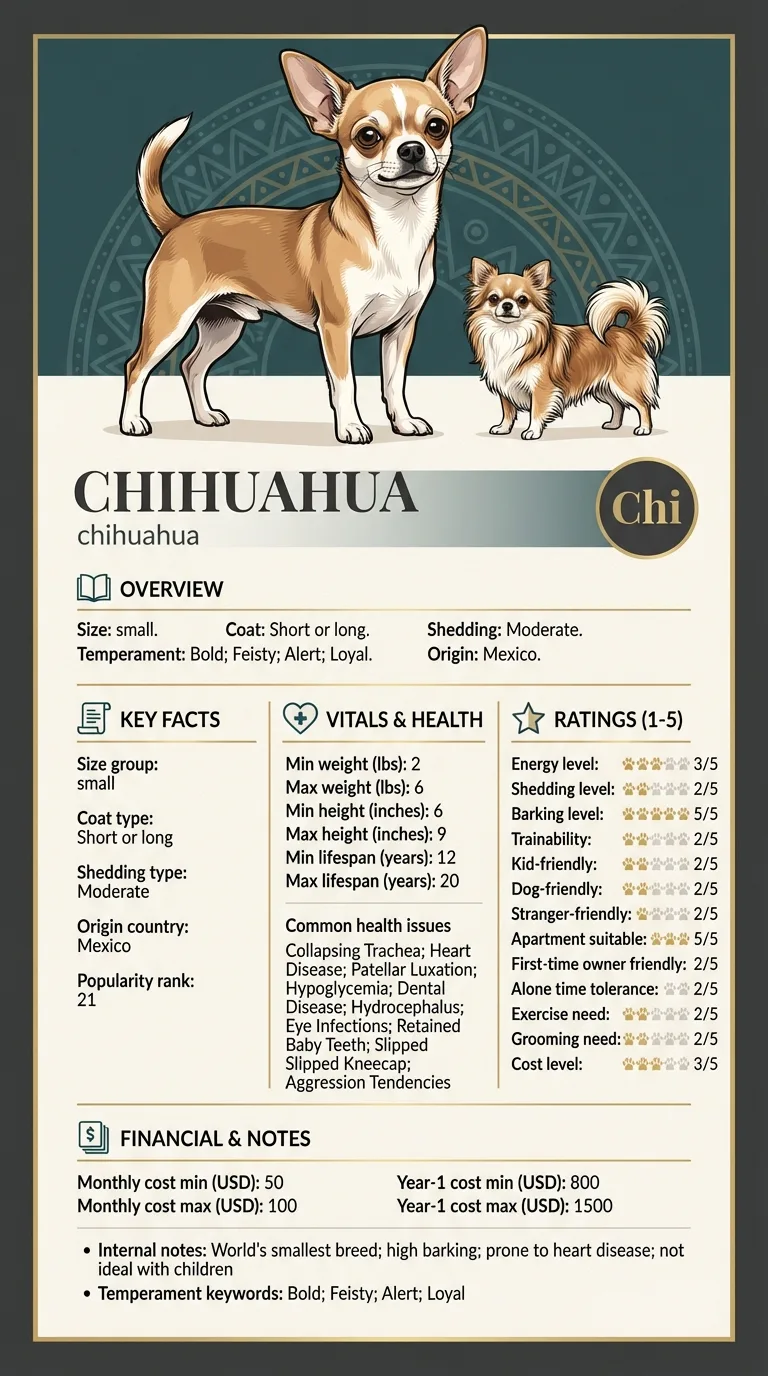
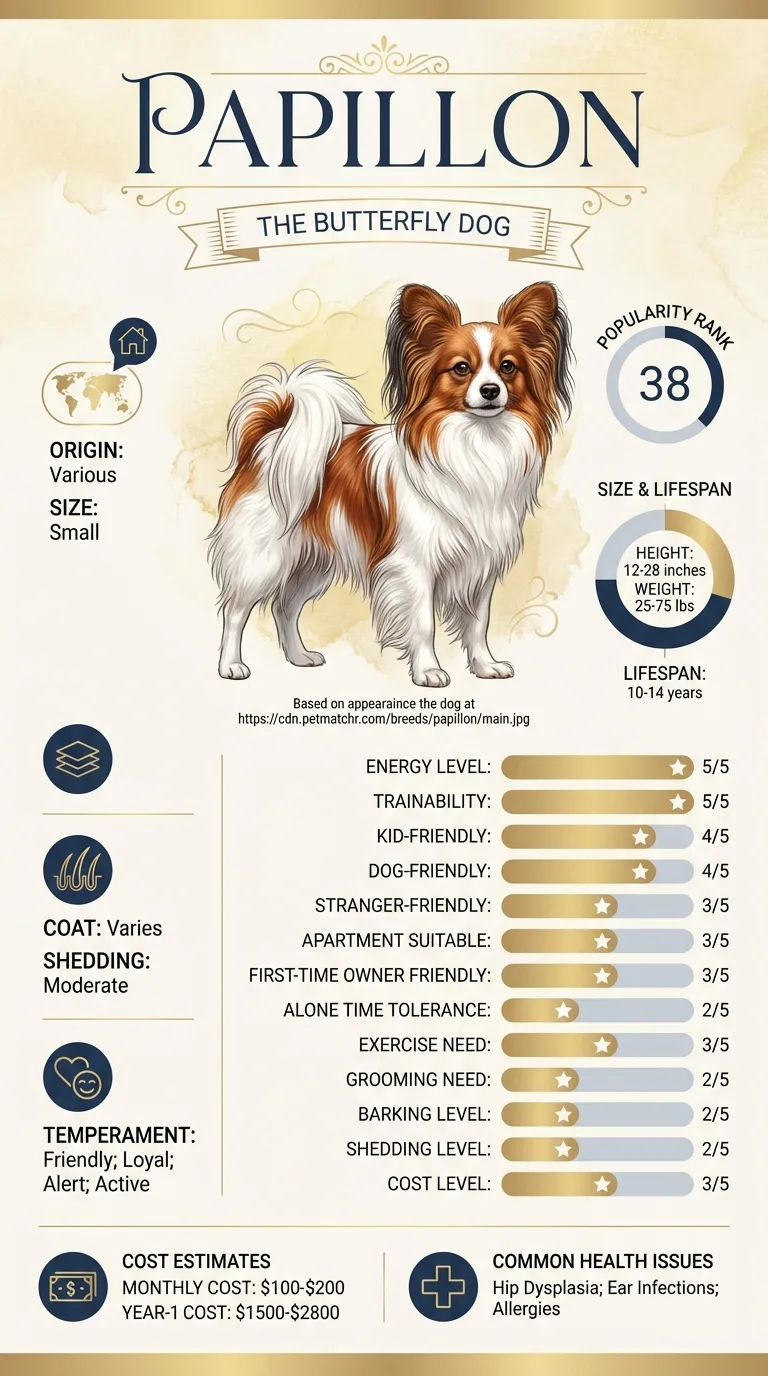
This is for someone already down to Chihuahua and Papillon and deciding between them. For this pair the decision usually turns on trainability and good for first-time owners, so those are covered first and in most detail. Both rate 5/5 for flats, so housing does not settle this one. It is written for the decision rather than the breed history.
Between Chihuahua and Papillon, trainability is what separates them, and Papillon is the lower-effort dog of the two to keep.
Choose Chihuahua if your walking routine is modest, a smaller dog suits your car, your home or your back and you want a dog that is more watchful with visitors.
Choose Papillon if this is your first dog, you already have another dog and you want a dog that picks up training quickly.
| Feature | chihuahua | papillon | Winner |
|---|---|---|---|
| Size class | small | small | Equal |
| Weight | 2–6 lbs | 5–10 lbs | Equal |
| Height | 6–9 in | 8–11 in | Equal |
| Lifespan | 12–20 years | 14–16 years | chihuahua |
| Exercise need | Low (2/5) | Moderate (3/5) | chihuahua |
| Grooming need | Low (2/5) | Low (2/5) | Equal |
| Shedding | Low (2/5) | Low (2/5) | Equal |
| Energy level | Moderate (3/5) | High (4/5) | Equal |
| Barking | Very high (5/5) | High (4/5) | papillon |
| Apartment suitability | Very high (5/5) | Very high (5/5) | Equal |
| Good for first-time owners | Low (2/5) | High (4/5) | papillon |
| Tolerates being alone | Low (2/5) | Low (2/5) | Equal |
| Trainability | Low (2/5) | Very high (5/5) | papillon |
| Good with kids | Low (2/5) | Moderate (3/5) | papillon |
| Good with other dogs | Low (2/5) | High (4/5) | papillon |
| Friendly to strangers | Low (2/5) | High (4/5) | papillon |
| Cost level | Moderate (3/5) | Low (2/5) | papillon |
| Coat | Short or long | Long, silky single coat | Equal |
| Origin | Mexico | Various | Equal |
| Typical monthly cost | $50–$100 | $80–$150 | Equal |
| Typical first-year cost | $800–$1,500 | $1,100–$2,300 | Equal |
Both breeds sit at the small end of the spectrum, but the Papillon runs noticeably larger: 5-10 lbs and 8-11 inches against the Chihuahua's 2-6 lbs and 6-9 inches. That modest size bump gives the Papillon a bit more physical resilience for handling and play than the more fragile, apple-headed Chihuahua. The Papillon's name, French for butterfly, comes from its large, fringed ears that fan out from the head, a distinctive silhouette next to the Chihuahua's smoother or longer coat options. Both remain lap-sized dogs, but owners choosing between them are picking between the very smallest possible dog and one just a size class up.
The Papillon runs at a high (4/5) energy level against the Chihuahua's moderate (3/5), and its exercise need is rated moderate (3/5) versus the Chihuahua's low (2/5). Despite its toy-dog size, the Papillon was bred partly from spaniel lines and retains real drive for play, fetch, and agility-style activity; many compete successfully in agility despite their small stature. The Chihuahua's lower energy and exercise needs make it the more sedentary of the two, content with short indoor activity rather than structured daily play. An owner drawn to a tiny dog that still wants to work for its exercise will find the Papillon the better match.
Grooming and shedding tie at low (2/5) for both breeds, which is a bit surprising given the Papillon's long, silky coat and dramatic fringed ears, but that single-layer coat lacks a dense undercoat, so it doesn't mat easily and needs only regular brushing rather than trimming. The Chihuahua's short-or-long coat options are similarly low-maintenance. Neither breed sheds heavily or requires professional grooming as a baseline, making this one of the few categories where the two are functionally equivalent despite looking very different; the Papillon's ear fringing is more about brushing frequency around the face than overall coat labor.
Both breeds tie at very high (5/5) for apartment suitability, making either a strong fit for compact living. Barking runs close but not identical: the Chihuahua rates very high (5/5) while the Papillon rates high (4/5), still a vocal, alert breed, just a notch quieter. Both tie at low (2/5) for tolerating time alone, so neither is naturally suited to long solo days without training or enrichment. For apartment dwellers choosing purely on space, either breed works; the deciding factor is more likely to be the Papillon's slightly lower bark frequency than any difference in square footage needed.
Trainability is one of the widest gaps in this comparison: the Papillon rates very high (5/5), among the most trainable toy breeds, while the Chihuahua rates low (2/5). That difference shows up in first-timer suitability too, high (4/5) for the Papillon versus low (2/5) for the Chihuahua. The Papillon's quick-witted, confident temperament makes it responsive to positive reinforcement and capable of learning complex tricks or agility sequences, while the Chihuahua's bold, feisty nature tends toward stubbornness. A new owner wanting a small dog that's genuinely easy to train will find the Papillon a far more forgiving choice.
The Papillon out-scores the Chihuahua in every social category: moderate (3/5) with kids versus low (2/5), high (4/5) with other dogs versus low (2/5), and high (4/5) with strangers versus low (2/5). Its friendly, confident temperament makes it more adaptable around unfamiliar people and pets, while the Chihuahua's loyal-but-wary nature keeps it more reserved outside its immediate circle. Neither breed is rated as strongly kid-proof as some larger breeds, but between the two, the Papillon is the more socially flexible option for a household that regularly has guests, other dogs, or children's friends coming through.
The Papillon holds a lifespan edge, 14-16 years against the Chihuahua's 12-20, though the Chihuahua's ceiling actually runs higher, its range wider and less predictable. Health-wise, the two breeds share real overlap: both lists include patellar luxation, dental disease, and collapsing trachea, common threads among small and toy breeds. The Papillon adds progressive retinal atrophy and open fontanel, a soft spot in the skull also seen in some Chihuahuas, to its list, while the Chihuahua's list extends further into hypoglycemia, heart disease, and hydrocephalus. Owners of either breed should prioritize dental care and airway monitoring as shared, near-universal concerns.
The Papillon rates a low (2/5) overall cost level, actually a step below the Chihuahua's moderate (3/5), despite running a slightly higher monthly figure of $80-$150 against the Chihuahua's $50-$100. First-year costs follow the same pattern: $1,100-$2,300 for the Papillon against $800-$1,500 for the Chihuahua. Both are genuinely inexpensive breeds to keep relative to larger dogs, with the modest gap likely reflecting the Papillon's coat care and slightly larger food portions. Either breed suits a budget-conscious owner far better than a large or giant breed would.
Chihuahua weighs 2–6 lbs and lives 12–20 years; Papillon weighs 5–10 lbs and lives 14–16 years. The two diverge most on trainability, good for first-time owners and good with other dogs and 1 other rated axes. They are level on tolerates being alone, apartment suitability and grooming need, so those cannot decide it. In the table, a "winner" means easier for an ordinary household — not better. Size, coat and origin are recorded without a verdict. Because both breeds are scored the same way, the gaps are reliable even where the absolute numbers are rough.

The Papillon, rated very high (5/5) for trainability against the Chihuahua's low (2/5), one of the biggest gaps in this comparison.
Yes, more than most pairs. Both lists include patellar luxation, dental disease, and collapsing trachea, though the Chihuahua's list adds hypoglycemia and heart disease.
The Papillon, rated high (4/5) on both versus the Chihuahua's low (2/5) on each.
The Papillon, at a high (4/5) energy level and moderate (3/5) exercise need, versus the Chihuahua's moderate (3/5) energy and low (2/5) exercise need.
It rates high (4/5) for first-time owners, well ahead of the Chihuahua's low (2/5), thanks to a friendly, trainable temperament.
The Chihuahua's range runs wider and higher, 12-20 years, than the Papillon's 14-16 years, though the Papillon's range is more consistently long.
The Papillon, rated high (4/5) versus the Chihuahua's very high (5/5); both are vocal breeds, but the Papillon is slightly quieter.
The Papillon, rated very high (5/5) versus the Chihuahua's low (2/5).
The Papillon, rated high (4/5) versus the Chihuahua's low (2/5).
The Papillon, rated moderate (3/5) versus the Chihuahua's low (2/5).
The Papillon, rated a low (2/5) cost level versus the Chihuahua's moderate (3/5).
Secure checkout on Stripe. We never see your card.
7-day money-back guarantee. Instant access.
Health information here is general and is not veterinary advice. If your dog shows pain, sudden behaviour change, or worsening symptoms, consult a licensed veterinarian.
Some links on this site are affiliate links. We may earn a commission at no extra cost to you, and we only suggest products we believe are helpful for dog owners.
We research and check what we publish, but we do not warrant that any figure, date, price, or statement is accurate, complete, or current, and we accept no liability for any loss, cost, injury, or other harm arising from the use of this site. Use it as one reference among several. You remain responsible for your own decisions and for your dog's care - confirm anything that matters with a licensed veterinarian or another qualified professional before you act on it. Full disclaimer.
Match your lifestyle to the right dog.
Take quizNot sure which breed is right for you? Take our 2-minute quiz to find out.
Take the quiz