Health
Do mixed-breed dogs live longer?
On average slightly, but body size explains much of that gap. Small dogs of any ancestry tend to outlive large ones.

Quick answer
Do mixed-breed dogs live longer?
On average slightly, but body size explains much of that gap. Small dogs of any ancestry tend to outlive large ones.
Averaging every purebred dog together produces a number that describes no actual breed. A Bichon Frise is not an average purebred, and the average was never meant to predict any individual dog.
People choosing between a Bichon and a similar-sized crossbreed and trying to weigh the health argument honestly, and current owners who have read the statistic and are now anxious about their dog.
This guide is not medical advice. If your dog shows pain, sudden behavior change, or worsening symptoms, consult a licensed veterinarian.
Some links may be affiliate links. We may earn a commission at no extra cost to you. We only suggest products we believe are helpful for dog owners.
We research and check what we publish, but we do not warrant that any figure, date, price, or statement is accurate, complete, or current, and we accept no liability for any loss, cost, injury, or other harm arising from the use of this site. Use it as one reference among several. You remain responsible for your own decisions and for your dog's care - confirm anything that matters with a licensed veterinarian or another qualified professional before you act on it. Full disclaimer.
The purebred versus mixed-breed health comparison is a statistics problem dressed as a buying decision. Population averages pool wildly different breeds and body sizes into two crude categories, then get quoted as if they predicted individual outcomes. For someone considering a Bichon Frise, the productive move is to replace the category question with specific questions about a specific litter.
Misapplication of this comparison is close to universal in online breed research. The underlying studies are legitimate; the summaries that circulate from them strip away the caveats about breed variation, body size and data source that make the findings interpretable. Almost every prospective owner encounters the simplified version, and very few encounter the qualifications.
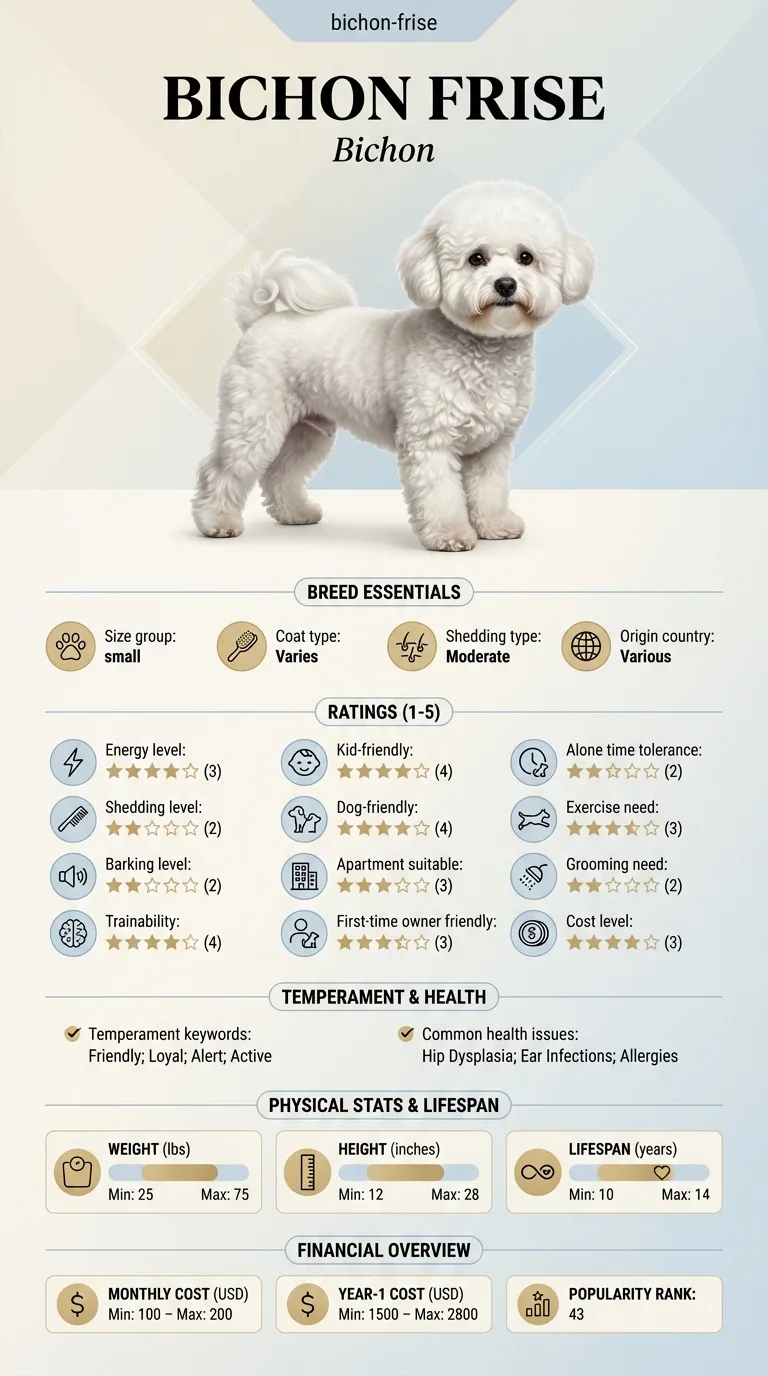
The Bichon Frise sits in a favourable position on the variables that actually drive these numbers. It is small, at 12 to 18 pounds, and small size is associated with longer life and lower cancer rates across dogs generally. It is long-lived at 14 to 15 years. Its documented health concerns are skin, kneecaps, urinary stones, eyes and teeth, which are chronic and manageable rather than rapidly fatal. Averaging it with breeds carrying very different risk profiles obscures all of that.
The information environment generates the problem. A single striking ratio travels further than a paragraph of caveats, and content aggregators reproduce the ratio without the study's population description. Commercial incentives push in the same direction, since hybrid vigour is a useful selling line for crossbreed sellers and health testing is a useful selling line for purebred breeders. Neither framing is designed to help you compare two actual puppies.
Statistics should never delay an examination. Book promptly for any new lump, a lump that is growing or changing, unexplained weight loss, persistent lethargy, or a wound that will not heal, regardless of what breed averages suggest. Seek urgent care for collapse, difficulty breathing, a rapidly swelling abdomen or uncontrolled bleeding. A vet who knows your individual dog is a far better guide to its risks than any population comparison.
See all Bichon Frise health problems, which breeds are prone to purebred vs mixed breeds, or the full Bichon Frise breed guide for temperament, exercise needs and ownership costs.
This is a decision-making shift rather than a process. Applying it means waiting for a breeder who screens, which typically adds months to a search. Owners consistently underestimate that wait and it is the main reason the careful comparison gets abandoned in favour of an available puppy.
You can explain what the purebred cancer statistic does and does not describe. You chose your dog on documented parental health rather than on a category label, and you spend your energy on the things that genuinely move the odds: weight, teeth, and turning up for preventive care.
Pooling all purebred dogs into a single group discards most of the information that would actually be useful.
If you are choosing a dog, the purebred versus mixed question is the wrong axis. The useful comparison is between two specific animals whose parentage you can investigate.
For a purebred, that means asking what the breed's documented concerns are and whether the parents were screened for them. For a Bichon Frise the list is skin allergies, patellar luxation, bladder stones, cataracts and dental disease, and the corresponding questions are whether the parents have documented patella examinations and ophthalmic assessments.
For a crossbred, the same logic applies but the answer is often unavailable. Mixed heritage genuinely reduces the chance of inheriting two copies of any single recessive variant. What it does not do is eliminate conditions influenced by many genes, or conditions driven by body shape, or anything acquired during life. A cross between two breeds that share a predisposition inherits that predisposition from both sides.
The other honest point is that health is not only genetics. Body weight, dental care, and whether a dog receives preventive veterinary attention account for an enormous share of the difference between two dogs' actual experiences, and none of that is decided at conception.

If you think your Bichon has purebred vs. mixed breeds, the plan is three steps: write down what you have seen and when it started, book a veterinary appointment rather than waiting for the next flare, and take video of the behaviour or symptom before you go — the thing you are worried about rarely happens in the consulting room. Screening in the parents covers skin allergies, patellar luxation, bladder stones.
What the vet visit should produce is a diagnosis and a written plan, not just reassurance: what is being ruled out, what the monitoring interval is, and which signs mean you come back sooner. Ask what the treatment costs across a year rather than per visit, because that is the number that decides whether you are managing this condition or reacting to it.
Between appointments, keep a short log — dates, what you saw, what changed. It is the single most useful thing an owner brings to a follow-up, and for purebred vs. mixed breeds it is often what separates a clear pattern from a guess.
Priyanka spent three weekends building a comparison spreadsheet between a Bichon Frise and a popular small crossbreed, filling columns with lifespan figures and cancer risk percentages pulled from a dozen websites. The columns did not separate. Every source gave a slightly different number and none described the same population. She eventually asked a vet friend which column mattered. The answer was none of them. What mattered was whether she could see patella and eye certificates for both parents of whichever puppy she chose. She asked five sellers. Two produced paperwork, three did not, and the spreadsheet went in the bin.
Key takeaway: The question that can actually be answered is about one litter, not one category. Certificates for the parents beat percentages for the population every time.
Studies have reported elevated cancer risk in purebred populations, but the figure is an average across every breed, and cancer risk varies enormously between them. It tells you something about populations and almost nothing about whether a particular Bichon will develop cancer.
Cancer is not among the breed's documented health concerns, which are skin allergies, patellar luxation, bladder stones, cataracts and dental disease. Any dog living 14 or 15 years has a reasonable chance of encountering cancer eventually, which is a consequence of longevity rather than a breed flaw.
Crossbreeding reduces the risk of recessive conditions from a single line, which is a real advantage. It does not remove polygenic conditions, structural problems tied to body shape, or acquired disease. A cross between two small breeds that both have kneecap issues still has kneecap issues.
Genetically they sit somewhere in between. A first cross between two purebred lines does gain some diversity, but if both parent breeds share a predisposition the offspring may inherit it regardless. Later generations bred cross to cross narrow the diversity again.
Ask what the parents were screened for, to see the certificates, and how old the oldest relatives in the line lived to be. Those answers are far more informative about your future dog than any population-level comparison between purebred and mixed.
It affects the risk of some cancers in both directions and interacts with timing, size and sex. It is genuinely a discussion to have with your own vet for your own dog rather than something to settle from a general rule.
On average slightly, but body size explains much of that gap. Small dogs of any ancestry tend to outlive large ones.
Its parents' documented health and its adult size, followed by weight management and preventive care through life.
Not necessarily. Popular crosses often cost as much as well-bred purebreds, sometimes with less health screening behind them.
No. A curly dense coat needs professional grooming every few weeks regardless of whether the dog is purebred.
It shifts the odds. Individual variation and early socialisation account for a great deal of what a dog is actually like.
A one-page prep sheet for this condition: the signs, the questions to ask, what to get priced. Unlocks here.
You get: Vet visit prep sheet
No spam. One-click unsubscribe. See our privacy policy.
Preview page 1 before you decide.
