Health
What does a luxating patella look like?
A sudden skip where one hind leg is carried for two or three strides, then dropped and used normally again.

Quick answer
What does a luxating patella look like?
A sudden skip where one hind leg is carried for two or three strides, then dropped and used normally again.
Most Bichons with slipping kneecaps never have surgery. What they have instead is a household and a routine built to keep the knee in the groove, and an owner who notices when things change.
Owners whose Bichon has a mild grade that a vet said to monitor, and who now want to know what monitoring actually means in practice from one week to the next.
This guide is not medical advice. If your dog shows pain, sudden behavior change, or worsening symptoms, consult a licensed veterinarian.
Some links may be affiliate links. We may earn a commission at no extra cost to you. We only suggest products we believe are helpful for dog owners.
We research and check what we publish, but we do not warrant that any figure, date, price, or statement is accurate, complete, or current, and we accept no liability for any loss, cost, injury, or other harm arising from the use of this site. Use it as one reference among several. You remain responsible for your own decisions and for your dog's care - confirm anything that matters with a licensed veterinarian or another qualified professional before you act on it. Full disclaimer.
This page deals with the day-to-day reality of a documented Bichon condition rather than with its diagnosis. Most owners of an affected dog are managing rather than treating: watching the frequency of the skip, keeping the dog lean, controlling the surfaces it moves on, and knowing which changes justify going back to the vet. Done well, that is often the whole of the treatment for the dog's whole life.
Patellar luxation is one of the most frequently diagnosed orthopaedic conditions in small breed dogs and it sits explicitly on the Bichon Frise's list of common health issues. Many affected dogs are found incidentally during a routine examination before the owner has noticed anything. Lower grades vastly outnumber the severe ones.
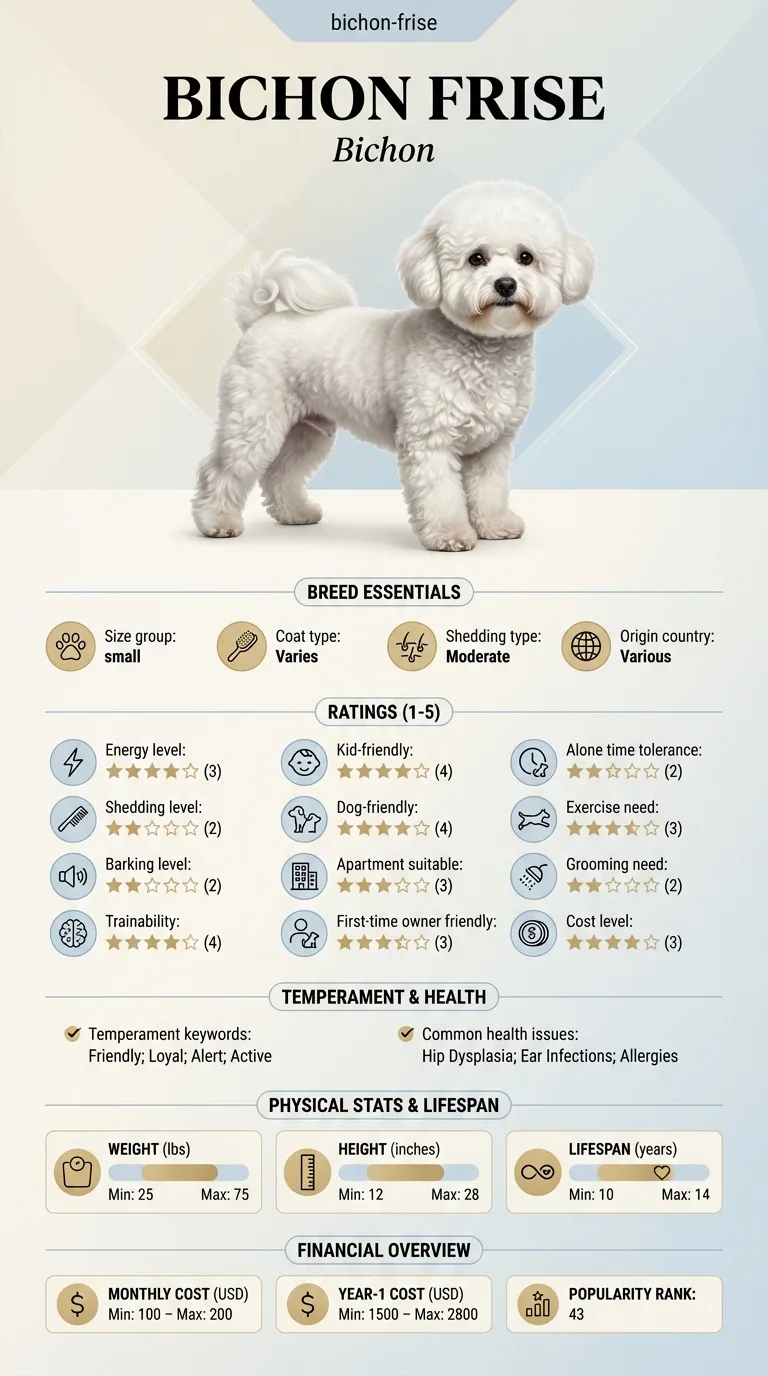
The condition is developmental and structural. In affected dogs the groove at the end of the femur is shallower than it should be, and the alignment of the thigh muscles and shin bone pulls the kneecap toward one side. Small breeds are over-represented for reasons tied to limb conformation rather than to activity. At nine to twelve inches tall and 12 to 18 pounds, the Bichon's short limbs give the quadriceps a mechanical arrangement in which even a modest misalignment displaces the kneecap.
Surfaces and heights dominate. A dog that turns at speed on tile is generating exactly the lateral force that pops the patella out, and the modern home is full of hard flooring. Furniture height is the second factor: a jump down from a sofa is a substantial drop for a dog this size, landing on a joint that is already loosely held. Weight is the third, and a Bichon's coat hides it so effectively that owners routinely discover a two-pound gain only when the dog is on the scales.
Book promptly if the skipping has clearly become more frequent, if your dog is stiff getting up in the morning, if it has started sitting with a hind leg splayed out, or if you can feel less muscle on one thigh than the other. Seek same-day attention if your Bichon suddenly cannot bear weight on a hind leg at all, holds it up continuously, or cries out when the leg is touched, since a sudden non-weight-bearing lameness in a dog with unstable knees can indicate a cruciate ligament rupture rather than a simple luxation.
See all Bichon Frise health problems, which breeds are prone to luxating patellas, or the full Bichon Frise breed guide for temperament, exercise needs and ownership costs.
Household changes show an effect within a fortnight, and owners often notice fewer skips almost immediately after putting runners down. Weight reduction takes three to four months to complete and is usually the change with the biggest single effect. Muscle building through structured exercise takes six to twelve weeks to become visible.
A stable grade year after year, a skip count that is not rising, even muscle on both thighs, and a dog that is comfortable rising in the morning at ten years old. Success is not the disappearance of the skip, which will not happen without surgery. It is the absence of progression.
Conservative management is not passive. These are the interventions that consistently reduce how often the kneecap slips and how much damage it does when it does.
Grading is done by a vet, but you are the one watching the dog every day, and the trend matters more than any single examination.
The measure worth tracking is frequency. Count how many times in a week you see the classic skip: the dog hops for a few strides with a hind leg carried, then puts it down and carries on. Write the number somewhere. A dog that skips twice a week in January and twice a week in July is stable. A dog that has gone from twice a week to twice a day is not.
The second measure is what happens afterwards. A stable knee is comfortable between episodes. If your Bichon starts sitting with the leg out to one side, hesitating before jumping, or is stiff on getting up in the morning, that suggests the joint is now sore rather than simply loose.
The third is symmetry. Run your hands down both thighs weekly. Muscle loss on one side means the dog has quietly stopped using that leg properly, and that is a change worth an appointment even if the skip itself has not increased.
These three observations, taken together, are what turns a monitoring plan into something real rather than a phrase written on a discharge sheet.

If you think your Bichon has luxating patellas, the plan is three steps: write down what you have seen and when it started, book a veterinary appointment rather than waiting for the next flare, and take video of the behaviour or symptom before you go — the thing you are worried about rarely happens in the consulting room. Screening in the parents covers skin allergies, patellar luxation, bladder stones.
What the vet visit should produce is a diagnosis and a written plan, not just reassurance: what is being ruled out, what the monitoring interval is, and which signs mean you come back sooner. Ask what the treatment costs across a year rather than per visit, because that is the number that decides whether you are managing this condition or reacting to it.
Between appointments, keep a short log — dates, what you saw, what changed. It is the single most useful thing an owner brings to a follow-up, and for luxating patellas it is often what separates a clear pattern from a guess.
Bramble was diagnosed with a low grade luxation in both knees at three. Her owner Hannah was told to monitor, went home, and had no idea what that meant. She started a simple tally on the fridge. In the first month Bramble skipped eleven times. Hannah put runners along the hall and kitchen, added a step to the sofa, and cut treats back until Bramble dropped from 18 pounds to 15 and a half. The second month's tally was four. Six years later it still hovers between three and six a month, and Bramble's grade has not changed at either annual check. She has never needed surgery.
Key takeaway: Monitoring only works if it produces a number. A tally on the fridge turned vague advice into a plan and showed within weeks which changes were actually helping.
In lower grades the moment of dislocation is usually more startling than painful, and dogs typically carry on immediately. Over years, though, the repeated dislocation wears cartilage and produces arthritis, and that is genuinely painful. Comfort now does not guarantee comfort at twelve.
The type matters more than the amount. Repeated fast turns, jumping for a ball and skidding on hard floors all encourage dislocation. Steady lead walking on soft ground builds the muscle that holds the kneecap in place and is one of the better things you can do.
No. Many dogs with lower grades live their whole lives without an operation, particularly if they stay lean and the household is set up sensibly. Surgery becomes the conversation when the grade increases, when pain appears between episodes, or when muscle is being lost.
Ask your vet before starting anything. Supplements cannot deepen the groove or realign the limb, which is what actually causes the luxation. Where they may help is with the secondary arthritis, and your vet is the right person to say whether that stage has been reached.
Redirect rather than forbid. A ramp or step means the dog still gets on the sofa, which matters for a breed this attached to its people, without the impact landing. Blocking access entirely tends to produce a dog that jumps when you are not looking.
Yes. Patella examination by a veterinarian is the most relevant orthopaedic screening for this breed, more so than hip scoring. A conscientious Bichon breeder should be able to show you documented patella examinations on both parents.
The early signs are set out in the sections above, and they are the reason to book a veterinary appointment rather than wait. Luxating Patellas in Bichons is diagnosed by a vet, not from a symptom list, and the sooner it is on record the more options remain open.
The early signs are set out in the sections above, and they are the reason to book a veterinary appointment rather than wait. Luxating Patellas in Bichon Frises is diagnosed by a vet, not from a symptom list, and the sooner it is on record the more options remain open.
A sudden skip where one hind leg is carried for two or three strides, then dropped and used normally again.
At each annual health check, and sooner if the frequency of skipping has clearly increased.
Very little. Rugs, a ramp and a nail routine are one-off costs, and weight control usually saves money on food.
Discuss it with your vet. Repeated jumping and tight turning are the two activities most likely to accelerate the problem.
Lay it flat first, feed along it, then raise it gradually. Most Bichons pick it up within a handful of short sessions.
A one-page prep sheet for this condition: the signs, the questions to ask, what to get priced. Unlocks here.
You get: Vet visit prep sheet
No spam. One-click unsubscribe. See our privacy policy.
Preview page 1 before you decide.
