Living
Which is bigger, Bichon Frise or Cane Corso?
The Cane Corso by far, at 90-110 lbs versus the Bichon's 12-18 lbs.

Quick answer
Which is bigger, Bichon Frise or Cane Corso?
The Cane Corso by far, at 90-110 lbs versus the Bichon's 12-18 lbs.
Bichon Frise or Cane Corso? On paper they differ most on apartment suitability, and on the scales Cane Corso is the heavier at 90–110 lbs. Here is how the two compare on everything that shapes an ordinary week.
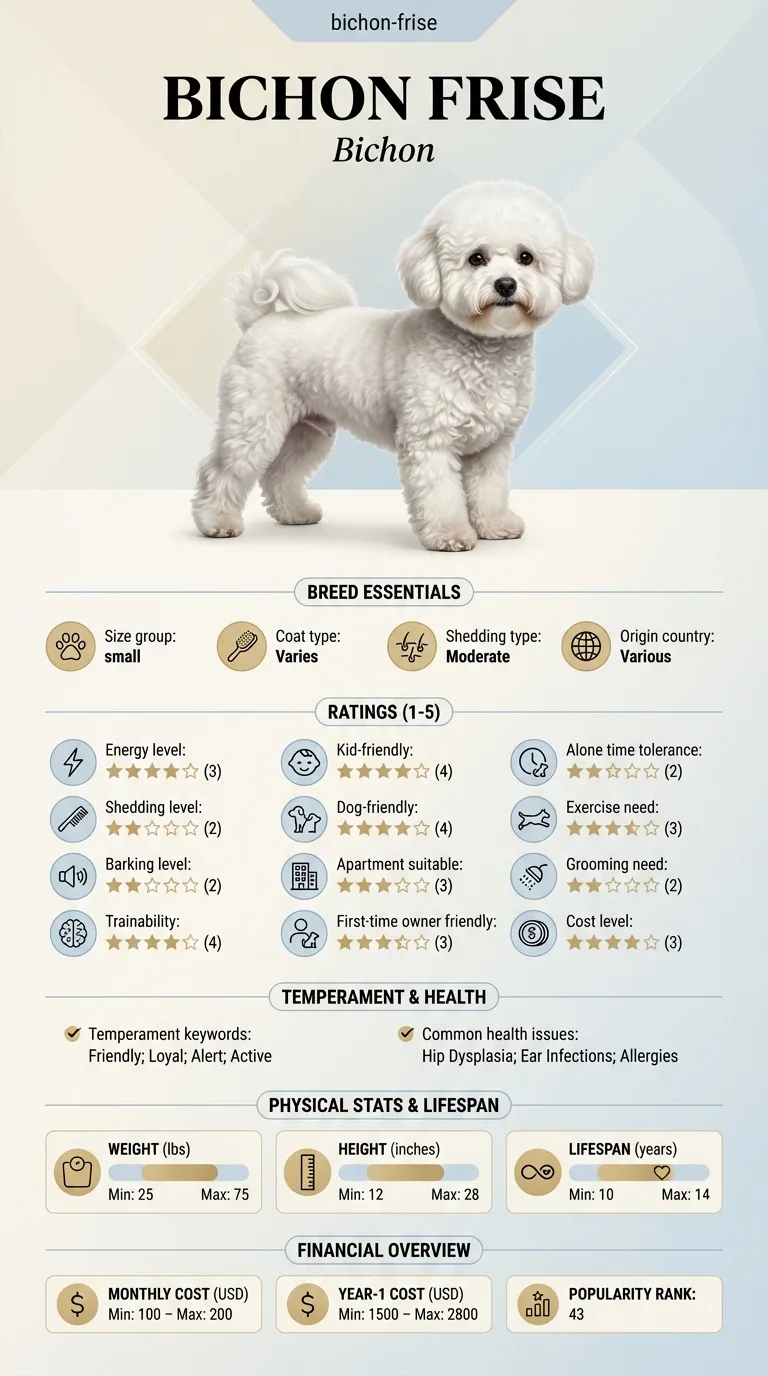
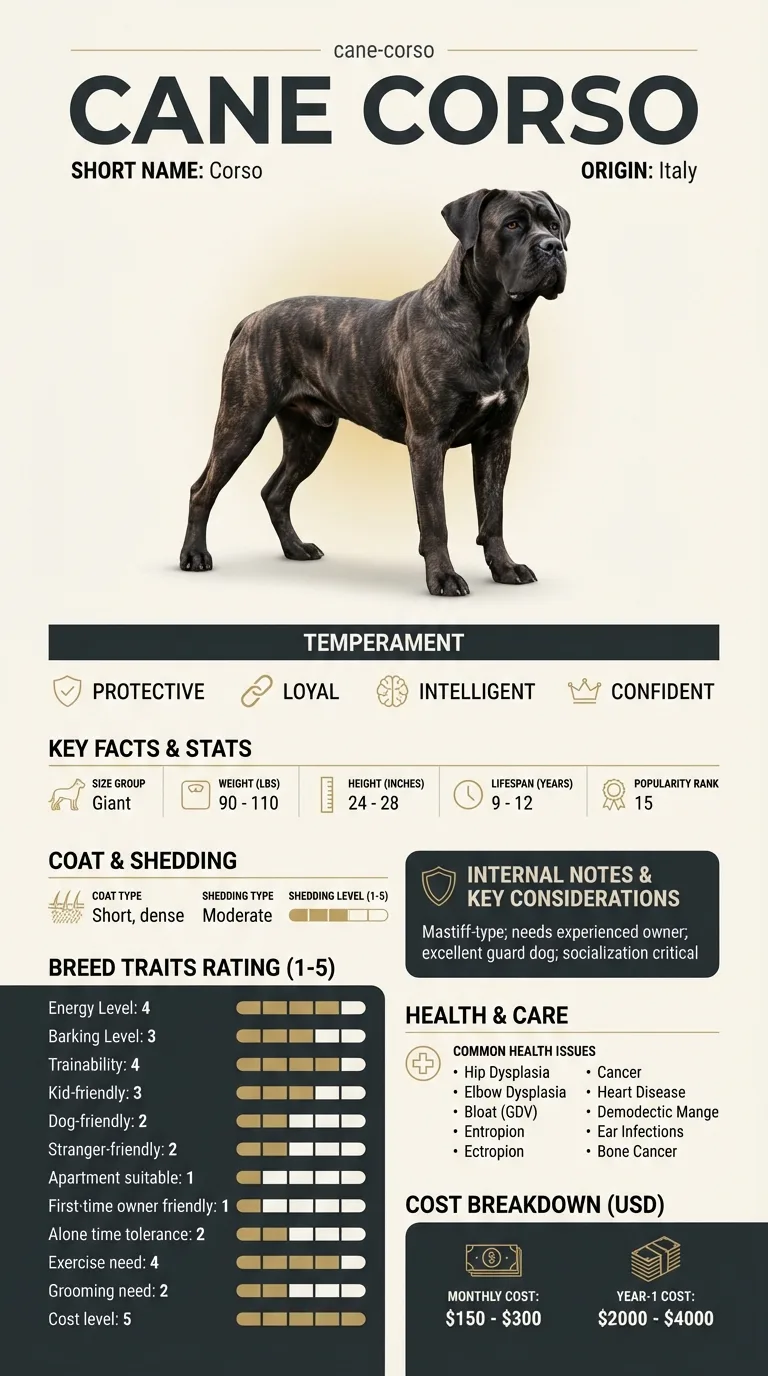
This is for someone already down to Bichon Frise and Cane Corso and deciding between them. For this pair the decision usually turns on apartment suitability and grooming need, so those are covered first and in most detail. Anyone choosing from a flat has a clear answer here: Bichon Frise rates 5/5 against 1/5. Breed history is left out; what follows is what you will actually live with.
Between Bichon Frise and Cane Corso, apartment suitability is what separates them, and Bichon Frise is the lower-effort dog of the two to keep.
Choose Bichon Frise if you are in a flat or a smaller home, this is your first dog and shedding is a problem in your house.
Choose Cane Corso if you do not want a standing grooming appointment, you want a dog that picks up training quickly and you want a dog that can keep up with an active routine.
| Feature | bichon frise | cane corso | Winner |
|---|---|---|---|
| Size class | small | giant | Equal |
| Weight | 12–18 lbs | 90–110 lbs | Equal |
| Height | 9–12 in | 24–28 in | Equal |
| Lifespan | 14–15 years | 9–12 years | bichon frise |
| Exercise need | Low (2/5) | High (4/5) | bichon frise |
| Grooming need | Very high (5/5) | Low (2/5) | cane corso |
| Shedding | Very low (1/5) | Moderate (3/5) | bichon frise |
| Energy level | Moderate (3/5) | High (4/5) | Equal |
| Barking | Moderate (3/5) | Moderate (3/5) | Equal |
| Apartment suitability | Very high (5/5) | Very low (1/5) | bichon frise |
| Good for first-time owners | High (4/5) | Very low (1/5) | bichon frise |
| Tolerates being alone | Low (2/5) | Low (2/5) | Equal |
| Trainability | Moderate (3/5) | High (4/5) | cane corso |
| Good with kids | High (4/5) | Moderate (3/5) | bichon frise |
| Good with other dogs | High (4/5) | Low (2/5) | bichon frise |
| Friendly to strangers | High (4/5) | Low (2/5) | bichon frise |
| Cost level | Moderate (3/5) | Very high (5/5) | bichon frise |
| Coat | Curly, dense double coat | Short, dense | Equal |
| Origin | Various | Italy | Equal |
| Typical monthly cost | $80–$150 | $150–$300 | Equal |
| Typical first-year cost | $1,100–$2,300 | $2,000–$4,000 | Equal |
The gap here is the largest in this entire batch: the Bichon Frise weighs 12-18 lbs against the Cane Corso's 90-110 lbs, and stands 9-12 inches versus 24-28 inches, the Corso is a genuine giant-breed mastiff, easily six to nine times the Bichon's weight. Both are marked tie on size class only because the comparison tool ties every size pairing by default; in reality, the Cane Corso's massive, muscular frame and short, dense coat put it in an entirely different category of dog to live with, handle, and physically manage than the small, fluffy Bichon.
The Cane Corso's High (4/5) exercise need and High (4/5) energy level dwarf the Bichon's Low (2/5) and Moderate (3/5). As a working guardian breed historically used for property protection and big-game hunting, the Corso's Protective, Confident temperament needs consistent structured exercise and mental engagement to stay balanced, an under-exercised Cane Corso is a serious liability given its size and strength, in a way an under-exercised Bichon simply isn't. This is not a breed where skipping the daily walk is a minor inconvenience.
Grooming flips against the Corso's size advantage: the Bichon's curly double coat demands Very high (5/5) grooming attention against the Corso's Low (2/5) for its short, dense coat. Shedding still favors the Bichon, Very low (1/5) versus Moderate (3/5) for the Corso, a big dog with a moderate shedding rate still means more total hair by volume than the numbers alone suggest. A Corso owner trades grooming time for far greater investment in exercise, training, and management given the breed's size and strength.
Apartment suitability could hardly be more different: Bichon Frise Very high (5/5) versus Cane Corso Very low (1/5), a 90-110 lb guardian breed with High exercise needs is fundamentally unsuited to compact living. Barking ties at Moderate (3/5). Both breeds tolerate being alone poorly, tied at Low (2/5), but the practical stakes differ enormously: a bored, anxious Bichon might chew a shoe, while a bored, anxious Cane Corso, bred for Protective, guarding instincts, represents a much bigger management challenge in a confined space.
First-time-owner suitability shows the widest split in the whole comparison: Bichon Frise High (4/5) versus Cane Corso Very low (1/5), this is explicitly not a beginner's breed. Trainability actually favors the Corso, High (4/5) against the Bichon's Moderate (3/5), meaning the breed learns readily, but its Protective, Confident nature requires an experienced handler who can establish clear leadership and manage its guarding instincts responsibly. A first-time owner drawn to the Corso's intelligence should strongly consider working with a professional trainer from puppyhood.
The Bichon Frise leads across the board here: High (4/5) with kids versus the Corso's Moderate (3/5), High (4/5) with other dogs versus Low (2/5), and High (4/5) friendliness to strangers versus the Corso's Low (2/5). This pattern is consistent with the Corso's purpose-bred role as a property guardian, its Protective, Loyal temperament makes it naturally wary of unfamiliar people and other dogs, which is a feature for a guard dog but a serious consideration for a household with frequent visitors, playdates, or a dog park habit.
The Bichon Frise's 14-15 year lifespan substantially outpaces the Cane Corso's 9-12 years, typical of giant breeds generally. The Corso's ten-item health list, Hip Dysplasia, Elbow Dysplasia, Bloat (GDV), Entropion, Ectropion, Cancer, Heart Disease, Demodectic Mange, Ear Infections, and Bone Cancer, reflects both its large size (joint and bone issues, Bloat) and general giant-breed cancer risk. The Bichon's five-item list is shorter and skews toward manageable conditions like Dental Disease and Skin Allergies rather than the life-threatening entries on the Corso's list.
The Cane Corso costs meaningfully more: Very high (5/5) cost level against the Bichon's Moderate (3/5), with monthly costs of $150-300 versus $80-150 and first-year costs of $2,000-4,000 versus $1,100-2,300. Feeding a 90-110 lb dog alone costs multiples of what a 12-18 lb dog eats, and the Corso's Bloat (GDV) risk, joint issues, and cancer susceptibility mean higher expected veterinary spending over its lifetime, even before factoring in the professional training many responsible Corso owners budget for.
Bichon Frise weighs 12–18 lbs and lives 14–15 years; Cane Corso weighs 90–110 lbs and lives 9–12 years. The two diverge most on apartment suitability, grooming need and good for first-time owners and 5 other rated axes. They are level on tolerates being alone and barking, so those cannot decide it. The comparison marks an easier option only where one exists. Facts like weight and country of origin are not scored. Both dogs are rated from the same dataset, which is what makes the numbers comparable with each other even though any individual dog sits somewhere inside its breed's range.

No, it rates Very low (1/5) for first-time-owner suitability, the lowest rating in this comparison, due to its size, strength, and Protective guarding instincts, which need an experienced handler.
Not well, it rates Very low (1/5) for apartment suitability against the Bichon Frise's Very high (5/5), reflecting its large size and High exercise needs.
Considerably, a Cane Corso typically weighs 90-110 lbs against the Bichon Frise's 12-18 lbs, roughly six to nine times heavier.
Not especially, they rate Low (2/5) for getting along with other dogs, versus the Bichon Frise's High (4/5), consistent with their guardian-breed wariness.
The Bichon Frise, at 14-15 years versus the Cane Corso's 9-12 years, a typical gap between small and giant breeds.
Hip and Elbow Dysplasia, Bloat (GDV), Cancer, Heart Disease, and Bone Cancer are all on its ten-item health list, reflecting risks common to large, deep-chested giant breeds.
Yes, substantially, its typical first-year cost runs $2,000-4,000 versus the Bichon Frise's $1,100-2,300, and it rates Very high (5/5) overall on cost level.
The Cane Corso by far, at 90-110 lbs versus the Bichon's 12-18 lbs.
The Bichon Frise, rated High (4/5) versus the Cane Corso's Very low (1/5).
The Cane Corso, with a first-year cost of $2,000-4,000 versus the Bichon's $1,100-2,300.
The Bichon Frise, at 14-15 years versus the Cane Corso's 9-12 years.
Secure checkout on Stripe. We never see your card.
7-day money-back guarantee. Instant access.
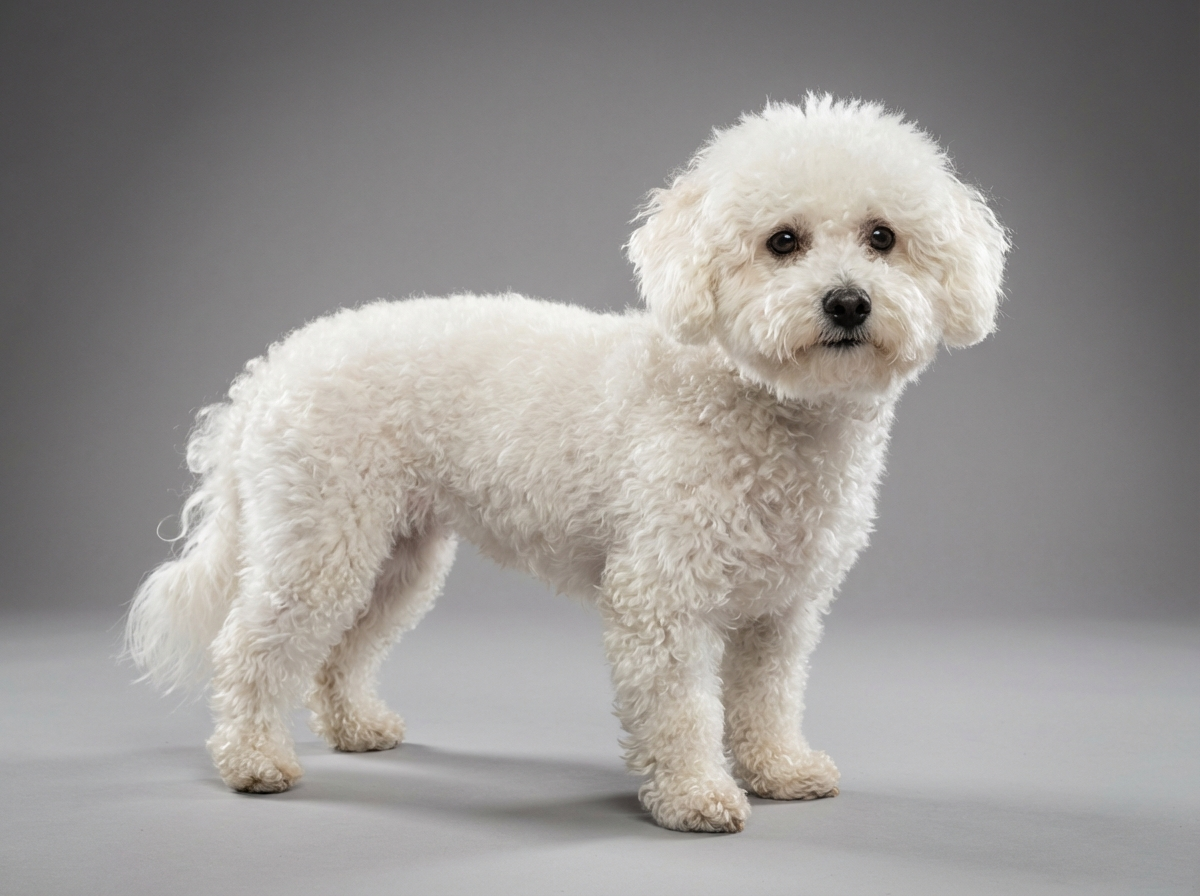
Health information here is general and is not veterinary advice. If your dog shows pain, sudden behaviour change, or worsening symptoms, consult a licensed veterinarian.
Some links on this site are affiliate links. We may earn a commission at no extra cost to you, and we only suggest products we believe are helpful for dog owners.
We research and check what we publish, but we do not warrant that any figure, date, price, or statement is accurate, complete, or current, and we accept no liability for any loss, cost, injury, or other harm arising from the use of this site. Use it as one reference among several. You remain responsible for your own decisions and for your dog's care - confirm anything that matters with a licensed veterinarian or another qualified professional before you act on it. Full disclaimer.
Match your lifestyle to the right dog.
Take quizNot sure which breed is right for you? Take our 2-minute quiz to find out.
Take the quiz