Health
At what age does arthritis start in Bichon Frises?
Signs usually surface from eight onward, but the underlying joint damage often begins much earlier if a kneecap has been luxating since young adulthood.

Quick answer
At what age does arthritis start in Bichon Frises?
Signs usually surface from eight onward, but the underlying joint damage often begins much earlier if a kneecap has been luxating since young adulthood.
By the time a Bichon Frise is visibly stiff, the joint damage has usually been accumulating for years, which is exactly why the early signs are worth learning.
Owners of Bichons aged eight and upward who have noticed their dog hesitating at the sofa. Also owners of much younger dogs who have already been told about a slipping kneecap and want to know what it means for the next decade.
This guide is not medical advice. If your dog shows pain, sudden behavior change, or worsening symptoms, consult a licensed veterinarian.
Some links may be affiliate links. We may earn a commission at no extra cost to you. We only suggest products we believe are helpful for dog owners.
We research and check what we publish, but we do not warrant that any figure, date, price, or statement is accurate, complete, or current, and we accept no liability for any loss, cost, injury, or other harm arising from the use of this site. Use it as one reference among several. You remain responsible for your own decisions and for your dog's care - confirm anything that matters with a licensed veterinarian or another qualified professional before you act on it. Full disclaimer.
Osteoarthritis is the progressive loss of joint cartilage with inflammation and new bone growth around the joint margins. It is painful, permanent and manageable. In the Bichon Frise it settles most often in the stifles, driven by a kneecap that does not track properly, and it becomes obvious in the second half of a long life. Owners usually notice hesitation before they notice a limp.
Very common in older small dogs generally, and reinforced in this breed by the documented tendency to patellar luxation. Many Bichons in their teens have measurable joint change even when their owners describe them as fine. That gap between what an owner sees and what an examination finds is the reason so much arthritis is treated late.
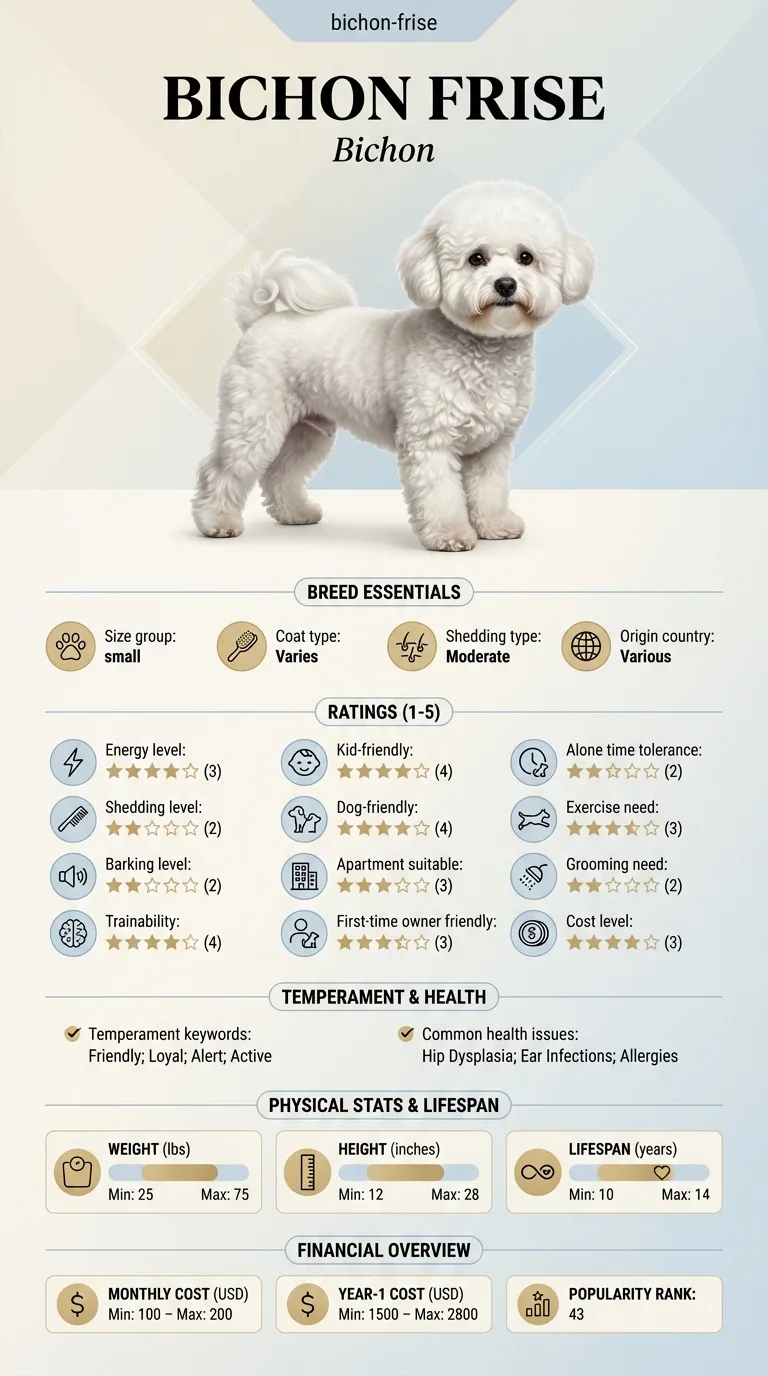
Patellar luxation sits on the Bichon Frise list of documented health issues, and it is the mechanical engine behind most arthritis in the breed. A kneecap that rides out of a shallow groove abrades cartilage with every repetition, and cartilage does not grow back. Body size contributes in a less obvious way: at 9 to 12 inches tall, a Bichon negotiating a standard sofa or a flight of human stairs is performing a proportionally enormous jump many times a day. The breed's long life then supplies the years needed for slow damage to become disabling.
The average Bichon home works against its joints in small ways. This is a breed rated five out of five for apartment suitability, which often means hard flooring and no grass. Slick laminate makes a dog scrabble, and scrabbling is a series of uncontrolled jolts. Furniture access without ramps means repeated drop landings. An exercise requirement of only two out of five makes it easy to under-exercise a dog into weak supporting muscle, while a food-motivated companion breed with an attentive owner slides into excess weight without anyone deciding to let it happen.
Raise joint concerns as soon as you see hesitation before jumping or morning stiffness, rather than waiting for a limp, because early treatment protects the joint that is left. Book promptly for a limp lasting more than two days, for a dog that will not bear weight at all, for a joint that is hot or swollen, or for sudden severe pain, since those suggest an acute injury rather than gradual arthritis. Seek urgent attention if your Bichon suddenly cannot use both hind legs, is dragging its feet, or has lost coordination, because that pattern points at the spine or nerves rather than at a worn knee and can be time-critical.
See all Bichon Frise health problems, which breeds are prone to arthritis, or the full Bichon Frise breed guide for temperament, exercise needs and ownership costs.
Weight loss and home modifications usually show a visible difference in six to twelve weeks. Prescribed pain relief often improves comfort within days, which is diagnostically useful in itself. Structured physiotherapy builds supporting muscle over two to three months. None of this reverses the disease. Expect a long slow curve across the second half of your dog's life, with good years and worse winters rather than a single decline.
Success is a fourteen-year-old Bichon Frise that still greets you at the door, still takes two short walks a day, sleeps comfortably through the night and gets onto the sofa using its steps. It is not a dog with pristine radiographs. The measure that matters is whether the joints are still supporting the cheerful, sociable life this breed is built for, and for how many more years.
Dogs do not limp until it is bad. They adapt first, and the adaptations are subtle. In a small, cheerful, playful breed those adaptations are especially easy to explain away as personality or age.
The kneecap should sit in a groove at the end of the thigh bone and glide up and down as the leg bends. In many small breeds that groove is shallower than it should be, and the kneecap slips sideways out of it.
Each slip is not a catastrophe. The dog skips a step, the kneecap pops back, and play resumes. What matters is the surface. Cartilage is smooth and has no nerve supply and no meaningful ability to repair itself. A kneecap riding over the edge of a groove thousands of times a year abrades that surface.
Once cartilage thins, bone experiences load it was never designed to feel. The joint responds by laying down new bone at the margins, thickening the capsule and producing inflammatory fluid. That is osteoarthritis, and it is permanent.
This is why the Bichon Frise timeline is different from the classic large-breed one. A retriever gets arthritis largely from load and years. A Bichon with luxating patellas can be building it from the age of two, and the fourteen to fifteen year lifespan of the breed leaves plenty of time for it to matter.

Pepper was ten, weighed 20 pounds against an ideal closer to 15, and had stopped following her owner Colin upstairs at bedtime. Colin assumed she preferred the kitchen. Her vet found thickened stifles and a kneecap that luxated easily on both sides. The plan had three parts and none of them were dramatic. Measured food in a bowl replaced free feeding and the biscuits handed out during television. The single long weekend walk became three short ones on grass. Rubber-backed runners went down the hall and a set of steps went beside the sofa. Pepper lost four and a half pounds over five months. Colin's note at the recheck said she had come upstairs on her own for the first time in a year. She is still arthritic. Her radiographs did not improve and never will. What changed was how much of her day the arthritis got to take.
Key takeaway: In a dog this size, four pounds is not a cosmetic detail, it is a quarter of the load going through every damaged joint, and shifting it does more than any product on a shelf.
Not inevitable, but common by the later years given the breed's lifespan of fourteen to fifteen. Dogs that stay lean, that keep steady low-impact activity, and whose kneecap problems were addressed early do markedly better than dogs that spend a decade overweight and under-exercised.
It makes an enormous difference, because the percentages are brutal at this size. A Bichon that should weigh 15 pounds and weighs 19 is carrying over a quarter more load through every damaged joint, every step, for years. Weight control is the single most effective thing an owner can do here and it costs nothing.
No. Rest deconditions the muscle that supports the joint and makes things worse. What changes is the shape of the exercise: shorter and more frequent, on even ground, avoiding hard stops and turns. This breed only needs a modest amount of activity anyway, so adapting is realistic.
The evidence is mixed and effects, where present, are modest. They are not a substitute for weight management, appropriate exercise or veterinary pain relief. Discuss any supplement with your vet rather than layering products, and give any single product a fair trial before judging it.
Dogs rarely cry with chronic joint pain. Look instead for behaviour change: less greeting at the door, sleeping in a different spot to avoid stairs, irritability when touched near the hips, licking one joint repeatedly, or a dog that has stopped asking for the games it used to demand.
Surgical correction, when it is indicated, reduces ongoing abrasion and can slow the process considerably. It does not reverse damage already done. This is a conversation to have with your vet or a surgeon while your dog is young, not at twelve when the joint is already remodelled.
Signs usually surface from eight onward, but the underlying joint damage often begins much earlier if a kneecap has been luxating since young adulthood.
Runners and rugs across slick floors. Scrabbling for grip on laminate or tile is a repeated jolt through already sore hind legs.
Better not to. A small set of steps or a ramp to the sofa and bed removes dozens of hard landings a week from a 15 pound frame.
Little and often beats one long outing. Two or three short lead walks a day suit the breed's modest requirement and keep the joints moving.
Ongoing pain relief, periodic monitoring blood tests and occasional physiotherapy add a recurring line well above the breed's typical monthly running cost.
A one-page prep sheet for this condition: the signs, the questions to ask, what to get priced. Unlocks here.
You get: Vet visit prep sheet
No spam. One-click unsubscribe. See our privacy policy.
Preview page 1 before you decide.