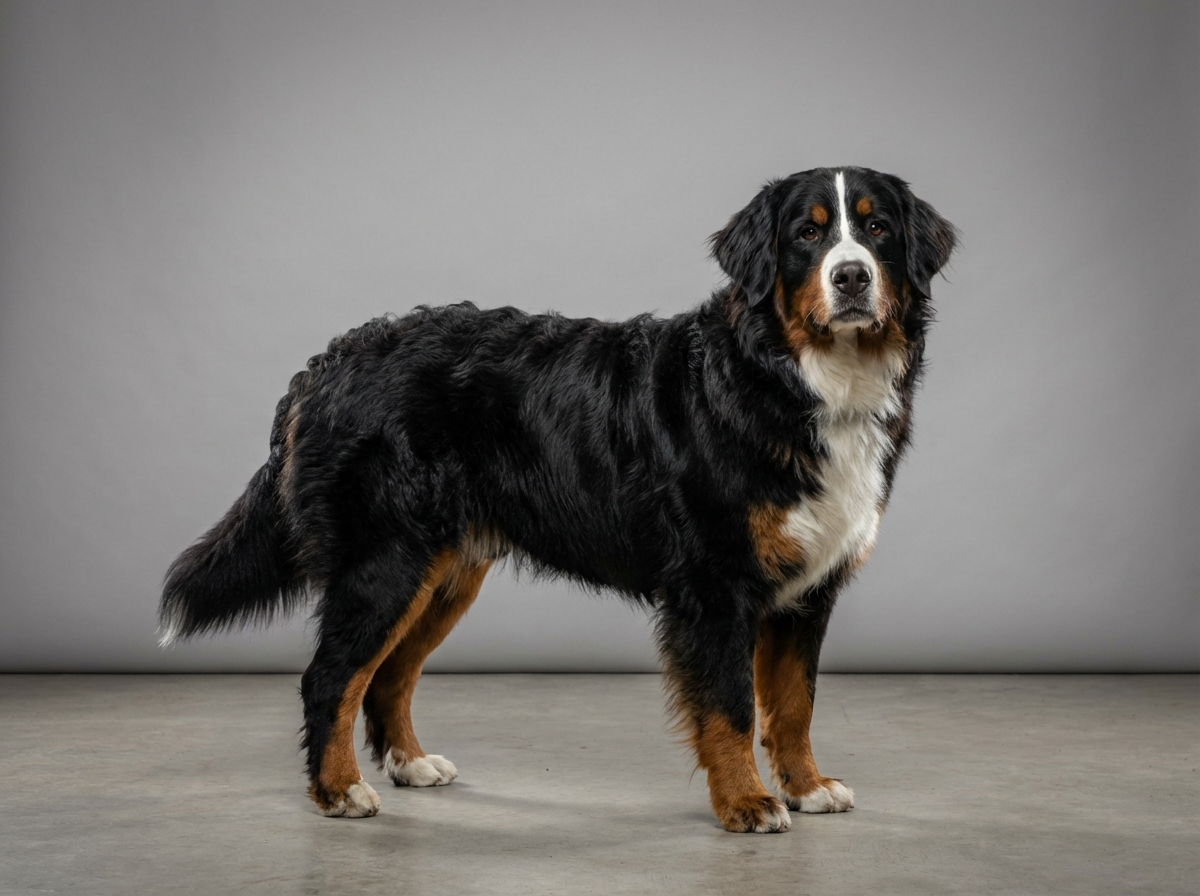
Health
Which way does a kneecap slip in a large breed?
Outward, more often than inward. Lateral luxation is the large and giant breed pattern, and it is frequently linked to alignment further up the limb.

Quick answer
Which way does a kneecap slip in a large breed?
Outward, more often than inward. Lateral luxation is the large and giant breed pattern, and it is frequently linked to alignment further up the limb.
A dog who skips a step, holds the leg up for a stride or two, then carries on as though nothing happened, is describing a kneecap that popped out and popped back.
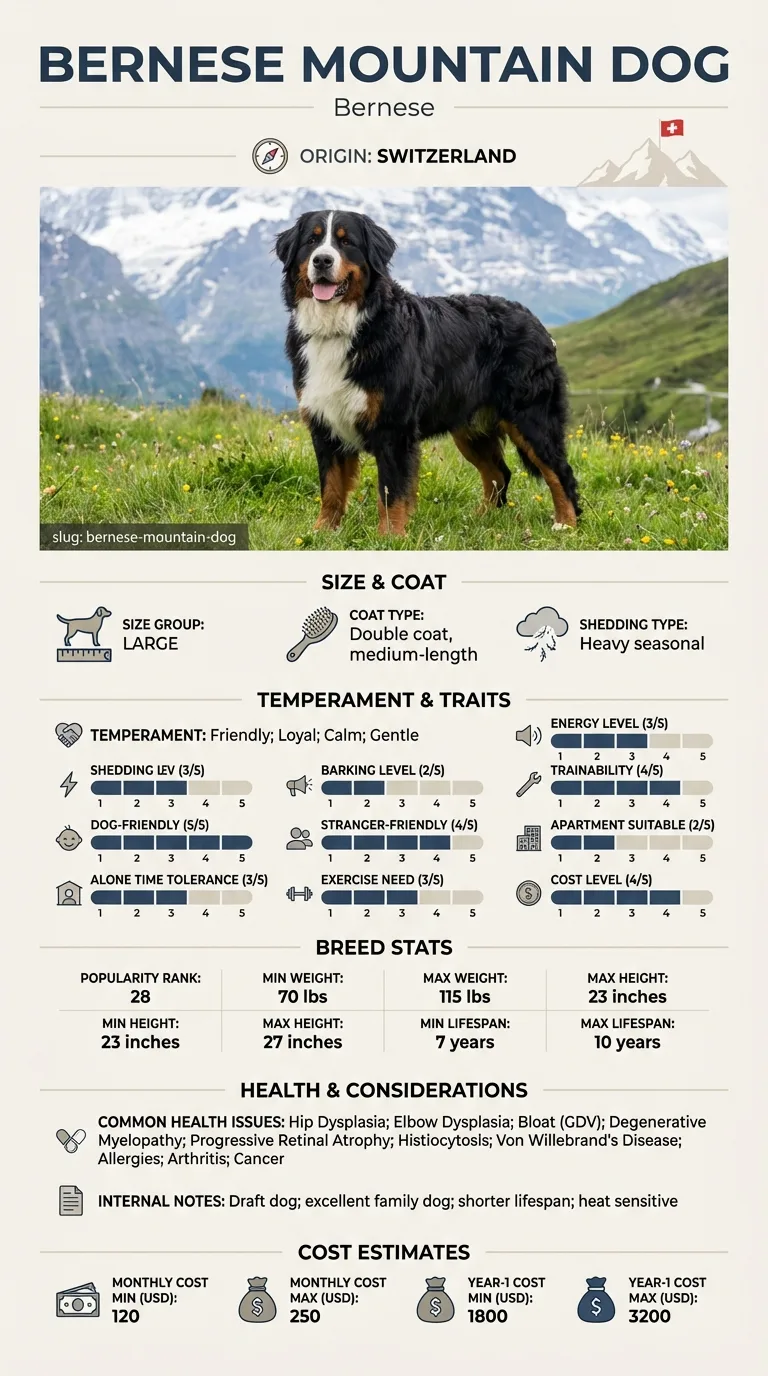
Owners who have seen the intermittent skipping gait in their Bernese and cannot capture it at the vet, and owners weighing whether an incidental finding on a routine examination needs anything doing about it.
This guide is not medical advice. If your dog shows pain, sudden behavior change, or worsening symptoms, consult a licensed veterinarian.
Some links may be affiliate links. We may earn a commission at no extra cost to you. We only suggest products we believe are helpful for dog owners.
We research and check what we publish, but we do not warrant that any figure, date, price, or statement is accurate, complete, or current, and we accept no liability for any loss, cost, injury, or other harm arising from the use of this site. Use it as one reference among several. You remain responsible for your own decisions and for your dog's care - confirm anything that matters with a licensed veterinarian or another qualified professional before you act on it. Full disclaimer.
Patellar luxation is displacement of the kneecap out of the groove it should track in. It is graded one to four by how readily it displaces and whether it returns on its own. Small breeds typically luxate medially; large breeds such as the Bernese Mountain Dog more often luxate laterally, usually as part of a broader limb alignment issue. The functional consequences are greater in a heavy dog than in a light one.
Patellar luxation is far more prevalent in small and toy breeds than in large ones, and it does not appear on the Bernese Mountain Dog's documented health issue list. Where it is found in this breed it is often an incidental low-grade finding on examination. That does not make it irrelevant, because in a dog carrying 70 to 115 pounds even modest joint instability accumulates wear faster than it would in a small dog.
The Bernese contributes weight and coexisting joint disease rather than a specific patellar predisposition. The breed's documented hip and elbow dysplasia mean that abnormal alignment further up the limb is genuinely common, and the kneecap tracks according to the alignment of the whole leg rather than the knee alone. The breed's long growth to a heavy adult weight also means the joint is loaded increasingly during the period when alignment is still being established, which is a different situation from a small dog that reaches adult size in months.
Flooring matters more than most owners think. Repeated slipping on tile or polished wood forces sudden lateral movements through the stifle in a dog with a great deal of momentum. Furniture and vehicle access add repeated hard landings on a flexed knee. Body condition is the third factor and the most controllable: every extra pound increases the sideways force acting on a kneecap that is already tracking imperfectly, and this breed gains weight readily on a calm indoor lifestyle.
Book a routine appointment for an intermittent skipping gait, since assessment is straightforward and early knowledge shapes management. Seek same-day care if your Bernese suddenly cannot bear weight on a hind leg, if the leg is held out at an odd angle, if there is swelling around the knee, or if he cries out and remains lame afterwards, because sudden severe hind limb lameness in a large dog raises the possibility of cruciate rupture, which is a different and more urgent problem.
Start here: Bernese Mountain Dog Most Common Genetic Disorders
See all Bernese Mountain DOG health problems, which breeds are prone to luxating patellas, or the full Bernese Mountain DOG breed guide for temperament, exercise needs and ownership costs.
Conservative management is judged over eight to twelve weeks, since building meaningful muscle in a large dog takes that long. Surgical correction, where indicated, involves roughly six to eight weeks of restricted activity followed by a graded return over three months, with physiotherapy throughout. Low-grade findings in an otherwise sound dog may need nothing at all beyond an annual recheck and honest attention to weight.
Success for a monitored dog is a skip that stays at the same frequency for years, with no lameness, no pain on examination and a stable weight. For a surgically treated dog, it is a return to normal gait without the hitch and without compensatory changes elsewhere. What nobody should expect is a knee that becomes anatomically normal, since the underlying groove and alignment are what they are.
Medial luxation, where the kneecap slips toward the inside of the leg, is the classic small-breed pattern. It is associated with a shallow groove and with the limb alignment typical of toy breeds, and it is what most articles on the subject describe.
Lateral luxation, where the kneecap slips outward, is the pattern more often seen in large and giant breeds. It tends to be linked to differences in hip and femoral alignment rather than to the knee alone, and in a large dog it frequently exists alongside other orthopaedic problems rather than in isolation.
That second point is the practically important one for a Bernese. Hip dysplasia is on this breed's documented health issue list, and so is elbow dysplasia and arthritis. A kneecap that tracks poorly in a dog whose hips are also poor is part of a chain, not an isolated fault, and treating only the knee often disappoints.
There is also a mechanical reality that changes the calculation. Grading systems for patellar luxation run from one to four, and a grade that a fifteen pound dog carries through life without difficulty can be a functional problem in a dog of 70 to 115 pounds, simply because there is so much more force running through the joint. Severity of signs and grade on examination correlate loosely in small dogs and more tightly in large ones.
Finally, chronic patellar instability wears cartilage, and it also predisposes to cruciate ligament rupture, which in a dog this size is a surgical problem with a long recovery.
The grade determines the conversation. Low grades in a large dog are usually monitored with attention to weight and muscling; higher grades are surgical discussions.

If you think your Bernese has luxating patellas, the plan is three steps: write down what you have seen and when it started, book a veterinary appointment rather than waiting for the next flare, and take video of the behaviour or symptom before you go — the thing you are worried about rarely happens in the consulting room. Screening in the parents covers hip dysplasia, elbow dysplasia, bloat (gdv).
What the vet visit should produce is a diagnosis and a written plan, not just reassurance: what is being ruled out, what the monitoring interval is, and which signs mean you come back sooner. Ask what the treatment costs across a year rather than per visit, because that is the number that decides whether you are managing this condition or reacting to it.
Between appointments, keep a short log — dates, what you saw, what changed. It is the single most useful thing an owner brings to a follow-up, and for luxating patellas it is often what separates a clear pattern from a guess.
Lotte was three and her owner had noticed for months that she occasionally hopped for a stride on her left hind leg while trotting across the garden. At every veterinary visit she walked perfectly, and two examinations found nothing. On the third visit her owner brought a video: forty seconds of Lotte trotting away from the camera, with a clear one-stride hitch appearing twice. With that, the vet manipulated the stifle specifically and found a grade two lateral luxation, alongside the mild hip changes already on her file. No surgery was recommended. Lotte went onto a weight reduction plan that took seven pounds off her, started fortnightly hydrotherapy to build her thighs and gluteals, and had runners fitted through the hall where she turned sharply. At six the hitch is still there, at the same frequency, and she has never been lame.
Key takeaway: Intermittent gait faults vanish in the consulting room, and two normal examinations do not mean nothing is happening. A short video taken at home is often the only way to get a fleeting problem in front of a vet.
It is not among the breed's documented common health issues, which are hip dysplasia, elbow dysplasia, bloat, degenerative myelopathy, progressive retinal atrophy, histiocytosis, von Willebrand's disease, allergies, arthritis and cancer. Patellar luxation occurs in large breeds but at much lower rates than in small ones, and in this breed it is usually a secondary consideration rather than a primary concern.
The dog trots normally, then for one or two strides holds a hind leg up close to the body, often with a small hop, then puts it down and continues without any apparent pain. It happens intermittently and often stops completely in an unfamiliar environment, which is why owners struggle to demonstrate it at the clinic.
Usually not on its own. Grade one and many grade two findings in a dog with no functional problem are monitored rather than operated. The decision to operate is driven by lameness, pain and progression, not by the grade in the notes. In a large breed the threshold is somewhat lower than in a small one because of the forces involved.
Yes, and this is the main reason large-breed patellar instability is taken seriously. A kneecap that tracks abnormally changes how force passes through the joint, which stresses the cruciate ligament. Cruciate rupture in a ninety pound dog is a surgical problem with months of rehabilitation.
The signature is the intermittency. Patellar luxation causes a momentary skip with an immediate return to normal. Hip pain causes a persistent alteration in gait, difficulty rising, and a bunny-hopping run rather than a one-stride hitch. A vet distinguishes them by manipulating each joint separately, and both can be present at once.
Substantially. Reducing body weight reduces the force pushing the kneecap off track with every step, and it slows the cartilage wear that follows. Alongside targeted muscle building around the thigh, weight control is the most effective non-surgical intervention available for a large dog.
Outward, more often than inward. Lateral luxation is the large and giant breed pattern, and it is frequently linked to alignment further up the limb.
Film it at home on a flat surface, from behind and from the side, at a trot. A thirty second video is worth more than a long description.
Often not much in the moment, which is why owners underreport it. The concern is the cartilage wear and the ligament strain accumulating underneath.
Keeping the dog lean and building thigh muscle through controlled, low-impact exercise. Swimming and hydrotherapy suit a heavy breed particularly well.
A one-page prep sheet for this condition: the signs, the questions to ask, what to get priced. Unlocks here.
You get: Vet visit prep sheet
No spam. One-click unsubscribe. See our privacy policy.
Preview page 1 before you decide.