Health
What is the quickest home sign of a sore knee?
A dog that sits with one hind leg kicked out to the side instead of folded underneath. Watch from behind on a hard floor.

Quick answer
What is the quickest home sign of a sore knee?
A dog that sits with one hind leg kicked out to the side instead of folded underneath. Watch from behind on a hard floor.
By the time a Bichon suddenly holds up a hind leg, the ligament has usually been failing for a long time, and in this breed the reason often traces back to a kneecap that never tracked properly.
Owners whose Bichon has abruptly become three-legged and who are trying to understand how a healthy dog injures a ligament doing nothing much. Also owners already managing a luxating patella who want to know what it sets up down the line.
This guide is not medical advice. If your dog shows pain, sudden behavior change, or worsening symptoms, consult a licensed veterinarian.
Some links may be affiliate links. We may earn a commission at no extra cost to you. We only suggest products we believe are helpful for dog owners.
We research and check what we publish, but we do not warrant that any figure, date, price, or statement is accurate, complete, or current, and we accept no liability for any loss, cost, injury, or other harm arising from the use of this site. Use it as one reference among several. You remain responsible for your own decisions and for your dog's care - confirm anything that matters with a licensed veterinarian or another qualified professional before you act on it. Full disclaimer.
Cruciate ligament disease is the progressive weakening and eventual rupture of the ligament that stabilises the knee against forward sliding and rotation. In dogs it is usually degenerative rather than traumatic. Once the ligament fails the joint becomes unstable, painful and inflamed, and arthritis follows. In the Bichon Frise the process is often accelerated by the kneecap instability documented for the breed.
Cruciate disease is among the most commonly treated orthopaedic conditions in dogs generally. In small breeds it is frequently seen alongside kneecap problems rather than in isolation, and since patellar luxation is documented in the Bichon Frise, this is a knee worth paying attention to. Many affected dogs eventually have problems in both knees rather than one.
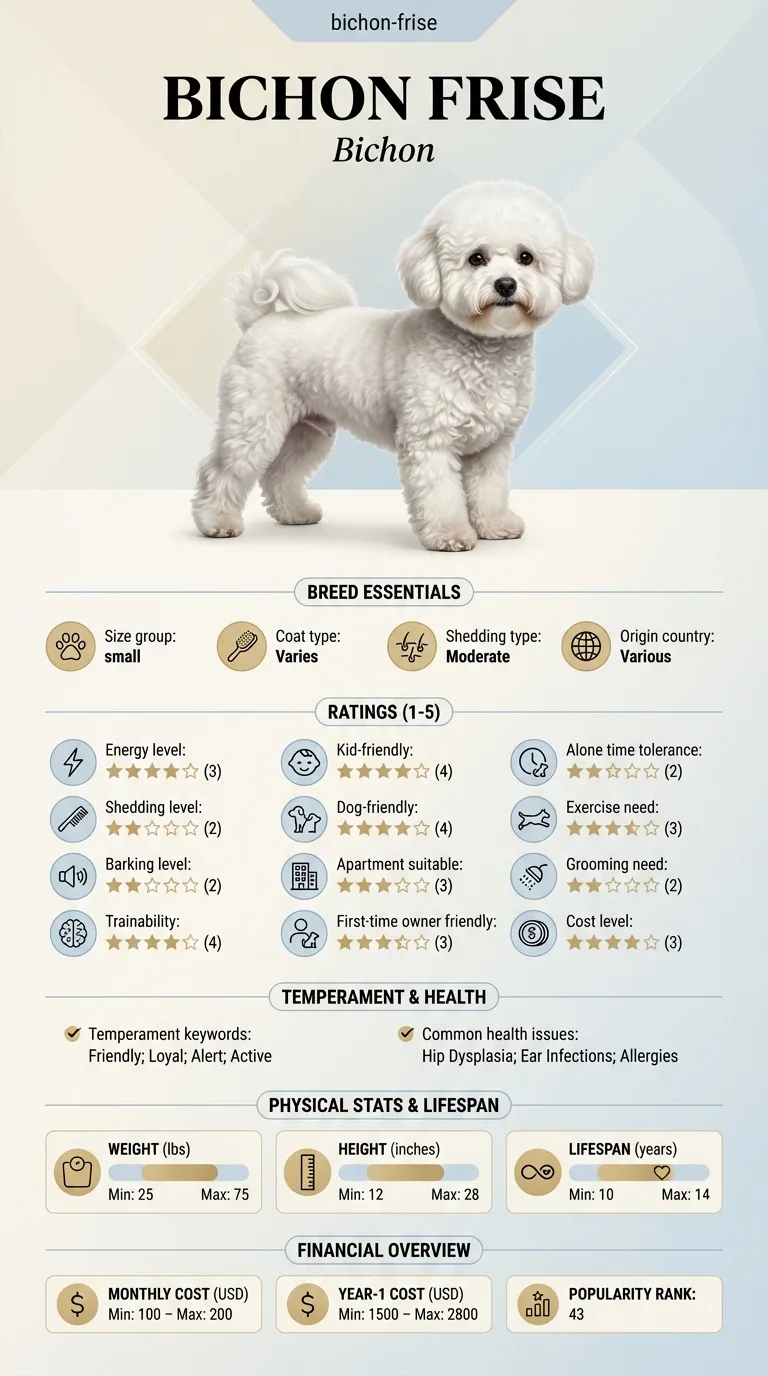
The mechanical link is specific. The groove that a kneecap runs in is often shallow in small breeds, and a kneecap that rides out of it changes the direction in which the thigh muscles pull across the joint. That introduces a twisting force that the cruciate ligament must absorb every stride. Patellar luxation is on the Bichon Frise's documented health list, so this is not a hypothetical chain of events in this breed. Body size cuts both ways: a 12 to 18 pound dog puts less absolute load through a knee than a large breed, which is why some small dogs manage conservatively, but the abnormal geometry is still there.
Households do a surprising amount of the damage. Slippery laminate and tile flooring cause hind legs to slide apart under a turning dog, which is exactly the rotational loading the ligament resists. Sofas and beds without ramps mean repeated landing impacts. An exercise pattern of sitting still all week and then a long energetic outing at the weekend produces a dog with poor muscle support attempting sudden movements. And in a breed with an exercise requirement of only two out of five, excess weight accumulates quietly and loads every step.
Book an assessment for intermittent hind limb lameness, for a dog that has started sitting with a leg out to the side, or for a hind end that looks like it is losing muscle. Book promptly rather than waiting for a limp that persists more than two days, since early partial tearing is where the useful decisions are made. Go the same day for a dog that will not bear any weight on a hind leg, for a knee that is hot, markedly swollen or acutely painful to touch, or for sudden severe pain. Seek urgent care if both hind legs fail at once, if your dog is dragging its feet or has lost coordination, since that pattern points at the spine or the circulation rather than at a knee.
See all Bichon Frise health problems, which breeds are prone to cruciate ligament injuries, or the full Bichon Frise breed guide for temperament, exercise needs and ownership costs.
Plan in months rather than weeks. Surgical repair is typically followed by six to eight weeks of tightly restricted activity, then a graded return over another two months, with full function commonly at four to six months. Conservative management runs on a similar schedule and demands the same discipline. Expect the affected knee to be permanently changed: it will carry some arthritis, and it will need lifelong weight management. Watch the other leg, because the second knee often follows.
Success is a dog that uses the leg normally at a walk, sits square again, has rebuilt the muscle it lost, and takes its two short daily walks without stiffness afterwards. It is not a knee that looks untouched on an X-ray. For a Bichon Frise with a documented kneecap tendency, success also means the underlying instability has been addressed rather than ignored, so the other side is not simply queuing up behind it.
Patellar luxation is one of the five health issues documented for the Bichon Frise, and it is the piece of the puzzle most owners are never told about.
A kneecap that slips sideways does more than skip a step. It changes the line along which the powerful thigh muscles pull. Instead of extending the joint cleanly, the pull develops a rotational component, and rotation is precisely the force the cruciate ligaments are there to resist.
A ligament resisting an abnormal force thousands of times a day does not fail immediately. It accumulates microscopic damage, becomes less elastic, and gradually loses strength. Small partial tears develop. The joint responds with inflammation, which further weakens the tissue.
Then one day the dog jumps off a chair, or turns quickly on a wet lawn, and the remaining fibres give way. To the owner it looks like an accident. To the joint it was the last event in a long sequence.
This is why a Bichon with an untreated luxating patella is not simply living with a slightly annoying knee. It is living with a knee under abnormal load, and the second problem grows out of the first.

Complete rupture is dramatic and obvious. Partial tearing, which is where the useful intervention lies, is subtle and easily attributed to age or to a bad night's sleep.
Barnaby was six and had a luxating patella on the left that his vet had graded as mild years earlier. It had never seemed to bother him beyond the occasional skip, so nothing had been done. His owner, Ruth, noticed at Christmas that he had started sitting oddly, with the left hind leg swung out sideways as if he could not fold it. He was not limping. He still wanted his walk. Her vet examined the knee and found not just the kneecap but a partially torn cruciate ligament and a thickened joint capsule. The instability had been quietly damaging the ligament for years. Barnaby had surgery to stabilise the joint and to deepen the groove the kneecap ran in, addressing both problems at once. Recovery took five months of confinement, physiotherapy and a strict feeding plan that took two pounds off him. He sits square now. Ruth checks the way both her dogs sit as a matter of routine, which she describes as the cheapest orthopaedic test in the house.
Key takeaway: A mild kneecap problem left alone is not a stable situation in this breed, and the way a dog sits will tell you it has moved on long before a limp does.
Cruciate disease is one of the most frequent orthopaedic problems in dogs overall, and it occurs across sizes. In small dogs it is particularly associated with kneecap instability, and patellar luxation is documented in the Bichon Frise. The two conditions frequently coexist in the same joint.
It depends on the dog, the degree of instability, the body weight and whether the kneecap is also involved. Small, light dogs sometimes do reasonably well with conservative management, meaning strict rest, weight control, pain relief and rehabilitation. Larger or more unstable knees generally do better surgically. Ask for both options to be explained.
There is a meaningful chance it will, because the same underlying degeneration and the same mechanical drivers usually affect both sides. Many dogs rupture the second ligament within a year or two of the first. That possibility is worth building into your planning, financially and practically.
Longer than most owners expect. After surgery, expect around eight weeks of strictly controlled activity followed by a graded return over a further couple of months, with full function often taking four to six months. Conservative management follows a similar or longer timeline and requires the same discipline about rest.
Some degree of arthritis develops in nearly all knees that have had cruciate disease, whether treated surgically or not, because the joint surfaces have already been loaded abnormally. Good treatment slows it and preserves function. Weight control and maintained muscle make more difference to the long term than most owners realise.
Rehabilitation is a genuine and valuable part of treatment, and in some small stable cases it is the main plan. It does not repair a ruptured ligament. What it does is build the muscle that stabilises the joint and restore normal use of the limb, which is why it improves outcomes whether or not surgery is performed.
A dog that sits with one hind leg kicked out to the side instead of folded underneath. Watch from behind on a hard floor.
Usually gradual. The ligament degenerates over months and a routine movement completes the rupture, which is what the owner sees.
A luxating patella changes the pull of the thigh muscles and adds rotational strain to the cruciate ligament, accelerating its degeneration.
Genuinely strict confinement, a lean body weight, and a structured physiotherapy programme. Half-enforced rest is the commonest cause of setbacks.
It is a major orthopaedic procedure and a substantial cost, potentially twice over if the second knee follows. Insurance taken out early matters here.
A one-page prep sheet for this condition: the signs, the questions to ask, what to get priced. Unlocks here.
You get: Vet visit prep sheet
No spam. One-click unsubscribe. See our privacy policy.
Preview page 1 before you decide.