Health
What does a positive thyroid antibody result mean?
The immune system is attacking the thyroid. It signals future risk rather than current disease if hormone levels are normal.

Quick answer
What does a positive thyroid antibody result mean?
The immune system is attacking the thyroid. It signals future risk rather than current disease if hormone levels are normal.
A dog can be actively destroying its own thyroid gland while every routine hormone test comes back perfectly normal. Antibody testing is what sees it happening.
Breeders deciding what to screen for and at what age, and owners who have been told their dog has thyroid antibodies but normal hormone levels and cannot work out what they are supposed to do about it.
This guide is not medical advice. If your dog shows pain, sudden behavior change, or worsening symptoms, consult a licensed veterinarian.
Some links may be affiliate links. We may earn a commission at no extra cost to you. We only suggest products we believe are helpful for dog owners.
We research and check what we publish, but we do not warrant that any figure, date, price, or statement is accurate, complete, or current, and we accept no liability for any loss, cost, injury, or other harm arising from the use of this site. Use it as one reference among several. You remain responsible for your own decisions and for your dog's care - confirm anything that matters with a licensed veterinarian or another qualified professional before you act on it. Full disclaimer.
This is a diagnosis about the future rather than the present. Immune-mediated thyroiditis identifies a dog whose immune system is dismantling its thyroid gland long before any hormone shortfall appears. For most owners it surfaces as an unexpected line on a laboratory report, and the correct response is a monitoring plan, not a prescription.
Antibody positivity is documented at meaningful rates in several predisposed breeds and at low rates across the wider dog population. It is rarely looked for in individual pet dogs, so the true frequency in a breed like the Bichon Frise is genuinely uncertain rather than known to be low. Absence of testing is not evidence of absence of the condition.
No documented Bichon predisposition exists for this condition, and the breed's recorded vulnerabilities lie elsewhere. What is relevant is that the Bichon is a breed with a known tendency toward immune-driven skin disease, and any dog whose immune system misfires in one tissue is a dog whose immune regulation is worth paying attention to generally. Its long 14 to 15 year lifespan also means a slow process starting at four has plenty of time to reach its endpoint.
Autoimmune disease is not caused by anything an owner does, and no diet, cleaning product or vaccine schedule has been established as the trigger. The environmental factors that genuinely matter are practical: whether the dog is tested at all, whether the results are repeated over time, and whether the person reading them understands that a positive antibody result in a well dog is a reason to schedule rather than to medicate.
This condition itself creates no emergencies during its silent phase. Contact your vet within a few days if an antibody-positive dog starts gaining weight without a change in food, becomes lethargic, seeks out warm places, or develops skin or ear infections that keep recurring. Seek urgent attention for profound weakness, collapse, unsteadiness or a sudden change in mental state, which are not typical of this process and point at something that needs assessing today.
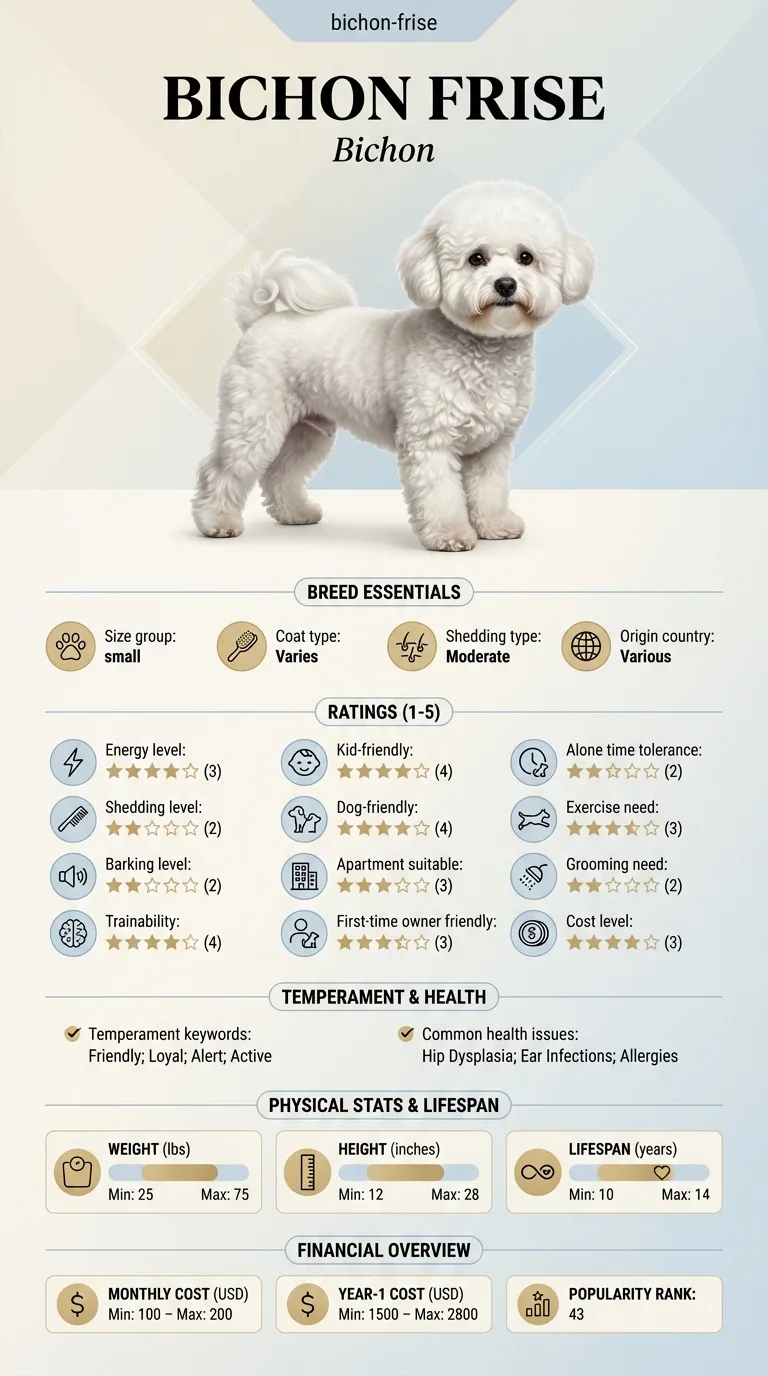
See all Bichon Frise health problems, which breeds are prone to immune mediated thyroiditis, or the full Bichon Frise breed guide for temperament, exercise needs and ownership costs.
The destruction happens over years, not months. A dog identified as antibody positive at three may not need treatment until eight, or ever. Expect a rhythm of annual testing with unchanged results punctuated, in some dogs, by a gradual drift downward that eventually crosses the treatment threshold.
Success is unglamorous: a file of dated results, a dog that feels well, and treatment that begins on the day the numbers say it should rather than after a year of unexplained lethargy. For a breeder, success is a positive result that never becomes a litter.
The thyroid has substantial reserve capacity. Estimates commonly cited in veterinary endocrinology suggest that a large majority of the gland must be lost before circulating hormone levels drop below normal. Until that threshold is crossed, the remaining tissue simply works harder and the dog appears entirely well.
This produces three distinct populations of dog. There are dogs with no autoimmune activity at all. There are dogs with detectable antibodies against thyroid tissue but normal hormone levels, who are in the silent phase and may or may not progress. And there are dogs who have crossed the threshold and are clinically hypothyroid.
The second group is the one that generates confusion. An antibody-positive dog with normal hormone levels needs no treatment today. What it needs is monitoring, because it sits at meaningfully higher risk of needing treatment in a few years than an antibody-negative dog does.
The practical consequence is a testing schedule rather than a prescription. Repeating the panel annually turns a single ambiguous result into a trajectory, and the trajectory is what tells you whether the process is progressing.

Antibody screening exists largely because of its value to breeding programmes, which explains why most pet owners never encounter it.
Delia ran a full health panel on her three-year-old Bichon stud, Aldo, as part of preparing him for his first litter. His hormone levels were solidly normal. His antibody result was positive. Her vet explained that Aldo was well, needed nothing, and should be retested annually. But the heritable component made the breeding decision straightforward, and Delia withdrew him from her programme. Aldo was retested at four, five and six. His hormone levels stayed normal throughout and he has never needed treatment. Delia's view is that the test cost her a litter and told her something true.
Key takeaway: A positive result in a healthy dog is not a diagnosis of illness. It is information about risk, and its main value is in decisions about breeding and about when to look again.
It is not among the breed's documented health concerns, which centre on skin allergies, patellar luxation, bladder stones, cataracts and dental disease. The condition is best recognised in breeds such as the Beagle, Golden Retriever and Doberman. A Bichon can develop it, but it is not a breed pattern.
Thyroiditis is one cause; hypothyroidism is the end state. Autoimmune destruction is the most common route to thyroid failure in dogs, but a gland can also simply atrophy without an identified immune cause. The treatment for the end state is the same either way.
No treatment, and no cause for panic. Your vet will most likely suggest repeating the panel in six to twelve months to see whether hormone levels are drifting. Many antibody-positive dogs stay clinically normal, and the ones who do progress are caught early by exactly this schedule.
There is no established treatment that halts it, and suppressing the immune system carries its own costs that are not justified for a gland whose output can be replaced with a cheap daily tablet. Management is monitoring and, when needed, hormone replacement.
Dogs with one autoimmune process are somewhat more likely to have another, so a vet may take other symptoms more seriously in a known antibody-positive dog. That does not mean a second condition is expected, only that it becomes worth ruling out rather than dismissing.
Not routinely. It is most useful in breeding animals and in dogs with unexplained symptoms where a vet is building a picture. Ask what the result would change before paying for it, which is a fair question about any test.
The immune system is attacking the thyroid. It signals future risk rather than current disease if hormone levels are normal.
Usually every six to twelve months, so a drop in hormone levels is caught before symptoms appear.
It is more expensive than a basic thyroid value because it is a specialised panel, often sent to an external laboratory.
No home measure influences the autoimmune process. What you can do is keep the monitoring appointments and note any change.
No. The trait has a heritable component in affected breeds, and removing carriers from breeding is the point of the test.
A one-page prep sheet for this condition: the signs, the questions to ask, what to get priced. Unlocks here.
You get: Vet visit prep sheet
No spam. One-click unsubscribe. See our privacy policy.
Preview page 1 before you decide.
