Health
What is immune-mediated thyroiditis in a Yorkie?
The immune system gradually destroying the thyroid gland, which is the usual route to hypothyroidism — a condition on this breed's documented health list.

Quick answer
What is immune-mediated thyroiditis in a Yorkie?
The immune system gradually destroying the thyroid gland, which is the usual route to hypothyroidism — a condition on this breed's documented health list.
Immune-mediated thyroiditis is the immune system slowly destroying the thyroid gland. It is not a dramatic illness — there is no crisis, no obvious pain, no single bad day that sends you to a vet. It is a gradual erosion, and by the time the classic signs appear, a substantial portion of the gland is typically already gone.
Owners of small, low-exercise dogs, because the early signs read as normal aging or normal small-dog behaviour. A Yorkie with a documented exercise need at the low end of the scale who becomes a bit more sedentary does not look alarming. Neither does a dog who seeks out warm spots, or whose coat is not quite what it was. Households where the dog is elderly get hit hardest by this, because everything gets attributed to age.
This guide is not medical advice. If your dog shows pain, sudden behavior change, or worsening symptoms, consult a licensed veterinarian.
Some links may be affiliate links. We may earn a commission at no extra cost to you. We only suggest products we believe are helpful for dog owners.
We research and check what we publish, but we do not warrant that any figure, date, price, or statement is accurate, complete, or current, and we accept no liability for any loss, cost, injury, or other harm arising from the use of this site. Use it as one reference among several. You remain responsible for your own decisions and for your dog's care - confirm anything that matters with a licensed veterinarian or another qualified professional before you act on it. Full disclaimer.
Immune-mediated thyroiditis is autoimmune destruction of the thyroid gland, and the usual route to hypothyroidism — which is on this breed's documented health list. Onset is gradual and signs are non-specific, so diagnosis often comes late. It is treated with lifelong daily hormone replacement, which is inexpensive and generally very effective.
Hypothyroidism is a well-recognised endocrine condition in dogs and appears among this breed's documented risks. The autoimmune form is a common underlying cause of it. It typically emerges in middle age rather than in young dogs, which is part of why signs get filed under aging.
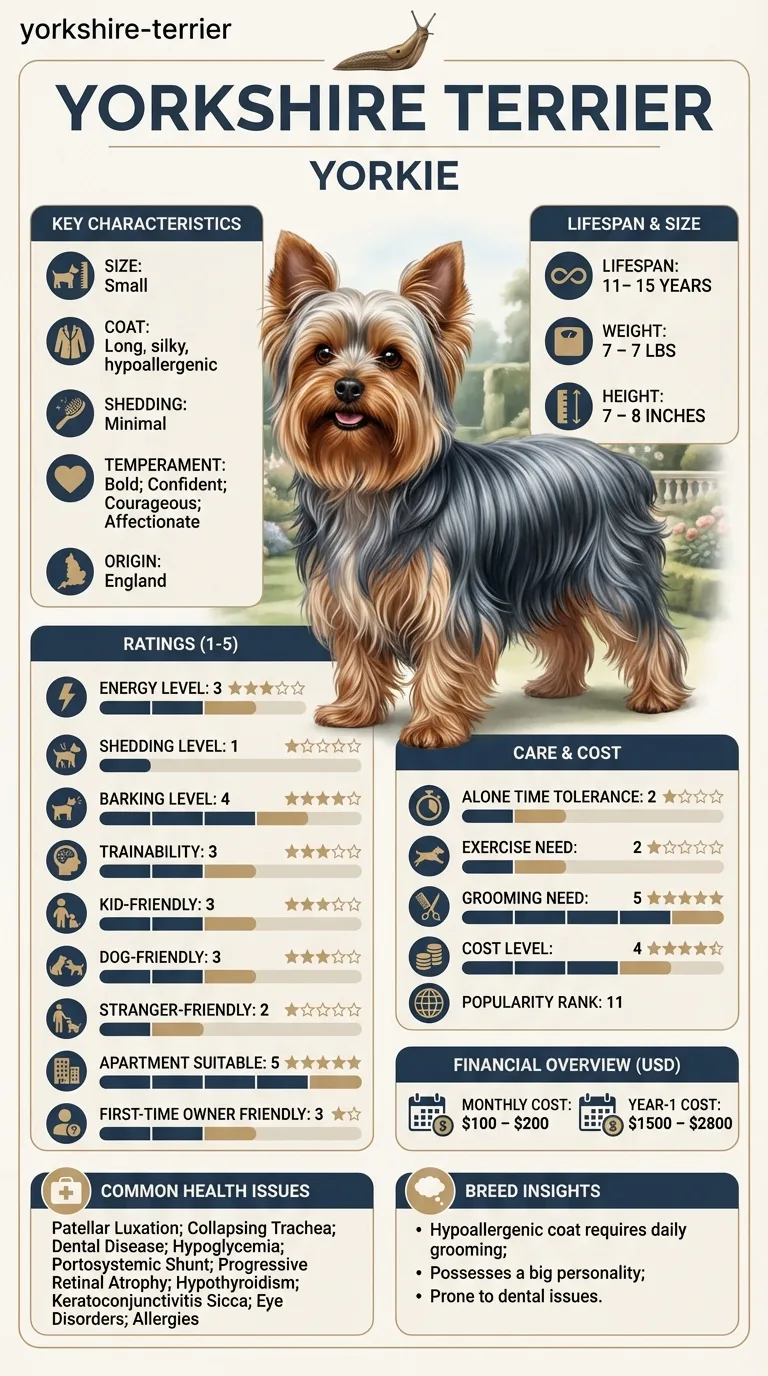
Hypothyroidism sits on the Yorkshire Terrier's documented health list alongside its other endocrine and systemic risks. The breed's very small size — 4 to 7 pounds — does not cause the disease but does mask it: proportional weight gain hides under coat, and reduced activity is unremarkable in a dog whose documented exercise need is already low. The long, silky coat that defines the breed is, usefully, also the tissue most likely to show early change.
There are no environmental drivers that start this process, and it is worth saying plainly because owners often search for something they did wrong. Diet, vaccination schedules and household products do not cause autoimmune thyroiditis. Environment matters only downstream: a cold house is harder on a dog who has lost the ability to regulate temperature well, and an untreated dog gains weight more readily on the same food.
Book an appointment for gradual coat thinning or dullness, unexplained weight gain, new cold-seeking behaviour, recurring skin or ear infections, or a general drop in engagement — especially in a middle-aged dog. Ask specifically for a full thyroid panel rather than a total T4 alone, and ask whether thyroglobulin autoantibody testing is appropriate. Seek prompt veterinary attention for marked lethargy, weakness or collapse, which are not typical presentations of uncomplicated hypothyroidism and suggest something else is going on that needs investigating urgently. If your Yorkie is already on thyroid medication, contact your vet before changing anything, and report new signs rather than assuming the dose still fits — requirements change over time.
Start here: Yorkshire Terrier Most Common Genetic Disorders: Screening
See all Yorkshire Terrier health problems, which breeds are prone to immune mediated thyroiditis, or the full Yorkshire Terrier breed guide for temperament, exercise needs and ownership costs.
The autoimmune damage is not reversible; the treatment replaces what the gland can no longer produce. Once medication starts, energy and mood often improve within a few weeks, while coat and skin changes take considerably longer — commonly two to four months to show real recovery, because coat grows on its own schedule. Dose is adjusted based on follow-up bloodwork, so expect at least one or two rechecks in the first few months rather than a single fix-and-forget prescription.
Success is a dog on a stable daily dose, at a healthy weight, with a coat that has come back, living an entirely normal life and an entirely normal lifespan. This is one of the more satisfying diagnoses in canine medicine precisely because the treatment works well and costs little. What success does not mean is coming off the medication — this is lifelong, and stopping because the dog looks well is how owners end up back where they started.
Hypothyroid signs are non-specific in any dog: lethargy, weight gain without more food, cold intolerance, a dull or thinning coat, recurring skin problems, sometimes a change in mood or reactivity. In a large working breed a drop in energy is conspicuous. In a 4-to-7-pound Yorkshire Terrier with a documented exercise need of two out of five, it simply is not.
The coat is often the more honest signal in this breed, because a Yorkie's long, silky coat is a big part of why owners look at their dog closely every day. Coat that thins, goes dry or brittle, loses its shine, or grows back slowly after clipping is worth taking seriously. So is skin that suddenly becomes prone to infections when it never used to be.
Weight is the other one, and it is deceptive at this size. On a seven-pound dog, half a pound is a substantial proportional gain and is nearly invisible under coat. Weighing monthly on a kitchen scale catches what looking at the dog does not.
There are two different questions and they get conflated. The first is whether the thyroid is underperforming — that is a hormone question, answered by measuring thyroid hormone levels and, importantly, by a full panel rather than a single total T4 in isolation, because a lone low T4 can be produced by other illness entirely.
The second question is why. Immune-mediated thyroiditis is identified by looking for thyroglobulin autoantibodies — evidence that the immune system is actively targeting thyroid tissue. A dog can carry those antibodies while hormone levels are still normal, which means the process is underway but the gland is still compensating.
That second finding is genuinely useful information rather than academic. It tells you this is likely to progress, it justifies monitoring rather than waiting for symptoms, and in a breeding context it matters a great deal. Ask your vet specifically what was measured, because 'the thyroid test was fine' can mean quite different things depending on which test was run.

A seven-year-old Yorkie was brought in for a coat that had gone dry and was growing back oddly after a summer clip. Her owner mentioned, almost as an aside, that she had started sleeping on the heating vent and had lost interest in the evening walk she used to demand. She looked, to everyone, entirely normal. The scale said she had gained just over half a pound in five months — on a six-pound dog, close to a ten percent gain, completely hidden under coat. A full thyroid panel and autoantibody testing confirmed autoimmune thyroiditis. Six weeks after starting replacement therapy she was asking for walks again; the coat took until the following spring to properly return.
Key takeaway: In a dog this small, the kitchen scale sees the disease months before the eye does.
Not quite. Thyroiditis is the autoimmune process attacking the gland; hypothyroidism is the hormone deficiency that results once enough tissue is lost. A dog can have the first before showing the second.
A total T4 alone can be lowered by unrelated illness or by some medications. A full panel gives a far more reliable picture, and autoantibody testing addresses the separate question of whether the cause is autoimmune.
No. This is an inherited autoimmune tendency. Diet, exercise and household routine do not start it, though they affect how visible the consequences are.
Thyroid hormone replacement is generally one of the cheaper long-term medications in veterinary practice, and a 4-to-7-pound dog needs very little of it. The recurring costs are the periodic blood tests to confirm the dose still fits.
Slower than the energy improvement. Expect two to four months for meaningful coat recovery, because hair growth cycles cannot be rushed.
No. The gland does not regenerate. The dog is well because the medication is replacing what the thyroid cannot make, and stopping reverses that.
It is a genuine consideration, since the predisposition is inherited. Autoantibody status is information a responsible breeding decision should account for, and it is a conversation to have with your vet.
It can be. Temperament and tolerance changes are recognised with hypothyroidism, which is one reason a behaviour problem in a middle-aged dog is worth a blood test before a training plan.
The immune system gradually destroying the thyroid gland, which is the usual route to hypothyroidism — a condition on this breed's documented health list.
Coat thinning or dullness, gradual weight gain, seeking out warm places, recurring skin infections, and a quiet drop in energy in a middle-aged dog.
A full thyroid panel rather than a single total T4, plus thyroglobulin autoantibody testing if the question is whether the cause is autoimmune.
Yes — daily oral hormone replacement is inexpensive and generally very effective, but it is lifelong and the dose needs periodic blood-test checks.
At 4 to 7 pounds with a low documented exercise need, both weight gain and reduced activity are easy to overlook, and coat hides body-shape change.
A one-page prep sheet for this condition: the signs, the questions to ask, what to get priced. Unlocks here.
You get: Vet visit prep sheet
No spam. One-click unsubscribe. See our privacy policy.
See a sample page before you decide.
Early access list
The free prep sheet covers the same-day warning signs, a symptom log and the questions to ask. We are considering a fuller kit that adds a cost worksheet for the usual tests and treatments (US price ranges with their sources) and a plain-English guide to ways of covering the bill. It is not built yet; this list tells us whether it is worth building.
One email, no spam, unsubscribe anytime. Information only, not veterinary advice.