Training
Which is more trainable?
The Miniature Poodle, rated Very High (5/5).

Quick answer
Which is more trainable?
The Miniature Poodle, rated Very High (5/5).
Bichon Frise or Poodle (Miniature)? On paper they differ most on trainability, and on the scales Bichon Frise is the heavier at 12–18 lbs. Here is how the two compare on everything that shapes an ordinary week.
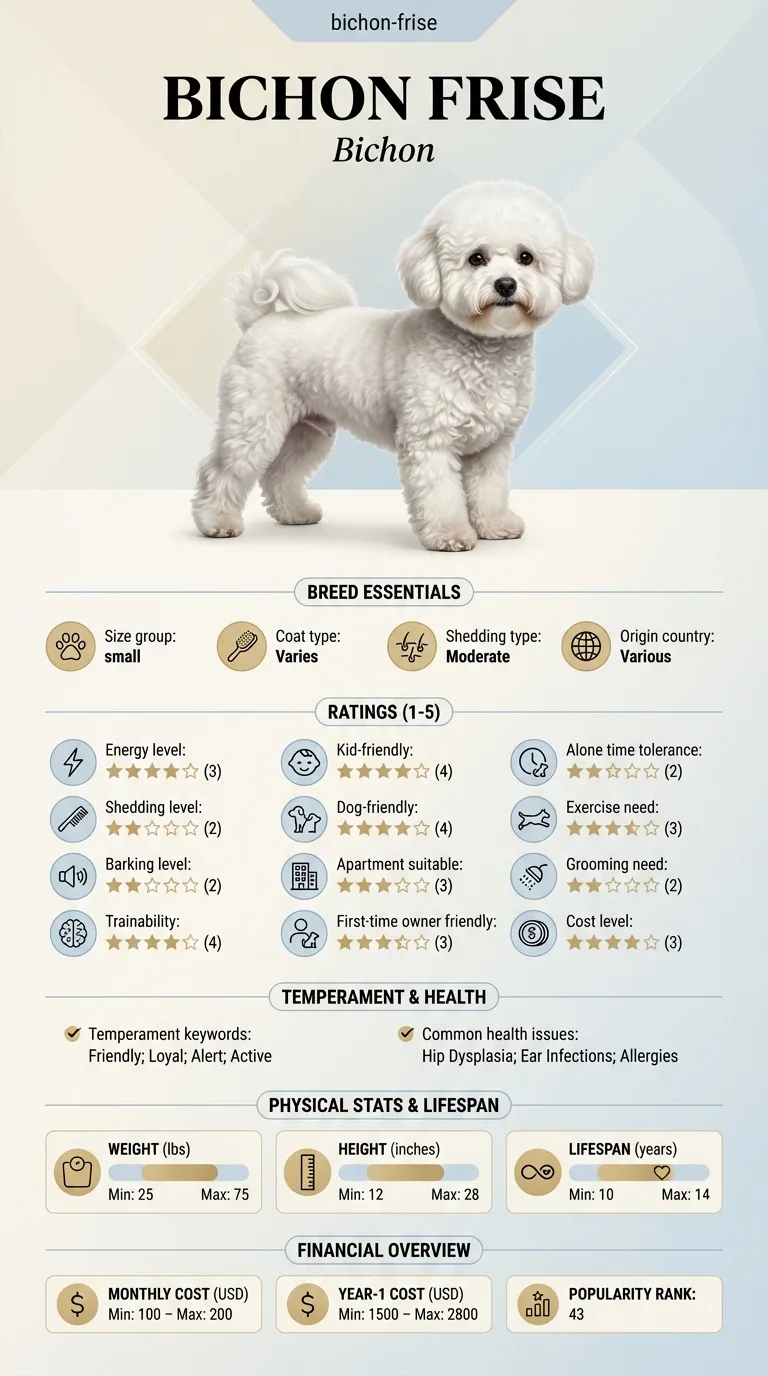
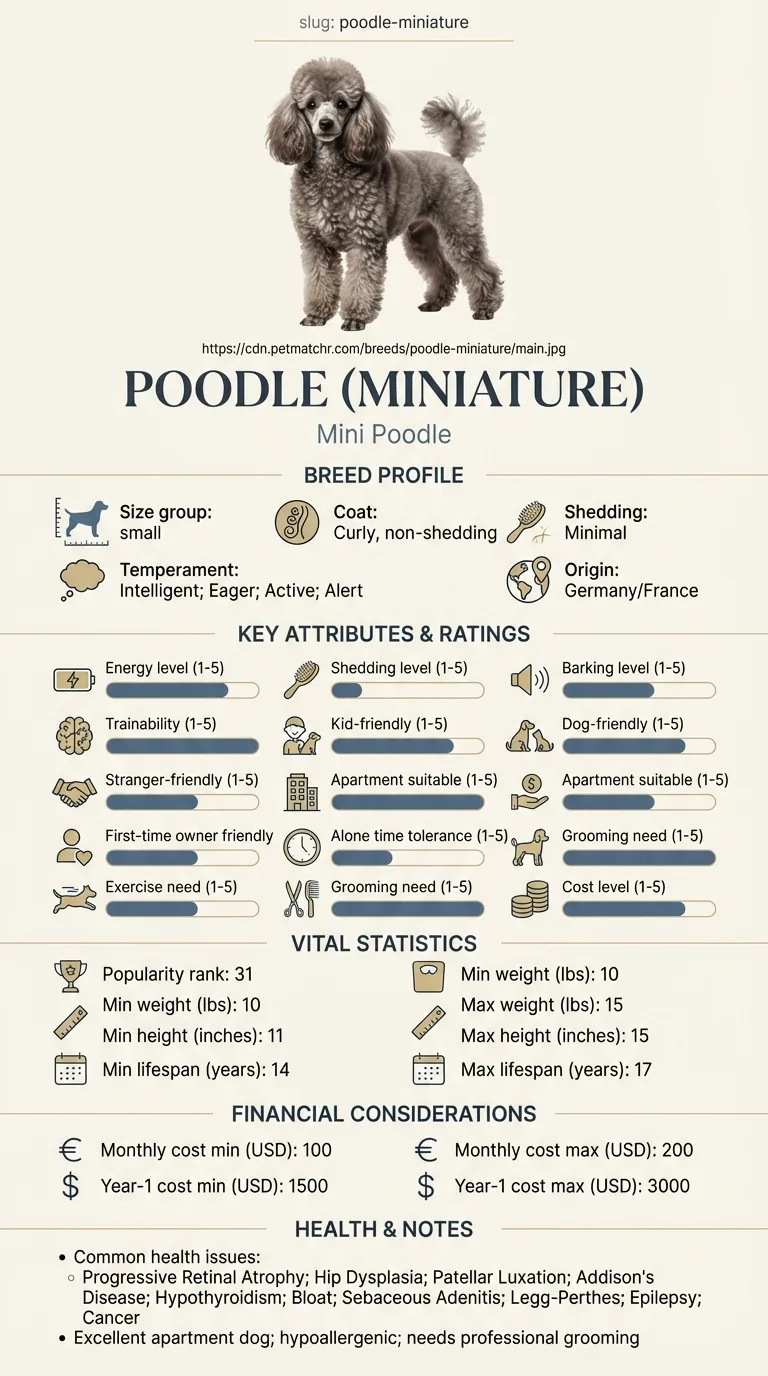
This is for someone already down to Bichon Frise and Poodle (Miniature) and deciding between them. For this pair the decision usually turns on trainability, so those are covered first and in most detail. Both rate 5/5 for flats, so housing does not settle this one. It is written for the decision rather than the breed history.
Between Bichon Frise and Poodle (Miniature), trainability is what separates them, and Bichon Frise is the lower-effort dog of the two to keep.
Choose Bichon Frise if this is your first dog and your walking routine is modest.
Choose Poodle (Miniature) if you want a dog that picks up training quickly, a smaller dog suits your car, your home or your back and you want a dog that can keep up with an active routine.
| Feature | bichon frise | poodle miniature | Winner |
|---|---|---|---|
| Size class | small | small | Equal |
| Weight | 12–18 lbs | 10–15 lbs | Equal |
| Height | 9–12 in | 11–15 in | Equal |
| Lifespan | 14–15 years | 14–17 years | poodle miniature |
| Exercise need | Low (2/5) | Moderate (3/5) | bichon frise |
| Grooming need | Very high (5/5) | Very high (5/5) | Equal |
| Shedding | Very low (1/5) | Very low (1/5) | Equal |
| Energy level | Moderate (3/5) | High (4/5) | Equal |
| Barking | Moderate (3/5) | Moderate (3/5) | Equal |
| Apartment suitability | Very high (5/5) | Very high (5/5) | Equal |
| Good for first-time owners | High (4/5) | Moderate (3/5) | bichon frise |
| Tolerates being alone | Low (2/5) | Low (2/5) | Equal |
| Trainability | Moderate (3/5) | Very high (5/5) | poodle miniature |
| Good with kids | High (4/5) | High (4/5) | Equal |
| Good with other dogs | High (4/5) | High (4/5) | Equal |
| Friendly to strangers | High (4/5) | Moderate (3/5) | bichon frise |
| Cost level | Moderate (3/5) | High (4/5) | bichon frise |
| Coat | Curly, dense double coat | Curly, non-shedding | Equal |
| Origin | Various | Germany/France | Equal |
| Typical monthly cost | $80–$150 | $100–$200 | Equal |
| Typical first-year cost | $1,100–$2,300 | $1,500–$3,000 | Equal |
This is the closest size match in the entire Bichon Frise comparison set: a Miniature Poodle runs 10–15 lbs and 11–15 inches against the Bichon's 12–18 lbs and 9–12 inches, putting the two within a few pounds and inches of each other in every dimension. Neither breed will dominate a small living room, and both fit comfortably into a standard-sized crate or carrier. The visual distinction comes down to coat and posture rather than mass — the Poodle's more upright, elegant stance against the Bichon's rounder, cottonball-like profile — making this one of the more genuinely apples-to-apples comparisons on the site.
The Miniature Poodle needs a bit more structured activity than the Bichon Frise, Moderate (3/5) exercise need against Low (2/5), and it also runs at a higher energy level, High (4/5) versus Moderate (3/5). That extra drive fits its Active, Eager, Alert temperament tags — Miniature Poodles were bred down from working retrievers and tend to retain more of that purposefulness than their calm appearance suggests. A Bichon's exercise needs are easy to satisfy with a short daily walk, while a Miniature Poodle generally benefits from a bit more — fetch, a longer walk, or a puzzle toy — to stay settled and avoid boredom-driven mischief.
Just like the general Poodle comparison, grooming and shedding tie exactly between the Bichon Frise and the Miniature Poodle — both Very High (5/5) on grooming and Very Low (1/5) on shedding. Both breeds carry a dense, curly coat that needs brushing several times weekly and a professional trim roughly every four to six weeks to prevent matting, and both are frequently recommended to allergy-sensitive households for the same reason. The Miniature Poodle's coat tends to hold a wider variety of stylish clips, while the Bichon is almost always kept in its trademark rounded, powder-puff shape — a styling difference rather than a maintenance-effort one.
This is a rare three-way tie: apartment suitability (Very High, 5/5), barking (Moderate, 3/5), and alone-time tolerance (Low, 2/5) all match exactly between the Bichon Frise and the Miniature Poodle. Practically speaking, that means an apartment dweller can pick between these two purely on temperament and grooming preference without worrying that one will be a noisier or more space-demanding neighbor than the other. Both breeds do share a real risk of separation-related anxiety given their matching Low (2/5) alone-tolerance score, so anyone in a small space who's frequently out for long stretches should plan for enrichment or a dog walker regardless of which breed they choose.
The Miniature Poodle rates Very High (5/5) on trainability, well above the Bichon Frise's Moderate (3/5), consistent with the Poodle line's broad reputation for quick learning and its Intelligent, Eager temperament tags. Yet the Bichon still rates slightly better for first-time owners, High (4/5) against the Poodle's Moderate (3/5) — a highly trainable dog also tends to need more consistent mental engagement to stay well-adjusted, which can be a steeper learning curve for a total beginner than the Bichon's more easygoing, if slower-to-train, nature. An owner interested in trick training or obedience sport will likely find the Miniature Poodle's capability the bigger draw despite the marginally steeper first-time learning curve.
Kids and other dogs both tie at High (4/5), so this remains an even matchup for most household considerations. Strangers are the one place they split, Bichon Frise High (4/5) against the Miniature Poodle's Moderate (3/5) — the Poodle's Alert temperament tag can show up as a bit more reserve or caution around new people, while the Bichon's Cheerful, Affectionate nature tends toward instant warmth with almost anyone. Households that frequently host guests or have kids who bring friends over regularly may lean toward the Bichon's more universally open social style, while the Miniature Poodle's slight wariness can double as a mild, informal early-warning system.
The Miniature Poodle edges out the Bichon Frise on lifespan, 14–17 years against 14–15, giving it the longest potential run of any breed matched against the Bichon in this size range. Its health list runs considerably longer, though — ten tracked conditions against the Bichon's five, including progressive retinal atrophy, hip dysplasia, patellar luxation, Addison's disease, hypothyroidism, bloat, sebaceous adenitis, Legg-Perthes, epilepsy, and cancer. Patellar luxation appears on both lists, a shared risk for small, active dogs with delicate joints, but the Miniature Poodle's additional risks — particularly Addison's disease and epilepsy — mean more vigilant monitoring for subtle symptoms like lethargy or seizure activity over its lifetime.
Cost level rates High (4/5) for the Miniature Poodle against Moderate (3/5) for the Bichon Frise, with monthly ranges of $100–$200 versus $80–$150 and first-year totals of $1,500–$3,000 against $1,100–$2,300. Given how closely matched these two breeds are in size and even in grooming need (both tie at Very High, 5/5), the cost gap likely comes down to the Miniature Poodle's considerably longer health-issue list — ten conditions including Addison's disease, epilepsy, and cancer can mean more diagnostic testing and potential ongoing treatment costs over a lifetime that the Bichon's shorter, more routine list doesn't carry to the same degree.
Bichon Frise weighs 12–18 lbs and lives 14–15 years; Poodle (Miniature) weighs 10–15 lbs and lives 14–17 years. The two diverge most on trainability. They are level on tolerates being alone, apartment suitability and barking, so those cannot decide it. In the table, a "winner" means easier for an ordinary household — not better. Size, coat and origin are recorded without a verdict. Because both breeds are scored the same way, the gaps are reliable even where the absolute numbers are rough.

Yes, nearly identical: the Bichon Frise runs 12–18 lbs and 9–12 inches, while the Miniature Poodle runs 10–15 lbs and 11–15 inches.
The Miniature Poodle, rated Very High (5/5) versus the Bichon Frise's Moderate (3/5).
Yes, both tie at Very Low (1/5) shedding.
The Miniature Poodle, 14–17 years versus the Bichon Frise's 14–15.
The Miniature Poodle, with ten tracked conditions versus the Bichon Frise's five.
The Bichon Frise, rated High (4/5) versus the Miniature Poodle's Moderate (3/5).
The Miniature Poodle, rated High (4/5) cost level versus the Bichon Frise's Moderate (3/5).
The Miniature Poodle, rated Very High (5/5).
The Miniature Poodle, 14–17 years versus the Bichon Frise's 14–15.
Yes, both Very Low (1/5).
The Bichon Frise, High (4/5) versus the Poodle's Moderate (3/5).
Secure checkout on Stripe. We never see your card.
7-day money-back guarantee. Instant access.
Health information here is general and is not veterinary advice. If your dog shows pain, sudden behaviour change, or worsening symptoms, consult a licensed veterinarian.
Some links on this site are affiliate links. We may earn a commission at no extra cost to you, and we only suggest products we believe are helpful for dog owners.
We research and check what we publish, but we do not warrant that any figure, date, price, or statement is accurate, complete, or current, and we accept no liability for any loss, cost, injury, or other harm arising from the use of this site. Use it as one reference among several. You remain responsible for your own decisions and for your dog's care - confirm anything that matters with a licensed veterinarian or another qualified professional before you act on it. Full disclaimer.
Match your lifestyle to the right dog.
Take quizNot sure which breed is right for you? Take our 2-minute quiz to find out.
Take the quiz