Behavior
Which sheds less?
The Bichon Frise, rated Very Low (1/5).

Quick answer
Which sheds less?
The Bichon Frise, rated Very Low (1/5).
Bichon Frise or Old English Sheepdog? On paper they differ most on apartment suitability, and on the scales Old English Sheepdog is the heavier at 60–100 lbs. Here is how the two compare on everything that shapes an ordinary week.
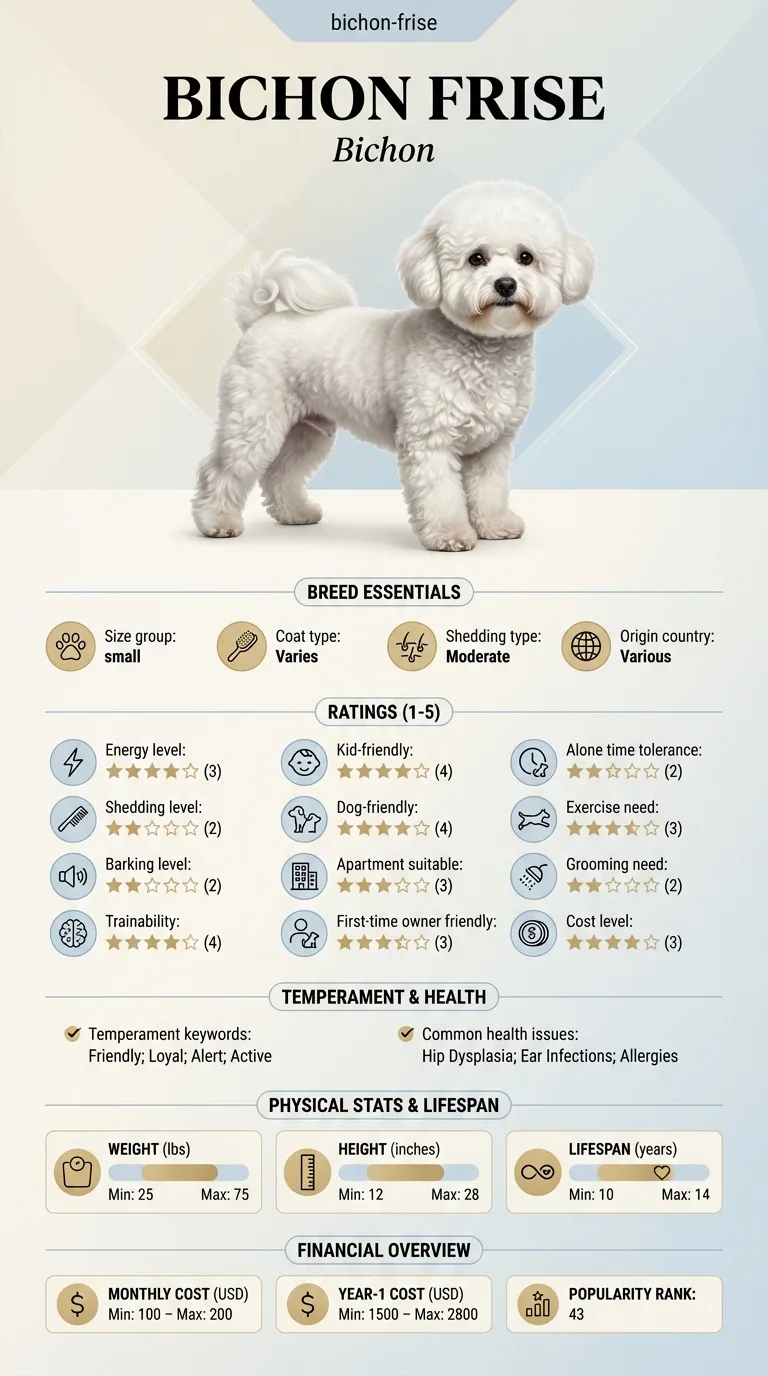
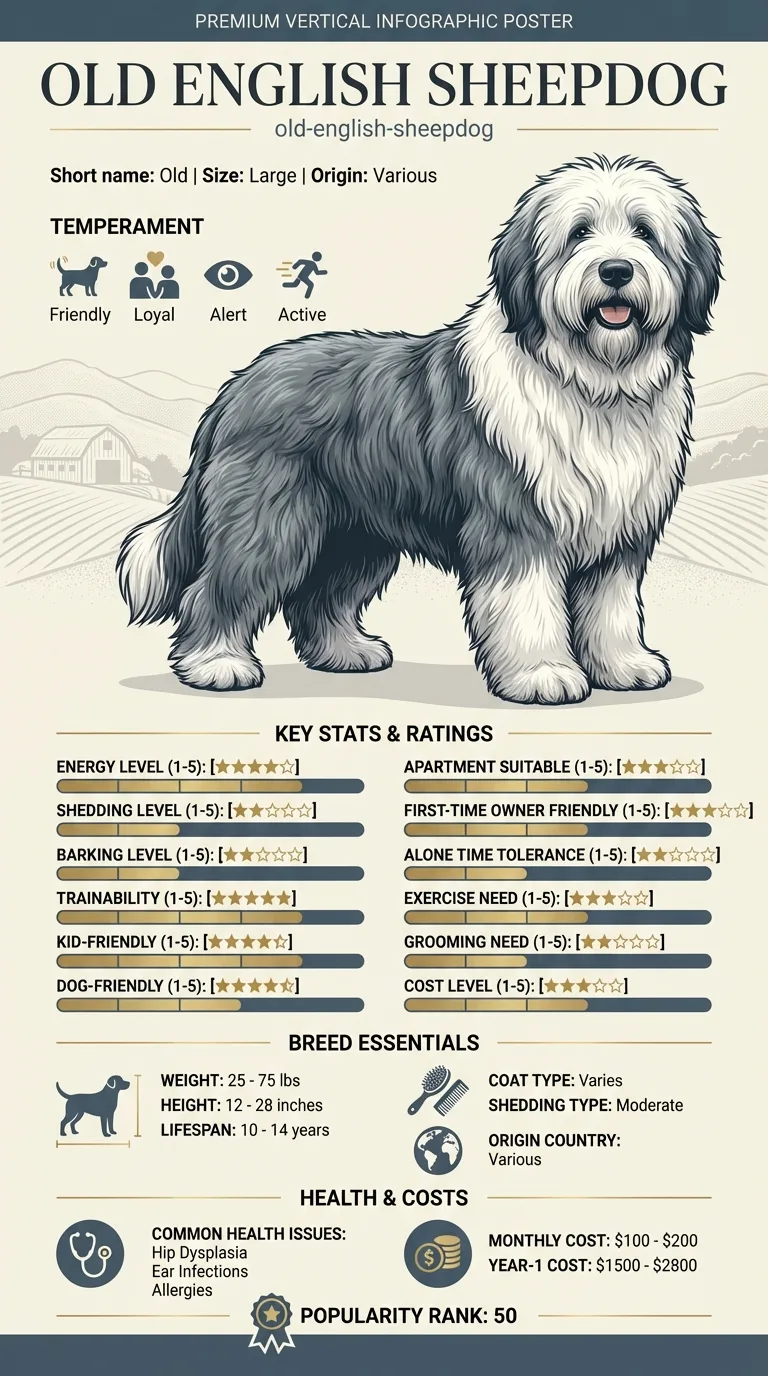
This is for someone already down to Bichon Frise and Old English Sheepdog and deciding between them. For this pair the decision usually turns on apartment suitability and shedding, so those are covered first and in most detail. Anyone choosing from a flat has a clear answer here: Bichon Frise rates 5/5 against 2/5. It is written for the decision rather than the breed history.
Between Bichon Frise and Old English Sheepdog, apartment suitability is what separates them, and Bichon Frise is the lower-effort dog of the two to keep.
Choose Bichon Frise if you are in a flat or a smaller home, this is your first dog and shedding is a problem in your house.
Choose Old English Sheepdog if there are young children at home and you want a dog that can keep up with an active routine.
| Feature | bichon frise | old english sheepdog | Winner |
|---|---|---|---|
| Size class | small | large | Equal |
| Weight | 12–18 lbs | 60–100 lbs | Equal |
| Height | 9–12 in | 20–24 in | Equal |
| Lifespan | 14–15 years | 10–12 years | bichon frise |
| Exercise need | Low (2/5) | Moderate (3/5) | bichon frise |
| Grooming need | Very high (5/5) | Very high (5/5) | Equal |
| Shedding | Very low (1/5) | High (4/5) | bichon frise |
| Energy level | Moderate (3/5) | Moderate (3/5) | Equal |
| Barking | Moderate (3/5) | Moderate (3/5) | Equal |
| Apartment suitability | Very high (5/5) | Low (2/5) | bichon frise |
| Good for first-time owners | High (4/5) | Low (2/5) | bichon frise |
| Tolerates being alone | Low (2/5) | Low (2/5) | Equal |
| Trainability | Moderate (3/5) | Moderate (3/5) | Equal |
| Good with kids | High (4/5) | Very high (5/5) | old english sheepdog |
| Good with other dogs | High (4/5) | High (4/5) | Equal |
| Friendly to strangers | High (4/5) | High (4/5) | Equal |
| Cost level | Moderate (3/5) | High (4/5) | bichon frise |
| Coat | Curly, dense double coat | Long, shaggy double coat | Equal |
| Origin | Various | Various | Equal |
| Typical monthly cost | $80–$150 | $110–$240 | Equal |
| Typical first-year cost | $1,100–$2,300 | $1,700–$3,200 | Equal |
An Old English Sheepdog stands roughly double the Bichon Frise's height (20–24 inches versus 9–12) and can weigh five times as much (60–100 lbs versus 12–18), placing it firmly in the large category against the Bichon's small frame. Both breeds share a shaggy, coat-heavy silhouette that can make casual observers underestimate the actual body underneath — the OES in particular is often bigger than photos suggest once the coat is factored in. For households weighing floor space, car trunk room, and how much dog needs to fit on a couch, this comparison is really about whether "big and shaggy" or "small and fluffy" fits the home better.
Energy level ties at Moderate (3/5) for both breeds, but exercise need doesn't: the Old English Sheepdog rates Moderate (3/5) against the Bichon Frise's Low (2/5), reflecting its herding-dog heritage and the Adaptable, Playful streak in its temperament profile. An OES that doesn't get a real daily walk or yard time tends to get restless in ways a similarly under-exercised Bichon usually doesn't. Both breeds can adjust to a range of activity levels, but owners drawn to the OES for its shaggy, cuddly appearance should know there's a working dog's stamina underneath that coat, not just a couch companion.
Grooming need ties at Very High (5/5) for both breeds — a real coincidence given how differently their coats behave. The Bichon Frise's curly double coat needs brushing and trims to prevent matting but barely sheds (Very Low, 1/5), while the Old English Sheepdog's long, shaggy double coat requires equally intensive brushing yet sheds at a High (4/5) rate, leaving noticeably more loose hair around the house. In practical terms, both breeds are multiple-times-a-week brushing commitments and regular professional grooming visits, but only the OES owner is also sweeping up drifts of fur between those sessions.
Apartment suitability splits clearly, Very High (5/5) for the Bichon Frise against Low (2/5) for the Old English Sheepdog, whose size alone makes small spaces a tighter fit. Barking ties at Moderate (3/5) for both, so neither is an especially quiet breed, and alone-time tolerance also ties, both rated Low (2/5) — meaning neither the compact Bichon nor the bulky OES handles long solo stretches particularly well, despite their very different sizes. A household considering the OES for its Watchful nature should note that watchfulness plus a low tolerance for solitude can add up to a vocal, anxious dog if left alone too often.
Trainability ties at Moderate (3/5), so neither breed is notably easier or harder to teach basic obedience on paper. The real gap shows up in the first-time-owner rating: High (4/5) for the Bichon Frise against Low (2/5) for the Old English Sheepdog, largely a function of size and coat-management skill rather than intelligence — an OES's Adaptable nature helps, but handling 80 lbs of dog through leash training and managing a working-breed coat is a steeper learning curve than most newcomers expect. Experienced owners who've handled a large, coated breed before will find the OES's temperament cooperative once past that initial learning period.
The Old English Sheepdog edges out the Bichon Frise with kids, Very High (5/5) versus High (4/5), fitting its long-standing reputation as a patient family herder that tolerates rough play well. Other dogs and strangers both tie at High (4/5), so both breeds are broadly sociable across the board — the OES's Gentle, Watchful nature and the Bichon's Cheerful, Affectionate temperament both translate to easy household integration. The main practical difference for families is again one of scale: an OES's herding instinct can mean gentle nudging or circling of small children, a quirky but generally harmless behavior a Bichon simply doesn't have the size or instinct to replicate.
The Bichon Frise's 14–15 year lifespan runs several years longer than the Old English Sheepdog's 10–12, a common pattern moving from small to large breeds. Both breeds are tracked for five conditions apiece, and they actually overlap on cataracts, but the OES's list also includes hip dysplasia, hypothyroidism, primary ciliary dyskinesia, and bloat (GDV) — the last being an emergency risk tied to its deep chest that Bichon owners never have to plan for. The Bichon's remaining risks — skin allergies, patellar luxation, bladder stones, dental disease — are generally less acute. An OES owner should know the signs of bloat and keep hip health on the radar from puppyhood.
Cost level rates High (4/5) for the Old English Sheepdog against Moderate (3/5) for the Bichon Frise, and the ranges back that up: $110–$240 monthly versus $80–$150, and $1,700–$3,200 in year one versus $1,100–$2,300. A chunk of that gap comes from food volume and grooming — an 80-lb dog eats considerably more than an 18-lb one, and professional grooming for a shaggy working coat isn't cheap, even though both breeds share the same Very High (5/5) grooming-need rating. Add in the OES's bloat risk, which can mean an emergency surgery bill some owners choose to insure against, and the long-run cost gap widens further than the base ranges suggest.
Bichon Frise weighs 12–18 lbs and lives 14–15 years; Old English Sheepdog weighs 60–100 lbs and lives 10–12 years. The two diverge most on apartment suitability, shedding and good for first-time owners. They are level on tolerates being alone, barking and good with other dogs, so those cannot decide it. In the table, a "winner" means easier for an ordinary household — not better. Size, coat and origin are recorded without a verdict. Because both breeds are scored the same way, the gaps are reliable even where the absolute numbers are rough.

Not especially — it rates Low (2/5) for apartment suitability against the Bichon Frise's Very High (5/5), mainly due to its 60–100 lb size.
The Old English Sheepdog sheds far more, High (4/5) versus the Bichon's Very Low (1/5), even though both share the identical Very High (5/5) grooming-need score.
Yes, rated Very High (5/5), actually a step above the Bichon Frise's High (4/5), thanks to a patient, tolerant herding-dog temperament.
The Bichon Frise, rated High (4/5) versus the Old English Sheepdog's Low (2/5).
Yes, rated Moderate (3/5) versus the Bichon's Low (2/5).
The Bichon Frise, 14–15 years versus the Old English Sheepdog's 10–12 years.
It's tracked only for the Old English Sheepdog among this pair, a risk tied to its deep chest that Bichon owners don't need to plan for.
The Bichon Frise, rated Very Low (1/5).
The Bichon Frise, Very High (5/5) versus Low (2/5).
The Old English Sheepdog, rated Very High (5/5).
The Bichon Frise, rated Moderate (3/5) cost level.
Secure checkout on Stripe. We never see your card.
7-day money-back guarantee. Instant access.
Health information here is general and is not veterinary advice. If your dog shows pain, sudden behaviour change, or worsening symptoms, consult a licensed veterinarian.
Some links on this site are affiliate links. We may earn a commission at no extra cost to you, and we only suggest products we believe are helpful for dog owners.
We research and check what we publish, but we do not warrant that any figure, date, price, or statement is accurate, complete, or current, and we accept no liability for any loss, cost, injury, or other harm arising from the use of this site. Use it as one reference among several. You remain responsible for your own decisions and for your dog's care - confirm anything that matters with a licensed veterinarian or another qualified professional before you act on it. Full disclaimer.
Match your lifestyle to the right dog.
Take quizNot sure which breed is right for you? Take our 2-minute quiz to find out.
Take the quiz