Behavior
Which barks more?
The Husky, rated Moderate (3/5) versus Low (2/5) for the Bernese, and it is known for howling and vocalizing.

Quick answer
Which barks more?
The Husky, rated Moderate (3/5) versus Low (2/5) for the Bernese, and it is known for howling and vocalizing.
Bernese Mountain Dog or Siberian Husky? On paper they differ most on good for first-time owners, and on the scales Bernese Mountain Dog is the heavier at 70–115 lbs. Here is how the two compare on everything that shapes an ordinary week.
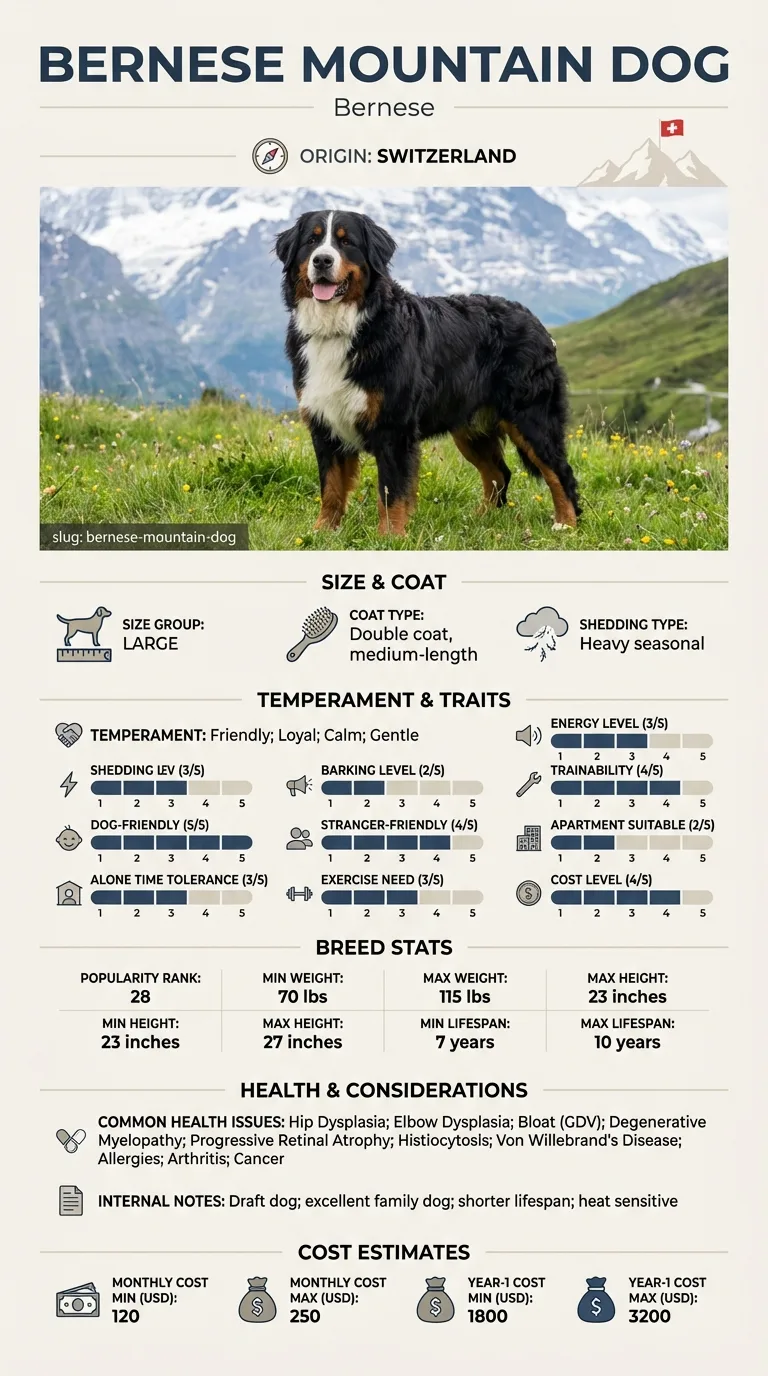
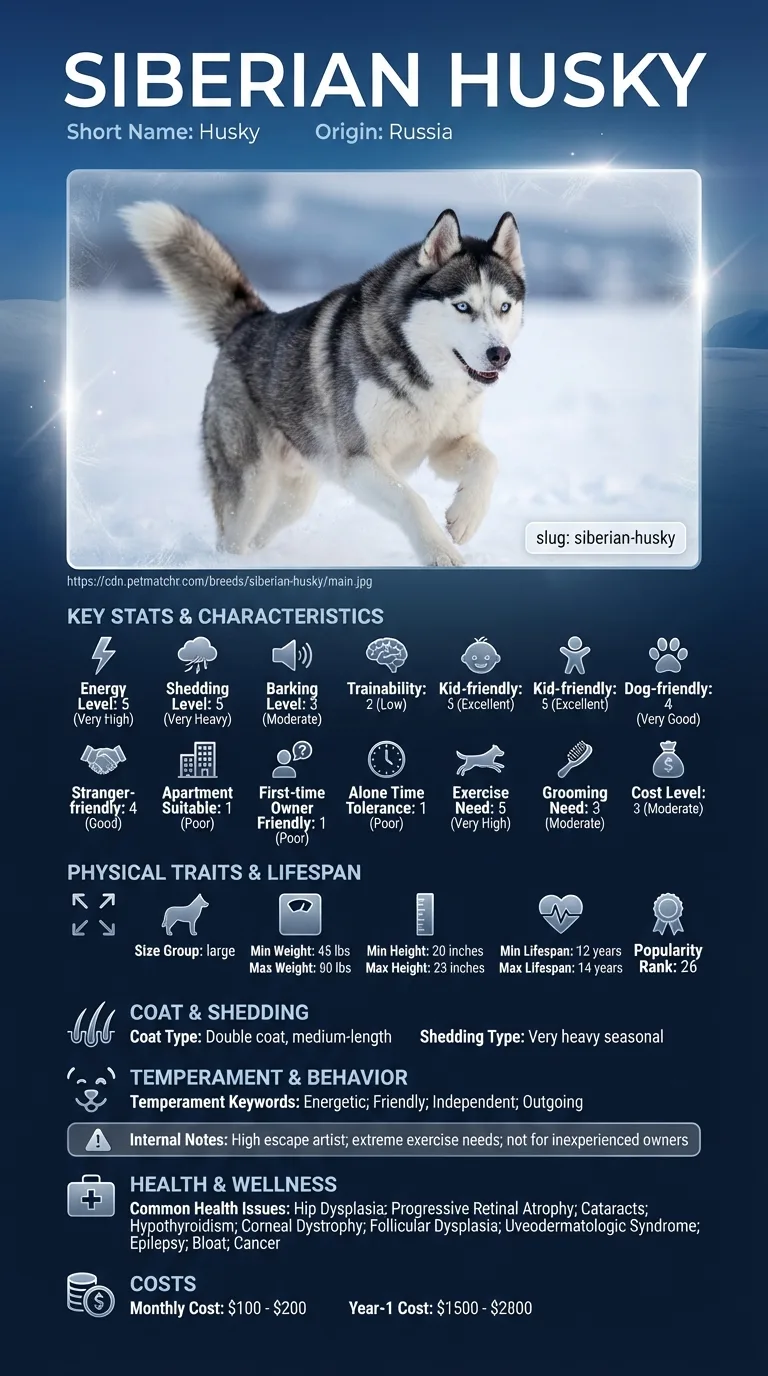
This is for someone already down to Bernese Mountain Dog and Siberian Husky and deciding between them. For this pair the decision usually turns on good for first-time owners and exercise need, so those are covered first and in most detail. Anyone choosing from a flat has a clear answer here: Bernese Mountain Dog rates 2/5 against 1/5. It is written for the decision rather than the breed history.
Between Bernese Mountain Dog and Siberian Husky, good for first-time owners is what separates them, and Bernese Mountain Dog is the lower-effort dog of the two to keep.
Choose Bernese Mountain Dog if this is your first dog, shedding is a problem in your house and your walking routine is modest.
Choose Siberian Husky if a smaller dog suits your car, your home or your back and you want a dog that can keep up with an active routine.
| Feature | bernese mountain dog | siberian husky | Winner |
|---|---|---|---|
| Size class | large | large | Equal |
| Weight | 70–115 lbs | 45–60 lbs | Equal |
| Height | 23–27 in | 20–23 in | Equal |
| Lifespan | 7–10 years | 12–14 years | siberian husky |
| Exercise need | Moderate (3/5) | Very high (5/5) | bernese mountain dog |
| Grooming need | Moderate (3/5) | Moderate (3/5) | Equal |
| Shedding | High (4/5) | Very high (5/5) | bernese mountain dog |
| Energy level | Moderate (3/5) | Very high (5/5) | Equal |
| Barking | Low (2/5) | Moderate (3/5) | bernese mountain dog |
| Apartment suitability | Low (2/5) | Very low (1/5) | bernese mountain dog |
| Good for first-time owners | High (4/5) | Very low (1/5) | bernese mountain dog |
| Tolerates being alone | Moderate (3/5) | Very low (1/5) | bernese mountain dog |
| Trainability | High (4/5) | Low (2/5) | bernese mountain dog |
| Good with kids | Very high (5/5) | Very high (5/5) | Equal |
| Good with other dogs | Very high (5/5) | High (4/5) | bernese mountain dog |
| Friendly to strangers | High (4/5) | High (4/5) | Equal |
| Cost level | High (4/5) | Moderate (3/5) | siberian husky |
| Coat | Double coat, medium-length | Double coat, medium-length | Equal |
| Origin | Switzerland | Russia | Equal |
| Typical monthly cost | $120–$250 | $100–$200 | Equal |
| Typical first-year cost | $1,800–$3,200 | $1,500–$2,800 | Equal |
Both breeds land in the large class, but they get there differently — the Bernese at 70-115 lbs is built heavier and stockier, while the Siberian Husky's 45-60 lbs and 20-23 in frame is leaner and built for endurance rather than mass. A Bernese can outweigh a Husky by 30-70 lbs despite similar overall size classification, which matters for anyone comparing the two based on large dog alone without digging into actual numbers. The Husky's lighter, athletic frame also means it typically moves and turns faster than the more solidly-built Bernese.
This is the starkest contrast in the whole comparison: the Husky needs Very high (5/5) exercise and carries Very high (5/5) energy, against the Bernese's Moderate (3/5) on both counts. Bred to pull sleds across long distances, the energetic, outgoing Husky needs serious daily running or high-intensity activity, not a casual walk — under-exercised Huskies are notorious for destructive behavior. The calm, gentle Bernese asks for far less. Anyone without the time or terrain for genuinely vigorous daily exercise should think hard before choosing the Husky over the comparatively laid-back Bernese.
Grooming needs tie at Moderate (3/5), but shedding tells a different story — the Husky's Very high (5/5) rating edges out even the Bernese's already-substantial High (4/5). Both carry a medium-length double coat built for cold climates, and both blow their undercoat heavily during seasonal changes, but the Husky is widely known as one of the heaviest-shedding breeds overall. Anyone choosing between these two based on hair tolerance should expect significant, near-constant shedding management regardless of which one they pick, with the Husky requiring slightly more vigilance.
Neither breed suits apartment life well, but the Husky is worse off, rated Very low (1/5) against the Bernese's already-low Low (2/5). Barking sits at Moderate (3/5) for the Husky versus Low (2/5) for the Bernese, and the Husky is famous for vocalizing in howls and talking rather than straightforward barking. The real dealbreaker for apartment living, though, is alone-tolerance: the Husky scores Very low (1/5), the lowest possible rating, against the Bernese's Moderate (3/5) — a Husky left alone for long stretches is a recipe for anxiety and property damage.
First-time owners should take note: the Bernese rates High (4/5) for beginner suitability while the Husky drops to Very low (1/5), and trainability follows the same pattern, High (4/5) versus Low (2/5). The Husky's independent, outgoing nature comes from a working history where quick individual decision-making mattered more than obedience to a musher's every command, and that instinct persists as stubbornness at home. Only experienced owners with a strong grasp of positive-reinforcement training and boundary-setting should consider a Husky over the far more biddable, first-timer-friendly Bernese.
Both breeds score Very high (5/5) with kids, and strangers-friendliness ties close too — High (4/5) for both. The Bernese edges ahead with other dogs, Very high (5/5) versus the Husky's High (4/5), though that is a narrower gap than in many other categories. Given the Husky's outgoing, friendly temperament, it actually holds its own socially better than its exercise and training scores might suggest — the household-fit question here is less about temperament and more about whether the family can meet the Husky's much higher activity and containment needs.
The Husky lives substantially longer, 12-14 years against the Bernese's 7-10 — roughly a four-to-seven year edge. Both carry ten flagged health conditions; the Bernese's list includes Bloat (GDV), Degenerative Myelopathy, and Histiocytosis, while the Husky's covers eye-focused concerns like Cataracts, Corneal Dystrophy, and Uveodermatologic Syndrome alongside Epilepsy and its own Bloat and Cancer risk. Husky owners should prioritize regular ophthalmologic screening given how many of its flagged conditions are eye-related, a pattern distinct from the more orthopedic and cancer-heavy Bernese health profile.
The Husky is somewhat cheaper to keep, rated Moderate (3/5) for cost against the Bernese's High (4/5), with monthly costs of $100-$200 versus $120-$250 and first-year costs of $1,500-$2,800 compared to $1,800-$3,200. That said, the sticker price does not capture everything — a Husky's Very high (5/5) exercise need may translate into real costs for dog walkers, daycare, or a securely fenced yard that do not show up in the baseline cost rating but matter just as much to a realistic monthly budget.
Bernese Mountain Dog weighs 70–115 lbs and lives 7–10 years; Siberian Husky weighs 45–60 lbs and lives 12–14 years. The two diverge most on good for first-time owners, exercise need and energy level and 2 other rated axes. They are level on grooming need, good with kids and friendly to strangers, so those cannot decide it. In the table, a "winner" means easier for an ordinary household — not better. Size, coat and origin are recorded without a verdict. Because both breeds are scored the same way, the gaps are reliable even where the absolute numbers are rough.

Not usually — it is rated Very low (1/5) for first-time owners, the lowest score possible, compared to High (4/5) for the Bernese Mountain Dog.
The Husky by far, rated Very high (5/5) versus Moderate (3/5) for the Bernese — Huskies need serious daily running, not just walks.
It is not recommended — the Husky scores Very low (1/5) for tolerating being alone, versus Moderate (3/5) for the Bernese.
The Husky, rated Very high (5/5) versus the Bernese's High (4/5), and it is widely known for heavy seasonal coat blowouts.
The Husky, typically 12-14 years compared to 7-10 years for the Bernese.
Both score Very high (5/5) with kids — a tie between the two breeds.
The Husky, at $100-$200 monthly versus $120-$250 for the Bernese, though its high exercise needs can add hidden costs like dog walkers.
The Husky, rated Moderate (3/5) versus Low (2/5) for the Bernese, and it is known for howling and vocalizing.
The Bernese Mountain Dog, rated High (4/5) versus Low (2/5) for the Husky.
The Husky, given its Very high (5/5) exercise drive and strong independent streak.
The Bernese Mountain Dog, rated Moderate (3/5) energy versus the Husky's Very high (5/5).
Secure checkout on Stripe. We never see your card.
7-day money-back guarantee. Instant access.
Health information here is general and is not veterinary advice. If your dog shows pain, sudden behaviour change, or worsening symptoms, consult a licensed veterinarian.
Some links on this site are affiliate links. We may earn a commission at no extra cost to you, and we only suggest products we believe are helpful for dog owners.
We research and check what we publish, but we do not warrant that any figure, date, price, or statement is accurate, complete, or current, and we accept no liability for any loss, cost, injury, or other harm arising from the use of this site. Use it as one reference among several. You remain responsible for your own decisions and for your dog's care - confirm anything that matters with a licensed veterinarian or another qualified professional before you act on it. Full disclaimer.
Match your lifestyle to the right dog.
Take quizNot sure which breed is right for you? Take our 2-minute quiz to find out.
Take the quiz