Health
Is a blue haze in my older dog's eyes a cataract?
Usually not. An even blue-grey haze in both eyes from about seven onward is typically harmless lens hardening. A vet can confirm it in a single examination.

Quick answer
Is a blue haze in my older dog's eyes a cataract?
Usually not. An even blue-grey haze in both eyes from about seven onward is typically harmless lens hardening. A vet can confirm it in a single examination.
Most cloudy eyes in older dogs are not cataracts at all. The difference is worth knowing before you worry.
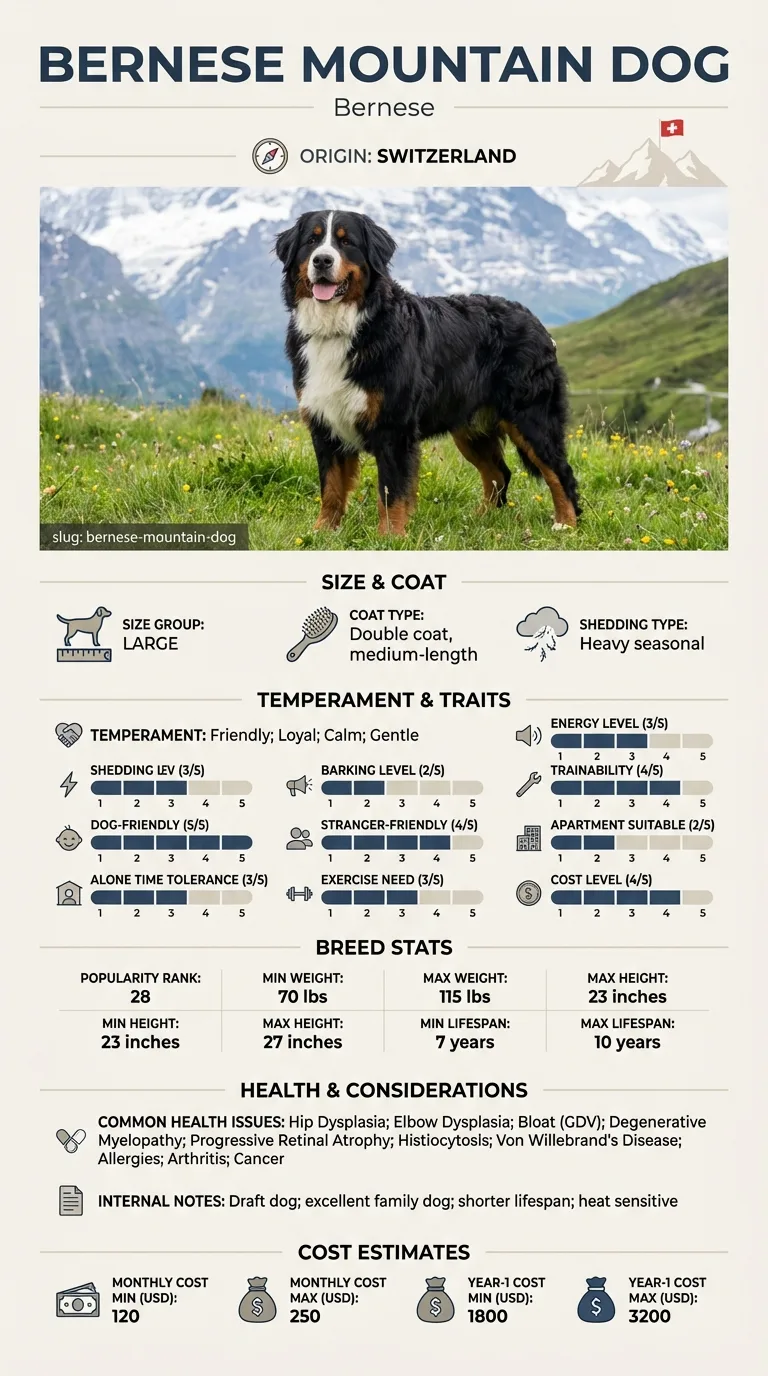
Owners who have noticed a bluish haze in both of their Berner's eyes and are trying to work out whether it explains the dog's hesitancy on the stairs.
This guide is not medical advice. If your dog shows pain, sudden behavior change, or worsening symptoms, consult a licensed veterinarian.
Some links may be affiliate links. We may earn a commission at no extra cost to you. We only suggest products we believe are helpful for dog owners.
We research and check what we publish, but we do not warrant that any figure, date, price, or statement is accurate, complete, or current, and we accept no liability for any loss, cost, injury, or other harm arising from the use of this site. Use it as one reference among several. You remain responsible for your own decisions and for your dog's care - confirm anything that matters with a licensed veterinarian or another qualified professional before you act on it. Full disclaimer.
The lens focuses light onto the retina. A cataract is any opacity within it, ranging from a dot that never affects vision to a completely white lens that blocks light entirely. What owners notice is cloudiness and, sometimes, a dog that has become cautious on unfamiliar ground.
Eye disease appears on the Bernese Mountain Dog's documented health list in the form of progressive retinal atrophy, which is a retinal rather than a lens condition. Cataracts occur in this breed as they do in most, and the harmless age-related haze that mimics them is close to universal in older dogs.
The documented ocular condition in this breed is retinal rather than lenticular, which is precisely why cloudy eyes in a Bernese need careful assessment: the eye that looks worst may not be the eye losing vision. A seven to ten year lifespan also means age-related lens hardening appears comparatively early in the dog's life, often prompting concern at six or seven.
Eye injury is the main environmental contributor and is relevant to a breed that works and walks in rough country. A scratch from undergrowth or an impact can cause inflammation inside the eye that later produces a cataract. Otherwise, the environment has little influence on lens opacity compared with genetics and metabolic health.
Book urgently for an eye that is red, held partly closed, watering heavily, or that the dog is rubbing, and for any cloudiness that appeared over days rather than months. Pain in an eye is always urgent, and sudden bilateral cloudiness in a middle-aged dog raises the possibility of diabetes, which needs assessing without delay. Book a routine examination for a gradual haze in both eyes so it can be identified properly, and for a dog that has become hesitant in dim light even though its eyes look clear, which points behind the lens rather than at it.
The two commonest mistakes here point in opposite directions, which is exactly why an examination settles it.
Start here: Bernese Mountain Dog Most Common Genetic Disorders
See all Bernese Mountain DOG health problems, which breeds are prone to cataracts, or the full Bernese Mountain DOG breed guide for temperament, exercise needs and ownership costs.
Lens hardening progresses over years and needs nothing. True cataracts vary from static for life to complete within weeks in diabetic dogs. Surgery, where suitable, restores vision within days with weeks of medicated aftercare.
A correct identification of which change is present, a confident dog moving normally around a stable home, and no eye that is ever left painful.
Nuclear sclerosis is the harmless one. From about six or seven, the lens fibres in any dog compact and take on a blue-grey haze that is even, symmetrical in both eyes, and looks slightly translucent. A vet shining a light through it can still see the retina behind. Dogs with it navigate normally and it needs no treatment. In a breed living seven to ten years, this is what most owners are seeing.
A true cataract is white rather than blue-grey, and it blocks rather than filters. It may be a small dot, a wedge, or the whole lens. If a vet cannot see the retina through it, the dog cannot see out through it either. Cataracts can be inherited, can follow inflammation or injury, and can develop with diabetes.
The third possibility is the one that catches people out. Progressive retinal atrophy is on the Bernese Mountain Dog's documented health list, and it affects the retina behind a perfectly clear lens. A dog with retinal disease can have eyes that look entirely normal while losing vision, typically in dim light first. That is why a dog bumping into things at dusk with clear eyes deserves an ophthalmic examination just as much as one with cloudy eyes does, and why the two conditions must be distinguished before any surgery is contemplated.
The practical test at home is behaviour. Watch your dog in a dim corridor, at dusk in the garden, and on unfamiliar ground. Hesitancy that appears in low light and disappears in bright light points at the retina. Difficulty in bright and dim conditions alike points at the lens.

Marjorie owns two Berners, half-sisters, both seven, and both developed a blue-grey haze in the same year. She booked them together, assuming she was about to hear the same thing twice. Greta had straightforward nuclear sclerosis, needed nothing, and sees perfectly well. Lotti had that too, but the examination also picked up retinal changes that explained why she had recently started hesitating at the back step at dusk. Lotti now has a mat at the top of the step, a spoken cue before anyone touches her, and no furniture has moved in the house since.
Key takeaway: The visible haze was the same in both dogs and meant something different in each. What separated them was an examination, not an observation.
You cannot tell reliably by looking. Nuclear sclerosis, the harmless age change, and a true cataract look similar to an owner. A vet examining the eye with the pupil dilated can see whether light still reaches the retina, and that is the distinction that matters.
Yes, by surgical removal of the lens and usually placement of an artificial one, performed by a veterinary ophthalmologist. It is a specialist procedure with a good success rate in suitable candidates, and candidacy depends on a healthy retina behind the lens.
Because removing the lens only restores vision if the retina works. Progressive retinal atrophy is documented in this breed, and a dog with both a cataract and retinal degeneration would gain nothing from the operation. Specialists test retinal function first for exactly this reason.
An uncomplicated cataract is not painful. However, a lens that has been cataractous for a long time can leak protein and trigger inflammation inside the eye, which is painful and can lead to secondary problems including raised pressure. A red, squinting or cloudy-plus-painful eye is urgent.
Cataracts that develop rapidly in both eyes of a middle-aged dog are a recognised sign of diabetes, and they can progress within weeks. If you have also noticed increased drinking, increased urination or weight loss, tell your vet immediately rather than at the next routine visit.
Remarkably well, provided the environment is stable. Dogs rely far more on scent and hearing than on sight. Keep furniture where it is, use a consistent route to the garden, and speak before touching. A calm, people-oriented breed like this one adapts particularly well.
Usually not. An even blue-grey haze in both eyes from about seven onward is typically harmless lens hardening. A vet can confirm it in a single examination.
If it is red, painful, squinting, or if cloudiness appeared over days rather than months. Rapid bilateral cataracts also raise the question of diabetes.
Keep furniture and routes unchanged, speak before touching, and use scent markers or texture changes at steps and doorways.
It is a specialist ophthalmic procedure and one of the more expensive elective surgeries in veterinary medicine, plus follow-up. Ask for a full estimate including aftercare.
Yes, and verbal cues become far more important. Teach directional words like step, wait and left early, while the dog can still see, so they are already fluent later.
A one-page prep sheet for this condition: the signs, the questions to ask, what to get priced. Unlocks here.
You get: Vet visit prep sheet
No spam. One-click unsubscribe. See our privacy policy.
Preview page 1 before you decide.