Behavior
Which sheds more?
The Bernese, rated High (4/5) versus Low (2/5) for the Weimaraner.

Quick answer
Which sheds more?
The Bernese, rated High (4/5) versus Low (2/5) for the Weimaraner.
Bernese Mountain Dog or Weimaraner? On paper they differ most on exercise need, and on the scales Bernese Mountain Dog is the heavier at 70–115 lbs. Here is how the two compare on everything that shapes an ordinary week.
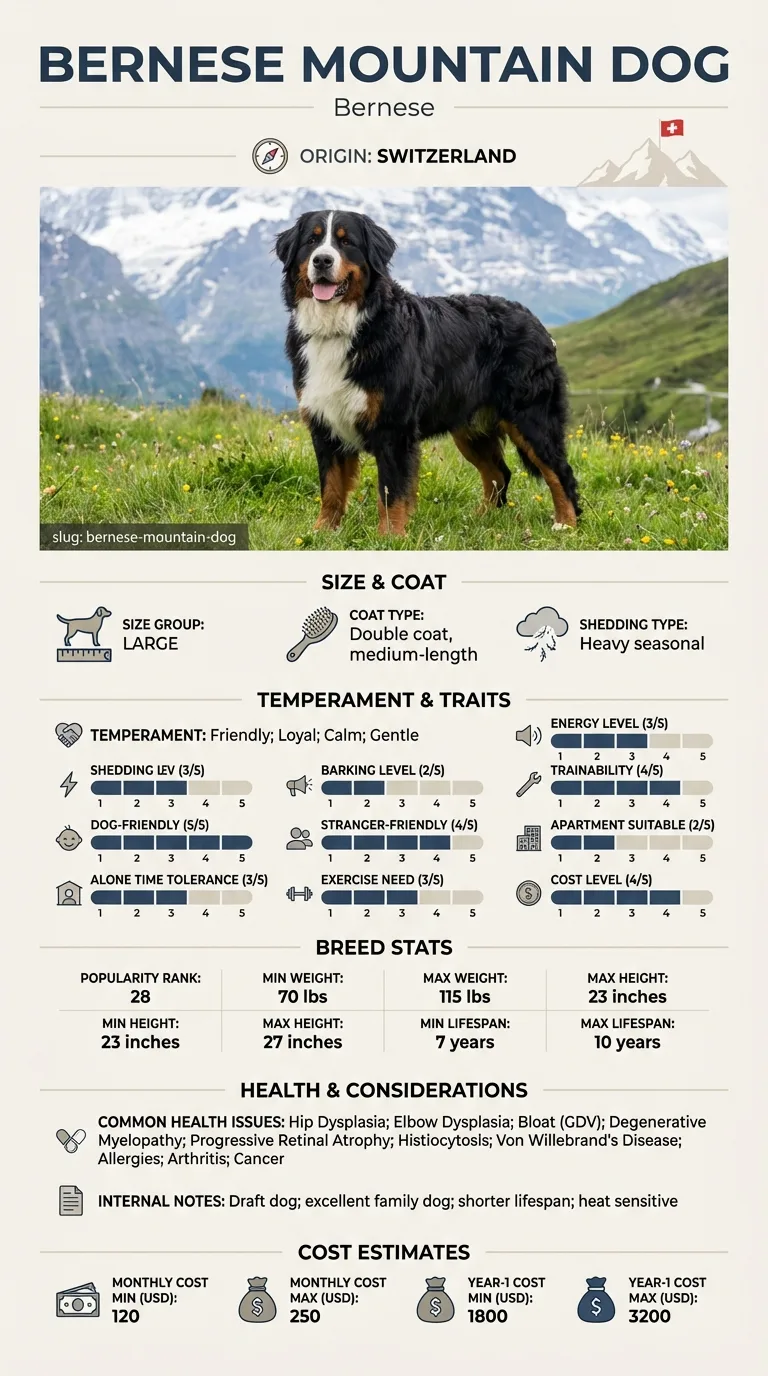
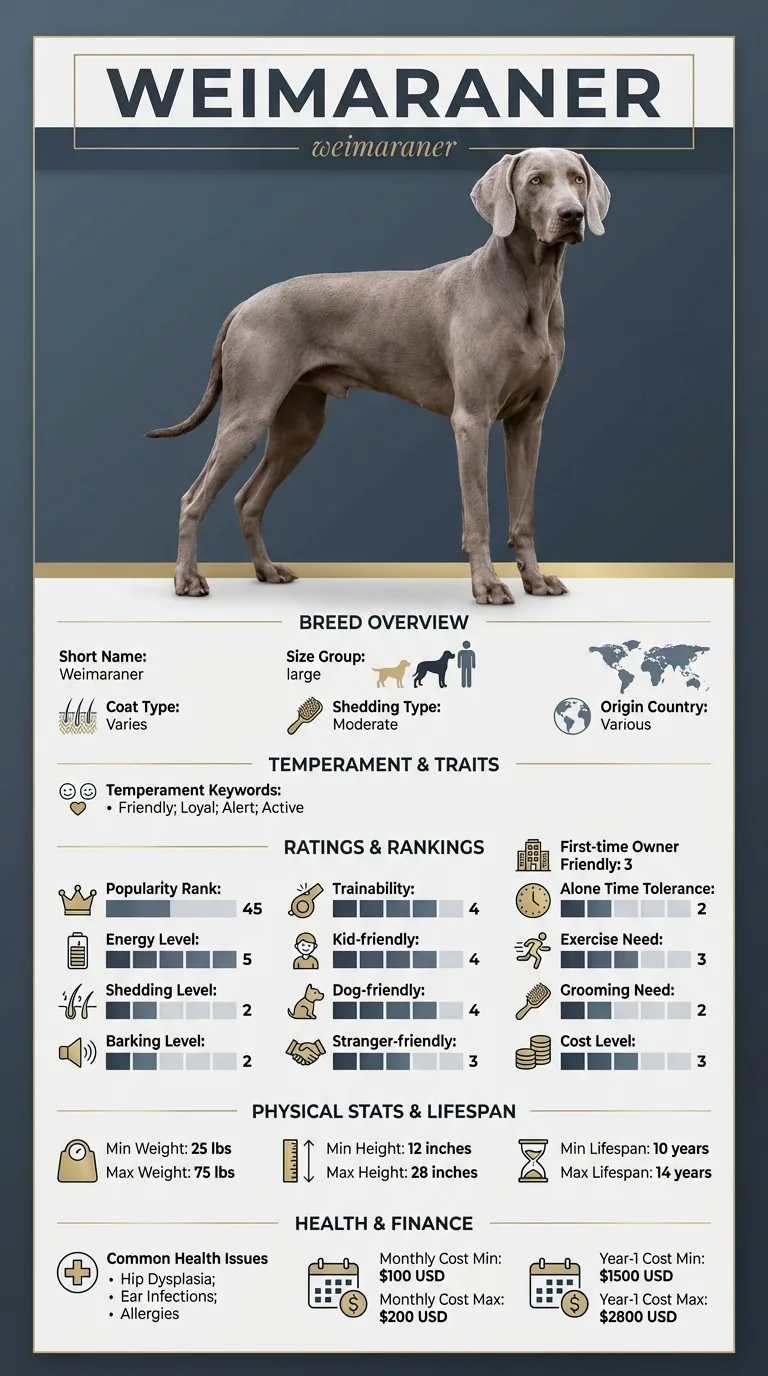
This is for someone already down to Bernese Mountain Dog and Weimaraner and deciding between them. For this pair the decision usually turns on exercise need and grooming need, so those are covered first and in most detail. Anyone choosing from a flat has a clear answer here: Bernese Mountain Dog rates 2/5 against 1/5. There is no origin story here — only what changes about your week.
Between Bernese Mountain Dog and Weimaraner, exercise need is what separates them, and Bernese Mountain Dog is the lower-effort dog of the two to keep.
Choose Bernese Mountain Dog if this is your first dog, your walking routine is modest and the dog will be alone during the working day.
Choose Weimaraner if you do not want a standing grooming appointment, shedding is a problem in your house and a smaller dog suits your car, your home or your back.
| Feature | bernese mountain dog | weimaraner | Winner |
|---|---|---|---|
| Size class | large | large | Equal |
| Weight | 70–115 lbs | 55–90 lbs | Equal |
| Height | 23–27 in | 23–27 in | Equal |
| Lifespan | 7–10 years | 10–13 years | weimaraner |
| Exercise need | Moderate (3/5) | Very high (5/5) | bernese mountain dog |
| Grooming need | Moderate (3/5) | Very low (1/5) | weimaraner |
| Shedding | High (4/5) | Low (2/5) | weimaraner |
| Energy level | Moderate (3/5) | Very high (5/5) | Equal |
| Barking | Low (2/5) | Moderate (3/5) | bernese mountain dog |
| Apartment suitability | Low (2/5) | Very low (1/5) | bernese mountain dog |
| Good for first-time owners | High (4/5) | Low (2/5) | bernese mountain dog |
| Tolerates being alone | Moderate (3/5) | Very low (1/5) | bernese mountain dog |
| Trainability | High (4/5) | High (4/5) | Equal |
| Good with kids | Very high (5/5) | High (4/5) | bernese mountain dog |
| Good with other dogs | Very high (5/5) | Moderate (3/5) | bernese mountain dog |
| Friendly to strangers | High (4/5) | Moderate (3/5) | bernese mountain dog |
| Cost level | High (4/5) | Moderate (3/5) | weimaraner |
| Coat | Double coat, medium-length | Short and sleek | Equal |
| Origin | Switzerland | Various | Equal |
| Typical monthly cost | $120–$250 | $110–$240 | Equal |
| Typical first-year cost | $1,800–$3,200 | $1,700–$3,200 | Equal |
Both breeds share the large classification and near-identical height ranges — 23-27 in for the Bernese, exactly the same for the Weimaraner — but weight tells a different story: the Bernese's 70-115 lbs can run well past the Weimaraner's leaner 55-90 lbs. The Weimaraner's short, sleek coat and athletic build give it a visibly lighter, more streamlined silhouette despite standing just as tall as the sturdier, heavier-coated Bernese. Anyone picturing large dog as a single category should note these two occupy very different points within it.
The Weimaraner is a serious athlete, rated Very high (5/5) for both exercise need and energy level against the Bernese's Moderate (3/5) on each measure. Bred for demanding fieldwork tracking large game, the energetic, headstrong Weimaraner needs vigorous daily exercise — running, hiking, or structured activity — to avoid the anxious, destructive behavior it is known for when under-stimulated. The calm Bernese needs far less to stay content. Households without significant time for sustained daily exercise should think carefully before choosing the Weimaraner over the comparatively relaxed Bernese.
Grooming clearly favors the Weimaraner, rated Very low (1/5) against the Bernese's Moderate (3/5), and shedding follows the same pattern — Low (2/5) for the Weimaraner's short, sleek coat versus High (4/5) for the Bernese's medium-length double coat. There is minimal brushing or seasonal coat-blow to manage with a Weimaraner, just the occasional bath, while the Bernese needs consistent attention to control loose hair around the house. For anyone weighing coat maintenance heavily in their decision, the Weimaraner is the far lower-upkeep option.
Neither breed is suited to apartment life, but the Weimaraner rates worse, Very low (1/5) against the Bernese's Low (2/5), driven largely by its intense exercise needs and its devoted, alert temperament that does not settle easily in confined spaces. Barking sits slightly higher for the Weimaraner too, Moderate (3/5) versus Low (2/5) for the Bernese. The starkest gap is alone-tolerance: the Weimaraner scores Very low (1/5), the lowest possible rating, against the Bernese's Moderate (3/5) — its health list even flags Separation Anxiety directly as a known concern.
Trainability ties close, High (4/5) for both breeds, but the Bernese remains notably friendlier to first-timers, High (4/5) versus Low (2/5) for the Weimaraner. The headstrong, alert Weimaraner is smart enough to learn quickly but strong-willed enough to test boundaries consistently, requiring a confident, consistent handler rather than a permissive one. First-time owners drawn to the Weimaraner's sleek looks should understand it demands considerably more structure and experience than the friendlier, more forgiving Bernese to avoid behavioral problems taking root.
The Bernese edges out the Weimaraner across social categories: Very high (5/5) with kids versus High (4/5), Very high (5/5) with other dogs versus Moderate (3/5), and High (4/5) with strangers versus Moderate (3/5). The devoted but headstrong Weimaraner tends to bond intensely with its immediate family while staying more reserved elsewhere, a pattern consistent with its history as a one-handler hunting companion. Families that host frequently or keep multiple dogs will likely find the broadly friendly Bernese the easier fit socially.
The Weimaraner lives somewhat longer, 10-13 years against the Bernese's 7-10. Health-wise, the Bernese's list runs twice as long at ten conditions, including Degenerative Myelopathy, Histiocytosis, and Von Willebrand's Disease, while the Weimaraner's five flagged concerns include Hypertrophic Osteodystrophy and its own Von Willebrand Disease risk, plus Bloat (GDV) — a shared concern for both deep-chested breeds. Notably, the Weimaraner's list also flags Separation Anxiety as a behavioral health concern, reinforcing how central alone-time management is to keeping this particular breed well-adjusted.
Costs run nearly identical: both are rated Moderate to High for overall cost, with the Weimaraner at $110-$240 monthly and $1,700-$3,200 in year one, just slightly below the Bernese's $120-$250 and $1,800-$3,200. The real cost difference is not captured in these baseline figures, though — the Weimaraner's Very high (5/5) exercise need and Very low (1/5) alone-tolerance often mean added expenses for dog walkers, daycare, or training support to manage separation anxiety that a calmer Bernese simply does not require.
Bernese Mountain Dog weighs 70–115 lbs and lives 7–10 years; Weimaraner weighs 55–90 lbs and lives 10–13 years. The two diverge most on exercise need, grooming need and energy level and 4 other rated axes. Almost every rated axis separates them at least slightly. Where the table declares a winner it means less work for the owner, nothing more; descriptive rows are left as ties on purpose. The value here is in the differences between the two columns; treat any single score as approximate.

Not ideally — it is rated Low (2/5) for first-time owners against the Bernese's High (4/5), largely due to its headstrong, high-energy temperament.
The Weimaraner, rated Very low (1/5) versus Moderate (3/5) for the Bernese, thanks to its short, sleek coat.
Not well — it scores Very low (1/5) for alone-tolerance and its health list specifically flags Separation Anxiety as a concern, versus Moderate (3/5) tolerance for the Bernese.
The Weimaraner, rated Very high (5/5) versus Moderate (3/5) for the Bernese — it needs serious daily activity to stay well-behaved.
The Weimaraner, typically 10-13 years compared to 7-10 years for the Bernese.
Both score well — the Bernese at Very high (5/5) and the Weimaraner at High (4/5) — making either workable for a family.
Yes — Bloat (GDV) appears on both breeds' health lists, a shared risk for deep-chested large dogs.
The Bernese, rated High (4/5) versus Low (2/5) for the Weimaraner.
The Weimaraner, described as headstrong versus the Bernese's more agreeable, gentle temperament.
The Bernese Mountain Dog, rated High (4/5) versus Moderate (3/5) for the Weimaraner.
The Weimaraner, rated Very high (5/5) versus Moderate (3/5) for the Bernese.
Secure checkout on Stripe. We never see your card.
7-day money-back guarantee. Instant access.
Health information here is general and is not veterinary advice. If your dog shows pain, sudden behaviour change, or worsening symptoms, consult a licensed veterinarian.
Some links on this site are affiliate links. We may earn a commission at no extra cost to you, and we only suggest products we believe are helpful for dog owners.
We research and check what we publish, but we do not warrant that any figure, date, price, or statement is accurate, complete, or current, and we accept no liability for any loss, cost, injury, or other harm arising from the use of this site. Use it as one reference among several. You remain responsible for your own decisions and for your dog's care - confirm anything that matters with a licensed veterinarian or another qualified professional before you act on it. Full disclaimer.
Match your lifestyle to the right dog.
Take quizNot sure which breed is right for you? Take our 2-minute quiz to find out.
Take the quiz