Costs
What is the most expensive single Bernese claim category?
Cancer treatment, which combines diagnostics, specialist referral and a long protocol, and which this breed is documented as being at elevated risk for.

Quick answer
What is the most expensive single Bernese claim category?
Cancer treatment, which combines diagnostics, specialist referral and a long protocol, and which this breed is documented as being at elevated risk for.
The expensive year in a Bernese's life is rarely the first one. It is the one where a single overnight emergency costs more than three years of premiums.
New Bernese owners deciding whether insurance is worth it for this breed, and existing owners trying to work out why a claim was reduced or refused.
This guide is not medical advice. If your dog shows pain, sudden behavior change, or worsening symptoms, consult a licensed veterinarian.
Some links may be affiliate links. We may earn a commission at no extra cost to you. We only suggest products we believe are helpful for dog owners.
We research and check what we publish, but we do not warrant that any figure, date, price, or statement is accurate, complete, or current, and we accept no liability for any loss, cost, injury, or other harm arising from the use of this site. Use it as one reference among several. You remain responsible for your own decisions and for your dog's care - confirm anything that matters with a licensed veterinarian or another qualified professional before you act on it. Full disclaimer.
Insurance claim patterns differ sharply between breeds because the underlying disease risks differ. For Bernese Mountain Dogs the claims that matter are concentrated in a small number of expensive categories: cancer, orthopaedic surgery, gastric emergencies and chronic skin disease. Understanding that concentration is what lets an owner choose a policy structure that will actually pay when it matters rather than one that looks cheap.
Insurance is optional, but the events it covers are not rare in this breed. Cancer, hip and elbow dysplasia, bloat, arthritis and degenerative myelopathy all appear on the Bernese Mountain Dog's documented health issue list, and several of them are surgical or long-course conditions. That combination is why this breed sits in a high premium band across most insurers rather than at the average for its size.
Body size is a cost multiplier that applies to every claim. Anaesthesia, analgesia, surgical implants and hospitalisation all scale with a dog of 70 to 115 pounds, so an identical procedure costs materially more in a Bernese than in a spaniel. The breed's condition list then supplies the frequency. A seven to ten year lifespan compresses the claims into a shorter window than in a longer-lived breed, which means the annual claim rate over a Bernese's life tends to be higher even where the lifetime total is not.
Where you live shapes the numbers as much as what you own. Emergency and specialist clinics in large metropolitan areas charge substantially more than rural general practices, and insurers price by postcode accordingly. Access to a twenty-four hour surgical facility matters enormously for a breed at risk of bloat, and households a long drive from one face a different practical risk regardless of their policy. Multi-dog homes and dogs with outdoor working lives also see different claim profiles.
Insurance decisions are financial, but they interact with medical urgency in one dangerous way: owners sometimes delay care while they check whether a claim will be paid. Do not do this. Bloat, breathing distress, collapse, a distended abdomen with unproductive retching, or an inability to stand are emergencies where minutes change outcomes, and you should go first and resolve the paperwork afterwards. For non-urgent matters, ask your veterinary practice for a written estimate before treatment, since most insurers will pre-authorise against one.
Start here: Bernese Mountain Dog Most Common Genetic Disorders
See all Bernese Mountain DOG health problems, which breeds are prone to insurance claims, or the full Bernese Mountain DOG breed guide for temperament, exercise needs and ownership costs.
Cover typically becomes active for accidents within days and for illness after roughly two weeks, with orthopaedic conditions often waiting considerably longer. Premiums rise every year as the dog ages, and in this breed the steepest increases usually arrive between five and eight, which is exactly when claims start. Expect to be paying more each year for a dog who is statistically more likely to need it, and budget for that curve rather than the first year quote.
Success is a policy you never have to argue about. That means a claim for a chronic condition being paid in its third year without a fresh exclusion appearing, an emergency admission covered without a pre-existing dispute, and an owner who was able to say yes to a specialist referral because the money was not the deciding factor. The measure is not how much you claimed; it is whether the cover held when it was needed.
Claim patterns follow the breed's documented health issues closely. Anyone deciding on cover should read the breed's condition list first, because that list is essentially the insurer's pricing model.
The single biggest trap is the pre-existing condition definition, and it is far broader than most owners assume. A note in the record saying a puppy had loose hips on examination, a soft murmur mentioned at a vaccine visit, or a single episode of an itchy ear can be enough for an insurer to exclude an entire body system later. This is why insuring in the first months, before the record accumulates, is worth more than shopping for a lower premium at three.
The second trap is the difference between annual and lifetime cover. A policy that resets its limit each year but permanently excludes anything claimed for previously is close to useless for the chronic conditions this breed actually gets. Hip dysplasia and skin allergy are not one-year problems. Look specifically for whether a condition remains covered in subsequent policy years.
Third are per-condition caps. A headline annual limit that looks generous can be subdivided so that no single condition can draw more than a fraction of it. Cancer treatment and orthopaedic surgery both run into these quickly in a large dog.
Fourth are breed-specific and bilateral exclusions. Some policies exclude hip dysplasia outright for predisposed breeds, or treat both hips or both knees as one condition for limit purposes. Both matter a great deal in a Bernese.
Finally, watch the waiting periods. Orthopaedic conditions often carry a longer waiting period than illness generally, sometimes six months, which is precisely the window in which a young large-breed dog might first show a problem.

Fritz was insured at four months, which his owners thought was early enough. At seven months he had a single ear infection, treated with drops, resolved in ten days, and recorded as otitis externa. At three years he developed the recurrent itching, chewing and repeated ear trouble that this breed sees with allergic skin disease. The insurer declined the claim, citing the earlier ear record as evidence of a pre-existing condition. His owners appealed with the full clinical notes, arguing that a single isolated infection at seven months was not the same condition as allergic dermatitis at three. The appeal partially succeeded: skin claims were reinstated, ear claims were not. Over the next four years Fritz's ear treatment cost his family more than his premiums did.
Key takeaway: In this breed the routine minor entries in a puppy's record are the ones that shape a policy years later. Insure early, keep your own copy of every note, and read the pre-existing definition before you read the price.
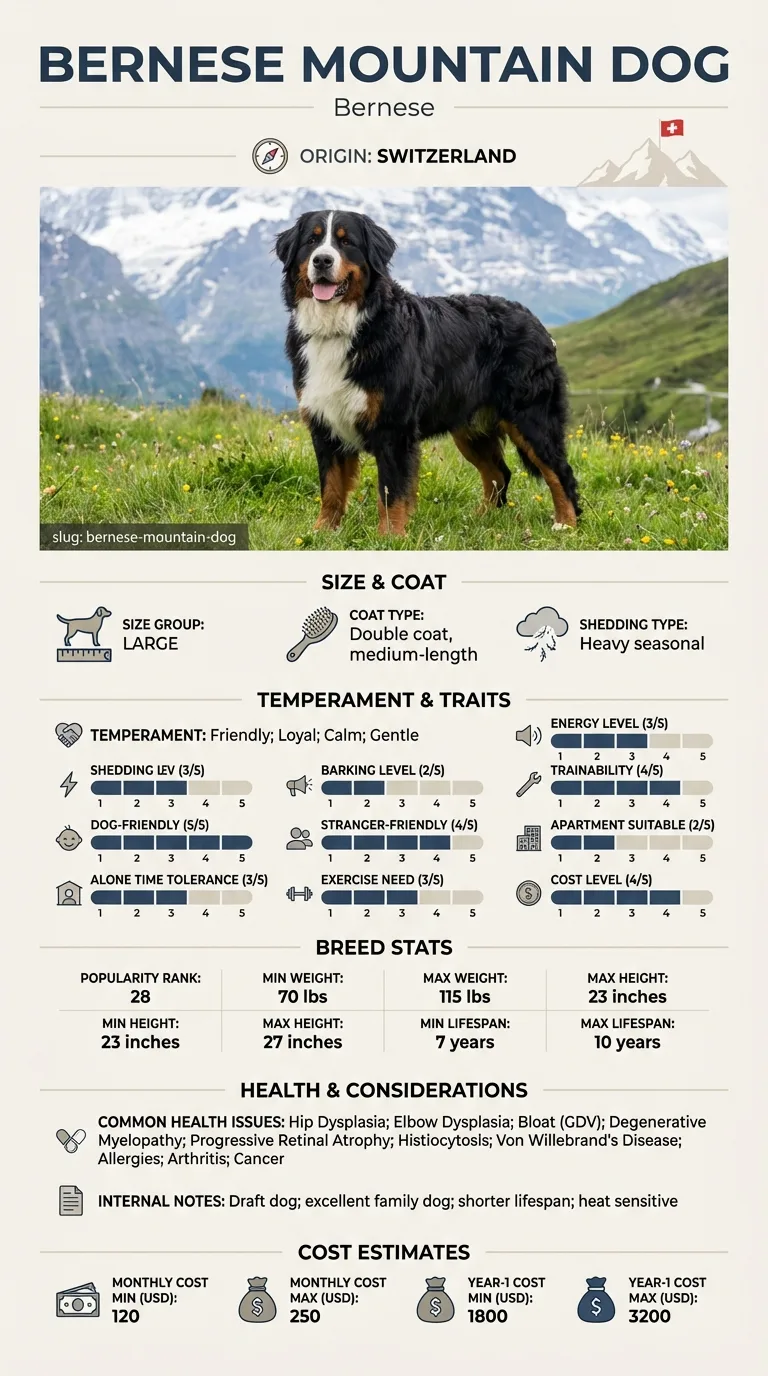
For most owners of this breed, yes, and the reason is the shape of the risk rather than the average. Routine care in a Bernese runs roughly 120 to 250 dollars a month and is budgetable. What is not budgetable is a bloat surgery, a cancer protocol or a hip replacement, and this breed has a meaningfully elevated chance of at least one of those.
Two reasons compound. Drug doses, anaesthetic time, surgical materials and hospitalisation all scale with a 70 to 115 pound body. On top of that, the breed's documented health issues include several expensive categories, notably cancer, bloat and joint disease. Insurers price the combination, not the size alone.
As early as the policy allows, typically within the first weeks at home. The value of early cover is not the premium; it is starting the policy before the veterinary record contains anything an insurer can later classify as pre-existing. A murmur noted at twelve weeks can shape what is covered for the rest of the dog's life.
Sometimes, and you must check rather than assume. Some insurers exclude hip dysplasia for predisposed breeds entirely, some cover it after an extended waiting period, and some cover it but treat both hips as a single condition against the limit. Ask the question in writing before buying, naming the condition.
Preventive gastropexy, often performed at the same time as spaying or neutering, is usually not covered as a preventive procedure by illness policies. It may still be one of the better financial decisions available in this breed, because it substantially reduces the risk of the emergency it prevents. Ask your insurer how they treat it before assuming either way.
Annual cover resets its limit each year but typically excludes any condition already claimed for. Lifetime cover keeps chronic conditions covered year after year up to a recurring limit. For a breed whose common problems are chronic rather than one-off, lifetime style cover is generally the more useful structure despite the higher price.
Cancer treatment, which combines diagnostics, specialist referral and a long protocol, and which this breed is documented as being at elevated risk for.
Whether a condition stays covered in later policy years. Chronic joint and skin disease in this breed run for years, not one claim period.
You can usually get a policy, but the diagnosed condition and often the whole related body system will be excluded. Cover for everything else still has value.
The procedure itself is usually not covered as routine. Some insurers apply conditions around neuter status for specific claims, so read the wording rather than assuming.
Often longer than for general illness, sometimes six months, which matters because large-breed joint problems can surface in the first year.
A one-page prep sheet for this condition: the signs, the questions to ask, what to get priced. Unlocks here.
You get: Vet visit prep sheet
No spam. One-click unsubscribe. See our privacy policy.
Preview page 1 before you decide.