DogBreedCompass
← Back to breed profile

Hip Dysplasia in Bernese Mountain Dogs

Quick answer

What is bunny-hopping and why does it matter?

It is when a dog moves both hind legs together instead of alternating, usually going upstairs or breaking into a run. It reduces the load on each hip individually and is one of the earliest visible signs.

A young Bernese with bad hips often does not limp. He sits down halfway through the walk, and everyone calls him lazy.

Hip Dysplasia in Bernese Mountain Dogs infographic

Owners raising a Bernese puppy who want to know which of their choices actually influence the outcome, and owners of an adult Berner who has started bunny-hopping up the stairs or struggling to rise from the floor.

Important reminder

This guide is not medical advice. If your dog shows pain, sudden behavior change, or worsening symptoms, consult a licensed veterinarian.

Some links may be affiliate links. We may earn a commission at no extra cost to you. We only suggest products we believe are helpful for dog owners.

What this problem looks like

Hip dysplasia is an inherited developmental condition in which the hip joint forms with an abnormally loose fit. The instability leads to abnormal wear, cartilage loss and progressive osteoarthritis. Bernese Mountain Dogs are among the breeds most affected, and it is listed among the breed's core documented health issues alongside elbow dysplasia, arthritis, bloat and cancer.

Common triggers

  • Rapid growth combined with excess body weight in the first year
  • Forced repetitive exercise before growth plates close
  • Slippery flooring that causes repeated splaying of the hind legs
  • Jumping in and out of vehicles or off furniture
  • Weight gain in adulthood, which accelerates existing joint wear

Hip dysplasia is one of the most frequently diagnosed orthopaedic conditions in large breeds and appears explicitly on the Bernese Mountain Dog's list of common health issues. Prevalence figures vary by scoring scheme and population, but the practical position for an owner is that this is a likely concern rather than a remote one, and screening in the parents genuinely shifts the odds.

Why this happens

Breed factors

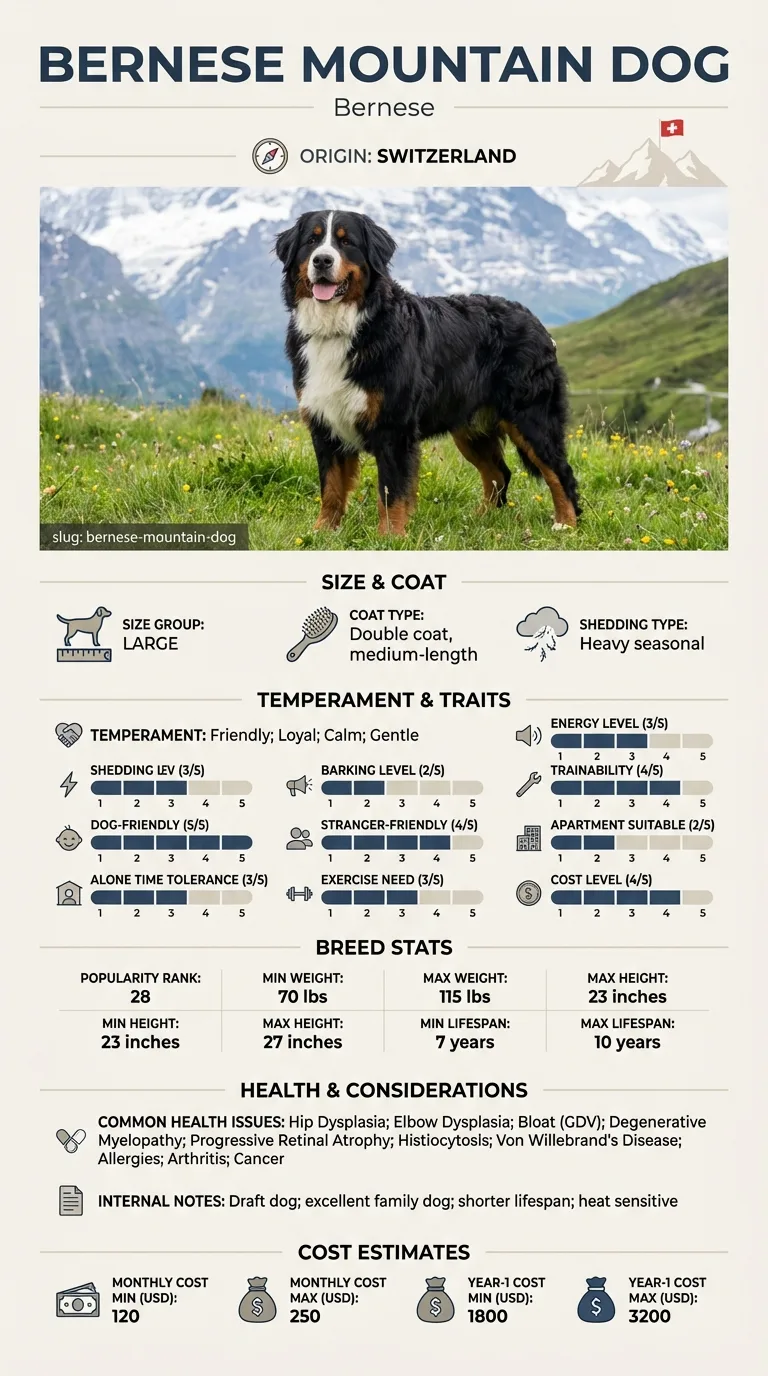
Inheritance is polygenic, meaning many genes contribute and no single test predicts it. What the breed adds on top is mechanical. A Bernese stands 23 to 27 inches and reaches 70 to 115 pounds, and it takes well over a year to get there, so a joint that is still developing is loaded by an increasingly heavy dog for months. The breed was also built as a draft animal, with a heavy front and powerful hindquarters, which concentrates force through the hips during pushing and pulling movements.

Environment factors

Nothing in the environment causes dysplasia, but several things determine how badly it expresses. Overfeeding during growth is the best documented, since a heavier puppy loads an unstable joint harder at exactly the wrong stage. Flooring matters more than owners expect: repeated slipping on tile or hardwood forces the hind limbs into abnormal positions under full body weight. Exercise pattern also counts, with sustained forced running being more damaging than free play, which the dog self-regulates.

What you can do at home (once it is not an emergency)

When to talk to your vet

Book an appointment rather than waiting if your Bernese is bunny-hopping, struggling to rise, reluctant to use stairs, or has become suddenly less willing on walks. None of that is an emergency, but early assessment gives you far more options than a first visit at seven years old. Seek same-day care if your dog is non-weight-bearing on a hind leg, cries out on movement, or has an abrupt loss of hind limb function, since sudden severe signs point to injury or to a spinal problem rather than to gradual dysplasia.

At home, alongside your vet's plan

  • Learn to body condition score by feel rather than by weight alone, since a dense coat hides shape completely. Ribs should be easy to find with light pressure.
  • Split exercise into three or four short outings a day rather than one long walk, and keep the ground flat and non-slip.
  • Put down runners on every hard-floor route the dog uses daily, especially between the bed, the door and the food bowl.
  • Use a ramp for the car from puppyhood so it is a habit rather than a retrofit after diagnosis.
  • Keep nails short. Long nails alter how the foot loads and change the whole limb posture in a heavy dog.

See all Bernese Mountain DOG health problems, which breeds are prone to hip dysplasia, or the full Bernese Mountain DOG breed guide for temperament, exercise needs and ownership costs.

What to expect, and how you know it is working

Conservative management shows its first results in six to twelve weeks, which is how long it takes for weight loss and targeted muscle work to change how a dog moves. Nothing useful happens in a fortnight. Surgical routes involve a recovery of roughly three to six months before full function, with strict restriction in the early weeks. Over the dog's life, expect a slow downward trend punctuated by better and worse periods rather than a steady decline.

Success is a dog who gets up without hesitation, walks comfortably every day, and holds a lean body condition into old age. It is not a normal hip on a radiograph, because the joint architecture does not correct itself. Many well-managed Bernese with radiographically poor hips live entirely comfortable lives, and that gap between the image and the dog is the whole point of treatment.

How a loose hip becomes a painful one

A healthy hip is a deep socket holding a round femoral head snugly, with cartilage taking the load. Dysplastic hips start with laxity, meaning the head can shift within the socket during movement. Every step becomes a small impact rather than a smooth rotation.

The body responds the way it responds to any repeated stress: it remodels. The socket flattens, the femoral head loses its round shape, cartilage wears through, and the joint capsule thickens. What began as an alignment problem becomes osteoarthritis, and arthritis is the thing that actually hurts.

This is why age of onset is confusing in this breed. Some Bernese show signs between five and twelve months, during the phase when laxity is greatest and the growth plates are still open. Others cruise through youth and present at six or seven with arthritis that has been building quietly for years. Same disease, two very different presentations.

Body size is the amplifier. A dog of 70 to 115 pounds puts far more force through an unstable joint than a small dog does, and the Bernese also grows to that weight over an extended puppyhood, so the joint is bearing serious load while it is still forming. That combination is why large working breeds dominate the hip dysplasia population.

What genuinely changes the outcome in the first year

Genetics set the range of possible outcomes; the first eighteen months determine where in that range your dog lands. These are the choices with the best evidence behind them.

Hip Dysplasia in Bernese Mountain Dogs - What genuinely changes the outcome in the first year
  • Keep the puppy lean. Growth-stage body weight is the best supported modifiable factor in hip dysplasia severity, and a chubby Bernese puppy is not a healthy one.
  • Feed a large-breed growth formula and follow it. Excess calcium and over-supplementation during growth can worsen skeletal development rather than support it.
  • Avoid forced repetitive exercise while growth plates are open: no jogging alongside a runner, no bicycle work, no long forced hikes before about eighteen months.
  • Let free play on soft, varied ground do the conditioning. Self-directed movement builds muscle without the repetitive loading that concerns orthopaedic vets.
  • Fit rugs or runners on slippery floors. Repeated splayed slips on hardwood or tile are a real source of joint stress in a heavy growing puppy.
  • Cut out repetitive high-impact jumping, particularly in and out of vehicles. A ramp is cheaper than a hip.

Greta was not lazy at fourteen months

Greta was a 96 pound Bernese who had always been described as the calm one. At fourteen months her owners noticed she was sitting down halfway through her evening walk and taking the stairs with both back legs together. Because the breed is naturally calm and moderate in energy, they had assumed this was just her personality settling. Radiographs under sedation showed significant laxity in both hips with early remodelling. Her vet was blunt: she was carrying about nine pounds more than she should, and that was the first thing to fix. Over four months Greta lost the weight, moved to four short walks a day, started fortnightly hydrotherapy, and had runners laid through the hallway. She never had surgery. She is six now, walks comfortably twice a day, and her owners can tell within a week when her weight has drifted up.

Key takeaway: In a breed whose default personality is calm, a young dog who becomes less willing to move is easy to misread as mellow. Reduced enthusiasm at under two years old deserves a radiograph, not an explanation.

Frequently asked questions

What are the earliest signs of hip dysplasia in a Berner?

Watch for a bunny-hopping gait where both back legs move together, reluctance to jump into the car, a wide or wobbly stance behind, sitting down partway through walks, and difficulty rising after rest. Overt limping often comes later. In this breed the earliest sign is usually reduced enthusiasm rather than obvious pain.

Can hip dysplasia be prevented by careful raising?

Not prevented, but genuinely influenced. The predisposition is inherited and no diet or exercise plan removes it. What growth-stage management does is reduce how severe the joint changes become and how early they cause trouble, which in a breed with a seven to ten year lifespan can mean the difference between a comfortable life and a limited one.

How is hip dysplasia diagnosed?

By a physical examination that tests for laxity and pain, combined with radiographs, usually under sedation so the hips can be positioned properly. Formal scoring schemes such as OFA evaluation or PennHIP measurement give a standardised result that is useful for breeding decisions and for comparing over time.

Does my Bernese need hip surgery?

Most do not. The majority of dogs are managed with weight control, controlled exercise, physical therapy and pain management prescribed by a veterinarian. Surgery, including total hip replacement, is considered when a dog remains painful or functionally limited despite good conservative management. That decision belongs with an orthopaedic specialist.

Should I stop walking a Bernese with hip dysplasia?

No, and this is the most common mistake. Muscle around the hip is what stabilises a poor joint, and rest destroys it. What changes is the pattern: several short flat walks a day instead of one long one, no jumping, no ball chasing, and no rough play on slippery ground. Swimming, where available, is excellent for this breed.

Will hip dysplasia shorten my dog's life?

Rarely directly. It affects quality of life and mobility rather than lifespan, and this breed's seven to ten year average is driven mostly by cancer. The indirect risk is real though: a dog who cannot exercise gains weight, and obesity worsens joints, cardiac load and general health together.

What should I ask a breeder about hips?

Ask for the hip scores of both parents in writing, from a recognised scheme, and ask what the grandparents scored. Ask how many dogs from previous litters have been scored and what the results were. A breeder who health tests will have these numbers ready; one who deflects the question is answering it.

Quick answers

View more answers
Health

What is bunny-hopping and why does it matter?

It is when a dog moves both hind legs together instead of alternating, usually going upstairs or breaking into a run. It reduces the load on each hip individually and is one of the earliest visible signs.

Health

At what age can Bernese hips be formally scored?

Screening radiographs are commonly taken from around a year, with formal certification schemes usually requiring the dog to be two years old before a final grade is issued.

Health

Does keeping a puppy lean really matter that much?

Yes. Growth-stage body condition is the strongest modifiable influence on how severe hip dysplasia becomes. Keeping ribs easily felt through the coat is the single most useful daily habit.

Training

Is swimming good for a dysplastic Bernese?

Very. It builds the muscle that stabilises the joint without loading it. Watch the water temperature and the exit ramp, since a heavy dog scrambling out of a pool is doing exactly the wrong movement.

Costs

What does hip treatment cost over a lifetime?

Conservative management adds ongoing costs for medication, therapy and rechecks on top of the breed's usual monthly range. Total hip replacement is a several-thousand-dollar procedure per hip in most regions.

Related DogBreedCompass guides

  • elbow dysplasia in Bernese Mountain DogsElbow dysplasia frequently occurs alongside hip disease in this breed and is assessed at the same time.
  • arthritis in Bernese Mountain DogsArthritis is the downstream condition that actually produces the pain.
  • Bernese Mountain Dog weight managementWeight is the dominant modifiable factor in joint disease severity.
  • Bernese Mountain Dog breed profileReaders researching hips usually want the full breed health and lifespan picture.
  • Bernese Mountain Dog cost of ownershipOrthopaedic care is one of the largest long-term expenses in this breed.

Bring the right questions to the vet

A one-page prep sheet for this condition: the signs, the questions to ask, what to get priced. Unlocks here.

You get: Vet visit prep sheet

No spam. One-click unsubscribe. See our privacy policy.

Preview page 1 before you decide.

Related guides