Bernese Mountain Dog vs Boston Terrier: Which Suits Your Home?
Quick answer
Which is the better all-around choice?
The Boston Terrier scores as well or better on nearly every practical measure -- grooming, apartment fit, first-time ownership, cost -- while the Bernese offers a bigger, calmer presence at a higher price and shorter lifespan.
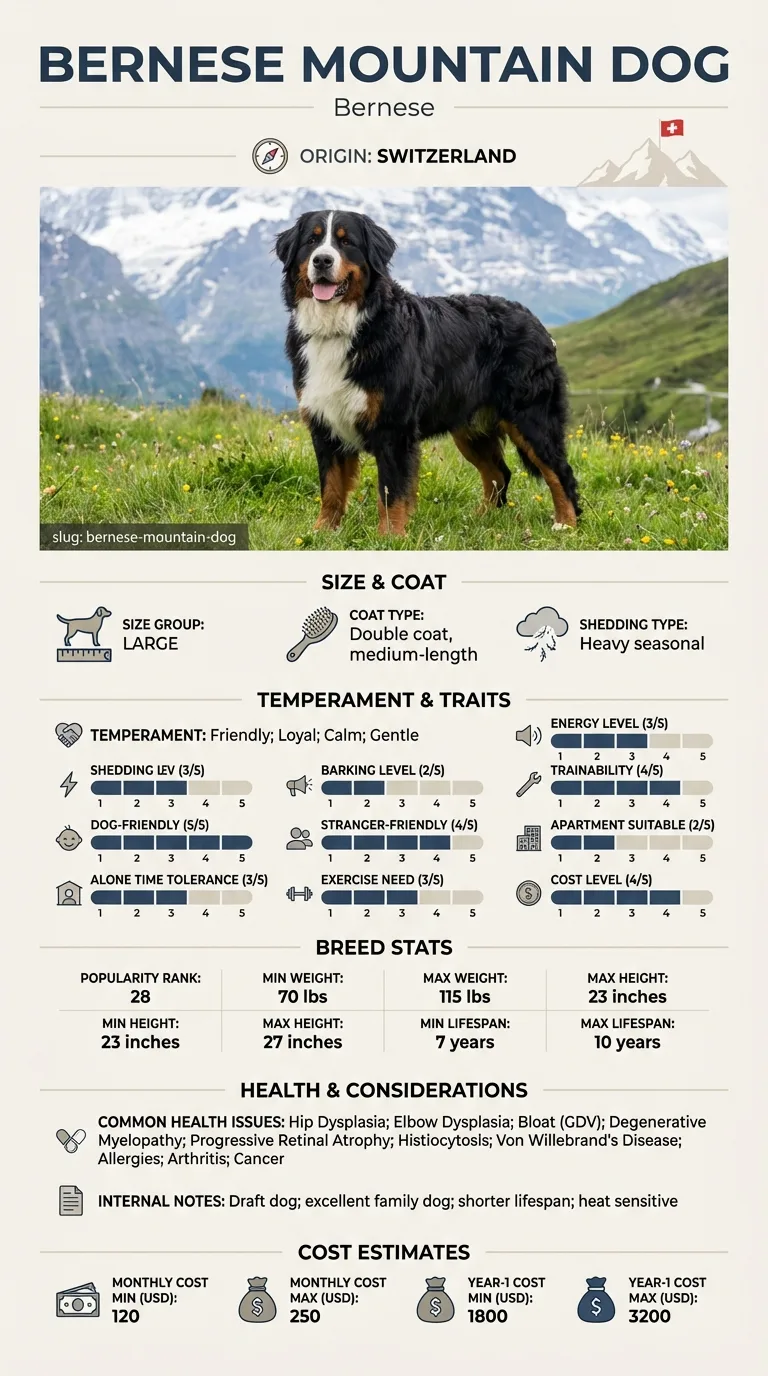
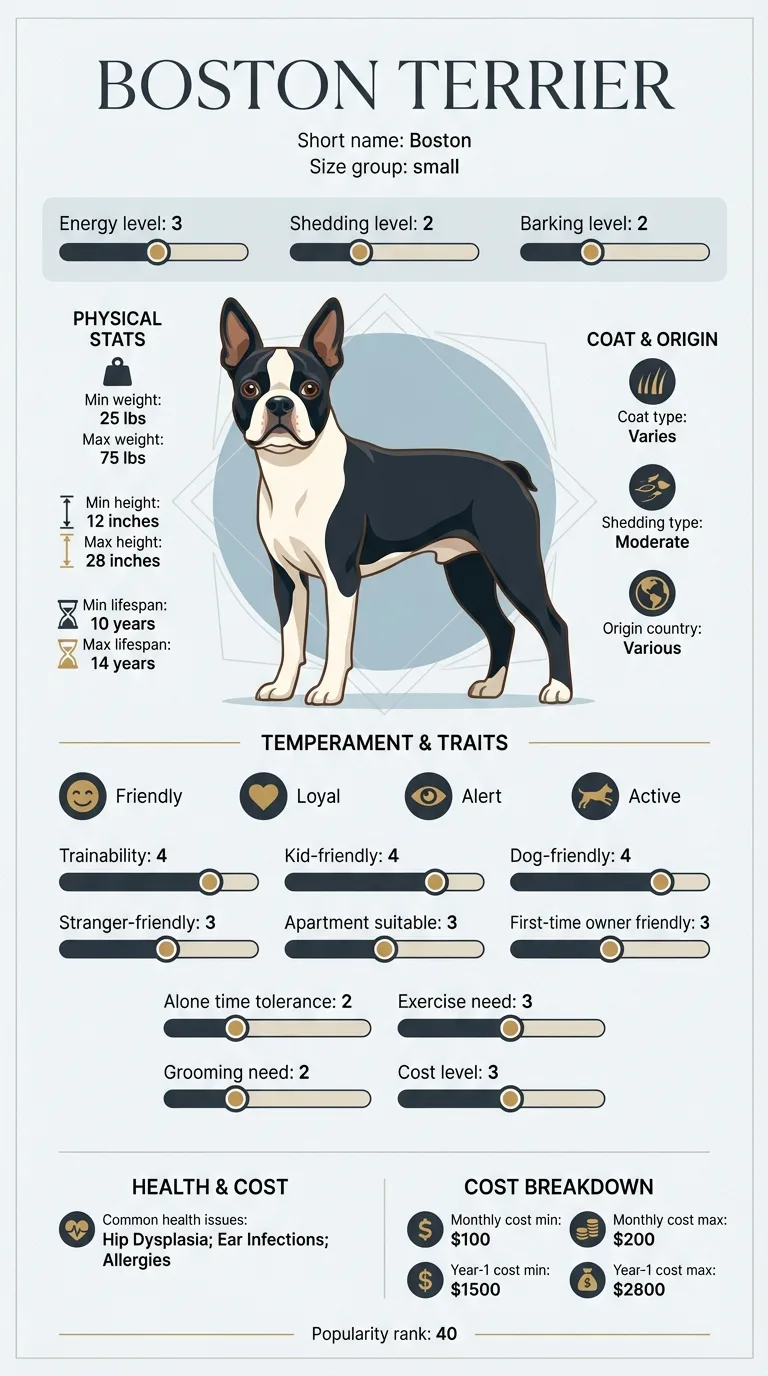
Bernese Mountain Dog or Boston Terrier? On paper they differ most on apartment suitability, and on the scales Bernese Mountain Dog is the heavier at 70–115 lbs. Here is how the two compare on everything that shapes an ordinary week.
This is for someone already down to Bernese Mountain Dog and Boston Terrier and deciding between them. For this pair the decision usually turns on apartment suitability and grooming need, so those are covered first and in most detail. Anyone choosing from a flat has a clear answer here: Boston Terrier rates 5/5 against 2/5. There is no origin story here — only what changes about your week.
Quick verdict
Between Bernese Mountain Dog and Boston Terrier, apartment suitability is what separates them, and Boston Terrier is the lower-effort dog of the two to keep.
Choose bernese mountain dog if...
Choose Bernese Mountain Dog if you already have another dog and you want a dog that can keep up with an active routine.
Choose boston terrier if...
Choose Boston Terrier if you are in a flat or a smaller home, this is your first dog and you do not want a standing grooming appointment.
Head-to-head comparison
Feature
bernese mountain dog
boston terrier
Winner
Size class
large
small
Equal
Weight
70–115 lbs
12–25 lbs
Equal
Height
23–27 in
15–17 in
Equal
Lifespan
7–10 years
11–13 years
boston terrier
Exercise need
Moderate (3/5)
Low (2/5)
boston terrier
Grooming need
Moderate (3/5)
Very low (1/5)
boston terrier
Shedding
High (4/5)
Low (2/5)
boston terrier
Energy level
Moderate (3/5)
Moderate (3/5)
Equal
Barking
Low (2/5)
Low (2/5)
Equal
Apartment suitability
Low (2/5)
Very high (5/5)
boston terrier
Good for first-time owners
High (4/5)
Very high (5/5)
boston terrier
Tolerates being alone
Moderate (3/5)
Moderate (3/5)
Equal
Trainability
High (4/5)
High (4/5)
Equal
Good with kids
Very high (5/5)
Very high (5/5)
Equal
Good with other dogs
Very high (5/5)
High (4/5)
bernese mountain dog
Friendly to strangers
High (4/5)
High (4/5)
Equal
Cost level
High (4/5)
Moderate (3/5)
boston terrier
Coat
Double coat, medium-length
Short and smooth
Equal
Origin
Switzerland
Various
Equal
Typical monthly cost
$120–$250
$80–$150
Equal
Typical first-year cost
$1,800–$3,200
$1,100–$2,300
Equal
Deep dive
Size and build
The size gap is stark -- 70-115 lbs for the Bernese against 12-25 lbs for the Boston Terrier, and 23-27 inches versus 15-17 inches. A Boston Terrier is roughly a quarter the weight of a Bernese at the low end, and closer to a tenth at the high end.
Energy and exercise
Both breeds are relatively easygoing for their categories. The Bernese needs moderate exercise (3/5); the Boston Terrier needs even less (2/5), partly a function of its brachycephalic build limiting how hard it can exert itself, especially in heat. Energy level ties at 3/5 for both.
Grooming and shedding
The Boston Terrier is the low-maintenance choice here -- 1/5 for grooming and 2/5 for shedding, against the Bernese's 3/5 on both. A short, smooth coat versus a double coat makes a real difference in weekly brushing time and how much fur ends up on the couch.
Apartment living, noise and time alone
The Boston Terrier is well suited to small spaces, rated 5/5 for apartment living against the Bernese's 2/5. Barking ties at 2/5 for both, and tolerating time alone ties at 3/5 -- so despite the size gap, neither dog is meaningfully worse company during a workday.
Training and owner experience
Both breeds train at the same 4/5 level, but the Boston Terrier edges ahead as a first-time-owner pick -- 5/5 versus the Bernese's still-solid 4/5. That's a rare case of the smaller, cheaper dog also being the easier one to start with.
Kids, other dogs and visitors
Both breeds tie at 5/5 with kids and 4/5 with strangers, showing genuinely similar social temperaments despite the size difference. The Bernese edges ahead with other dogs (5/5 versus 4/5). Their temperament lists overlap on friendly, though the Bernese's list leans calm and gentle while the Boston Terrier's leans lively and comical -- a real difference in day-to-day energy even at matching activity scores.
Health and lifespan
The Boston Terrier's 11-13 year lifespan beats the Bernese's 7-10, and its health list is shorter -- five conditions centered on its flat-faced build (brachycephalic airway syndrome, corneal ulcers) versus the Bernese's ten, which include cancer and bloat. Both lists deserve attention, but the underlying risk profile differs: breathing and eye issues for one, systemic disease for the other.
Cost to keep
The Bernese costs more across the board -- 4/5 versus 3/5 on the cost scale, $120-250 monthly against $80-150, and $1,800-3,200 in year one compared to $1,100-2,300. A dog five times the size eats, and needs medicating, at a scale to match.
Bernese Mountain Dog vs Boston Terrier at a glance
Bernese Mountain Dog weighs 70–115 lbs and lives 7–10 years; Boston Terrier weighs 12–25 lbs and lives 11–13 years. The two diverge most on apartment suitability, grooming need and shedding. They are level on tolerates being alone, barking and energy level, so those cannot decide it. Where the table declares a winner it means less work for the owner, nothing more; descriptive rows are left as ties on purpose. The value here is in the differences between the two columns; treat any single score as approximate.
Bernese Mountain Dog vs Boston Terrier: Which Suits Your Home? - Bernese Mountain Dog vs Boston Terrier at a glance
Frequently asked questions
How big is a Boston Terrier next to a Bernese?
Much smaller -- 12-25 lbs versus 70-115 lbs. Even a large Boston Terrier is dwarfed by an average Bernese.
Which is easier to groom?
The Boston Terrier, by a wide margin -- a 1/5 grooming need and 2/5 shedding score against the Bernese's 3/5 on both.
Is either a good first dog?
Both work well for first-timers, but the Boston Terrier rates slightly higher -- 5/5 versus the Bernese's 4/5 -- and needs less exercise and grooming to manage day to day.
How do they compare for apartment living?
The Boston Terrier fits small spaces easily (5/5); the Bernese does not (2/5). Size is the deciding factor here.
What will it cost monthly?
$120-250 for the Bernese versus $80-150 for the Boston Terrier, with first-year costs of $1,800-3,200 and $1,100-2,300 respectively.
Do their health risks overlap?
Not much. The Boston Terrier's issues center on its short face and eyes -- airway syndrome, corneal ulcers, cataracts -- while the Bernese's list is longer and includes cancer, bloat, and joint disease.
Which lives longer?
The Boston Terrier, at 11-13 years against the Bernese's 7-10.
The Boston Terrier scores as well or better on nearly every practical measure -- grooming, apartment fit, first-time ownership, cost -- while the Bernese offers a bigger, calmer presence at a higher price and shorter lifespan.
Costs
What's the monthly cost gap?
The Bernese runs $120-250 against the Boston Terrier's $80-150 -- roughly $40-100 more per month.
Training
How much exercise do they need?
Both are moderate to low -- 3/5 for the Bernese, 2/5 for the Boston Terrier -- neither demands intense daily activity.
Health
What's the lifespan difference?
The Boston Terrier's 11-13 years beats the Bernese's 7-10, a meaningful gap for a much smaller dog.
Related DogBreedCompass guides
Bernese Mountain Dog breed guide – Readers comparing the two usually want the full profile of Bernese Mountain Dog before deciding.
Boston Terrier breed guide – The same for Boston Terrier, so the comparison can be checked against the detail.
Health information here is general and is not veterinary advice. If your dog shows pain, sudden behaviour change, or worsening symptoms, consult a licensed veterinarian.
Some links on this site are affiliate links. We may earn a commission at no extra cost to you, and we only suggest products we believe are helpful for dog owners.
We research and check what we publish, but we do not warrant that any figure, date, price, or statement is accurate, complete, or current, and we accept no liability for any loss, cost, injury, or other harm arising from the use of this site. Use it as one reference among several. You remain responsible for your own decisions and for your dog's care - confirm anything that matters with a licensed veterinarian or another qualified professional before you act on it. Full disclaimer.