Health
Does crossing remove MDR1 risk?
Not if the other parent is also a herding breed. The variant is shared across collies, Australian Shepherds, Border Collies and their relatives.

Quick answer
Does crossing remove MDR1 risk?
Not if the other parent is also a herding breed. The variant is shared across collies, Australian Shepherds, Border Collies and their relatives.
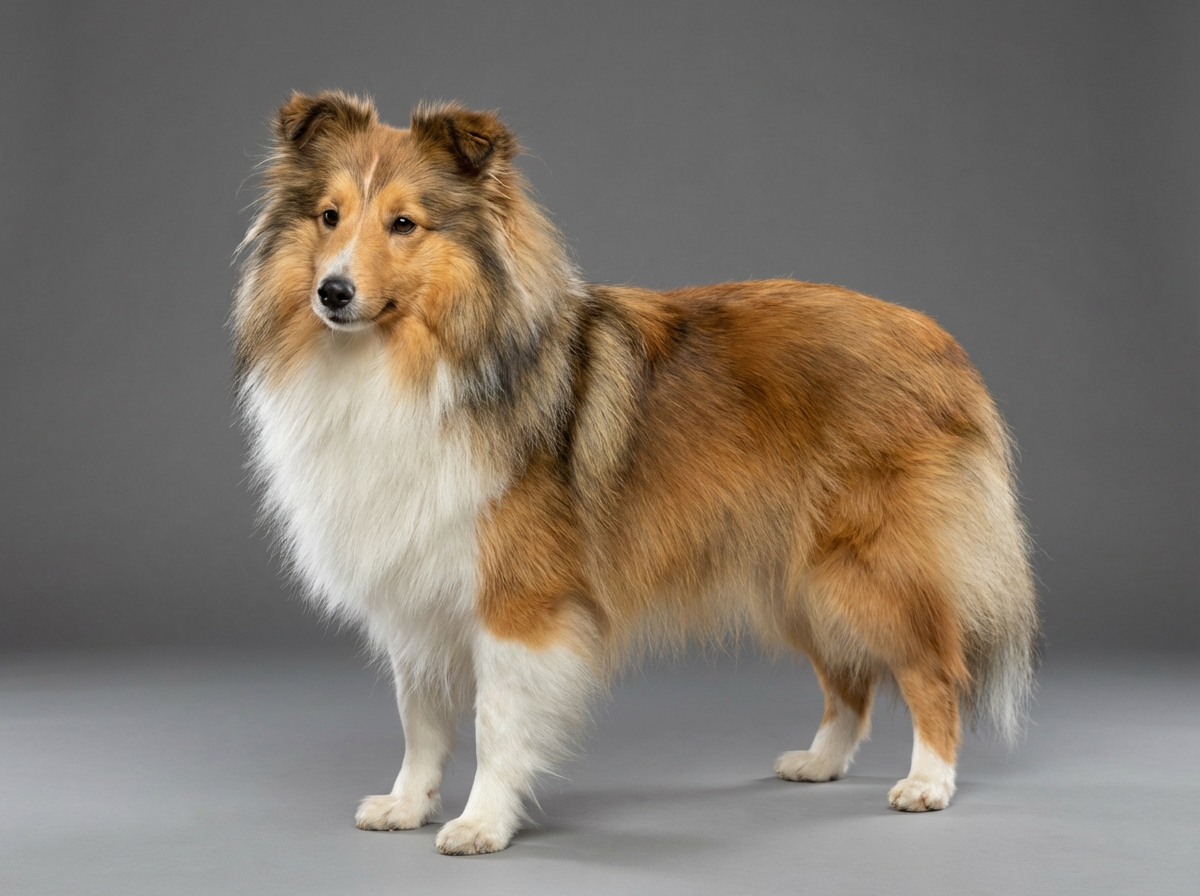
Crossing a Shetland Sheepdog with another herding breed does not remove its most dangerous inherited problem, and may well preserve it.
People choosing between a purebred Sheltie puppy and a Sheltie cross from a rescue or a designer breeder, and owners of Sheltie mixes wondering which of the breed's conditions they should still be watching for.
This guide is not medical advice. If your dog shows pain, sudden behavior change, or worsening symptoms, consult a licensed veterinarian.
Some links may be affiliate links. We may earn a commission at no extra cost to you. We only suggest products we believe are helpful for dog owners.
We research and check what we publish, but we do not warrant that any figure, date, price, or statement is accurate, complete, or current, and we accept no liability for any loss, cost, injury, or other harm arising from the use of this site. Use it as one reference among several. You remain responsible for your own decisions and for your dog's care - confirm anything that matters with a licensed veterinarian or another qualified professional before you act on it. Full disclaimer.
The purebred versus mixed-breed health comparison is usually presented as a single verdict when it is actually a condition-by-condition question. For the Shetland Sheepdog specifically, crossing meaningfully reduces the risk of the recessive conditions concentrated in the collie family, does little for the polygenic ones, and does nothing at all for MDR1 drug sensitivity if the other parent is also a herding breed. Owners meet this as a purchase decision made on bad information.
The belief is close to universal and the reasoning error behind it is equally so. In practical terms, the most consequential version for Shelties and their crosses is the assumption that a mixed-breed dog does not need MDR1 testing, which leads directly to preventable drug reactions in dogs of herding ancestry every year.
The Shetland Sheepdog's health list divides neatly along the lines that make this question answerable. Collie Eye Anomaly and dermatomyositis are concentrated in the collie family, so crossing outside it genuinely helps. Hypothyroidism and patellar luxation are polygenic and widespread, so crossing helps less. MDR1 drug sensitivity is the exception that matters most, because it is shared throughout the herding group, which is precisely the group Shelties are most often crossed with. That single fact overturns the general assumption for this breed.
Most of what determines a dog's health is not its pedigree status. Body weight, dental care, exercise, whether the owner insured it before anything was noted, and whether the correct genetic tests were run all matter more than whether the dog has papers. A well-bred, well-tested purebred with a lean body condition will out-live a poorly bred crossbred that is overweight and untested, and the comparison as usually framed obscures that entirely.
There is no medical urgency attached to a breeding decision, but two conversations are worth booking. First, discuss MDR1 testing for any dog of known or suspected herding ancestry before it needs any medication, sedation or parasite treatment, because the consequence of getting this wrong is a genuine emergency. Second, when you acquire a dog of mixed or uncertain background, ask your vet which screening is appropriate given what the dog appears to be, since a plan built on both likely parent breeds is more useful than one built on either alone. Go urgently only if an untested dog develops neurological signs after any medication, which should be treated as a possible drug reaction.
See all Shetland Sheepdog health problems, which breeds are prone to purebred vs mixed breeds, or the full Shetland Sheepdog breed guide for temperament, exercise needs and ownership costs.
The decision itself takes as long as it takes to gather two sets of health results, usually days. The consequences run the length of the dog's life, which for a Shetland Sheepdog is twelve to fourteen years. MDR1 testing takes two to four weeks to come back and never needs repeating. Expect no version of this choice that removes health risk entirely, because none exists in either direction.
Success is a decision made on specifics: these are the parents' test results, this is what each parent breed is prone to, and this is what has been tested for in this puppy. Whether that ends in a purebred or a cross matters far less than whether the reasoning was condition by condition. And whichever you choose, success includes having the MDR1 answer written on the front of the file.
The genuine mechanism behind hybrid vigour is straightforward and it applies to a specific class of disease. Recessive conditions require two copies of a variant, one from each parent. Within a closed breed population, the same variants circulate at high frequency, so two carriers meeting is common. Cross to an unrelated breed and the second copy is unlikely to be there, so recessive conditions become much less likely to appear.
That is a real effect and it is not trivial. But it comes with three important limits.
The first is that it only works if the two breeds do not share the variant. Cross a Shetland Sheepdog with an Australian Shepherd, a Border Collie, a Rough Collie or a Miniature American Shepherd and you have crossed two populations that share the same ancestry and the same variants. Nothing has been diluted.
The second is that many conditions are not simple recessives. Hip dysplasia, patellar luxation, cancer and most behavioural traits are influenced by many genes plus environment. A cross inherits a blend of both parents' polygenic risk rather than an exemption from it.
The third is that a mix inherits from two breeds, which means two sets of predispositions. A Sheltie crossed with a breed prone to something the Sheltie is not prone to has gained a risk as well as diluted one.
Crossing changes the shape of the risk profile. It does not remove it.
Applied to the Shetland Sheepdog's documented health list, the picture is specific rather than general.

Priyanka adopted a scruffy tricolour mix from a rescue, described as collie cross something, and named her Pepper. She had chosen a mixed breed deliberately, having read that they were healthier, and did not run any testing. At three, Pepper was given a standard parasite treatment and became severely ataxic within thirty six hours. She spent four days on supportive care. The emergency vet asked whether she had been MDR1 tested, and explained that the variant runs through the entire collie and shepherd group and that a mixed-breed dog of that appearance is not protected by being mixed. Pepper's subsequent test came back affected. Priyanka's reflection was that she had used the healthier-mixed-breed idea as a substitute for finding anything out. The one test that would have prevented the whole episode costs less than the food she buys in a fortnight, and nobody, including her, had thought a mixed dog would need it.
Key takeaway: For dogs of herding ancestry, mixed-breed status offers no protection against MDR1 drug sensitivity, because the variant is shared across the whole group. Test the dog in front of you rather than reasoning from a population average.
On average, mixes show lower rates of conditions caused by single recessive variants, because two carriers are less likely to meet. For polygenic conditions, and for anything driven by size and conformation, the difference largely disappears. It is an average effect across populations, not a guarantee about any individual dog.
Yes, and arguably more urgently than a purebred, because nobody will assume it. The variant is common across collies, Australian Shepherds, Border Collies, Old English Sheepdogs, Shelties and their crosses. A dog of unknown herding ancestry that has not been tested should be treated as potentially affected.
Some studies report higher rates of certain cancers in purebred populations, and that is a real finding for specific cancers in specific breeds. It does not translate into a single multiplier that applies to every purebred dog. The Shetland Sheepdog is not a breed defined by cancer risk the way some are.
Not reliably. Herding drive, vocalisation and reserve with strangers are all substantially heritable, and a Sheltie crossed with another working breed is likely to be at least as demanding. Buyers looking for a quieter dog are usually better served by choosing a different breed than by crossing this one.
Exactly what you would ask a Sheltie breeder: MDR1 genotypes for both parents, eye examinations with dates, and evidence of health testing appropriate to both parent breeds. A crossbred litter is not exempt from testing, and a breeder who says hybrid vigour makes testing unnecessary has told you something important.
It makes MDR1 testing more important rather than less, since you cannot rule out herding ancestry. It is the cheapest way to remove a genuinely dangerous unknown from a dog's future medical care, and many rescues will have done it or will support it.
Not if the other parent is also a herding breed. The variant is shared across collies, Australian Shepherds, Border Collies and their relatives.
The recessive ones concentrated in the collie family, chiefly Collie Eye Anomaly and dermatomyositis, and only when crossed outside that family.
Yes. A breeder who cites hybrid vigour as a reason not to test has given you a reason to look elsewhere.
Sometimes, since insurers price partly by breed, but the individual dog's recorded history matters far more than its pedigree status.
Do not count on it. Vocalisation is substantially heritable and crossing with another working breed often preserves it entirely.
A one-page prep sheet for this condition: the signs, the questions to ask, what to get priced. Unlocks here.
You get: Vet visit prep sheet
No spam. One-click unsubscribe. See our privacy policy.
See a sample page before you decide.
Early access list
The free prep sheet covers the same-day warning signs, a symptom log and the questions to ask. We are considering a fuller kit that adds a cost worksheet for the usual tests and treatments (US price ranges with their sources) and a plain-English guide to ways of covering the bill. It is not built yet; this list tells us whether it is worth building.
One email, no spam, unsubscribe anytime. Information only, not veterinary advice.