Health
What does genetic load mean for a dog breed?
The accumulated burden of disease-associated genetic variants built up in a closed-registry population over many generations of limited founders.

Quick answer
What does genetic load mean for a dog breed?
The accumulated burden of disease-associated genetic variants built up in a closed-registry population over many generations of limited founders.
Every purebred dog carries some inherited risk, but not all breeds carry it the same way. Genetic load is the term researchers use for the accumulated burden of disease-associated variants a closed population builds up over generations, and it helps explain why a breed can have several named conditions rather than just one.
Prospective owners trying to understand why this breed's health list looks longer than some others and whether that should change their decision. Breeders navigating test panels and outcrossing debates. Owners of an affected dog wondering whether one diagnosis makes further ones more likely.
This guide is not medical advice. If your dog shows pain, sudden behavior change, or worsening symptoms, consult a licensed veterinarian.
Some links may be affiliate links. We may earn a commission at no extra cost to you. We only suggest products we believe are helpful for dog owners.
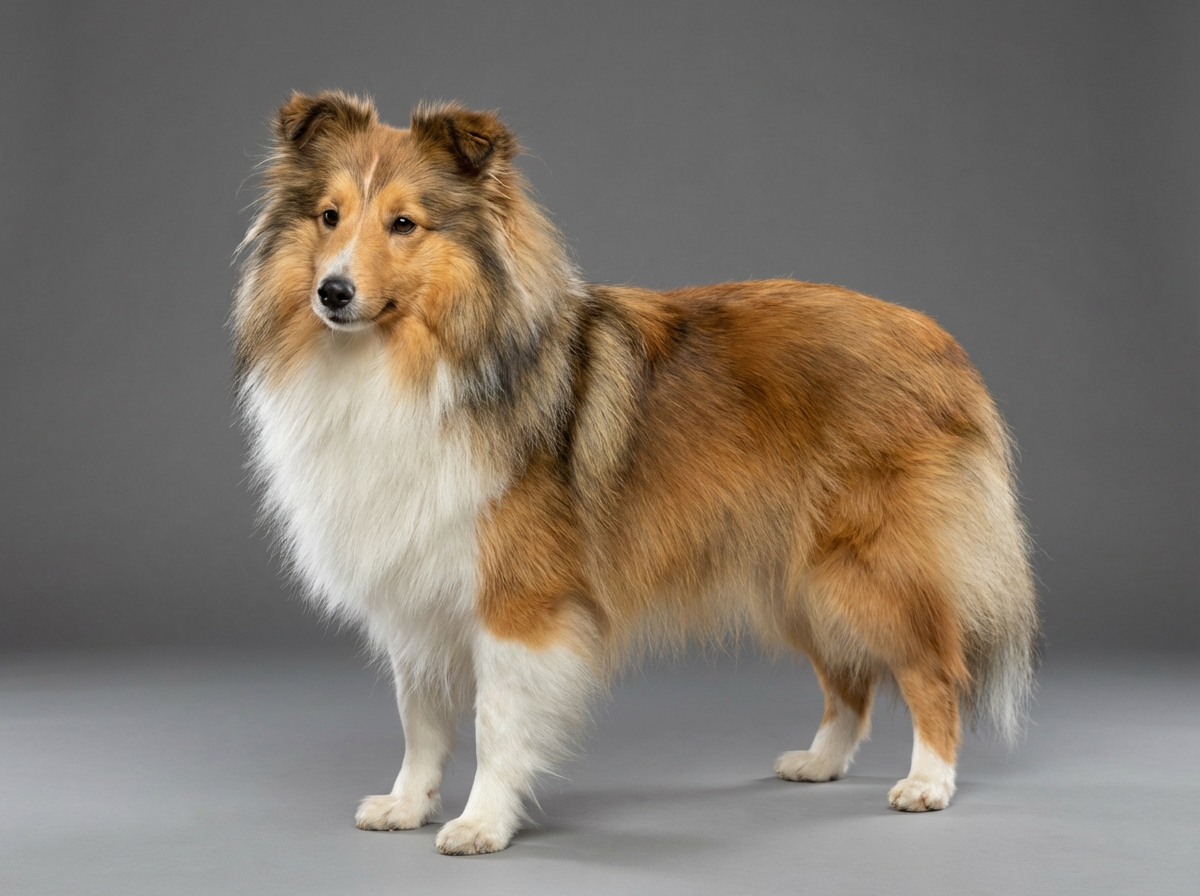
Genetic load describes the accumulated burden of disease-associated genetic variants that a closed-registry breed population builds up over generations from a limited number of founding dogs. The Shetland Sheepdog's five documented conditions, spanning the eyes, drug metabolism, skin and muscle, the thyroid and the joints, are a concrete, testable expression of this broader population genetics concept rather than five unrelated coincidences.
Every closed-registry purebred dog population carries some degree of genetic load; it is a near-universal feature of how modern dog breeds were established. The Shetland Sheepdog's five specifically documented conditions place it among breeds with a reasonably well-characterised and broad health profile, which is arguably an advantage for testing purposes compared with less-studied breeds carrying similar underlying risk that has simply not been identified yet.
The Shetland Sheepdog descends from a relatively small regional population developed in the Shetland Islands and refined through selective breeding for working ability and a specific appearance standard. Like most breeds with this history, its studbook has remained closed for many generations, meaning the current gene pool is a direct, undiluted descendant of a limited founding group. The breed's five documented conditions, Collie Eye Anomaly, MDR1, dermatomyositis, hypothyroidism and patellar luxation, reflect variants that were present in or arose within that founding population and have persisted through recessive inheritance and popular sire effects.
Genetic load itself is not caused or worsened by environment, diet or management, since it is fixed at the level of the breeding population rather than the individual dog's lifestyle. Where environment matters is in whether a given variant becomes clinically expressed: a dog carrying the MDR1 variant is only affected in practice when exposed to a specific drug, and a dog with a mild Collie Eye Anomaly lesion may never show any functional consequence. Breeding practices, specifically whether tested results are used to inform pairings, are the one modifiable environmental factor with real influence over future generations.
This is a background genetics topic rather than a condition with clinical symptoms of its own, so there is no emergency threshold attached to it directly. Do talk to your vet if your dog develops signs consistent with any of the five documented conditions, such as new skin or coat changes, altered gait, or reduced tolerance of standard medications, since early recognition of each individual condition is what actually protects your dog, rather than the population-level concept of genetic load itself. Bring any known DNA panel results to appointments where relevant, particularly before sedation or new medication is prescribed.
See all Shetland Sheepdog health problems, which breeds are prone to genetic load, or the full Shetland Sheepdog breed guide for temperament, exercise needs and ownership costs.
Genetic load is a population-level pattern that changes over dog generations, typically measured in years to decades of consistent testing and selective breeding practice, not something that shifts within one dog's lifetime. For an individual owner, the relevant timeline is simply the DNA panel turnaround, usually two to three weeks, for whichever tests are actually available and relevant.
At the population level, success is a gradual reduction in the frequency of each documented variant as testing becomes standard practice and breeders consistently avoid carrier-to-carrier pairings. At the individual level, success is simply an owner who understands which of the five documented conditions their own dog's parents were tested for, and who is not caught unaware by a diagnosis that could have been anticipated.
None of these mechanisms are unique to the Shetland Sheepdog. They describe how genetic load builds in any closed-registry breed, and the Sheltie's documented five-condition list is a visible, testable result of a process shared with most purebred dogs of similarly sized founding populations.
It is worth being precise about what this concept does and does not tell you. Genetic load describes a population-level pattern, not an individual dog's fate. A specific Shetland Sheepdog puppy might carry none of the five documented variants, all of them as an unaffected carrier, or be clinically affected by one. Population statistics do not predict any single dog, and comparative rankings between breeds vary between studies depending on methodology, sample size and which panel of conditions is counted, so a specific superlative claim about one breed carrying more load than every other studied breed should be treated cautiously rather than as settled fact. What is well established, and directly relevant here, is that the Shetland Sheepdog's own five-condition list is real, documented and testable.
For a breeder, the practical response to genetic load is multi-condition DNA panel testing before every pairing, calculation of the coefficient of inbreeding for a proposed litter rather than relying on pedigree familiarity alone, and a willingness to avoid repeating a popular pairing simply because it produced attractive puppies once. None of the five documented conditions need to appear together in a single dog if breeding decisions actively avoid carrier-to-carrier pairings for each of them individually.
For an owner, the practical response is smaller but still real. Ask a breeder for DNA panel results covering MDR1 and, where available, markers associated with Collie Eye Anomaly, alongside hip and patella screening for the parents. A clear or carrier result for one condition tells you nothing about the others, so a single test is reassuring about a single thing. And a dog testing clear or carrier for every currently available panel is not guaranteed free of every inherited risk, since panels only test for variants that have been identified and mapped, not for every possible inherited condition. Genetic load is reduced generation by generation through deliberate testing and pairing decisions, not eliminated by a single well-tested litter.

Fenella had bred Shelties for over a decade using a well-regarded stud dog whose puppies consistently did well in the show ring. After her third litter from that pairing, she began to notice hypothyroidism turning up in offspring at a higher rate than she expected, alongside one puppy later diagnosed with dermatomyositis. Rather than assume bad luck, she had the stud dog and her own brood bitches run through a full multi-condition panel. The results showed the stud dog carried variants relevant to both conditions. Fenella retired him from that particular pairing line and began selecting future stud dogs specifically to avoid repeating carrier-to-carrier matches for any tested condition, even when a pairing looked attractive on paper. Her next three litters, planned around the panel results rather than show record alone, produced no cases of either condition.
Key takeaway: A popular, otherwise excellent stud dog can still concentrate genetic load across many litters. Testing before pairing, not after a pattern emerges, is what actually interrupts it.
No. It describes a pattern across the breed population, not a prediction for an individual dog. Many Shetland Sheepdogs live full lives without developing any of the five documented conditions, and testing parents before breeding further reduces that risk for their puppies specifically.
Comparative rankings vary by study, methodology and which conditions are counted, so a specific claim of being the single highest of all breeds studied should be treated with caution rather than taken as settled fact. What is well documented is that this breed carries five named inherited conditions, which is a genuinely broad list worth taking seriously on its own terms.
A dog with one copy of a recessive variant, a carrier, shows no signs at all and can pass the variant to half its puppies on average. Without DNA testing, carriers are indistinguishable from clear dogs, which is exactly why the variant can spread through a population for many generations before enough carrier-to-carrier pairings produce visibly affected puppies.
It is a genuine option that some breed health programmes have used successfully for specific single-gene conditions, but it is a significant, multi-generation undertaking requiring careful planning and is not something an individual buyer or casual breeder can achieve. For most owners, panel testing within the existing gene pool is the realistic lever.
That is a personal decision, but it is worth weighing against the fact that responsible testing already exists for several of the breed's documented conditions and meaningfully lowers risk in well-bred litters. A five-condition list with available tests is arguably more manageable than an untested breed with fewer named conditions simply because less research has been done on it.
Not directly through a shared genetic mechanism in most cases, since the five conditions involve different genes and different biological systems. A dog can certainly have more than one by chance, and general immune-related predisposition may modestly link some of the endocrine and skin conditions, but each is inherited and tested largely independently.
Ask for DNA panel results for MDR1 and any available Collie Eye Anomaly marker test, hip and patella screening results for both parents, and whether the pairing avoids carrier-to-carrier matches for any tested condition. Ask to see the documents rather than accepting a verbal assurance.
The accumulated burden of disease-associated genetic variants built up in a closed-registry population over many generations of limited founders.
Five: Collie Eye Anomaly, MDR1 drug sensitivity, dermatomyositis, hypothyroidism and patellar luxation, spanning several different body systems.
Yes, gradually, through DNA panel testing before breeding and avoiding carrier-to-carrier pairings, generation by generation rather than in a single litter.
A multi-condition DNA panel typically costs well under a hundred dollars per dog, modest against the value of avoiding an affected litter.
Not directly. It is a breeding and population concept; a pet owner's practical concern is simply whether their individual dog's parents were properly tested.
A one-page prep sheet for this condition: the signs, the questions to ask, what to get priced. Unlocks here.
You get: Vet visit prep sheet
No spam. One-click unsubscribe. See our privacy policy.
Preview page 1 before you decide.