Behavior
Barks more?
Shetland Sheepdog.

Quick answer
Barks more?
Shetland Sheepdog.
Cavalier King Charles Spaniel or Shetland Sheepdog? On paper they differ most on barking, and on the scales Shetland Sheepdog is the heavier at 15–25 lbs. Here is how the two compare on everything that shapes an ordinary week.
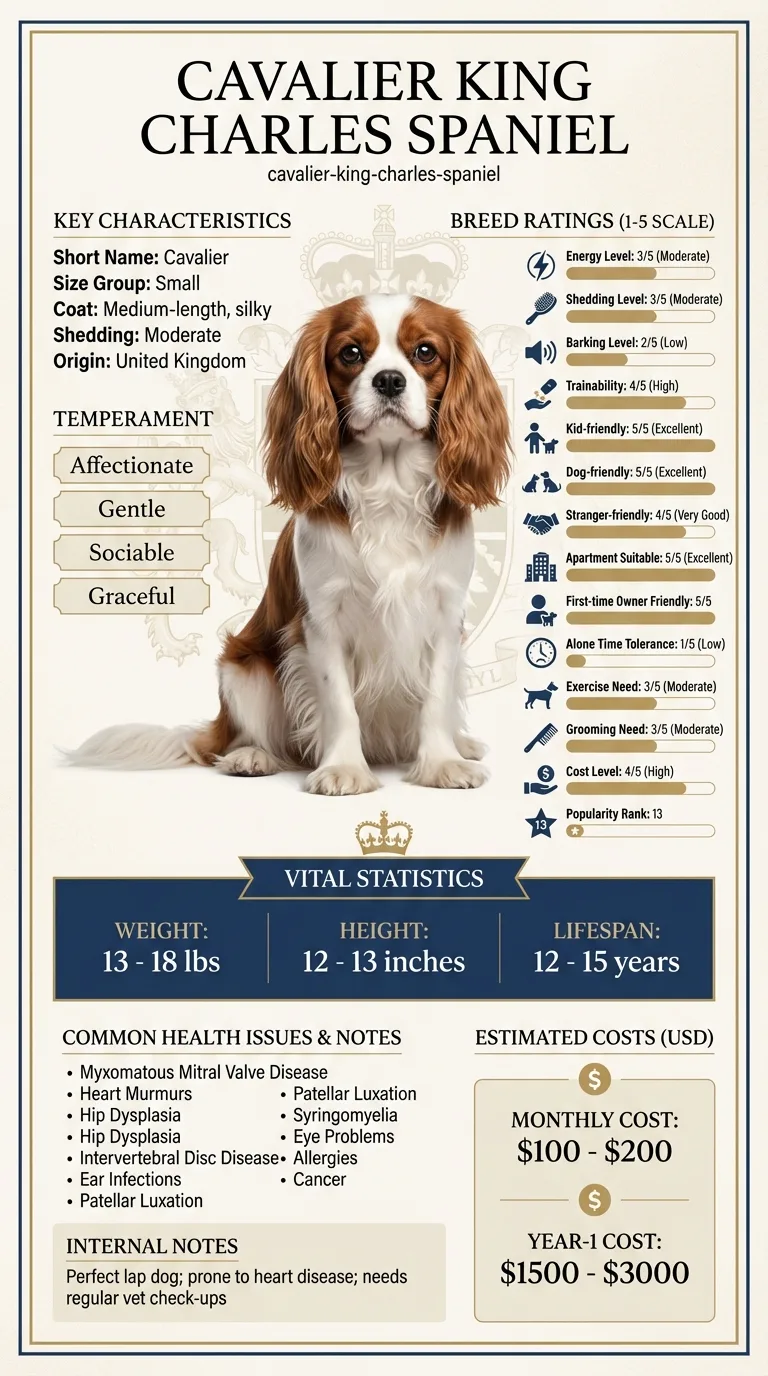
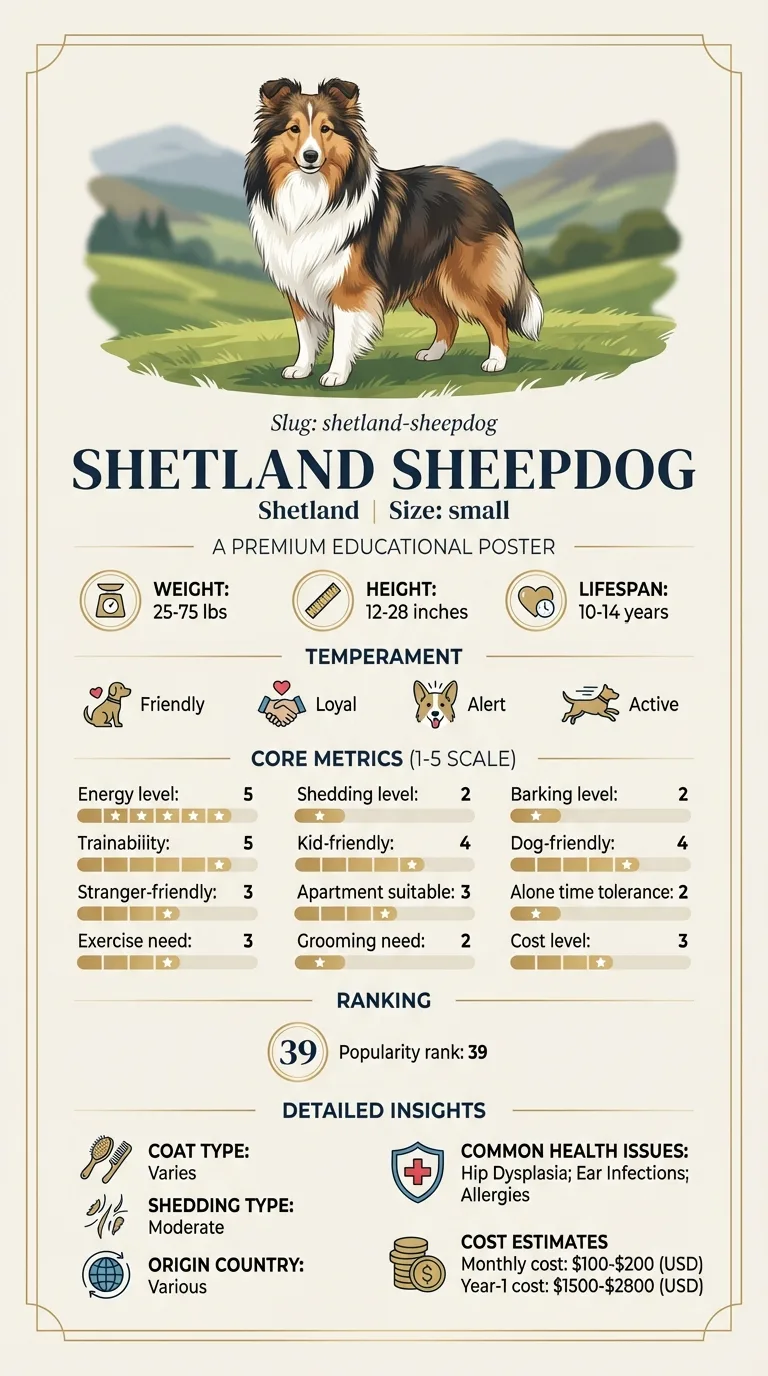
This is for someone already down to Cavalier King Charles Spaniel and Shetland Sheepdog and deciding between them. For this pair the decision usually turns on barking and apartment suitability, so those are covered first and in most detail. Anyone choosing from a flat has a clear answer here: Cavalier King Charles Spaniel rates 5/5 against 3/5. The focus throughout is on daily consequences rather than breed background.
Between Cavalier King Charles Spaniel and Shetland Sheepdog, barking is what separates them, and Cavalier King Charles Spaniel is the lower-effort dog of the two to keep.
Choose Cavalier King Charles Spaniel if you are in a flat or a smaller home, this is your first dog and you do not want a standing grooming appointment.
Choose Shetland Sheepdog if you want a dog that picks up training quickly, you want a dog that can keep up with an active routine and you want a dog that is more watchful with visitors.
| Feature | cavalier king charles spaniel | shetland sheepdog | Winner |
|---|---|---|---|
| Size class | small | small | Equal |
| Weight | 13–18 lbs | 15–25 lbs | Equal |
| Height | 12–13 in | 13–16 in | Equal |
| Lifespan | 12–15 years | 12–14 years | cavalier king charles spaniel |
| Exercise need | Moderate (3/5) | High (4/5) | cavalier king charles spaniel |
| Grooming need | Moderate (3/5) | High (4/5) | cavalier king charles spaniel |
| Shedding | Moderate (3/5) | High (4/5) | cavalier king charles spaniel |
| Energy level | Moderate (3/5) | High (4/5) | Equal |
| Barking | Low (2/5) | Very high (5/5) | cavalier king charles spaniel |
| Apartment suitability | Very high (5/5) | Moderate (3/5) | cavalier king charles spaniel |
| Good for first-time owners | Very high (5/5) | High (4/5) | cavalier king charles spaniel |
| Tolerates being alone | Very low (1/5) | Low (2/5) | shetland sheepdog |
| Trainability | High (4/5) | Very high (5/5) | shetland sheepdog |
| Good with kids | Very high (5/5) | High (4/5) | cavalier king charles spaniel |
| Good with other dogs | Very high (5/5) | High (4/5) | cavalier king charles spaniel |
| Friendly to strangers | High (4/5) | Low (2/5) | cavalier king charles spaniel |
| Cost level | High (4/5) | Moderate (3/5) | shetland sheepdog |
| Coat | Medium-length, silky | Long, dense double coat | Equal |
| Origin | United Kingdom | Various | Equal |
| Typical monthly cost | $100–$200 | $80–$150 | Equal |
| Typical first-year cost | $1,500–$3,000 | $1,100–$2,300 | Equal |
These two sit close in the small-breed range - 13-18 lbs and 12-13 inches for the Cavalier against 15-25 lbs and 13-16 inches for the Shetland Sheepdog - so size alone won't decide much here. The Sheltie's build reflects its herding-dog ancestry: a long, dense double coat and an athletic frame built for working sheep on rough Scottish terrain, versus the Cavalier's softer, companion-bred physique. Anyone picturing a miniature collie has the right idea; the Sheltie looks and moves like a working herder shrunk down, not simply a small dog in the Cavalier's mold.
Exercise need favors the Cavalier, Moderate (3/5) against High (4/5) for the Shetland Sheepdog, whose bright, devoted herding instincts need real daily activity - long walks, fetch, or ideally structured activities like agility. A Sheltie that doesn't get enough mental and physical stimulation tends to redirect that herding drive toward chasing cars, joggers, or kids, which is a behavior pattern worth planning around from day one. The Cavalier's lower energy ceiling means it's satisfied with less, but a Sheltie owner who enjoys an active lifestyle will find the breed a genuinely engaged partner.
Grooming and shedding both favor the Cavalier here, Moderate (3/5) against High (4/5) for the Shetland Sheepdog on each count. The Sheltie's long, dense double coat requires more frequent brushing to prevent matting, especially during seasonal blow-outs, and produces noticeably more loose fur around the house than the Cavalier's medium-length coat. Owners drawn to the Sheltie's beautiful coat should be honest with themselves about the multiple-times-a-week brushing commitment it demands, particularly compared to the Cavalier's more forgiving weekly routine.
Barking is the standout difference: Low (2/5) for the Cavalier against Very high (5/5) for the Shetland Sheepdog, a vocal, sensitive breed that tends to bark at movement, sound, and pretty much anything it perceives as out of place. Apartment suitability follows suit, Very high (5/5) against Moderate (3/5), and thin walls or close neighbors make a Sheltie's barking tendency a real practical concern. Tolerating time alone actually favors the Sheltie slightly, Low (2/5) against the Cavalier's Very low (1/5), but neither breed is well suited to being left alone for long stretches.
Trainability favors the Shetland Sheepdog, Very high (5/5) against High (4/5) for the Cavalier, and its bright, herding-bred intelligence makes it one of the most consistently trainable breeds around. Suitability for first-time owners still tilts toward the Cavalier, Very high (5/5) against High (4/5), because the Sheltie's sensitivity means it responds poorly to harsh corrections and needs a gentle, patient training style to thrive. A first-time owner who researches positive-reinforcement methods can absolutely succeed with a Sheltie, but the margin for training missteps is narrower than with the more forgiving Cavalier.
Good with kids and other dogs both favor the Cavalier, Very high (5/5) against High (4/5) for the Shetland Sheepdog on each measure, and friendly-to-strangers shows the widest gap of all - High (4/5) for the Cavalier against Low (2/5) for the Sheltie. That reserve toward strangers tracks with the Sheltie's sensitive, devoted-to-family temperament; it tends to bond tightly with its own household while staying watchful and vocal around unfamiliar people. Families wanting a dog that instantly welcomes every visitor lean Cavalier; those fine with a more reserved greeter get a fiercely loyal companion in the Sheltie.
Lifespan slightly favors the Cavalier, 12-15 years against 12-14 for the Shetland Sheepdog, though both ranges overlap substantially. The Sheltie's health list is distinctive: Collie Eye Anomaly and MDR1 Drug Sensitivity are conditions specific to collie-type breeds, the latter meaning certain common medications can cause severe reactions and must be flagged to any vet treating the dog. The Cavalier's risks instead center on Myxomatous Mitral Valve Disease, heart murmurs, and syringomyelia. Both breeds share patellar luxation risk, but a Sheltie owner in particular should keep an MDR1 test result on file for emergencies.
Cost level favors the Shetland Sheepdog, Moderate (3/5) against High (4/5) for the Cavalier, with monthly costs of $80-150 versus $100-200 and first-year costs of $1,100-2,300 versus $1,500-3,000. Some of the Cavalier's higher baseline reflects its greater predisposition toward cardiac screening as it ages, an ongoing cost category the Sheltie's health profile doesn't carry to the same degree. A Sheltie owner's costs instead lean toward genetic testing for MDR1 sensitivity and eye conditions early on, plus grooming supplies for that dense coat.
Cavalier King Charles Spaniel weighs 13–18 lbs and lives 12–15 years; Shetland Sheepdog weighs 15–25 lbs and lives 12–14 years. The two diverge most on barking, apartment suitability and friendly to strangers. Almost every rated axis separates them at least slightly. The table below marks a winner only where one breed is genuinely easier for a typical owner; size and origin are facts rather than merits and stay level. Ratings come from one source applied to both breeds, so they are meaningful against each other rather than as absolute scores.

The Shetland Sheepdog by a wide margin - Very high (5/5) against the Cavalier's Low (2/5).
Workable but vocal - they rate Moderate (3/5) for apartment suitability against the Cavalier's Very high (5/5).
The Sheltie, rated Very high (5/5) against High (4/5) for the Cavalier, thanks to its herding-bred intelligence.
Not especially - they rate Low (2/5) against the Cavalier's High (4/5) and tend to be more reserved with unfamiliar people.
A genetic condition found in collie-type breeds, including the Sheltie, that can cause severe reactions to certain common medications - worth flagging to any vet treating the dog.
The Sheltie, rated High (4/5) against the Cavalier's Moderate (3/5), due to its long, dense double coat.
The Sheltie, with a cost level of Moderate (3/5) against High (4/5) for the Cavalier.
Shetland Sheepdog.
Shetland Sheepdog.
Cavalier King Charles Spaniel.
Shetland Sheepdog.
Secure checkout on Stripe. We never see your card.
7-day money-back guarantee. Instant access.
Health information here is general and is not veterinary advice. If your dog shows pain, sudden behaviour change, or worsening symptoms, consult a licensed veterinarian.
Some links on this site are affiliate links. We may earn a commission at no extra cost to you, and we only suggest products we believe are helpful for dog owners.
We research and check what we publish, but we do not warrant that any figure, date, price, or statement is accurate, complete, or current, and we accept no liability for any loss, cost, injury, or other harm arising from the use of this site. Use it as one reference among several. You remain responsible for your own decisions and for your dog's care - confirm anything that matters with a licensed veterinarian or another qualified professional before you act on it. Full disclaimer.
Match your lifestyle to the right dog.
Take quizNot sure which breed is right for you? Take our 2-minute quiz to find out.
Take the quiz