Health
What is the earliest change in a working Sheltie's heart health?
Slower recovery after a fixed effort, measured in the minutes afterwards rather than during the work itself.

Quick answer
What is the earliest change in a working Sheltie's heart health?
Slower recovery after a fixed effort, measured in the minutes afterwards rather than during the work itself.
A Sheltie will keep running for you long after a sensible dog would have sat down. That loyalty is exactly the diagnostic problem.
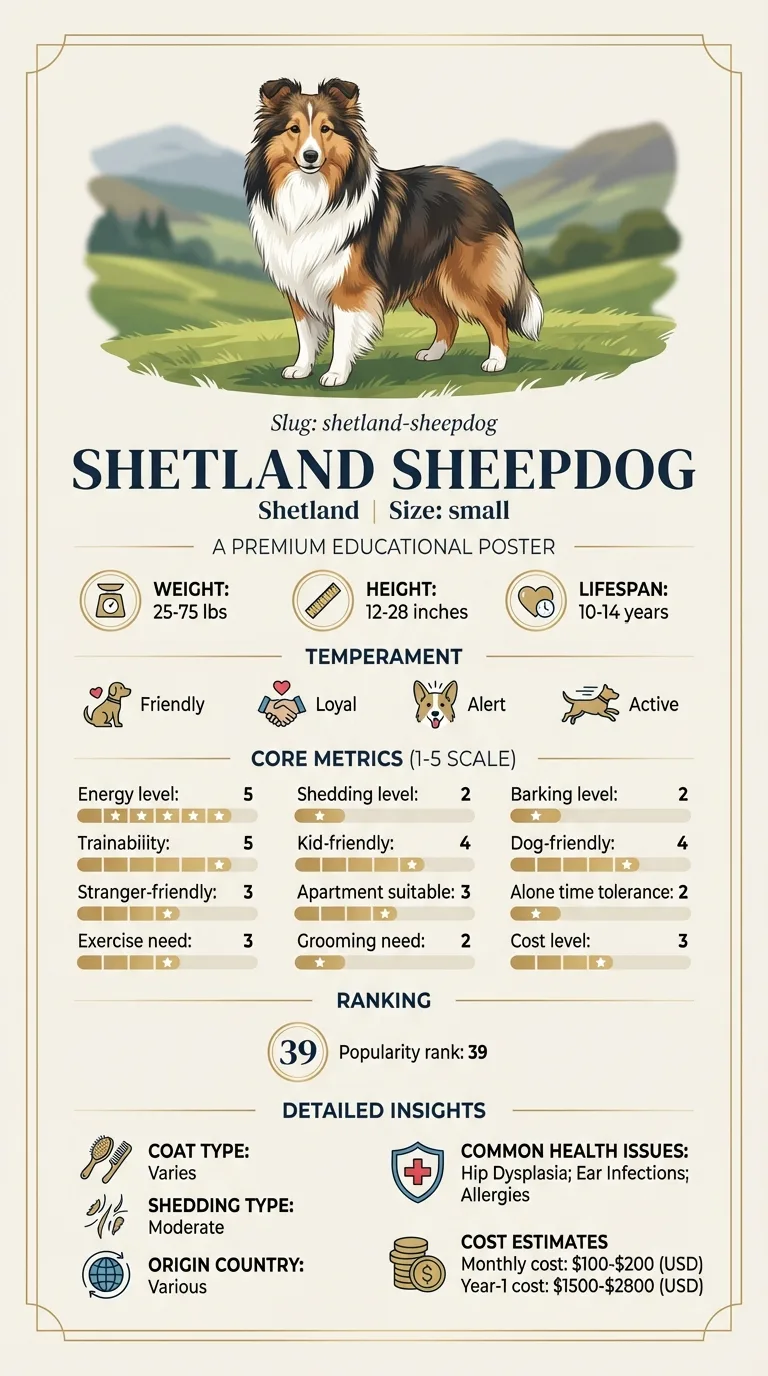
Handlers and active owners whose Sheltie has started dropping half a second on familiar courses, or lagging on the second half of a hike, and who cannot tell whether that is age, heat, fitness or the heart.
This guide is not medical advice. If your dog shows pain, sudden behavior change, or worsening symptoms, consult a licensed veterinarian.
Some links may be affiliate links. We may earn a commission at no extra cost to you. We only suggest products we believe are helpful for dog owners.
In an active Shetland Sheepdog, heart problems rarely announce themselves as obvious illness. They show up as a gradual loss of quality in work the dog still wants to do: slower recovery between efforts, wider turns, a lag on the way home. Because the breed's drive overrides fatigue and its coat produces heat symptoms that look identical, owners routinely attribute the change to age for a year or more before anyone examines the heart.
Genuine cardiac limitation in a young or middle-aged Sheltie is uncommon. Performance decline in the same dog is very common, and most of it turns out to be thyroid, orthopaedic, weight or heat. The value of the cardiac question is in ruling it out early rather than assuming it.
Two breed traits collide here. The Shetland Sheepdog's high energy and high trainability produce a dog that will work through discomfort to keep the handler engaged, so the usual behavioural warning of self-limiting simply does not appear. Its long, dense double coat then loads the same cardiovascular system with a thermal burden during every session. Neither of those is heart disease, but both distort what heart disease looks like when it eventually arrives in an older dog.
Session design and climate do most of the damage. Repeated short bursts with inadequate recovery, trials held on hot afternoons, travel in a warm crate, and grass surfaces that hold heat all push a coated dog toward its limit. Fitness matters in the other direction: a conditioned Sheltie recovers faster, which widens the gap between a normal reading and an abnormal one and makes the home measurement more sensitive.
Treat as an emergency and go straight in: collapse or fainting during or after exercise, gums that go grey, blue or brick red, breathing that stays fast and effortful long after the dog should have cooled down, or any dog that seems disoriented after a run. Heatstroke and rhythm disturbances both live in that list and both kill. Book within the week: a persistent change in recovery times across several comparable sessions, a new reluctance to start work the dog previously loved, or a cough that appears after exertion. Ask specifically for auscultation, a thyroid panel and an orthopaedic exam together, because the three most common explanations sit in three different systems.
See all Shetland Sheepdog health problems, which breeds are prone to heart problems, or the full Shetland Sheepdog breed guide for temperament, exercise needs and ownership costs.
Building a usable recovery baseline takes about a month of ordinary sessions. If a change is real, it will usually persist across three or four comparable outings rather than appearing once. Investigating a decline is typically one appointment for bloods and examination and, if needed, one more for imaging. Where a genuine cardiac limit is found, adapting the dog's competition schedule is a matter of a season rather than an overnight retirement.
Success is a working Sheltie whose five-minute recovery number this year looks like last year's, and an owner who would notice within a fortnight if it did not. It is not a dog that never slows down; a twelve to fourteen year lifespan guarantees decline eventually. It is knowing which decline you are watching, and being the one who chooses when the dog stops rather than letting the dog's willingness make that call.
Most dogs self-limit. They slow down, they lie in shade, they refuse the next repetition. A Sheltie with a strong working temperament often does not, because the reward of the work outweighs the discomfort until the discomfort is severe.
So the early signs do not look like refusal. They look like small losses of quality. A tighter turn that has gone wide. A recovery between runs that used to take one minute and now takes three. A dog that used to lead on the walk home and now trails. None of that reads as illness, and all of it is data.
The second complication is the coat. A dense double coat means a working Sheltie runs hot, and heat produces the same picture as a struggling heart: heavy panting, slow recovery, reluctance in the second half of a session. Separating the two requires the same session done in cool conditions, which is a test you can actually run yourself.
The most useful home metric for an active Sheltie is not how hard the dog can go, it is how quickly it comes back down.
Pick a fixed effort you can repeat: a set number of retrieves, a known hill, one course at a familiar height. Straight afterwards, put a hand on the chest and count the heartbeat for fifteen seconds. Then count it again at two minutes and at five. Write the three numbers down alongside the temperature and humidity.
Do this a handful of times while the dog is well, and you own a baseline that nobody else has. A dog whose five-minute number begins to sit higher across several sessions, in comparable weather, is a dog that has changed. That is worth a vet visit before the dog ever misses a jump.
The other thing to record is anything that looks like a wobble, a stagger or a brief collapse after effort. In an athletic dog those episodes are the single most important thing to describe accurately, and they belong on video.

Marta's Sheltie, Fen, was seven and had been consistent in agility for four seasons. Over one winter he started finishing courses about half a second slower and taking noticeably longer to stop panting afterwards. Marta assumed his heart, partly because a clubmate's dog had recently been diagnosed with a murmur. Her vet listened, found nothing, and ran a broader panel anyway. Fen's thyroid was low. His coat had also been thinning along the flanks, which Marta had put down to a bad moult. On replacement therapy his recovery times came back within about ten weeks, and by spring his run times were what they had been. The heart was never the problem. What Marta kept was the habit. She still counts his pulse at five minutes after the second run of every training night and writes it on her phone, because now she knows what his normal looks like written down.
Key takeaway: In a Sheltie, exercise intolerance is a symptom with several plausible owners, and the thyroid is a documented one. Measure recovery, then let the vet work through the list rather than starting at the scariest item.
No. The documented conditions for this breed are Collie Eye Anomaly, MDR1 drug sensitivity, dermatomyositis, hypothyroidism and patellar luxation. Cardiac disease in Shelties is the ordinary small-dog kind, arriving with age rather than inheritance.
The heart is one candidate among several. Hypothyroidism, which is documented in this breed, produces exactly this picture and is a cheap blood test. So does an unnoticed knee or a couple of extra pounds. Ask for the thyroid panel and the orthopaedic exam alongside any cardiac question.
Repeat the same effort on a cool morning. If the dog recovers normally in the cold and poorly in the heat, the coat and the weather are your answer. If the recovery is poor regardless of conditions, that points elsewhere and needs investigating.
Not automatically. Many stay sound into double figures at lower jump heights. Retirement should follow evidence, meaning a specific finding or a genuine change in recovery, not a birthday. Dropping height and course length usually comes before stopping altogether.
It means an urgent appointment and a video. Post-exercise collapse can come from rhythm disturbances, from heat, from low blood sugar or from neuromuscular causes, and they are managed completely differently. Do not repeat the activity until someone has looked.
Very much, and not only for cardiac work. A dog that travels to trials picks up more parasite exposure, more injuries and more sedated procedures than a house pet. Knowing the genotype before you need it is basic risk management in this breed.
Slower recovery after a fixed effort, measured in the minutes afterwards rather than during the work itself.
Yes. Hand flat on the left chest just behind the elbow, count for fifteen seconds, multiply by four. Do it when the dog is well so you know normal.
A high-drive adult wants an hour or more of real activity daily plus mental work. Cutting that without a medical reason usually creates behaviour problems.
An annual auscultation is sensible for any Sheltie, and for a competing dog it is worth booking deliberately rather than hoping it happens at vaccination time.
No. This breed will comply past its limit because it wants to work, so the handler has to be the one who stops the session.
A one-page prep sheet for this condition: the signs, the questions to ask, what to get priced. Unlocks here.
You get: Vet visit prep sheet
No spam. One-click unsubscribe. See our privacy policy.
Preview page 1 before you decide.