Health
What is the classic sign of a liver shunt in a puppy?
Poor growth combined with neurological dullness, circling or head pressing an hour or two after a meal.

Quick answer
What is the classic sign of a liver shunt in a puppy?
Poor growth combined with neurological dullness, circling or head pressing an hour or two after a meal.
The classic picture is a puppy that is smaller than its littermates and seems oddly vacant an hour after eating.
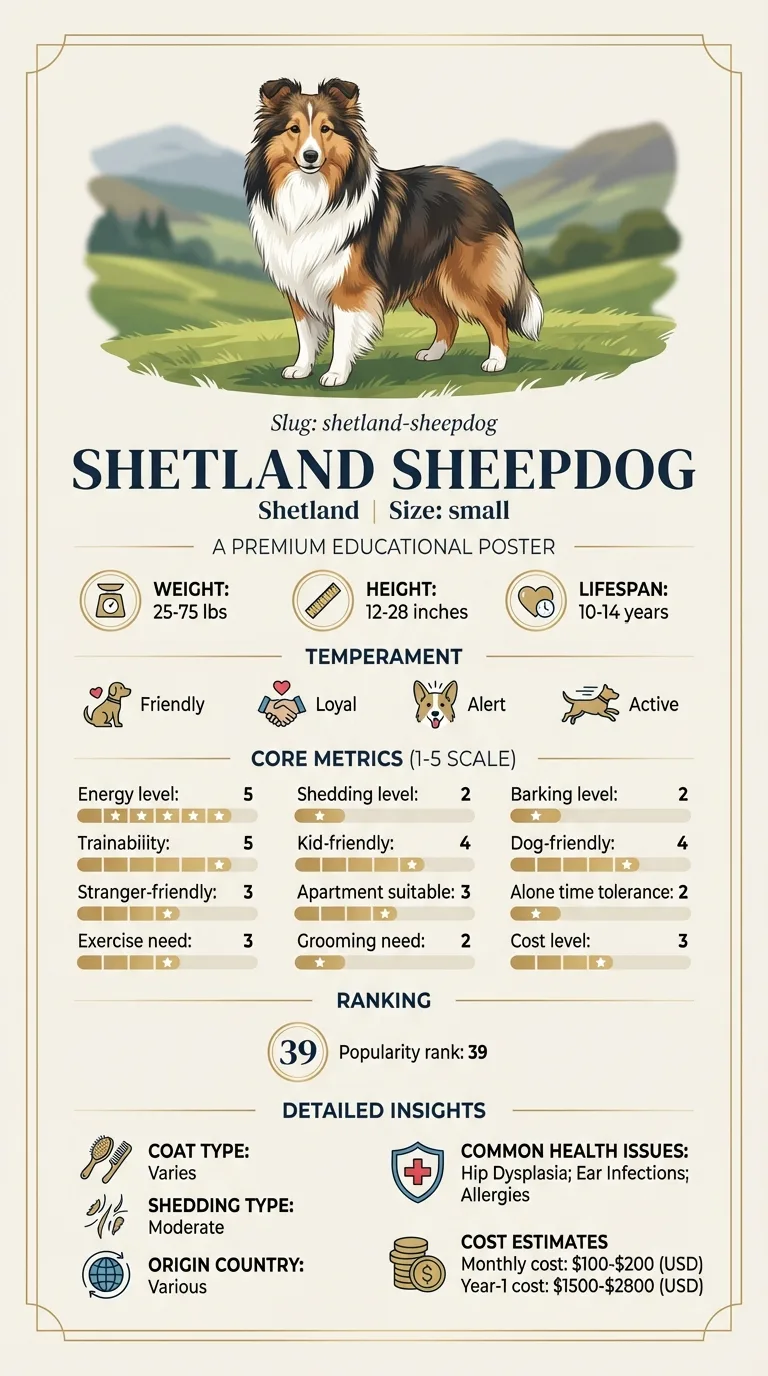
Owners of a young Sheltie that has never grown properly, recovers strangely slowly from sedation, or has episodes of staring at walls, circling or wobbling that come and go around mealtimes.
This guide is not medical advice. If your dog shows pain, sudden behavior change, or worsening symptoms, consult a licensed veterinarian.
Some links may be affiliate links. We may earn a commission at no extra cost to you. We only suggest products we believe are helpful for dog owners.
A portosystemic shunt is an abnormal vessel that routes blood from the digestive tract around the liver rather than through it, so toxins from digestion reach the brain unfiltered. In Shetland Sheepdogs it is uncommon. Where it occurs it is usually congenital and shows in the first year as a puppy that fails to grow properly and becomes dull, wobbly or disoriented an hour or two after eating. Life with a shunt dog is dominated by diet discipline.
Uncommon in this breed. Congenital shunts are concentrated in a handful of small breeds, particularly Yorkshire Terriers and Maltese, and the Shetland Sheepdog is not among the classic ones. It nonetheless belongs on the list for any Sheltie puppy that is failing to thrive, because the screening test is cheap and the consequences of missing it are severe.
There is no documented predisposition to portosystemic shunts in the Shetland Sheepdog, and the honest breed connection here is not to the disease but to its management. MDR1 drug sensitivity means this breed already handles certain drug classes abnormally, and a shunt independently impairs the liver's ability to clear drugs. A Sheltie with both faces a genuinely constrained anaesthetic and prescribing situation, and the two are easy to confuse with one another because both can present as an odd reaction to a routine medication.
The vessel itself is congenital and nothing in the environment causes it. What the environment controls entirely is how often the dog becomes symptomatic. Protein load is the main lever, which makes food, treats, scavenged scraps and visitors with good intentions the practical daily risks. Constipation and dehydration both worsen toxin absorption. In a household with children or other pets, keeping a shunt dog's diet genuinely exclusive takes real organisation.
Go immediately, as an emergency: seizures, collapse, persistent head pressing, blindness that has come on suddenly, or a dog that cannot be roused properly. These represent a severe encephalopathic crisis and need treatment now. Also go the same day for repeated vomiting or any sign of gastrointestinal bleeding, such as black tarry stools, because bleeding into the gut floods the system with protein and can trigger a crisis. Book within days: a puppy that is not growing, that seems dull after meals, that drinks excessively, or that recovered strangely from a routine sedation. Ask for a paired bile acid test by name, and mention that the dog is a Shetland Sheepdog with a possible MDR1 issue.
See all Shetland Sheepdog health problems, which breeds are prone to liver shunts, or the full Shetland Sheepdog breed guide for temperament, exercise needs and ownership costs.
Medical stabilisation usually produces noticeable improvement within one to two weeks, and owners often describe the puppy waking up. Imaging and surgical planning follow over several weeks. Surgical closure is deliberately gradual, and full redirection of blood flow through the liver takes weeks to months, with liver function improving over that period. Dogs managed medically need indefinite diet and medication with monitoring bloodwork every few months for life.
For a surgical case, success is a dog that catches up in size, comes off medication and eats a normal diet, which does happen with single extrahepatic shunts operated well. For a medically managed dog, success is a stable weight, no encephalopathic episodes for months at a time, and a household that has made the diet routine rather than a daily battle. In both cases it is a dog that behaves like a dog rather than a patient.
The liver is the body's filter. When blood skips it, toxins from digestion reach the brain, and the resulting picture is called hepatic encephalopathy. Because it is driven by digestion, the signs wax and wane with feeding.
Suspicion usually arises from routine bloodwork in a poorly grown puppy: low urea, low protein, small red blood cells, mildly raised liver values. The specific test is a paired bile acid measurement, taken fasted and then two hours after a meal, which reveals whether the liver is extracting what it should. An ammonia level can support the picture.
Confirming where the shunt is, and whether it is a single vessel outside the liver or a network inside it, needs imaging. Ultrasound in experienced hands, then a CT angiogram in most referral settings. That imaging requires general anaesthesia, and here two problems compound each other in a Shetland Sheepdog.
A dog with a shunt already clears drugs poorly, because the liver is the organ doing the clearing. On top of that, MDR1 drug sensitivity is documented in this breed, which independently changes how certain agents behave. An anaesthetist facing both needs to know about both, and the genotype should be tested and recorded before the dog is booked in.
Treatment is medical first, with a specific diet and medication to reduce the production and absorption of gut toxins, and then surgical in suitable cases, where the shunting vessel is gradually closed off so blood is redirected through the liver. Single vessels outside the liver have the best surgical outlook. Networks inside the liver are usually managed medically for life.

If you think your Shetland has liver shunts, the plan is three steps: write down what you have seen and when it started, book a veterinary appointment rather than waiting for the next flare, and take video of the behaviour or symptom before you go — the thing you are worried about rarely happens in the consulting room. Screening in the parents covers collie eye anomaly, mdr1 drug sensitivity, dermatomyositis.
What the vet visit should produce is a diagnosis and a written plan, not just reassurance: what is being ruled out, what the monitoring interval is, and which signs mean you come back sooner. Ask what the treatment costs across a year rather than per visit, because that is the number that decides whether you are managing this condition or reacting to it.
Between appointments, keep a short log — dates, what you saw, what changed. It is the single most useful thing an owner brings to a follow-up, and for liver shunts it is often what separates a clear pattern from a guess.
Marcus took the smallest puppy in the Sheltie litter, which his breeder described as a slow starter, and thought little of it. At five months Elliot was still noticeably undersized and had a habit of going glassy-eyed on the sofa after supper, which Marcus interpreted as a full belly and a sleepy dog. What forced the issue was his neuter. Elliot took most of a day to come round properly, and the vet flagged it. Bloodwork showed low urea and low protein, and a paired bile acid test came back markedly abnormal. A CT angiogram at a referral centre, with an anaesthetic protocol chosen around both his liver and a carrier MDR1 result, found a single vessel outside the liver. He had it gradually closed surgically at seven months. Elliot grew four centimetres in the following six months and came off his medication at a year. He is now a fully normal three-year-old who eats ordinary food. Marcus keeps a photo of him at five months next to one at three years, because nobody believes it is the same dog.
Key takeaway: A slow-growing puppy that goes vacant after meals is not a quirk of personality. The bile acid test is cheap, and in the surgically correctable form of this disease, catching it in the first year is the difference between a cure and a lifetime of management.
They are not on the breed's documented health list, which covers Collie Eye Anomaly, MDR1 drug sensitivity, dermatomyositis, hypothyroidism and patellar luxation. Congenital shunts are seen more often in Yorkshire Terriers, Maltese and a few other small breeds. A Sheltie can have one, but it is uncommon.
Usually in the first six to twelve months, because the abnormal vessel has been there since before birth. Some mildly affected dogs go undiagnosed into adulthood and are picked up on pre-anaesthetic bloodwork or after an unexpectedly rough recovery from a routine neuter.
Two blood samples, one after fasting and one two hours after a meal, comparing how well the liver extracts bile acids from the circulation. It is inexpensive, widely available and the standard screening test where a shunt is suspected. It tells you the liver is being bypassed, not where.
A prolonged or strange recovery from anaesthesia is a genuine flag for liver dysfunction, since the liver metabolises anaesthetic agents. In a Shetland Sheepdog it is also a flag for MDR1 drug sensitivity, which produces exaggerated responses to certain drugs. Both are worth testing for rather than assuming one.
No. It offers the best long-term outcome for a single vessel outside the liver, which is the most common congenital form, but it is specialist surgery with real risk and cost. Shunts inside the liver, and multiple acquired shunts, are generally managed medically. The choice is made after imaging, not before.
Many do live comfortably for years on a prescription diet plus medication to reduce gut toxin production. It requires strict dietary discipline, since a single unauthorised high-protein treat can precipitate an episode. It is a life of careful management rather than a cure.
Poor growth combined with neurological dullness, circling or head pressing an hour or two after a meal.
Paired bile acid blood tests first, then imaging under anaesthesia to locate the vessel. The blood test is cheap and widely available.
Yes. Head pressing, seizures or collapse in a dog with suspected liver disease means immediate veterinary care, not a next-day appointment.
Imaging plus specialist surgery commonly totals several thousand dollars, and medical management adds a permanent monthly cost for diet and medication.
No. Protein load drives the episodes, so every treat must fit the prescribed diet. Household members and visitors need to know this too.
A one-page prep sheet for this condition: the signs, the questions to ask, what to get priced. Unlocks here.
You get: Vet visit prep sheet
No spam. One-click unsubscribe. See our privacy policy.
Preview page 1 before you decide.