Health
What is the earliest sign of heart disease in a Sheltie?
A slow upward drift in the sleeping breathing rate. It appears before coughing, before tiredness, and before anything you would notice by eye.

Quick answer
What is the earliest sign of heart disease in a Sheltie?
A slow upward drift in the sleeping breathing rate. It appears before coughing, before tiredness, and before anything you would notice by eye.
In this breed, heart disease is a chapter of old age rather than a genetic inheritance, and it announces itself quietly.
Owners of Shelties past about nine, particularly the ones who have noticed the dog taking longer to settle at night, or waking to a short dry cough, and are not sure whether that is the heart or simply age.
This guide is not medical advice. If your dog shows pain, sudden behavior change, or worsening symptoms, consult a licensed veterinarian.
Some links may be affiliate links. We may earn a commission at no extra cost to you. We only suggest products we believe are helpful for dog owners.
Heart disease in a Shetland Sheepdog almost always means degenerative mitral valve disease arriving in the last third of life. The valve leaks, the leak grows slowly, and for years nothing visible happens. When it does start to matter, the first change is in how the dog breathes while asleep. Owners feel the impact as a monitoring routine, periodic imaging, and eventually a daily tablet, rather than as a sudden crisis.
Common in old age and absent as a breed inheritance. Degenerative valve disease is the leading acquired heart condition in dogs under about twenty pounds, and a Sheltie living into its teens is squarely in that population. Only a minority of dogs with a murmur ever progress to failure.
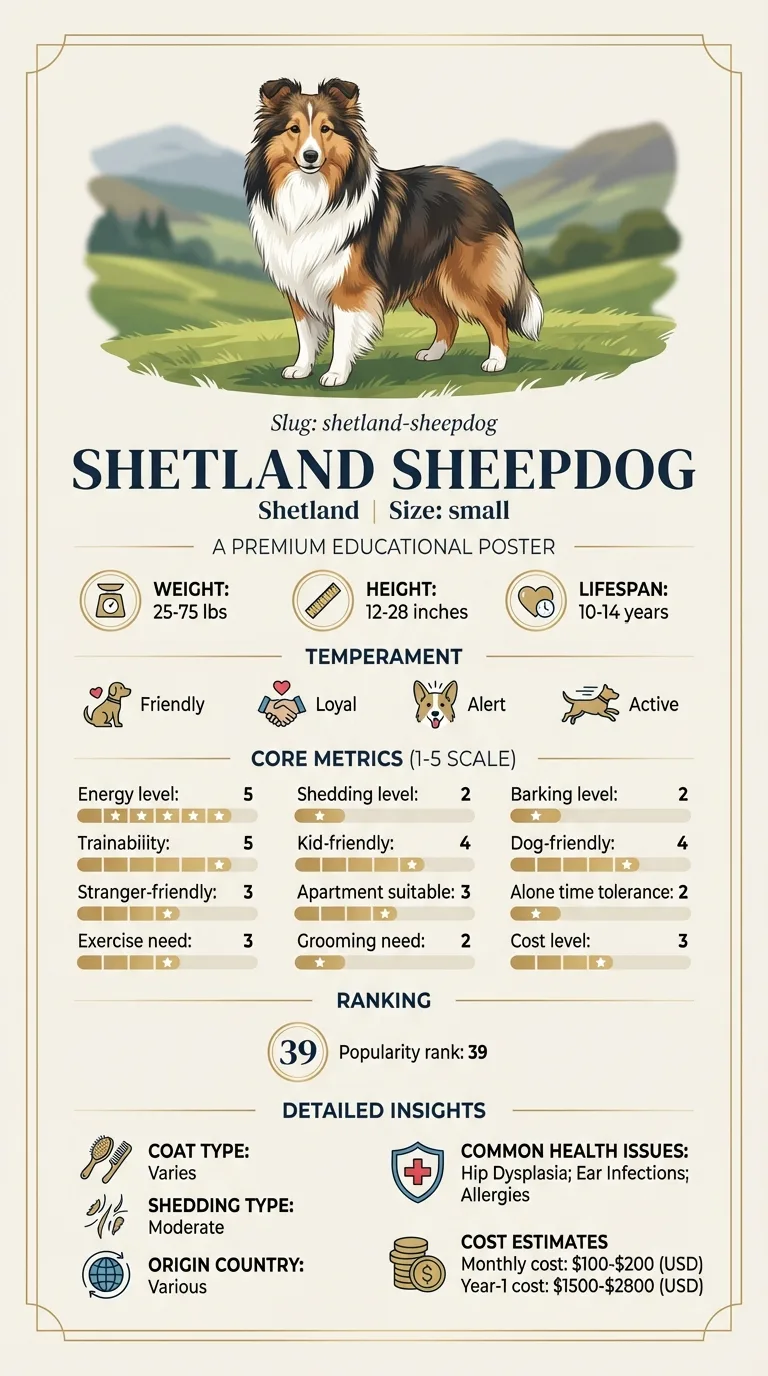
The Sheltie's frame is the driver. At thirteen to sixteen inches and fifteen to twenty five pounds it belongs to the size class where valve tissue degenerates with age, and its long twelve to fourteen year lifespan means many individuals live to reach that stage. Nothing in the breed's documented health profile adds cardiac risk on top of that. What the breed does add is a complication in handling: MDR1 drug sensitivity means every sedation for imaging or dentistry has to be planned around a known genotype rather than assumed safe.
Two things owners control matter. Weight is the first, and a Sheltie's undercoat is genuinely good at hiding it, so judging by eye fails. The second is oral health, because chronic dental infection in a small dog is a persistent inflammatory load that no cardiac plan benefits from. Heat is a third factor for this coat type, less as a cause than as a stressor that makes a compromised heart look worse than it is.
Go now, treat as an emergency: breathing that is fast and effortful while the dog is at rest or asleep, standing with elbows out and neck extended, blue or grey gums, restlessness that will not resolve at night, or a collapse. Fluid on the lungs kills quickly and there is no version of that which waits for morning. Call within the week: a sleeping breath count that has stayed above your dog's baseline across several readings, a new cough, reduced appetite alongside any of the above, or a belly that appears to be filling. Book routinely: annual heart auscultation from eight, and the recheck interval your vet has set.
See all Shetland Sheepdog health problems, which breeds are prone to heart disease, or the full Shetland Sheepdog breed guide for temperament, exercise needs and ownership costs.
Think in years. Many Shelties spend two to four years between the first murmur and any change on imaging, and some never leave that phase. Once enlargement appears and medication begins, rechecks usually settle into a six-month rhythm with dose adjustments made across months. If congestive failure occurs, the picture shifts to weeks and months, and the goal changes from prevention to comfort and quality of days.
Success is an ordinary life that happens to include a tablet and a calendar. Your Sheltie still asks for the walk, still barks at the postman, still eats with enthusiasm, and the number in your log has not moved. It is not the disappearance of the murmur, which will not happen, and it is not a dog wrapped in cotton wool, which would cost this breed more than the disease does.
The mitral valve is a pair of thin flaps between the left atrium and the left ventricle. Every heartbeat, they slap shut so blood is pushed forward into the body instead of backward into the lungs. Over years, in small dogs, the tissue of those flaps thickens and becomes lumpy, and lumpy flaps no longer meet edge to edge.
A little blood slips back on each beat. That backwash is the murmur your vet hears. For a long time it changes nothing, because the heart simply works slightly harder and the body never notices.
The turning point is enlargement. When enough blood is going backwards, the left atrium stretches to hold it. A stretched atrium raises the pressure in the vessels behind it, and those vessels run through the lungs. Fluid begins to weep into lung tissue, and that is congestive heart failure.
Everything useful about managing this in a Sheltie hangs on catching the moment the chamber starts to stretch, which is well before the dog looks ill.
A Sheltie is a poor self-reporter. This is a breed bred to keep working, with a herding drive that will carry it past the point where it should have stopped, and a coat thick enough to hide changes in body shape. You cannot rely on watching the dog and noticing.
So you count. Once a week, when the dog is genuinely asleep, count chest rises for thirty seconds and double the number. Write it and the date somewhere permanent. Do this while the dog is healthy so you have a real baseline rather than a guess.
The log earns its keep in two ways. It gives your vet an objective trend at every visit instead of an impression. And when the number does climb, you will see it as a run of rising weeks rather than one alarming night, which is the difference between a scheduled appointment and an emergency admission.
Add two other columns if you like: weight, taken monthly on the same scale, and how far the dog chose to walk on your usual route.

If you think your Shetland has heart disease, the plan is three steps: write down what you have seen and when it started, book a veterinary appointment rather than waiting for the next flare, and take video of the behaviour or symptom before you go — the thing you are worried about rarely happens in the consulting room. Screening in the parents covers collie eye anomaly, mdr1 drug sensitivity, dermatomyositis.
What the vet visit should produce is a diagnosis and a written plan, not just reassurance: what is being ruled out, what the monitoring interval is, and which signs mean you come back sooner. Ask what the treatment costs across a year rather than per visit, because that is the number that decides whether you are managing this condition or reacting to it.
Between appointments, keep a short log — dates, what you saw, what changed. It is the single most useful thing an owner brings to a follow-up, and for heart disease it is often what separates a clear pattern from a guess.
Callum started counting when his Sheltie Bracken turned eight, mostly because his vet suggested it and it took thirty seconds. For two and a half years the number was twenty. He recorded it in the margin of his work diary every Sunday evening. The autumn Bracken was ten and a half, the number went to twenty six, then twenty eight, then twenty nine. No cough, no tiredness, nothing else at all. Callum rang on the Tuesday. The echo showed a left atrium that had grown since the previous scan, and Bracken started medication that week. What his vet pointed out afterwards was that dogs usually arrive at that stage in the middle of the night, already struggling, because nobody was counting. Bracken arrived on a Tuesday afternoon, comfortable, and started treatment before a single crisis. He lived another two years and three months.
Key takeaway: The value of the weekly count is not that it detects heart disease. It is that it changes when you find out, and in valve disease the difference between finding out early and finding out at 3am is most of the outcome.
There is no documented inherited cardiac disease in this breed. The health list for Shelties covers the eyes, thyroid, skin and kneecaps. Degenerative valve disease is a small-dog ageing phenomenon that Shelties share with terriers, poodles and mixed breeds of similar size.
Around eight is a sensible point to start the weekly breathing log and to ask your vet to note the heart specifically at each annual. Before that, an unexplained murmur deserves investigation rather than watching, because young-dog murmurs have different causes.
Usually not. A leaking valve without an enlarged heart is monitored. Medication typically begins when imaging shows the chambers have started to enlarge, which is often before the dog shows a single symptom. That is why the imaging matters more than the stethoscope.
Years, frequently. Many dogs sit in the pre-treatment monitoring phase for a long time, and many more do well on medication for a long stretch after that. Plenty of Shelties with a documented murmur reach the far end of the breed's twelve to fourteen year range and die of something else.
The standard cardiac drugs are not the MDR1 concern. The concern is sedation for imaging and any parasite or anti-nausea drug added alongside. Have the DNA test done and make sure the result is on the chart, because a Sheltie with heart disease will be sedated and medicated more often than an average dog.
Do not make sweeping changes on your own. Very low sodium diets and supplement regimes have specific indications and specific risks, and they belong to the vet managing the case. The dietary change that helps every Sheltie with a heart finding is getting the dog to the lean end of its healthy weight.
While the heart is stable and untreated, keeping this breed active is the right call. Once medication starts, activity is usually still encouraged but at the dog's own pace, avoiding heat and long uninterrupted efforts. Ask directly at each recheck rather than assuming last year's answer still holds.
A slow upward drift in the sleeping breathing rate. It appears before coughing, before tiredness, and before anything you would notice by eye.
Yearly at minimum from about eight, and at whatever interval your vet sets once a murmur is on record. Six months is a common answer.
No special equipment, but pick a cool sleeping spot. A dense double coat plus a working heart in a warm room is an unnecessary combination.
Typically tens of dollars a month, plus periodic bloodwork and imaging. It reshapes rather than doubles this breed's usual eighty to one hundred fifty dollar monthly running cost.
No. In a breed that barks as much as this one, throat and airway irritation is a strong competing explanation, especially if the dog wears a flat collar.
A one-page prep sheet for this condition: the signs, the questions to ask, what to get priced. Unlocks here.
You get: Vet visit prep sheet
No spam. One-click unsubscribe. See our privacy policy.
Preview page 1 before you decide.