Health
Is hip dysplasia a common Sheltie problem?
No. The breed's documented issues are the eyes, MDR1 drug sensitivity, dermatomyositis, thyroid function and kneecaps. Hips are a minor concern by comparison.

Quick answer
Is hip dysplasia a common Sheltie problem?
No. The breed's documented issues are the eyes, MDR1 drug sensitivity, dermatomyositis, thyroid function and kneecaps. Hips are a minor concern by comparison.
Prevalence figures for hip dysplasia describe the dogs somebody chose to submit for scoring, which is not the same as describing the breed.
Prospective Sheltie owners comparing breeds on paper, and current owners trying to work out whether the figure they found means their dog is likely to be affected. It is also for anyone about to ask a breeder the wrong question.
This guide is not medical advice. If your dog shows pain, sudden behavior change, or worsening symptoms, consult a licensed veterinarian.
Some links may be affiliate links. We may earn a commission at no extra cost to you. We only suggest products we believe are helpful for dog owners.
This is a data-literacy problem rather than a medical one. Breed prevalence figures for hip dysplasia come from voluntary registry submissions, which are subject to selection bias in both directions and vary by scheme, country and era. Owners meet the issue when they try to compare breeds on paper or to convert a published percentage into a personal risk estimate, and neither of those things is what the number was built to do.
The misreading is close to universal. Almost every breed comparison article quotes prevalence percentages without their denominators, and almost every prospective owner uses them as risk estimates. For Shetland Sheepdogs the practical consequence is small, since hips are a minor breed issue, but the same reasoning error does real damage when applied to eyes and to MDR1.
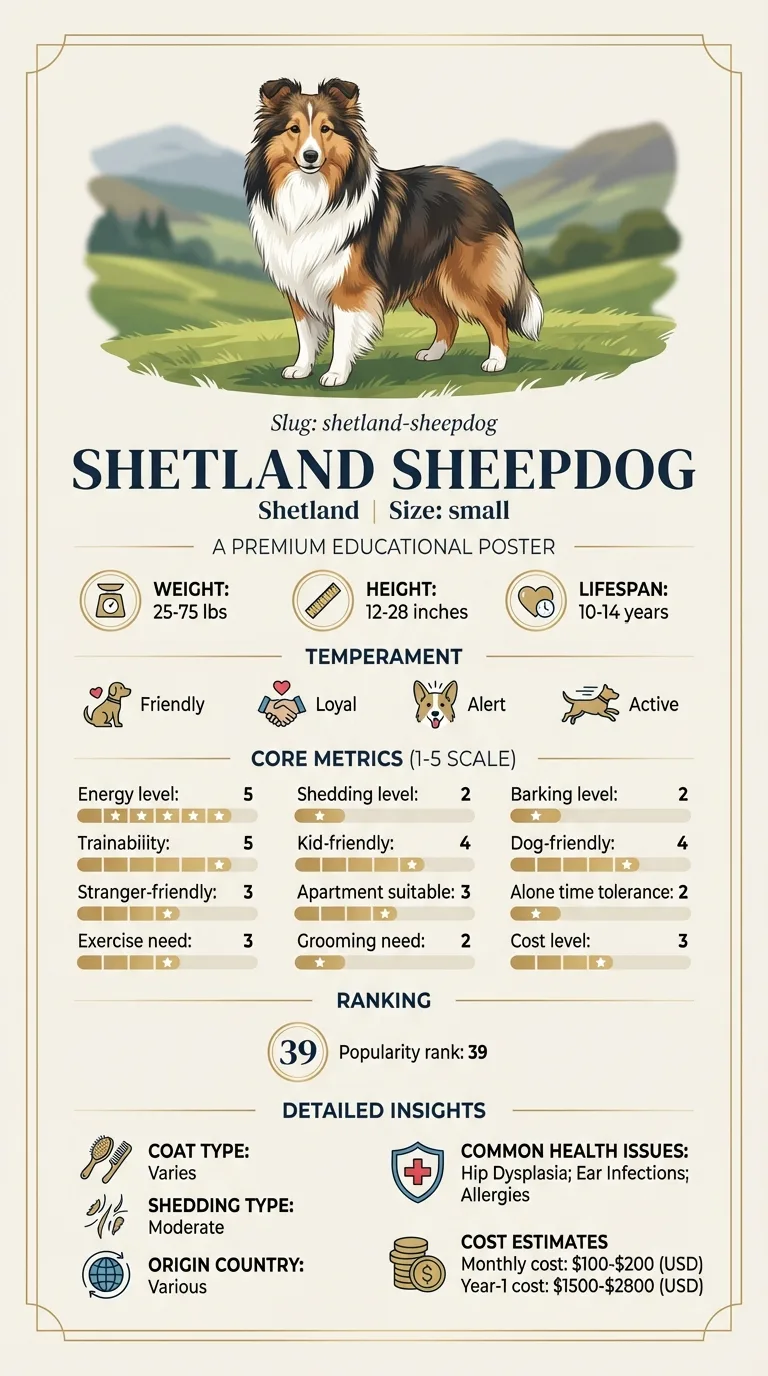
Shetland Sheepdogs sit in an awkward statistical middle. Ranked around thirty ninth in popularity, the breed produces enough dogs to generate published figures but not enough hip evaluations to make those figures stable. Breeders in this breed also allocate their screening budget rationally toward eye examination and MDR1 genotyping, which are the conditions with real documented significance here, so hip submissions are sparse by choice rather than by neglect. That sparseness is exactly what makes the resulting percentage fragile.
The wider information environment does the rest. Breed comparison content is written to rank breeds against each other, which requires numbers whether or not comparable numbers exist. Registry pages present percentages without prominent denominators. Search results surface the most quotable figure rather than the best sourced one. None of this is deliberate distortion; it is simply what happens when a technical statistic is repurposed as consumer advice.
Statistics are not a reason to see a vet, but the dog might be. Book an examination promptly if your Sheltie shows any of the signs that make hip disease a live question: a persistent change in how it sits or climbs, bunny-hopping on stairs, reluctance to jump that has lasted more than a couple of weeks, or hind limb muscle that feels smaller on one side. Go urgently if a hind leg is suddenly non-weight-bearing or the dog cannot rise. Before agreeing to any radiographs, confirm that the MDR1 test has been done and the result recorded, since imaging requires sedation and this breed's genotype determines which agents are appropriate.
See all Shetland Sheepdog health problems, which breeds are prone to hip dysplasia prevalence, or the full Shetland Sheepdog breed guide for temperament, exercise needs and ownership costs.
Getting a defensible answer about an individual puppy takes as long as it takes the breeder to send you two sets of paperwork, usually days. Getting a defensible answer about the breed takes considerably longer, because it means locating the registry's own summary, its denominator and its scheme definition. If you image your own dog, that is a single appointment. What you will not get, on any timeline, is a percentage that predicts your dog.
Success is being able to say what you actually know: these are the parents' eye results, this is their MDR1 status, this is what was and was not screened, and here is my own dog's examination. That is a smaller set of claims than a confident percentage, and every one of them is true. Trading a false precise number for a true vaguer one is the whole point.
Hip registries publish the proportion of evaluated dogs that received each grade. The critical word is evaluated. Nobody scores a random sample of the breed; owners and breeders choose to submit radiographs, and those choices are not neutral.
Two opposite biases operate at once. Breeders often decline to submit films that clearly look bad, which removes affected dogs from the denominator and pulls the published rate down. Meanwhile, dogs that are already limping are more likely to be radiographed at all, which pushes it up. Which bias dominates varies by breed, by country and by decade.
Submission volume matters too. A breed with tens of thousands of evaluations produces a stable figure. A breed where only a few hundred dogs have ever been scored produces a number that moves substantially when one large kennel starts or stops submitting. Shetland Sheepdogs are a moderately popular breed, ranked around thirty ninth, and Sheltie breeders concentrate their screening effort on eyes and on MDR1 rather than on hips, so hip submission numbers are correspondingly thinner.
Finally, prevalence is a population statement. It tells you nothing about an individual animal. A four percent breed rate does not mean your puppy has a four percent risk if both its parents were unscored.
When you are actually choosing a Sheltie puppy, these questions will tell you more than any registry figure.

Priya went into her Sheltie search armed with a percentage she had found in a breed comparison article and asked every breeder the same question: what is your hip dysplasia rate. The first breeder gave her a number straight back, lower than the published one, with nothing behind it. The second said she had never formally scored hips because in thirty years of Shelties she had seen two hip cases and dozens of eye and thyroid problems, so that was where her money went. She then produced eye certificates for both parents dated that year, MDR1 results showing the sire clear and the dam a carrier, and an explanation of why that pairing could not produce an affected puppy. Priya realised she had been asking the question that was easiest to answer rather than the one that mattered. She bought from the second breeder. Her dog, now four, has been examined annually and has clear eyes and a documented genotype on file at her practice.
Key takeaway: A breed prevalence figure is an answer to a question about populations. When you are buying one puppy, replace it with questions about that puppy's two parents, and insist on paperwork rather than percentages.
Published figures for the breed are low compared with large working breeds, but they rest on a relatively small number of submitted evaluations and are subject to the usual reporting bias. Treat any single percentage as an approximation of a screened subgroup, not as your dog's risk.
Different registries use different grading schemes, different minimum ages, different countries and different decades. A figure from a hip scoring scheme that requires a specific view at twelve months is not directly comparable to one from a scheme that accepts films from any adult dog.
It means dysplasia is unlikely to be your Sheltie's main problem, which is true. It does not mean the individual dog in front of you is clear. Breed-level statistics and individual diagnosis answer different questions, and only imaging answers the second one.
Hip scores are worth seeing, but they should not be your first filter for this breed. Eye examination and MDR1 genotype are where a Sheltie breeder's screening effort ought to be concentrated, because those are the conditions with documented breed significance.
On average, mixes drawn from unrelated parents show somewhat lower rates of conditions that need two copies of a variant. Hip dysplasia is not one of those; it is influenced by many genes plus growth and weight, so a mix inherits a blend of risks rather than an exemption.
Radiographs under sedation plus the scheme's evaluation fee generally comes to a few hundred dollars. For a Shetland Sheepdog the sedation portion should be planned around the dog's MDR1 status, which is a separate and much cheaper test done first.
No. The breed's documented issues are the eyes, MDR1 drug sensitivity, dermatomyositis, thyroid function and kneecaps. Hips are a minor concern by comparison.
No. It describes a screened population. Your puppy's risk depends on its own parents, and only their certificates tell you anything about that.
Eye certification dates and MDR1 genotypes for both parents, with paperwork you can see rather than a verbal assurance.
Insurers price by breed and often exclude hereditary conditions in some tiers, so read the wording rather than assuming a low-prevalence breed is treated leniently.
Not routinely. Screening is for breeding decisions and for investigating a symptomatic dog, not something every pet needs on a schedule.
A one-page prep sheet for this condition: the signs, the questions to ask, what to get priced. Unlocks here.
You get: Vet visit prep sheet
No spam. One-click unsubscribe. See our privacy policy.
Preview page 1 before you decide.