Health
What does 2/6 mean on my Sheltie's notes?
A quiet murmur heard clearly over one area, on a loudness scale of one to six. It is the most common incidental finding and is usually monitored rather than treated.

Quick answer
What does 2/6 mean on my Sheltie's notes?
A quiet murmur heard clearly over one area, on a loudness scale of one to six. It is the most common incidental finding and is usually monitored rather than treated.
The number your vet wrote down describes how loud it was, and loudness is one of the least informative things about a murmur.
New Sheltie puppy owners who heard the words soft murmur at the eight-week check and are now wondering whether to complete the purchase, and adult-dog owners who have just been handed a grade on a piece of paper with no explanation attached.
This guide is not medical advice. If your dog shows pain, sudden behavior change, or worsening symptoms, consult a licensed veterinarian.
Some links may be affiliate links. We may earn a commission at no extra cost to you. We only suggest products we believe are helpful for dog owners.
A heart murmur in a Shetland Sheepdog is an audible sign of turbulent blood flow, graded one to six by loudness alone. In puppies it is frequently innocent and temporary. In adults past eight it usually reflects an ageing mitral valve. In frightened or anaemic dogs of any age it can appear and then vanish. The day-to-day impact for most owners is a recheck interval and a note on the file rather than any change to the dog's life.
Very common as a finding across a Sheltie's lifetime and much less common as a disease. Soft transient murmurs appear in many puppies. Incidental soft murmurs turn up in a fair share of middle-aged and older dogs at routine exams. Only some of those represent a heart that is changing shape.
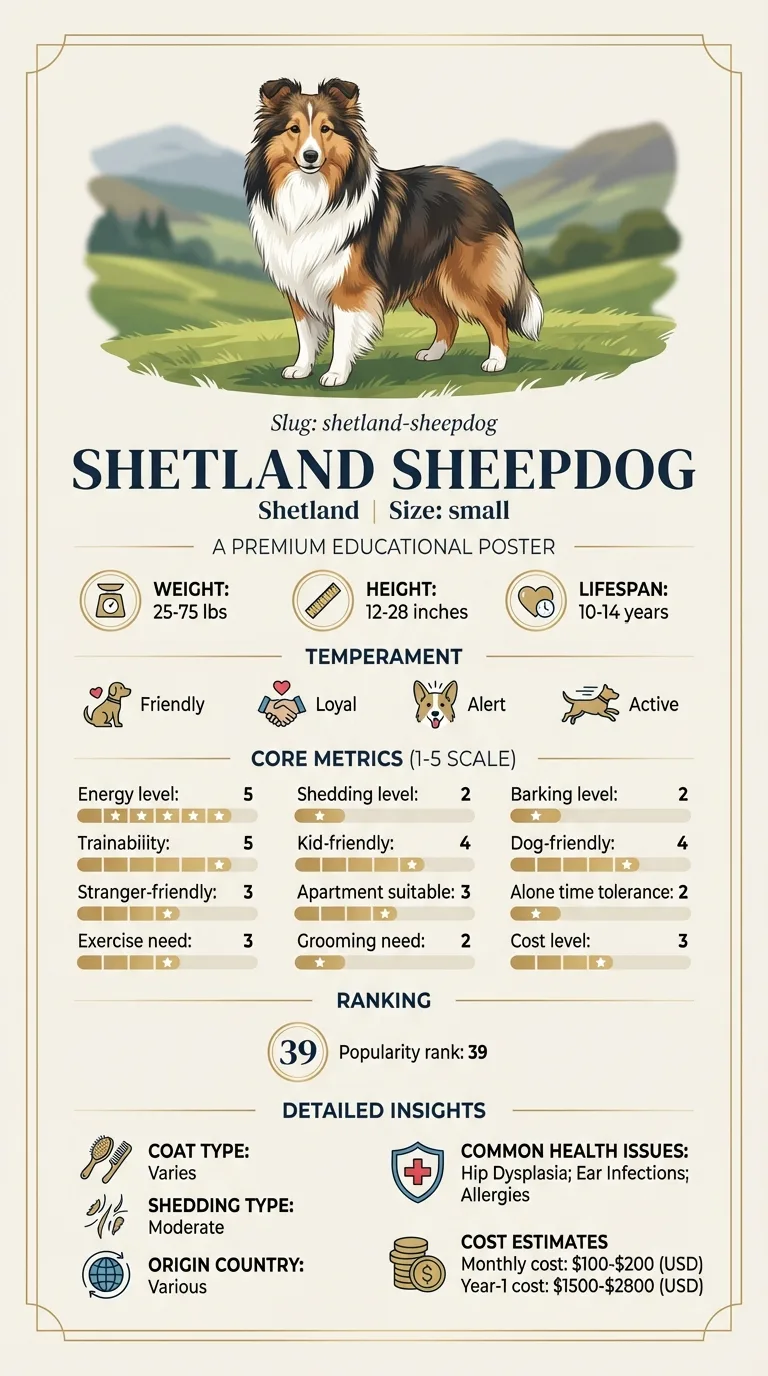
Shetland Sheepdogs do not carry a documented inherited murmur-producing defect. The breed's contribution is indirect and comes in two forms. First, its small size places it in the group whose mitral valves degenerate with age, so a Sheltie living twelve to fourteen years will often acquire a murmur eventually. Second, its temperament plays a role at the moment of detection: a dog rated low on stranger friendliness arrives at the clinic with a heart rate that flatters the finding, which is exactly how a stress murmur is generated.
Handling and setting shape the result more than owners expect. A hurried exam in a noisy waiting area with an anxious dog produces louder, less interpretable sounds. Body condition matters too, because a fat pad over the chest wall muffles the sound and can lower the apparent grade in a dog whose valve is genuinely leaking. A Sheltie's thick coat compounds this, which is one more reason grade alone is a poor yardstick.
Immediately, as an emergency: a murmur alongside collapse, fainting, blue or grey gums, or fast effortful breathing at rest. Those signs are about the dog, not the sound, and they do not wait. Within days: a murmur newly found in a dog over eight, any murmur of grade 3 or louder, a murmur in a puppy that is smaller or less energetic than its littermates, or a murmur discovered while planning anaesthesia for a neuter or dental. Routine: a deliberate recheck of any soft murmur at the interval your vet specifies, and a four to five month recheck for every puppy murmur.
See all Shetland Sheepdog health problems, which breeds are prone to heart murmurs, or the full Shetland Sheepdog breed guide for temperament, exercise needs and ownership costs.
For a puppy, expect an answer within a few months: the murmur is either gone by five months or it is investigated. For an adult, expect a recheck cycle rather than a resolution. Soft murmurs are commonly rechecked at six or twelve months for years without anything changing. If imaging is done, you will typically have a clear answer within a single appointment, and that answer will set the interval for everything afterwards.
Success is knowing which kind of murmur you have. A file that reads grade 2, mitral, unchanged at three consecutive annual exams, dog asymptomatic is a good outcome even though the murmur is still there. The failure mode is not the sound persisting; it is nobody ever establishing what is producing it, so that five years later there is still no baseline to compare against.
Murmurs are graded one to six purely by how audible they are through a stethoscope. The scale says nothing directly about how sick the dog is. Here is what each step means in plain terms.
In a Sheltie puppy, a soft murmur found between six and twelve weeks is frequently innocent. Puppies have low blood viscosity, fast heart rates and a chest that is still changing shape, and all three create flow turbulence in a structurally normal heart. Innocent murmurs are typically grade one or two, change with position, and are gone by four or five months.
The ones that are not innocent are the ones that are loud, or that persist past five months, or that come with a puppy who tires before its littermates. In the rough-coated collie family the congenital defect worth ruling out is a fetal vessel that should have closed after birth and did not. It has a characteristic continuous sound and it is correctable, but only if someone looks.
In an adult Sheltie, a new murmur means something different again. There was no murmur last year and now there is, so something has changed. In a dog past eight that is usually the mitral valve beginning to leak. In a younger adult it is worth checking whether the dog is anaemic, feverish or simply frightened out of its wits on the table, because Shelties are wary of strangers and a panicking dog produces a real sound that is not a real problem.
The practical rule is that any murmur which is new, loud, or attached to a dog that seems off should be imaged, and any murmur that is old, soft and attached to a dog that is thriving can reasonably be watched.

A breeder had two Sheltie pups from the same litter noted with soft murmurs at the eight-week vet check, and she told both buyers the same thing: get it rechecked at five months, and here is my number. The first pup, Tarn, was rechecked in November. Nothing. The vet listened twice, in two positions, and wrote resolved. He was a normal puppy who had grown out of a normal puppy murmur. The second pup, Isla, still had hers, and it had become continuous rather than intermittent. Her vet referred her, imaging found a fetal vessel that had never closed, and it was corrected before she was seven months old. She went on to compete in agility. The breeder's point afterwards was simple. She had not known which pup was which at eight weeks, and neither had the vet. The recheck is what separated them.
Key takeaway: The grade written at the first exam does not tell you which kind of murmur your Sheltie has. The scheduled second listen does, and skipping it is the only genuinely bad choice available.
Ask the breeder for the vet's actual note, then have your own vet listen and give an opinion on whether it is likely innocent. Agree in writing what happens if it persists past five months. Many soft puppy murmurs vanish, but the decision should rest on a second listen and a plan, not on hope.
Not reliably. Grade correlates loosely with severity at the extremes, so a grade 6 is always significant and a grade 1 rarely is, but in the middle of the scale it tells you very little. A grade 2 from a valve that is stretching the heart matters more than a grade 4 from a trivial jet.
Yes, and often for boring reasons. Heart rate, excitement level, body position, hydration and even which vet is listening all shift the apparent grade. This is one reason a single grade is a weak basis for decisions and a trend across visits is a better one.
It matters a great deal. A murmur loudest low on the left side over the heart's apex points toward the mitral valve. One loudest higher and further forward, or on the right, points elsewhere. Your vet notes this because it narrows the list before any imaging happens.
Not always. A soft murmur in a well, middle-aged Sheltie may reasonably be rechecked in six months. Imaging becomes the right call when the murmur is grade 3 or louder, when it is new in an older dog, when the dog has any symptom, or when a procedure requiring anaesthesia is being planned.
Because investigating a murmur may mean sedating the dog for radiographs, and MDR1 drug sensitivity is documented in Shetland Sheepdogs. The genotype changes which sedatives are appropriate. It is a one-off cheek swab or blood test and it is worth doing before you need the answer, not after.
It can produce one. Shelties score low on stranger friendliness, and a genuinely frightened dog with a racing heart can generate audible turbulence in a normal heart. A murmur that is present at the clinic and absent at a calm home recheck is worth noting in the file.
A quiet murmur heard clearly over one area, on a loudness scale of one to six. It is the most common incidental finding and is usually monitored rather than treated.
Soft ones often do, typically by four to five months. One still present after that should be imaged rather than watched any longer.
Ask about eye certification and MDR1 status first, since those are the breed's documented issues, and ask whether the litter was auscultated before going home.
Once it is on the record, anything cardiac is likely to be excluded as pre-existing. Insuring a Sheltie puppy before the first murmur is ever noted is the practical move.
Usually not on its own. Shelties are highly trainable and thrive on work, and unless imaging shows a problem there is rarely a reason to hold one back.
A one-page prep sheet for this condition: the signs, the questions to ask, what to get priced. Unlocks here.
You get: Vet visit prep sheet
No spam. One-click unsubscribe. See our privacy policy.
Preview page 1 before you decide.