Living
Which breed should I actually pick?
If you want minimal grooming and top apartment suitability, go Dachshund. If you want an easier-to-train dog that's better with kids and other dogs and don't mind brushing a double coat, go Sheltie.

Quick answer
Which breed should I actually pick?
If you want minimal grooming and top apartment suitability, go Dachshund. If you want an easier-to-train dog that's better with kids and other dogs and don't mind brushing a double coat, go Sheltie.
Dachshund or Shetland Sheepdog? On paper they differ most on grooming need, and on the scales Dachshund is the heavier at 11–32 lbs. Here is how the two compare on everything that shapes an ordinary week.
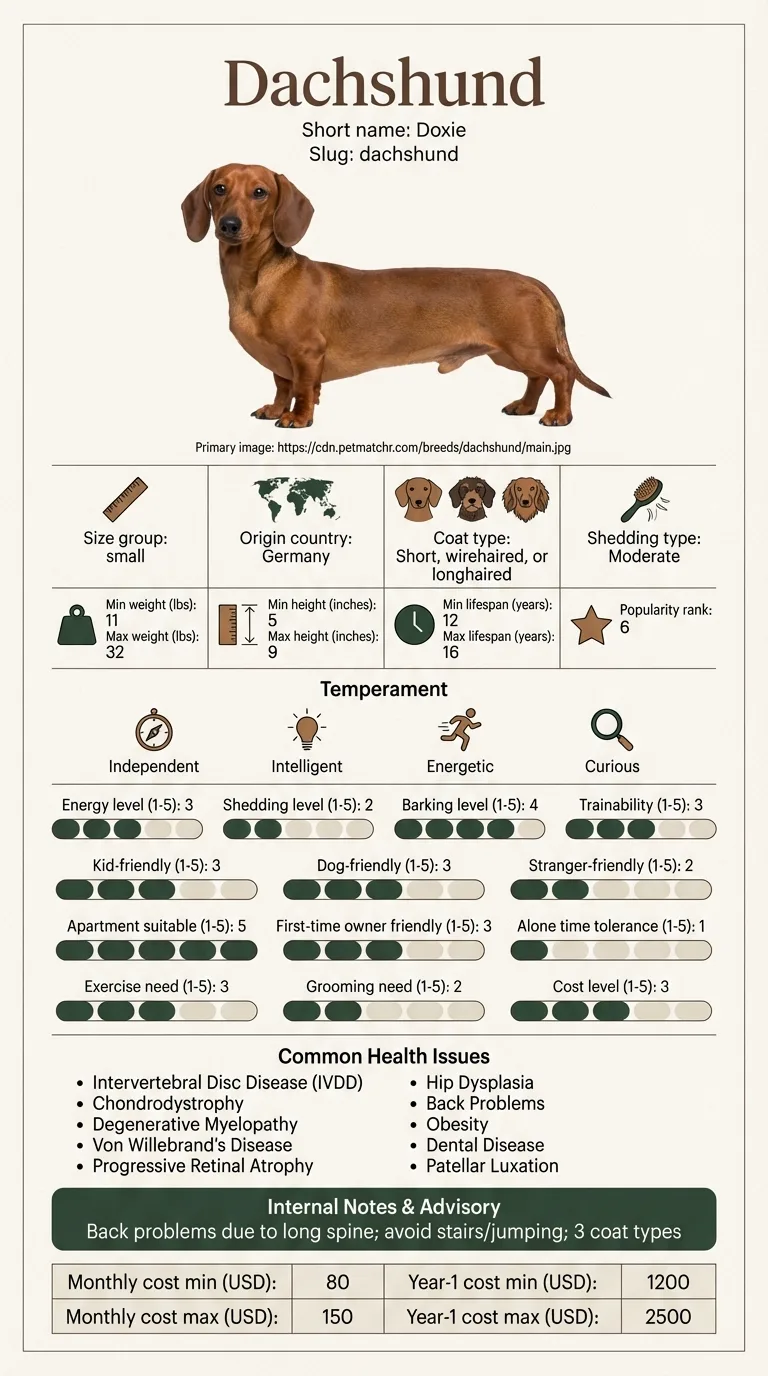
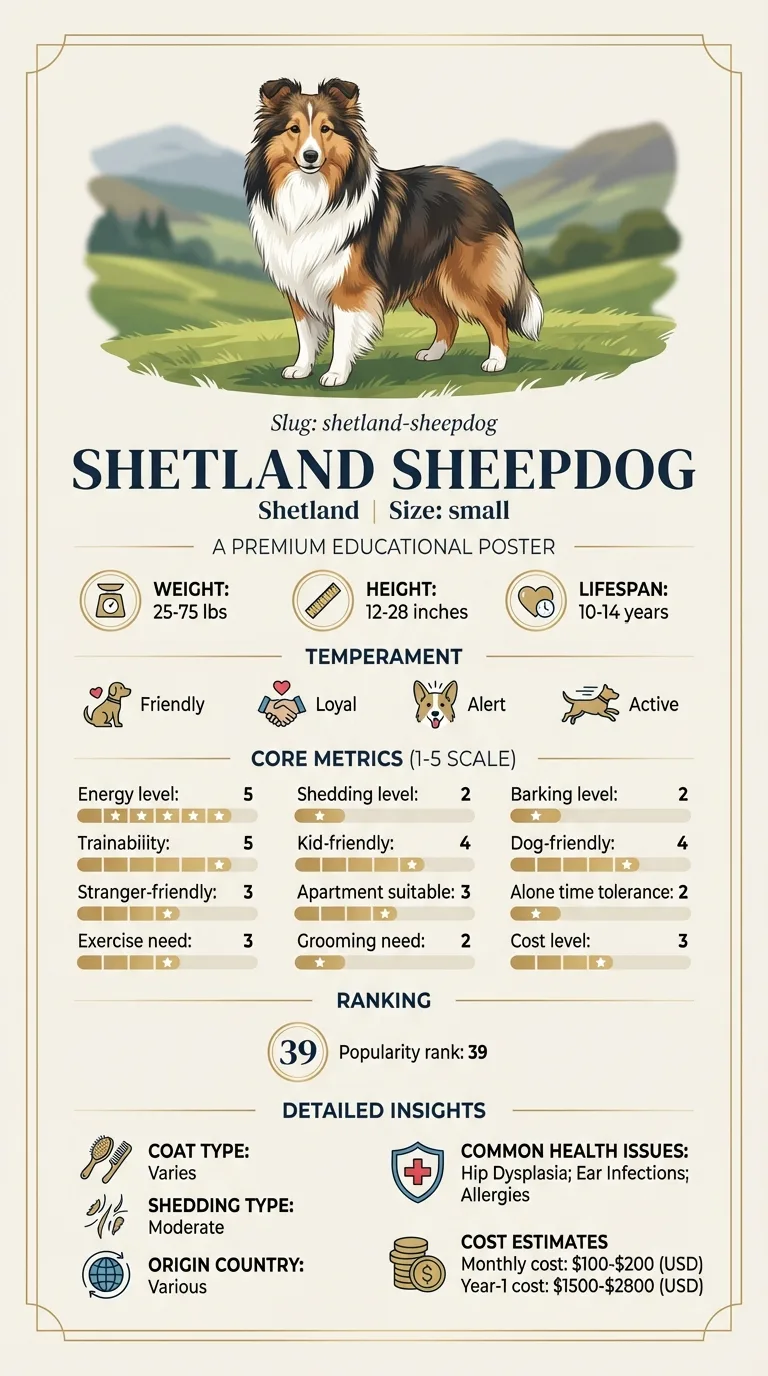
This is for someone already down to Dachshund and Shetland Sheepdog and deciding between them. For this pair the decision usually turns on grooming need and apartment suitability, so those are covered first and in most detail. Anyone choosing from a flat has a clear answer here: Dachshund rates 5/5 against 3/5. Breed history is left out; what follows is what you will actually live with.
Between Dachshund and Shetland Sheepdog, grooming need is what separates them, and Dachshund is the lower-effort dog of the two to keep.
Choose Dachshund if you are in a flat or a smaller home, you do not want a standing grooming appointment and shedding is a problem in your house.
Choose Shetland Sheepdog if this is your first dog, there are young children at home and you already have another dog.
| Feature | dachshund | shetland sheepdog | Winner |
|---|---|---|---|
| Size class | small | small | Equal |
| Weight | 11–32 lbs | 15–25 lbs | Equal |
| Height | 5–9 in | 13–16 in | Equal |
| Lifespan | 12–16 years | 12–14 years | dachshund |
| Exercise need | Moderate (3/5) | High (4/5) | dachshund |
| Grooming need | Low (2/5) | High (4/5) | dachshund |
| Shedding | Low (2/5) | High (4/5) | dachshund |
| Energy level | Moderate (3/5) | High (4/5) | Equal |
| Barking | High (4/5) | Very high (5/5) | dachshund |
| Apartment suitability | Very high (5/5) | Moderate (3/5) | dachshund |
| Good for first-time owners | Moderate (3/5) | High (4/5) | shetland sheepdog |
| Tolerates being alone | Very low (1/5) | Low (2/5) | shetland sheepdog |
| Trainability | Moderate (3/5) | Very high (5/5) | shetland sheepdog |
| Good with kids | Moderate (3/5) | High (4/5) | shetland sheepdog |
| Good with other dogs | Moderate (3/5) | High (4/5) | shetland sheepdog |
| Friendly to strangers | Low (2/5) | Low (2/5) | Equal |
| Cost level | Moderate (3/5) | Moderate (3/5) | Equal |
| Coat | Short, wirehaired, or longhaired | Long, dense double coat | Equal |
| Origin | Germany | Various | Equal |
| Typical monthly cost | $80–$150 | $80–$150 | Equal |
| Typical first-year cost | $1,200–$2,500 | $1,100–$2,300 | Equal |
Both are small dogs but built differently. The Dachshund runs 11-32 lbs and stands just 5-9 inches, low to the ground with that signature elongated spine. The Sheltie is taller at 13-16 inches with a narrower weight range, 15-25 lbs. Neither dominates a dog park by size, but the Sheltie carries itself more like a miniature herding dog while the Dachshund's shape is unlike almost anything else in the small category.
The Sheltie edges out the Dachshund here, rated high (4/5) for exercise need versus moderate (3/5), and it shows in daily life since Shelties were bred to herd and want a job to do. The Dachshund is content with shorter walks and yard time. If you're not up for agility courses or long fetch sessions, the Dachshund's lower bar is the easier fit.
This is a clear split. Dachshund grooming sits at low (2/5) with low shedding (2/5) — a quick brush covers it, especially on smooth-coated dogs. The Sheltie's double coat pushes both grooming and shedding to high (4/5), meaning regular brushing and a heavier shed during coat-blow seasons. Budget real weekly time for the Sheltie's coat; the Dachshund asks for almost none.
Dachshunds score very high (5/5) on apartment suitability, the Sheltie only moderate (3/5) — and both dogs bark a lot, the Dachshund at high (4/5), the Sheltie at very high (5/5). Neither is a quiet dog for thin-walled buildings. Alone time is rough for both too: Dachshund very low (1/5) tolerance, Sheltie low (2/5). Plan on crate training or a dog walker if you're out most of the day.
The Sheltie is far easier to train, rated very high (5/5) against the Dachshund's moderate (3/5), and it also scores higher for first-time owners (4/5 vs 3/5). Dachshunds are intelligent but independent-minded, which shows up as selective listening. If this is your first dog and you want a breed that takes to obedience work quickly, the Sheltie has the edge.
The Sheltie beats the Dachshund across the board — good with kids (4/5 vs 3/5), good with other dogs (4/5 vs 3/5) — though both are equally reserved with strangers at low (2/5). A Dachshund's low back and tendency to nip when startled make supervision around small kids more important than with the sturdier Sheltie.
The Dachshund lives longer on paper, 12-16 years against the Sheltie's 12-14, but carries a heavier health list tied to its shape: IVDD, chondrodystrophy, degenerative myelopathy and back problems all trace back to that long spine. The Sheltie's concerns — collie eye anomaly, MDR1 drug sensitivity, dermatomyositis — are fewer in number but still worth screening for before you buy.
Monthly costs land in the same $80-150 range for both, and first-year costs are close too — $1,200-2,500 for the Dachshund, $1,100-2,300 for the Sheltie. Cost level is rated moderate (3/5) for both breeds. The bigger variable isn't the sticker price, it's the Sheltie's grooming time versus the Dachshund's potential IVDD-related vet bills.
Dachshund weighs 11–32 lbs and lives 12–16 years; Shetland Sheepdog weighs 15–25 lbs and lives 12–14 years. The two diverge most on grooming need, apartment suitability and shedding and 1 other rated axes. They are level on cost level and friendly to strangers, so those cannot decide it. The comparison marks an easier option only where one exists. Facts like weight and country of origin are not scored. Both dogs are rated from the same dataset, which is what makes the numbers comparable with each other even though any individual dog sits somewhere inside its breed's range.

The Dachshund weighs 11-32 lbs and stands 5-9 inches; the Sheltie weighs less on average (15-25 lbs) but stands taller at 13-16 inches. Both count as small breeds, but the Sheltie looks more like a compact herding dog while the Dachshund is built low and long.
The Sheltie, by a wide margin — its shedding is rated high (4/5) against the Dachshund's low (2/5). Its double coat blows out seasonally, while a smooth-coated Dachshund needs barely any brushing.
The Sheltie is rated better for first-timers, high (4/5) versus the Dachshund's moderate (3/5), mainly because it's far easier to train (5/5 vs 3/5). The Dachshund's independent streak means basic obedience takes more patience.
The Dachshund is rated very high (5/5) for apartment living, better than the Sheltie's moderate (3/5). Both bark a lot though — high (4/5) for the Dachshund, very high (5/5) for the Sheltie — so a thin-walled building is a challenge either way.
Both land in the same $80-150 monthly range, and first-year costs are close: $1,200-2,500 for the Dachshund versus $1,100-2,300 for the Sheltie. Grooming time for the Sheltie is the main added cost if you pay a groomer.
Only patellar luxation appears on both lists. Otherwise the Dachshund's risks center on its spine — IVDD, chondrodystrophy, degenerative myelopathy — while the Sheltie's concerns run to eye and skin conditions like collie eye anomaly and dermatomyositis, plus MDR1 drug sensitivity.
The Sheltie again, rated high (4/5) on both counts against the Dachshund's moderate (3/5) on both. Neither breed is especially warm to strangers — both score low (2/5) there.
If you want minimal grooming and top apartment suitability, go Dachshund. If you want an easier-to-train dog that's better with kids and other dogs and don't mind brushing a double coat, go Sheltie.
Basically none — both run $80-150 a month, and cost level is rated moderate (3/5) for both breeds.
The Sheltie, rated high (4/5) versus the Dachshund's moderate (3/5). It was bred to herd and wants more structured activity than a Dachshund's shorter walks.
The Dachshund, typically 12-16 years against the Sheltie's 12-14 years, despite carrying more spine-related health risks.
Secure checkout on Stripe. We never see your card.
7-day money-back guarantee. Instant access.
Health information here is general and is not veterinary advice. If your dog shows pain, sudden behaviour change, or worsening symptoms, consult a licensed veterinarian.
Some links on this site are affiliate links. We may earn a commission at no extra cost to you, and we only suggest products we believe are helpful for dog owners.
We research and check what we publish, but we do not warrant that any figure, date, price, or statement is accurate, complete, or current, and we accept no liability for any loss, cost, injury, or other harm arising from the use of this site. Use it as one reference among several. You remain responsible for your own decisions and for your dog's care - confirm anything that matters with a licensed veterinarian or another qualified professional before you act on it. Full disclaimer.
Match your lifestyle to the right dog.
Take quizNot sure which breed is right for you? Take our 2-minute quiz to find out.
Take the quiz