Health
What's the earliest sign of arthritis in a Pug?
Stiffness right after waking or resting that loosens up once the dog starts moving around.

Quick answer
What's the earliest sign of arthritis in a Pug?
Stiffness right after waking or resting that loosens up once the dog starts moving around.
On a dog this small, a few extra pounds land on the joints like a much bigger weight gain would on a larger breed.
This affects most Pugs eventually, since arthritis is largely a function of age, but it hits earlier and harder in dogs who have carried extra weight for years. Owners of Pugs past the age of seven or eight, and any owner whose dog has struggled with weight control, should expect this to become relevant sooner rather than later.
This guide is not medical advice. If your dog shows pain, sudden behavior change, or worsening symptoms, consult a licensed veterinarian.
Some links may be affiliate links. We may earn a commission at no extra cost to you. We only suggest products we believe are helpful for dog owners.
We research and check what we publish, but we do not warrant that any figure, date, price, or statement is accurate, complete, or current, and we accept no liability for any loss, cost, injury, or other harm arising from the use of this site. Use it as one reference among several. You remain responsible for your own decisions and for your dog's care - confirm anything that matters with a licensed veterinarian or another qualified professional before you act on it. Full disclaimer.
Arthritis in Pugs is primarily an age-related wear condition made worse by this breed's tendency toward weight gain. It affects mobility and comfort progressively over time, most visibly in hesitation to jump, stiffness after rest, and gradual reluctance to engage in activities the dog used to do without issue.
Osteoarthritis is extremely common in aging dogs generally, and Pugs are no exception; most Pugs who live into their senior years will show at least some degree of joint changes, with severity heavily influenced by lifetime weight management.
This breed's documented tendency toward obesity, combined with a naturally small, narrow frame, means the same absolute weight gain translates into a larger proportional load on the joints than it would in a bigger dog. Over years, that added mechanical stress accelerates normal cartilage wear.
A sedentary indoor lifestyle without regular low-impact movement can allow both weight gain and muscle loss around the joints to compound each other, while cold or damp environments are commonly reported by owners to worsen stiffness on any given day.
Talk to your vet if you notice new reluctance to jump or use stairs, stiffness that doesn't loosen with movement, limping, or a change in how your dog sits or rises. A vet can confirm the diagnosis with a physical exam and imaging and rule out other causes of joint pain before starting a treatment plan.
Start here: Pug Most Common Genetic Disorders: What to Screen For
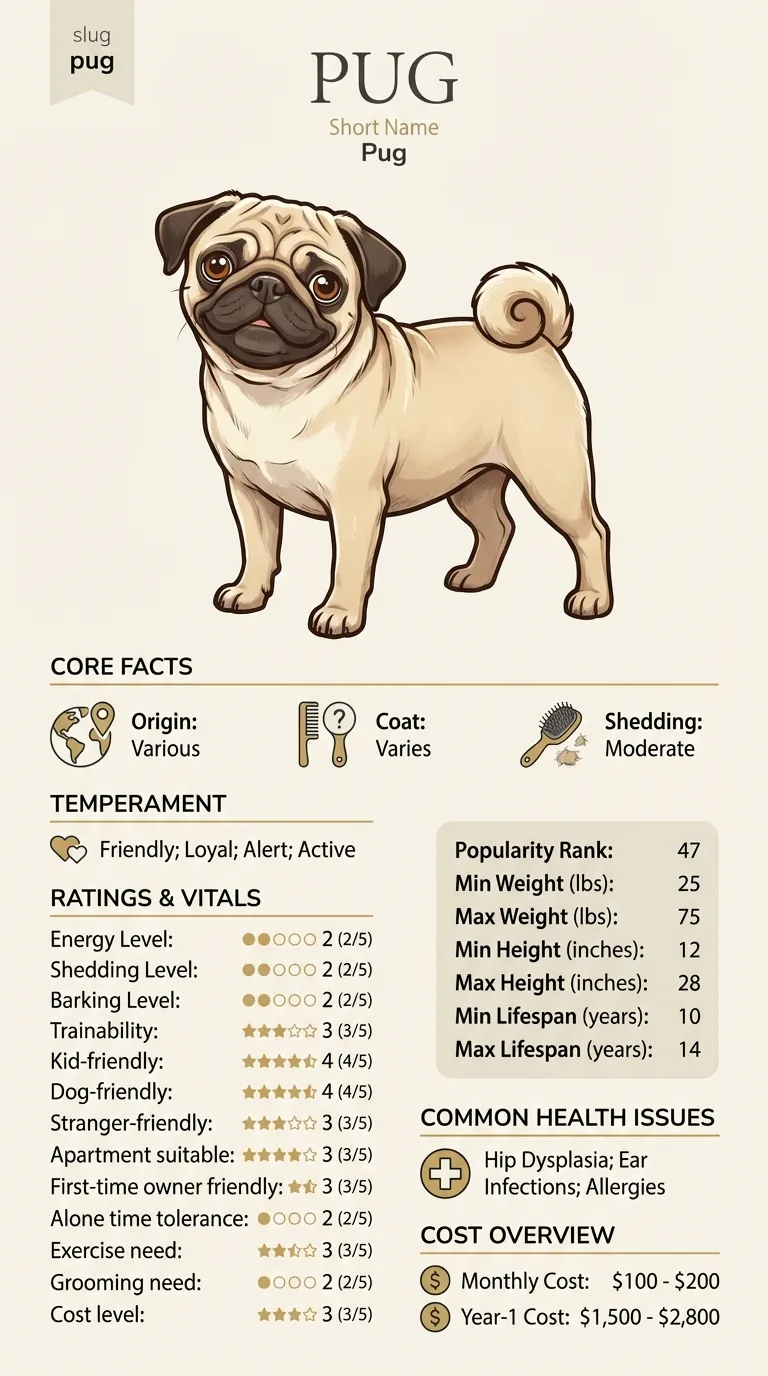
See all PUG health problems, which breeds are prone to arthritis, or the full PUG breed guide for temperament, exercise needs and ownership costs.
Most dogs show noticeable comfort improvement within two to six weeks of starting a combined weight-management and pain-control plan, though arthritis itself is a lifelong, progressive condition that requires ongoing management rather than a one-time fix.
Success means steady or improved mobility and comfort for as long as possible, with slower progression than an unmanaged case, not a return to a younger dog's full joint function.
Joint cartilage wears down through repeated mechanical load over a dog's lifetime, and that load scales with body weight relative to frame size. Because a Pug's healthy weight range is narrow, fourteen to eighteen pounds, even a small absolute weight gain represents a large percentage increase in the load each joint carries with every step. Combine that with a breed already prone to weight gain due to a strong food-driven appetite, and arthritis in Pugs often shows up a few years earlier than it would in a similarly aged dog who has stayed lean throughout life.
Because Pugs are not a high-energy breed to begin with, a gradual slowdown is easy to mistake for normal aging rather than joint pain. The signs worth watching for are more specific: hesitation before jumping onto furniture a dog used to manage easily, stiffness that's worse right after waking up and eases with movement, reluctance to climb stairs, or a change in how a dog sits, favoring one hip or shifting weight off a particular leg. These are functional changes, not just "slowing down," and they're the signals that tend to get noticed months after they first started because they crept in gradually.

If you think your Pug has arthritis, the plan is three steps: write down what you have seen and when it started, book a veterinary appointment rather than waiting for the next flare, and take video of the behaviour or symptom before you go — the thing you are worried about rarely happens in the consulting room. Screening in the parents covers brachycephalic airway syndrome (boas), pug dog encephalitis, corneal ulcers.
What the vet visit should produce is a diagnosis and a written plan, not just reassurance: what is being ruled out, what the monitoring interval is, and which signs mean you come back sooner. Ask what the treatment costs across a year rather than per visit, because that is the number that decides whether you are managing this condition or reacting to it.
Between appointments, keep a short log — dates, what you saw, what changed. It is the single most useful thing an owner brings to a follow-up, and for arthritis it is often what separates a clear pattern from a guess.
At eight years old, Mochi the Pug had carried a few extra pounds for most of his adult life. His owner noticed he'd started hesitating before jumping onto the couch and seemed stiff for the first several minutes after waking from a nap. A vet visit confirmed early arthritis in both hips, and the plan started with weight loss: cutting his daily calories and swapping one long walk for two shorter ones. Over four months, Mochi lost two pounds, a meaningful amount on his frame, and his hesitation at the couch largely disappeared. His owner still watches for stiff mornings but says the daily routine change made a bigger difference than she expected from something so small.
Key takeaway: On a breed this compact, modest weight loss can meaningfully change how comfortable an arthritic dog is day to day, often more than owners expect before they try it.
It varies, but signs often begin appearing around seven to nine years old, sometimes earlier in overweight dogs. Regular vet checkups starting in the senior years help catch it before it significantly limits mobility.
No, cartilage damage from osteoarthritis is not reversible with current treatment. The goal of management is slowing further progression and controlling pain and inflammation to keep a dog comfortable and mobile, not undoing existing joint damage.
Significantly. Because a Pug's healthy weight range is narrow, even a few extra pounds represent a large proportional increase in the load carried by every joint, making weight control one of the single most effective things an owner can do for long-term joint health.
Common signs include stiffness after rest that loosens with movement, reluctance to jump or climb stairs, slower rising from lying down, and less interest in walks than usual. Pugs rarely vocalize pain clearly, so behavior changes are the more reliable signal.
Many vets recommend joint-support supplements as part of a broader management plan, though they work best alongside weight control and any other treatment your vet prescribes, not as a standalone fix.
Regular, low-impact exercise like shorter, more frequent walks helps maintain muscle mass that supports joints, while high-impact activity like jumping should be limited. Complete rest tends to make stiffness worse, not better.
X-rays help confirm the diagnosis and rule out other causes of joint pain, and most vets recommend them once symptoms are suspected rather than treating based on symptoms alone.
Stiffness right after waking or resting that loosens up once the dog starts moving around.
Yes, significantly; even modest weight loss reduces joint load meaningfully on a frame this small.
Yes, shorter and more frequent low-impact walks are usually better than fewer long ones for arthritic joints.
Costs vary with supplements, vet visits, and any prescribed medication, and typically add a modest recurring monthly expense.
Yes, ramps or steps for furniture and limiting repeated stair use reduce repetitive joint strain in an arthritic dog.
A one-page prep sheet for this condition: the signs, the questions to ask, what to get priced. Unlocks here.
You get: Vet visit prep sheet
No spam. One-click unsubscribe. See our privacy policy.
Preview page 1 before you decide.