Living
Beagle or Pug - which fits my life?
Want a calmer, quieter apartment dog with low exercise needs? Take the Pug. Want a more active companion with a wider health profile away from airway problems? Take the Beagle.

Quick answer
Beagle or Pug - which fits my life?
Want a calmer, quieter apartment dog with low exercise needs? Take the Pug. Want a more active companion with a wider health profile away from airway problems? Take the Beagle.
Beagle or Pug? On paper they differ most on exercise need, and on the scales Beagle is the heavier at 20–30 lbs. Here is how the two compare on everything that shapes an ordinary week.
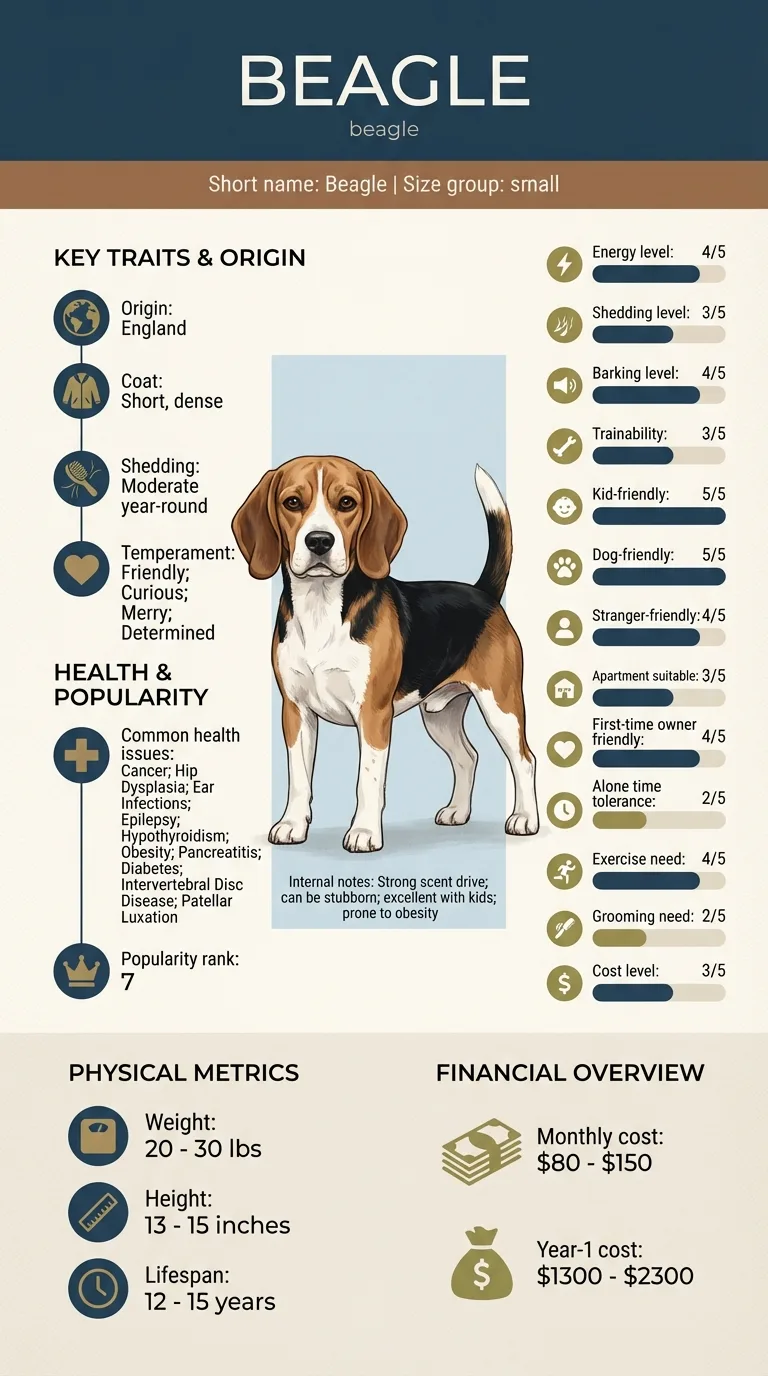
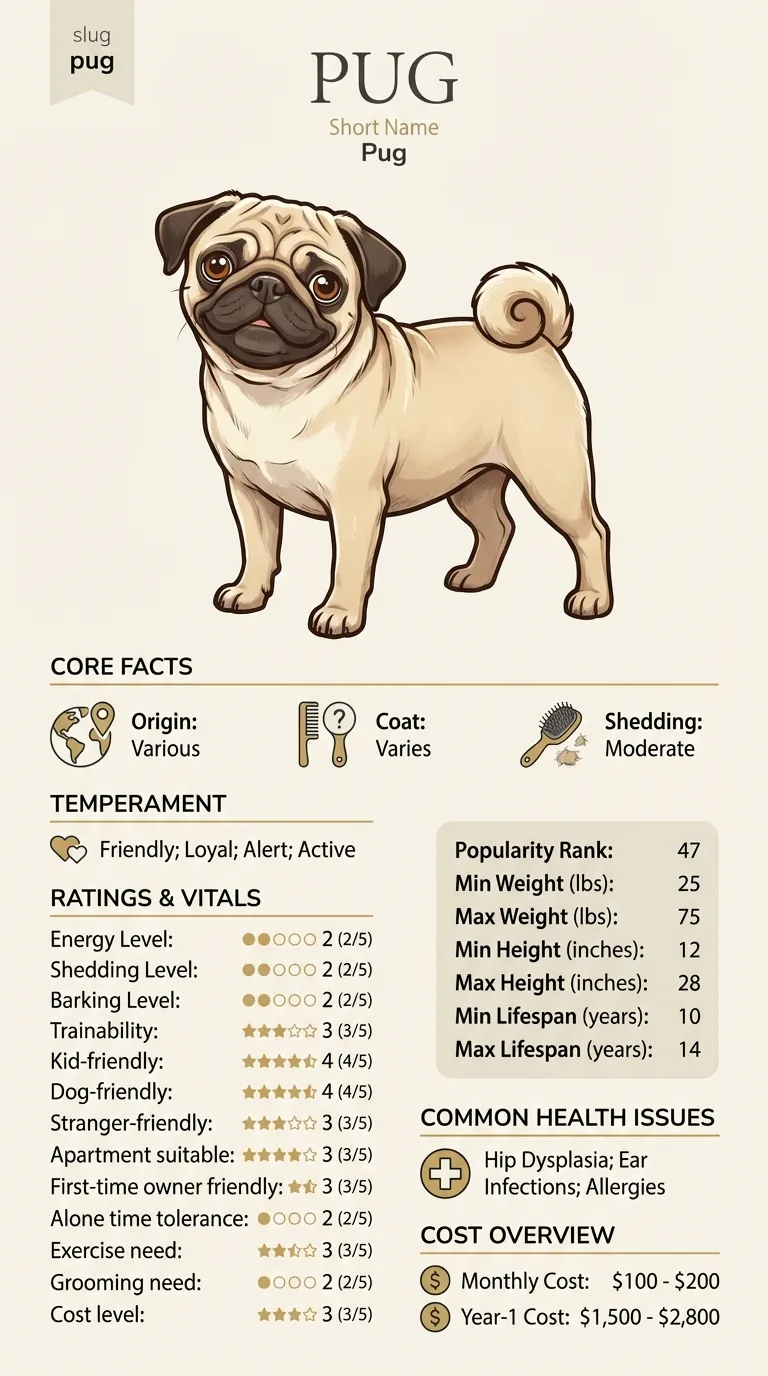
This is for someone already down to Beagle and Pug and deciding between them. For this pair the decision usually turns on exercise need and energy level, so those are covered first and in most detail. Anyone choosing from a flat has a clear answer here: Pug rates 5/5 against 3/5. There is no origin story here — only what changes about your week.
Between Beagle and Pug, exercise need is what separates them, and Pug is the lower-effort dog of the two to keep.
Choose Beagle if shedding is a problem in your house, you already have another dog and you want a dog that can keep up with an active routine.
Choose Pug if you are in a flat or a smaller home, this is your first dog and your walking routine is modest.
| Feature | beagle | pug | Winner |
|---|---|---|---|
| Size class | small | small | Equal |
| Weight | 20–30 lbs | 14–18 lbs | Equal |
| Height | 13–15 in | 10–13 in | Equal |
| Lifespan | 12–15 years | 13–15 years | pug |
| Exercise need | High (4/5) | Low (2/5) | pug |
| Grooming need | Low (2/5) | Low (2/5) | Equal |
| Shedding | Moderate (3/5) | High (4/5) | beagle |
| Energy level | High (4/5) | Low (2/5) | Equal |
| Barking | High (4/5) | Low (2/5) | pug |
| Apartment suitability | Moderate (3/5) | Very high (5/5) | pug |
| Good for first-time owners | High (4/5) | Very high (5/5) | pug |
| Tolerates being alone | Low (2/5) | Low (2/5) | Equal |
| Trainability | Moderate (3/5) | Moderate (3/5) | Equal |
| Good with kids | Very high (5/5) | Very high (5/5) | Equal |
| Good with other dogs | Very high (5/5) | High (4/5) | beagle |
| Friendly to strangers | High (4/5) | Very high (5/5) | pug |
| Cost level | Moderate (3/5) | Moderate (3/5) | Equal |
| Coat | Short, dense | Short, smooth double coat | Equal |
| Origin | England | Various | Equal |
| Typical monthly cost | $80–$150 | $80–$150 | Equal |
| Typical first-year cost | $1,300–$2,300 | $1,100–$2,300 | Equal |
The Pug runs smaller across the board - 14-18 lbs and 10-13 inches against the Beagle's 20-30 lbs and 13-15 inches. Both count as small breeds, but you're looking at a genuine size step down if you go Pug, along with a completely different build: short-legged and stocky versus the Beagle's compact hound frame. That build also affects how each breed handles heat, something worth factoring into your climate.
The exercise gap is the story here: high (4/5) for the Beagle against low (2/5) for the Pug. In practice, a Pug's flat face limits how hard it can push in heat or humidity, something a scent hound built for distance doesn't deal with the same way. Short, cool-weather walks work better for a Pug than long midday outings, while a Beagle can handle more sustained activity across a wider range of conditions.
Grooming need ties at low (2/5) for both, but shedding doesn't - the Pug rates high (4/5) against the Beagle's moderate (3/5). Don't let the short coat fool you; Pugs are notorious shedders despite needing almost no brushing technique. They also need regular cleaning of their facial folds to prevent skin irritation, a maintenance task the Beagle's coat doesn't require at all.
The Pug is the better apartment dog on paper: very high (5/5) suitability against the Beagle's moderate (3/5), plus far less barking (low 2/5 versus high 4/5). If noise complaints from neighbors are a real concern, that barking gap alone might decide this comparison, especially in a building with strict rules about noise. Ask your landlord about breed or noise restrictions before signing a lease with either dog.
Both breeds tie at moderate (3/5) trainability, but the Pug edges ahead for first-time owners, rated very high (5/5) against the Beagle's high (4/5). Neither breed tolerates solo time well (both low, 2/5), so the training difference matters less than making sure someone's usually home. Positive, food-based methods work well with both, though a Pug's lower exercise need means training sessions may be one of its few real outlets for mental stimulation.
Both breeds tie at very high (5/5) with kids, making either a safe bet for a family. The Beagle edges ahead with other dogs (very high 5/5 versus high 4/5), while the Pug is slightly friendlier to strangers (very high 5/5 versus high 4/5) - small differences, but worth knowing if one factor matters more to your particular household setup.
These two barely overlap on health - only obesity shows up on both lists. The Pug's risks are dominated by its flat face: brachycephalic airway syndrome, corneal ulcers, and pug dog encephalitis, none of which apply to the Beagle. The Pug also lives slightly longer, 13-15 years against the Beagle's 12-15. Ask a vet about airway screening before committing to a Pug.
Costs are close to identical: moderate (3/5) for both, $80-150 monthly for each, and first-year costs of $1,300-2,300 for the Beagle versus $1,100-2,300 for the Pug. Where the Pug can get expensive is unpredictable - brachycephalic breeds sometimes need airway surgery, a cost that doesn't show up in routine budgeting. Setting aside an emergency fund is a sensible move with either breed, but especially the Pug.
Beagle weighs 20–30 lbs and lives 12–15 years; Pug weighs 14–18 lbs and lives 13–15 years. The two diverge most on exercise need, energy level and apartment suitability and 1 other rated axes. They are level on tolerates being alone, cost level and grooming need, so those cannot decide it. Where the table declares a winner it means less work for the owner, nothing more; descriptive rows are left as ties on purpose. The value here is in the differences between the two columns; treat any single score as approximate.

The Pug, at 14-18 lbs and 10-13 inches against the Beagle's 20-30 lbs and 13-15 inches.
The Pug, rated high (4/5) against the Beagle's moderate (3/5) - surprising for such a short coat, but Pugs are known heavy shedders.
Slightly - very high (5/5) versus the Beagle's high (4/5). Both are workable first dogs; the Pug's lower exercise need (low 2/5 versus the Beagle's high 4/5) is likely why it edges ahead.
The Pug by a wide margin - low (2/5) barking and very high (5/5) apartment suitability, against the Beagle's high (4/5) barking and moderate (3/5) suitability.
Both run $80-150 monthly, essentially the same. First-year totals are close too, though a Pug's brachycephalic health issues can bring unplanned vet costs the Beagle's list doesn't carry.
Barely - obesity is the only condition on both lists. The Pug's other risks are almost all tied to its flat face, like airway syndrome and corneal ulcers, which the Beagle doesn't face.
The Beagle by a wide margin - high (4/5) exercise need against the Pug's low (2/5). A Beagle that doesn't get a real walk will find its own entertainment, usually destructively.
Want a calmer, quieter apartment dog with low exercise needs? Take the Pug. Want a more active companion with a wider health profile away from airway problems? Take the Beagle.
Nearly identical on paper - both $80-150 monthly - though the Pug carries more risk of unplanned costs from its flat-faced anatomy.
Big gap: high (4/5) for the Beagle versus low (2/5) for the Pug. The Beagle needs a real daily walk; the Pug does not.
Close - 13-15 years for the Pug versus 12-15 for the Beagle - with almost no health overlap between the two breeds.
See every pug comparison.
Secure checkout on Stripe. We never see your card.
7-day money-back guarantee. Instant access.
Health information here is general and is not veterinary advice. If your dog shows pain, sudden behaviour change, or worsening symptoms, consult a licensed veterinarian.
Some links on this site are affiliate links. We may earn a commission at no extra cost to you, and we only suggest products we believe are helpful for dog owners.
We research and check what we publish, but we do not warrant that any figure, date, price, or statement is accurate, complete, or current, and we accept no liability for any loss, cost, injury, or other harm arising from the use of this site. Use it as one reference among several. You remain responsible for your own decisions and for your dog's care - confirm anything that matters with a licensed veterinarian or another qualified professional before you act on it. Full disclaimer.
Match your lifestyle to the right dog.
Take quizNot sure which breed is right for you? Take our 2-minute quiz to find out.
Take the quiz