Health
Why does my Papillon make a honking cough?
Most likely a collapsing trachea, a documented breed issue where weakened cartilage lets the windpipe flatten during fast airflow.

Quick answer
Why does my Papillon make a honking cough?
Most likely a collapsing trachea, a documented breed issue where weakened cartilage lets the windpipe flatten during fast airflow.
Nothing about a Papillon's face restricts its breathing. Everything about its windpipe can.
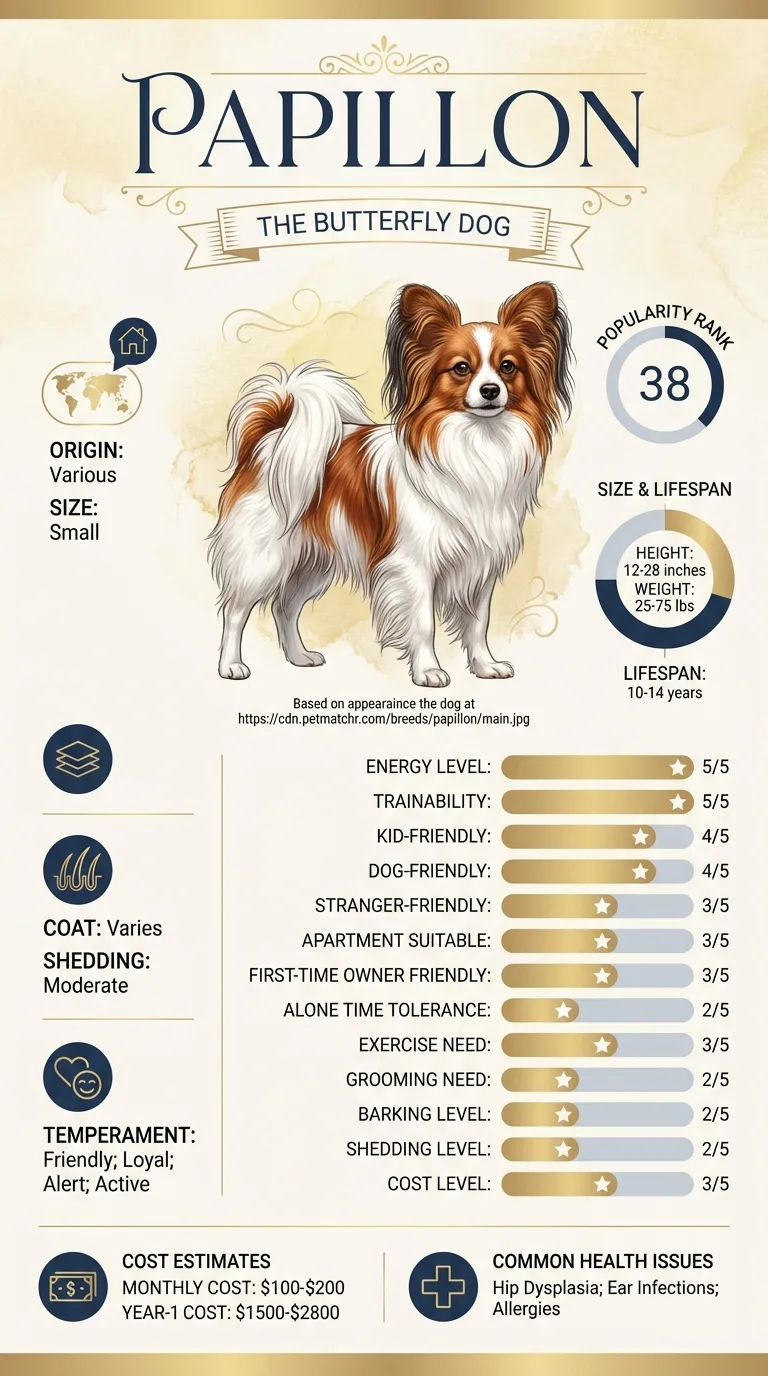
Owners whose Papillon has developed a dry honking cough on excitement or on the lead, and those who have read alarming statistics about airway disease in flat faced breeds and applied them to a dog with a perfectly normal muzzle.
This guide is not medical advice. If your dog shows pain, sudden behavior change, or worsening symptoms, consult a licensed veterinarian.
Some links may be affiliate links. We may earn a commission at no extra cost to you. We only suggest products we believe are helpful for dog owners.
We research and check what we publish, but we do not warrant that any figure, date, price, or statement is accurate, complete, or current, and we accept no liability for any loss, cost, injury, or other harm arising from the use of this site. Use it as one reference among several. You remain responsible for your own decisions and for your dog's care - confirm anything that matters with a licensed veterinarian or another qualified professional before you act on it. Full disclaimer.
The Papillon's documented airway condition is collapsing trachea, in which weakened cartilage rings allow the windpipe to flatten when air moves through it quickly. The result is a distinctive dry honking cough triggered by excitement, leash pressure, drinking, cold air or heat. It is a mechanical problem rather than an obstruction of the face, which is why comparisons with flat faced breeds mislead more than they inform.
Collapsing trachea is listed among the Papillon's common health issues and is well recognised across toy breeds generally. Many affected dogs cough only occasionally and never progress beyond a nuisance. A smaller number develop persistent coughing that limits activity, and those dogs benefit most from formal veterinary management.
The tracheal cartilage in affected toy breeds is deficient in the components that give it rigidity, so the rings flatten under negative pressure rather than holding their shape. It is a structural weakness present in the tissue rather than something acquired, though it usually becomes clinically obvious in adulthood or later. A Papillon's very long lifespan of fourteen to sixteen years gives a slowly progressing airway problem plenty of time to develop, and the breed's alert, vocal temperament supplies the excitement that triggers episodes.
Households drive the frequency of episodes almost entirely. A dog walked on a collar has pressure applied to the weak section daily. A dog in a smoking household, or one where aerosols and scented products are used freely, has a permanently irritated airway. A dog that is allowed to hurl itself at the door for every visitor is provoking collapse several times an evening. Warm humid rooms compound all of it.
Book an appointment for any new honking cough so it can be characterised and imaged, and go sooner if coughing has become frequent enough to interrupt walks, meals or sleep. Go to an emergency clinic immediately for a dog that cannot recover its breath between coughs, whose gums or tongue look blue, grey or very pale, that collapses during a coughing fit, or that is breathing with obvious effort at rest. In hot weather, a Papillon with a known airway problem that is panting frantically needs treating as a heat emergency, not as a coughing episode.
See all Papillon health problems, which breeds are prone to respiratory disease, or the full Papillon breed guide for temperament, exercise needs and ownership costs.
Owners who switch to a harness often notice fewer episodes within days. Weight reduction on a small dog takes two to four months to show its benefit. Arousal training takes weeks. The underlying cartilage weakness is permanent and may progress slowly across the dog's remaining decade, so this is ongoing management rather than a course of treatment.
Success is a dog that honks occasionally rather than daily, completes its walks, sleeps undisturbed, tolerates ordinary excitement, and has never had a coughing episode that frightened anybody. It is not a silent windpipe.
Air moving rapidly through a tube lowers the pressure inside it. In a healthy windpipe the cartilage rings are rigid enough to resist that, and the tube holds its shape. In a dog with weakened cartilage, the faster the airflow the more the tube collapses, and the more it collapses the faster the remaining air must move through the narrowed section. The process feeds itself.
When the walls touch and vibrate, the result is a loud, dry, resonant honk that owners almost universally compare to a goose. It comes in bursts, it ends as suddenly as it started, and the dog typically shakes itself and carries on.
That mechanism explains every trigger. Excitement means fast breathing. Pulling against a collar means direct external pressure on the exact section that is already weak. Drinking, eating, cold air and airborne irritants all provoke it. Heat is the worst combination of all, because panting is both the cooling system and the fastest airflow the dog produces, so the dog is forced to do the thing that closes its own airway.
Diagnosis is made on radiographs, and importantly on more than one, because the trachea narrows at different points during breathing in and breathing out. Some vets will use fluoroscopy or endoscopy to see the collapse dynamically. A single still film can miss it entirely.

This condition is managed rather than cured, but the management is unusually effective and most of it is free or nearly free.
If you think your Papillon has respiratory disease, the plan is three steps: write down what you have seen and when it started, book a veterinary appointment rather than waiting for the next flare, and take video of the behaviour or symptom before you go — the thing you are worried about rarely happens in the consulting room. Screening in the parents covers patellar luxation, progressive retinal atrophy, dental disease.
What the vet visit should produce is a diagnosis and a written plan, not just reassurance: what is being ruled out, what the monitoring interval is, and which signs mean you come back sooner. Ask what the treatment costs across a year rather than per visit, because that is the number that decides whether you are managing this condition or reacting to it.
Between appointments, keep a short log — dates, what you saw, what changed. It is the single most useful thing an owner brings to a follow-up, and for respiratory disease it is often what separates a clear pattern from a guess.
Petra's Papillon Anouk started honking at seven, mostly on walks and always when the postman came. Radiographs confirmed tracheal collapse in the neck portion. Her vet gave her three jobs before any medication. Move to a harness. Get Anouk from eight pounds five ounces to seven and a half. And do something about the door. The harness helped within a week. The weight took four months and Petra used a kitchen scale for the food. The door took longest: she spent six weeks teaching Anouk to run to a mat and lie down when the bell rang, paying her generously from her measured daily ration. Anouk went from coughing most days to coughing perhaps twice a month, and never needed a prescription at all.
Key takeaway: Tracheal collapse responds to mechanics rather than medicine. Take the pressure off the neck, take the weight off the chest, and take the frenzy out of the day, and most Papillons cough a great deal less.
No. Brachycephalic means a shortened, flattened skull with a compressed nasal passage, seen in breeds such as the Pug, French Bulldog and Boston Terrier. A Papillon has a fine, well proportioned tapering muzzle with a normal length nasal passage. Statistics about elevated respiratory disease risk in flat faced breeds simply do not describe this breed.
Dry, loud, resonant and abrupt, most often described as a goose honk. It comes in short bursts of a few coughs, it is triggered by excitement, leash pressure, drinking or cold air, and the dog usually appears completely normal immediately afterwards. It is quite distinct from the soft, wet, night time cough of heart disease.
No. The cartilage does not regain its rigidity. It is managed, and managed well it can become a minor feature of a dog's life rather than a dominant one. In severe cases that do not respond to medical and lifestyle management, surgical options including stents or external ring supports exist, and these belong with a specialist.
Often it progresses gradually, which matters in a breed living fourteen to sixteen years. How fast varies enormously and is influenced by weight, by whether a collar is still being used, and by how often the dog is allowed to work itself into a frenzy. Many dogs stay in a mild, occasional stage for years.
An ordinary honking burst that resolves in seconds is not. It becomes an emergency if the dog cannot get its breath back between coughs, if the gums or tongue turn blue or grey, if the dog collapses, or if a coughing fit escalates into obvious distress. Those situations need a clinic immediately rather than a call in the morning.
Both cause coughing in older small dogs and a Papillon can have both at once, which makes the distinction genuinely difficult. The pattern helps: airway coughs are dry and triggered by activity, cardiac coughs are softer and worse at night with a rising resting breathing rate. Radiographs looking at both the heart silhouette and the trachea are usually how it is sorted out.
Most likely a collapsing trachea, a documented breed issue where weakened cartilage lets the windpipe flatten during fast airflow.
A harness, always. Pressure from a collar falls directly on the section of windpipe most likely to collapse, and switching is the single best change you can make.
No. They have a normal tapering muzzle and a full length nasal passage. Airway statistics about brachycephalic breeds do not apply to them.
No, but it is often managed very effectively with a harness, weight control, irritant removal and arousal management, with surgery reserved for severe cases.
A one-page prep sheet for this condition: the signs, the questions to ask, what to get priced. Unlocks here.
You get: Vet visit prep sheet
No spam. One-click unsubscribe. See our privacy policy.
Preview page 1 before you decide.