Health
Is the Bernese Mountain Dog a brachycephalic breed?
No. He has a normal muzzle on a large frame, which places him outside the group affected by structural airway obstruction.

Quick answer
Is the Bernese Mountain Dog a brachycephalic breed?
No. He has a normal muzzle on a large frame, which places him outside the group affected by structural airway obstruction.
Noisy breathing in a flat-faced dog is often lifelong and structural. Noisy breathing in a Bernese is usually new information.
Owners who have noticed a change in their dog's breathing or bark and want to know what it means, and owners who have found brachycephalic airway content and cannot tell whether it applies to a normally proportioned breed.
This guide is not medical advice. If your dog shows pain, sudden behavior change, or worsening symptoms, consult a licensed veterinarian.
Some links may be affiliate links. We may earn a commission at no extra cost to you. We only suggest products we believe are helpful for dog owners.
We research and check what we publish, but we do not warrant that any figure, date, price, or statement is accurate, complete, or current, and we accept no liability for any loss, cost, injury, or other harm arising from the use of this site. Use it as one reference among several. You remain responsible for your own decisions and for your dog's care - confirm anything that matters with a licensed veterinarian or another qualified professional before you act on it. Full disclaimer.
Respiratory disease in a Bernese Mountain Dog is not a structural airway problem, because the breed has normal facial proportions. Breathing difficulty here arises from acquired conditions: failure of the laryngeal cartilages to open in older large dogs, fluid in the lungs from heart disease, infection, chest tumours, or most commonly from heat stress in a heavily coated dog whose only cooling mechanism is panting.
Respiratory disease is not among this breed's documented health issues, and the Bernese sits in the low-risk group for structural airway obstruction rather than the high-risk one. Claims placing this breed several times above non-brachycephalic dogs for respiratory disease misapply data from flat-faced breeds. What is genuinely common in a Berner is heat-related breathing distress, which every owner in a warm region will encounter.
The dominant breed factor is thermoregulatory rather than anatomical. A medium-length double coat with a dense undercoat, on a body weighing 70 to 115 pounds, with predominantly dark colouring, produces a dog who accumulates heat quickly and sheds it slowly. Since panting is the primary cooling route, a hot Bernese breathes hard by necessity. Size contributes a second factor: laryngeal paralysis is a condition of large breeds in middle and old age, and a Berner falls squarely into that population.
Humidity is the single most important environmental variable, because panting depends on evaporation and high humidity disables it. Radiant heat from asphalt and direct sun compounds it. Enclosed spaces without airflow, particularly vehicles, allow heat to accumulate faster than owners expect. Dusty or smoky indoor air irritates airways in any dog. And households without effective cooling deny a heat-sensitive dog the overnight recovery that restores his margin for the following day.
Go immediately to an emergency service if your Bernese is breathing with visible abdominal effort at rest, stands with elbows out and neck extended and will not lie down, has blue, grey or very pale gums, collapses, or is panting frantically and cannot settle after ten minutes in a cool place. Those are emergencies with a short window. Book a prompt appointment for a new raspy noise on breathing in, a changed or hoarse bark, a cough that has persisted more than a few days, reduced exercise tolerance on cool days, or a resting breath rate that has climbed over weeks.
Start here: Bernese Mountain Dog Most Common Genetic Disorders
See all Bernese Mountain DOG health problems, which breeds are prone to respiratory disease, or the full Bernese Mountain DOG breed guide for temperament, exercise needs and ownership costs.
Heat-related breathing distress resolves within minutes to hours once cooling is effective, though monitoring for delayed complications continues for one to two days. Laryngeal paralysis is progressive and does not improve on its own; management runs from environmental control through to surgical intervention, and dogs live with it for years. Infections respond over one to three weeks with treatment. The timeline is entirely dependent on which cause is found, which is why diagnosis comes first.
For the heat-related version, which is the common one here, success is an unremarkable summer with no episode of distress and a schedule built around cool hours. For an acquired airway condition, success is a dog who breathes comfortably at rest, sleeps without noise, tolerates gentle walks in cool weather, and has never had an emergency breathing crisis. Restoring the airway of a young dog is not what is being aimed at, because this breed did not start with a compromised one.
Brachycephalic obstructive airway syndrome arises from a specific set of anatomical features: nostrils narrowed to slits, a soft palate too long for a shortened skull, a compressed nasal passage, and secondary collapse of tissue in the larynx. It is a consequence of breeding for a foreshortened face.
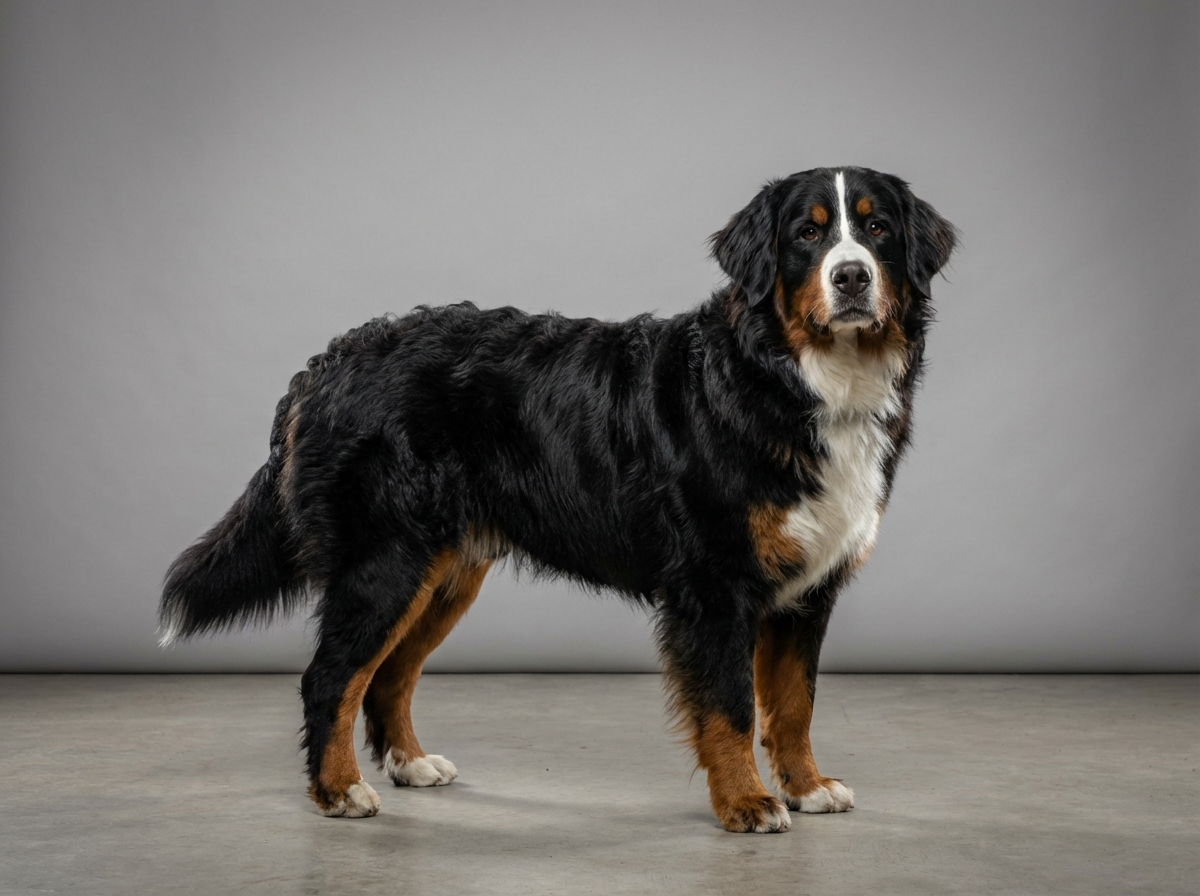
A Bernese Mountain Dog has none of that. He is a mesocephalic breed with a muzzle of normal proportion, developed in Switzerland as a farm and draft dog whose job required stamina outdoors. Airway obstruction is not built into him.
This matters practically. Statistics comparing brachycephalic and non-brachycephalic dogs for respiratory disease place this breed in the low-risk group, not the high-risk one, and any figure presenting a Bernese as several times more likely to have respiratory disease than a non-brachycephalic dog has simply been misapplied to the wrong breed.
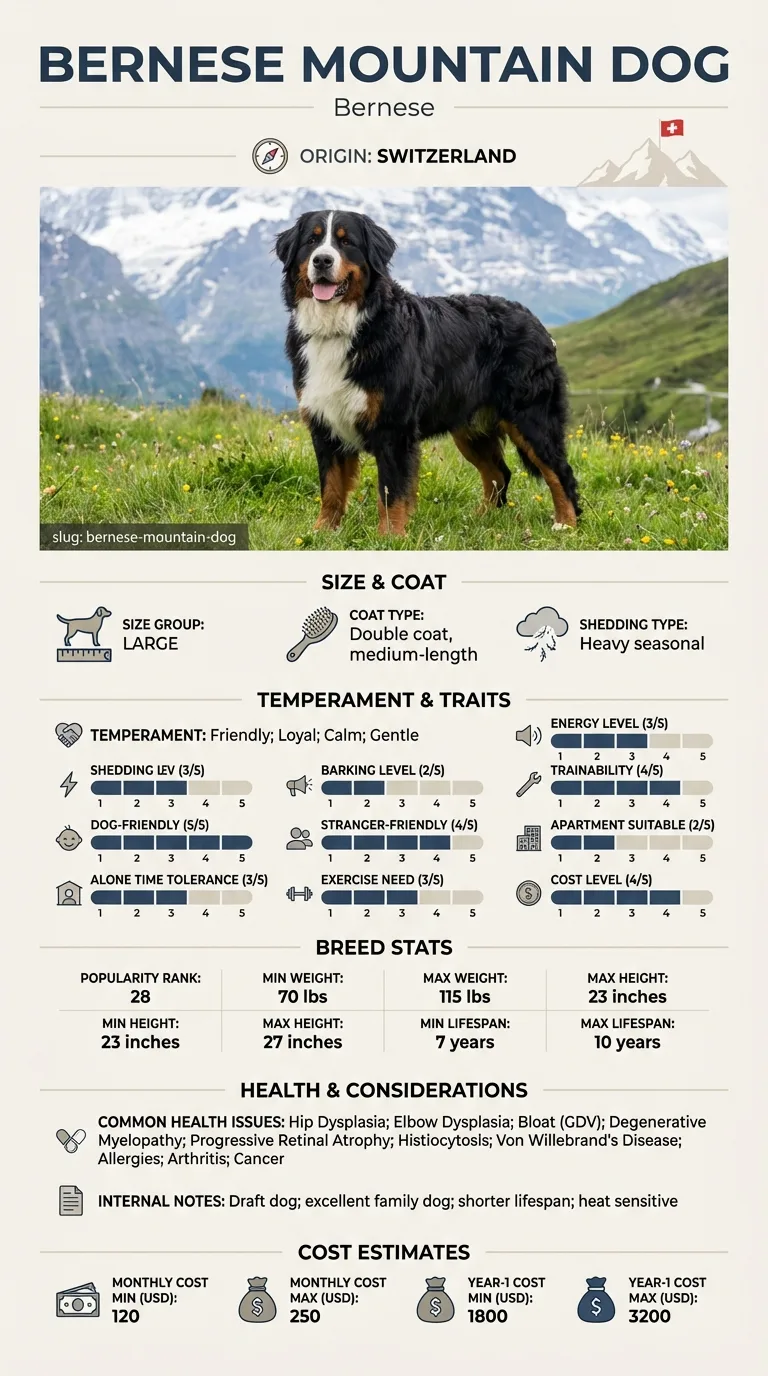
What is genuinely true of this breed is different and worth taking seriously. Bernese Mountain Dogs are heat sensitive, carrying a dense double coat built for Alpine winters on a body of 70 to 115 pounds. Heavy panting is their primary cooling mechanism, so a Berner will breathe hard on a warm day in a way a short-coated dog will not, and owners frequently interpret normal thermoregulation as a respiratory problem.
The distinction to draw is between a dog who breathes hard because he is hot and a dog whose airway or lungs are not working. The first resolves in shade and air conditioning. The second does not.
This is the list a veterinarian works through for a Bernese with breathing trouble. Note that none of it is structural airway narrowing, and several entries are urgent.

If you think your Bernese has respiratory disease, the plan is three steps: write down what you have seen and when it started, book a veterinary appointment rather than waiting for the next flare, and take video of the behaviour or symptom before you go — the thing you are worried about rarely happens in the consulting room. Screening in the parents covers hip dysplasia, elbow dysplasia, bloat (gdv).
What the vet visit should produce is a diagnosis and a written plan, not just reassurance: what is being ruled out, what the monitoring interval is, and which signs mean you come back sooner. Ask what the treatment costs across a year rather than per visit, because that is the number that decides whether you are managing this condition or reacting to it.
Between appointments, keep a short log — dates, what you saw, what changed. It is the single most useful thing an owner brings to a follow-up, and for respiratory disease it is often what separates a clear pattern from a guess.
Theo was nine and his family noticed, in an offhand way, that his bark had gone hoarse. It sounded as though he had a sore throat, and they assumed he had been barking too much at the postman. Over the following summer he became far less willing on walks and started making a rasping noise when he breathed in, particularly when excited. On a warm afternoon in July he panicked at the door and could not settle for twenty minutes, which is what finally took them to the vet. Examination under light sedation showed the laryngeal cartilages were not opening properly. The diagnosis was laryngeal paralysis, a recognised condition of older large-breed dogs and nothing to do with the flat-faced airway syndrome his family had been reading about. Theo was managed with strict heat avoidance, weight reduction and a harness rather than a collar, with surgery held in reserve.
Key takeaway: In a large breed, a hoarse bark can precede visible breathing trouble by many months. A change in voice is worth mentioning to a veterinarian rather than filing under too much barking.
No, not structurally. Respiratory disease does not appear among the breed's documented health issues, which are hip and elbow dysplasia, bloat, degenerative myelopathy, retinal atrophy, histiocytosis, von Willebrand's disease, allergies, arthritis and cancer. The breed's genuine breathing-related vulnerability is heat intolerance, which is a cooling problem rather than an airway one.
A new inspiratory noise in a middle-aged or older large breed dog, especially with a hoarse or changed bark, is the classic description of laryngeal paralysis. It needs veterinary assessment rather than monitoring, because affected dogs are at serious risk of a breathing crisis in warm weather or during exertion.
More than you would expect from a short-coated dog. Panting is how a Berner sheds heat, and a dense double coat on a large body makes it his main tool. What is not normal is panting that does not settle after ten to fifteen minutes of rest in a cool place, or panting while the dog is resting indoors in comfortable conditions.
Look at effort and posture. A panting dog has a relaxed body and an open mouth with the tongue out. A dog in respiratory distress uses his abdomen visibly to breathe, may stand with his elbows held away from his body and his neck extended, is reluctant to lie down, and often has abnormally coloured gums. The second picture is an emergency.
Occasional snoring in a relaxed sleeping position is usually unremarkable in any breed. What deserves attention is snoring that has newly appeared or become much louder, snoring that occurs while the dog is awake, or noise accompanied by exercise intolerance or a changed bark, since those point toward the upper airway rather than sleeping posture.
Allergies are on the Bernese documented health issue list, but in dogs they present overwhelmingly as skin and ear disease rather than as respiratory signs. Dogs do not typically develop hay fever the way people do. Persistent coughing or breathing difficulty should be investigated as a chest or airway problem rather than attributed to allergy.
No. He has a normal muzzle on a large frame, which places him outside the group affected by structural airway obstruction.
Laryngeal paralysis, appearing in middle-aged to older dogs as a raspy inspiratory noise, a changed bark and marked heat intolerance.
Distress shows visible abdominal effort, elbows held out, neck extended, reluctance to lie down and abnormal gum colour. Panting alone does none of that.
Because panting is his only real cooling mechanism and a dense double coat on a large body makes it hard work. That is heat management, not respiratory disease.
A one-page prep sheet for this condition: the signs, the questions to ask, what to get priced. Unlocks here.
You get: Vet visit prep sheet
No spam. One-click unsubscribe. See our privacy policy.
Preview page 1 before you decide.