Behavior
Which is the better overall pick?
For lower cost, an easier coat, and a longer expected lifespan, the Papillon wins on paper; families wanting a sturdier dog for young kids may still prefer the Corgi.

Quick answer
Which is the better overall pick?
For lower cost, an easier coat, and a longer expected lifespan, the Papillon wins on paper; families wanting a sturdier dog for young kids may still prefer the Corgi.
Papillon or Pembroke Welsh Corgi? On paper they differ most on shedding, and on the scales Pembroke Welsh Corgi is the heavier at 24–30 lbs. Here is how the two compare on everything that shapes an ordinary week.
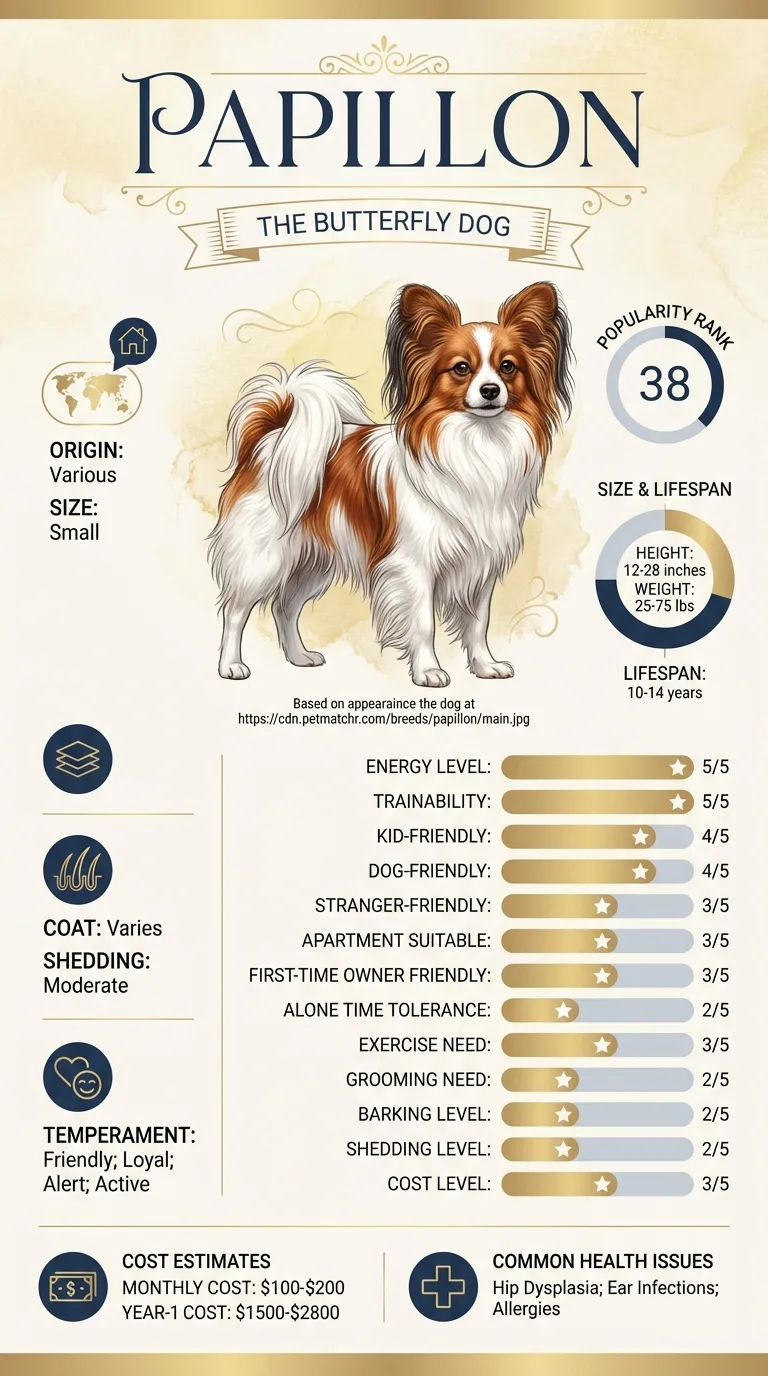
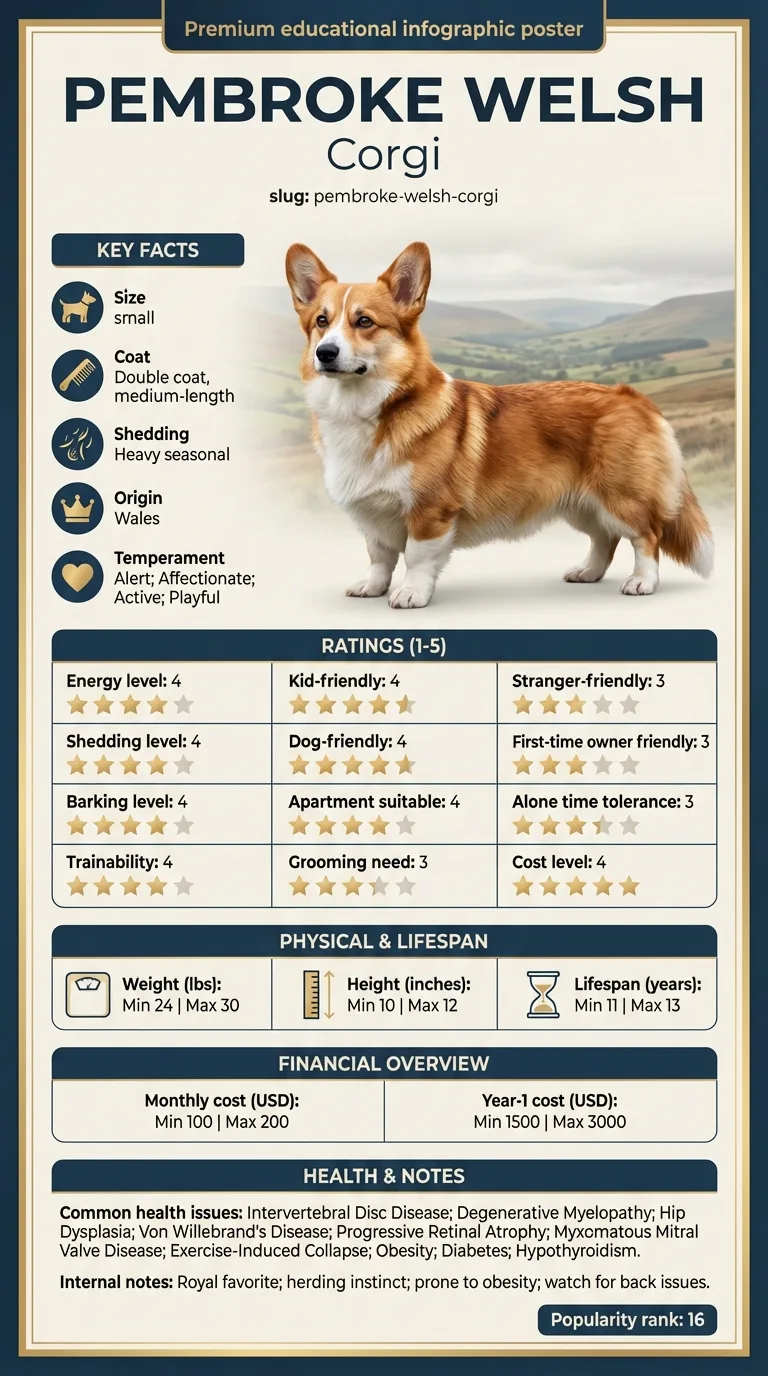
This is for someone already down to Papillon and Pembroke Welsh Corgi and deciding between them. For this pair the decision usually turns on shedding and cost level, so those are covered first and in most detail. Anyone choosing from a flat has a clear answer here: Papillon rates 5/5 against 4/5. It is written for the decision rather than the breed history.
Between Papillon and Pembroke Welsh Corgi, shedding is what separates them, and Papillon is the lower-effort dog of the two to keep.
Choose Papillon if you are in a flat or a smaller home, this is your first dog and you do not want a standing grooming appointment.
Choose Pembroke Welsh Corgi if the dog will be alone during the working day, there are young children at home and you want a dog that can keep up with an active routine.
| Feature | papillon | pembroke welsh corgi | Winner |
|---|---|---|---|
| Size class | small | small | Equal |
| Weight | 5–10 lbs | 24–30 lbs | Equal |
| Height | 8–11 in | 10–12 in | Equal |
| Lifespan | 14–16 years | 11–13 years | papillon |
| Exercise need | Moderate (3/5) | High (4/5) | papillon |
| Grooming need | Low (2/5) | Moderate (3/5) | papillon |
| Shedding | Low (2/5) | High (4/5) | papillon |
| Energy level | High (4/5) | High (4/5) | Equal |
| Barking | High (4/5) | High (4/5) | Equal |
| Apartment suitability | Very high (5/5) | High (4/5) | papillon |
| Good for first-time owners | High (4/5) | Moderate (3/5) | papillon |
| Tolerates being alone | Low (2/5) | Moderate (3/5) | pembroke welsh corgi |
| Trainability | Very high (5/5) | High (4/5) | papillon |
| Good with kids | Moderate (3/5) | High (4/5) | pembroke welsh corgi |
| Good with other dogs | High (4/5) | High (4/5) | Equal |
| Friendly to strangers | High (4/5) | Moderate (3/5) | papillon |
| Cost level | Low (2/5) | High (4/5) | papillon |
| Coat | Long, silky single coat | Double coat, medium-length | Equal |
| Origin | Various | Wales | Equal |
| Typical monthly cost | $80–$150 | $100–$200 | Equal |
| Typical first-year cost | $1,100–$2,300 | $1,500–$3,000 | Equal |
Both breeds are filed under 'small' size class, but the numbers tell a different story: the Papillon weighs just 5–10 lbs at 8–11 inches, while the Corgi weighs 24–30 lbs — up to six times heavier — despite standing only slightly taller at 10–12 inches. The Corgi is a low, long, sturdy dog; the Papillon is a genuinely tiny one.
Energy level ties at high (4/5) for both, but exercise need tips toward the Corgi — high (4/5) against the Papillon's moderate (3/5). The Corgi was bred to herd cattle by nipping at heels all day, and that heritage still shows up as a need for real daily activity, not just play in the living room. A Papillon's exercise needs are easier to meet indoors, which matters if outdoor space is limited.
The Papillon is the easier coat to manage: low (2/5) grooming and low (2/5) shedding, despite its long, silky look, since it's a single coat with no undercoat to blow out seasonally. The Corgi's double coat brings moderate (3/5) grooming but high (4/5) shedding — it sheds more heavily than its grooming score alone would suggest. Expect noticeably more vacuuming with a Corgi in the house, even though its brushing schedule isn't as demanding as you might guess.
Both breeds tie at high (4/5) for barking, so quiet isn't really on the table with either. Apartment suitability favors the Papillon — very high (5/5) against the Corgi's still-solid high (4/5). The Papillon does worse at tolerating being alone, though, low (2/5) against the Corgi's moderate (3/5). That alone-tolerance gap is worth weighing against apartment suitability if you're out of the house for long stretches most days.
The Papillon rates ahead on both counts that matter for a new owner: high (4/5) for first-time-owner suitability against the Corgi's moderate (3/5), and very high (5/5) trainability against the Corgi's still-strong high (4/5). Papillons are consistently ranked among the most trainable small breeds, and these numbers reflect that. The Corgi's own intelligence is real too — it's simply a step behind the Papillon's near-top rating.
The Corgi rates better with kids, high (4/5) against the Papillon's moderate (3/5) — worth noting for a family with young children. The Papillon comes out ahead with strangers instead, high (4/5) against the Corgi's moderate (3/5). With other dogs the two tie at high (4/5). Neither breed's stranger rating is bad, but the Papillon's edge could matter if you host often.
The Papillon's lifespan is a real standout here — 14 to 16 years against the Corgi's 11 to 13, a gap that can run to five years at the extremes. The two breeds' health risks barely overlap, sharing only progressive retinal atrophy. The Corgi's list is longer and more structural, reflecting its long back and short legs: intervertebral disc disease, degenerative myelopathy, hip dysplasia, plus obesity and diabetes risk that comes with a big appetite on short legs.
The Papillon is meaningfully cheaper to keep: cost level low (2/5) against the Corgi's high (4/5), monthly costs of $80–$150 against $100–$200, and first-year costs of $1,100–$2,300 against $1,500–$3,000. Corgi ownership also often comes with orthopedic vigilance given the back and joint risks on its health list. That's roughly $700 more in a Corgi's first year at the top of each range, before any unplanned vet visits.
Papillon weighs 5–10 lbs and lives 14–16 years; Pembroke Welsh Corgi weighs 24–30 lbs and lives 11–13 years. The two diverge most on shedding and cost level. They are level on barking, good with other dogs and energy level, so those cannot decide it. In the table, a "winner" means easier for an ordinary household — not better. Size, coat and origin are recorded without a verdict. Because both breeds are scored the same way, the gaps are reliable even where the absolute numbers are rough.

The Corgi, by a lot — 24 to 30 lbs against the Papillon's 5 to 10, even though both are officially classed as small breeds and stand at similar heights.
The Corgi, clearly — high (4/5) shedding from its double coat against the Papillon's low (2/5) from its single coat.
The Papillon rates higher — high (4/5) for first-time owners and very high (5/5) trainability, against moderate (3/5) on both counts for the Corgi.
The Papillon edges it, very high (5/5) apartment suitability against the Corgi's high (4/5) — though both bark a fair amount, tied at high (4/5).
The Papillon runs $80–$150 a month and $1,100–$2,300 in year one; the Corgi runs $100–$200 a month and $1,500–$3,000 — the Corgi's cost level rates high (4/5) against the Papillon's low (2/5).
Only progressive retinal atrophy overlaps. The Corgi's list is longer and centers on its back and joints — intervertebral disc disease and hip dysplasia among them — a byproduct of its long spine and short legs.
The Papillon, by a wide margin — 14 to 16 years against the Corgi's 11 to 13.
For lower cost, an easier coat, and a longer expected lifespan, the Papillon wins on paper; families wanting a sturdier dog for young kids may still prefer the Corgi.
$80–$150 for the Papillon versus $100–$200 for the Corgi.
The Corgi, rated high (4/5) against the Papillon's moderate (3/5).
The Papillon, typically 14 to 16 years against the Corgi's 11 to 13.
Secure checkout on Stripe. We never see your card.
7-day money-back guarantee. Instant access.
Health information here is general and is not veterinary advice. If your dog shows pain, sudden behaviour change, or worsening symptoms, consult a licensed veterinarian.
Some links on this site are affiliate links. We may earn a commission at no extra cost to you, and we only suggest products we believe are helpful for dog owners.
We research and check what we publish, but we do not warrant that any figure, date, price, or statement is accurate, complete, or current, and we accept no liability for any loss, cost, injury, or other harm arising from the use of this site. Use it as one reference among several. You remain responsible for your own decisions and for your dog's care - confirm anything that matters with a licensed veterinarian or another qualified professional before you act on it. Full disclaimer.
Match your lifestyle to the right dog.
Take quizNot sure which breed is right for you? Take our 2-minute quiz to find out.
Take the quiz