Health
How do I measure my dog's craniofacial ratio?
Nose tip to the notch between the eyes, divided by that notch to the bump at the back of the skull. Well under a third suggests a brachycephalic head; a Papillon sits comfortably above it.

Quick answer
How do I measure my dog's craniofacial ratio?
Nose tip to the notch between the eyes, divided by that notch to the bump at the back of the skull. Well under a third suggests a brachycephalic head; a Papillon sits comfortably above it.
You can place your own dog on that spectrum in about a minute with a tape measure and no veterinary training at all.
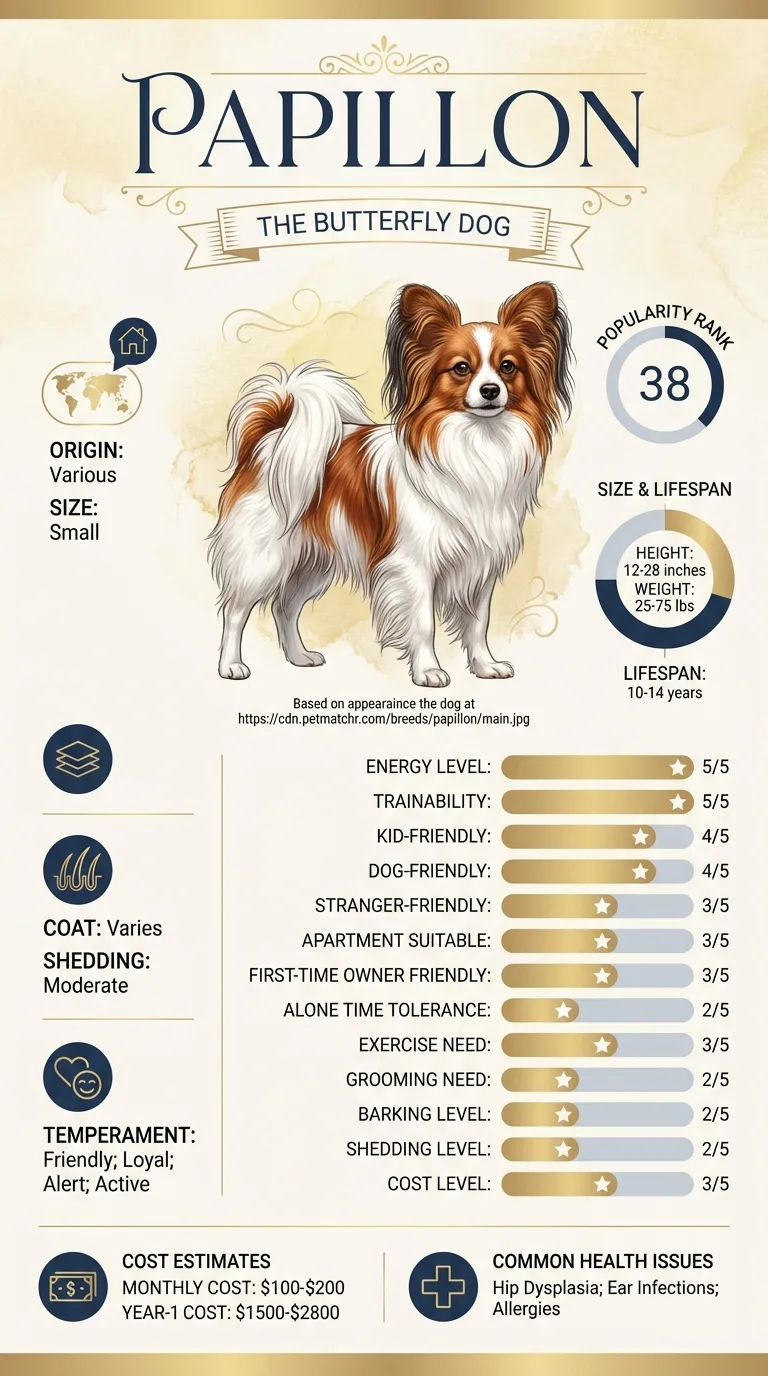
Owners of a Papillon with a shorter or blunter muzzle than the photographs they have seen, owners of a rescue dog of uncertain parentage, and anyone weighing up a puppy whose face looks different from its littermates.
This guide is not medical advice. If your dog shows pain, sudden behavior change, or worsening symptoms, consult a licensed veterinarian.
Some links may be affiliate links. We may earn a commission at no extra cost to you. We only suggest products we believe are helpful for dog owners.
We research and check what we publish, but we do not warrant that any figure, date, price, or statement is accurate, complete, or current, and we accept no liability for any loss, cost, injury, or other harm arising from the use of this site. Use it as one reference among several. You remain responsible for your own decisions and for your dog's care - confirm anything that matters with a licensed veterinarian or another qualified professional before you act on it. Full disclaimer.
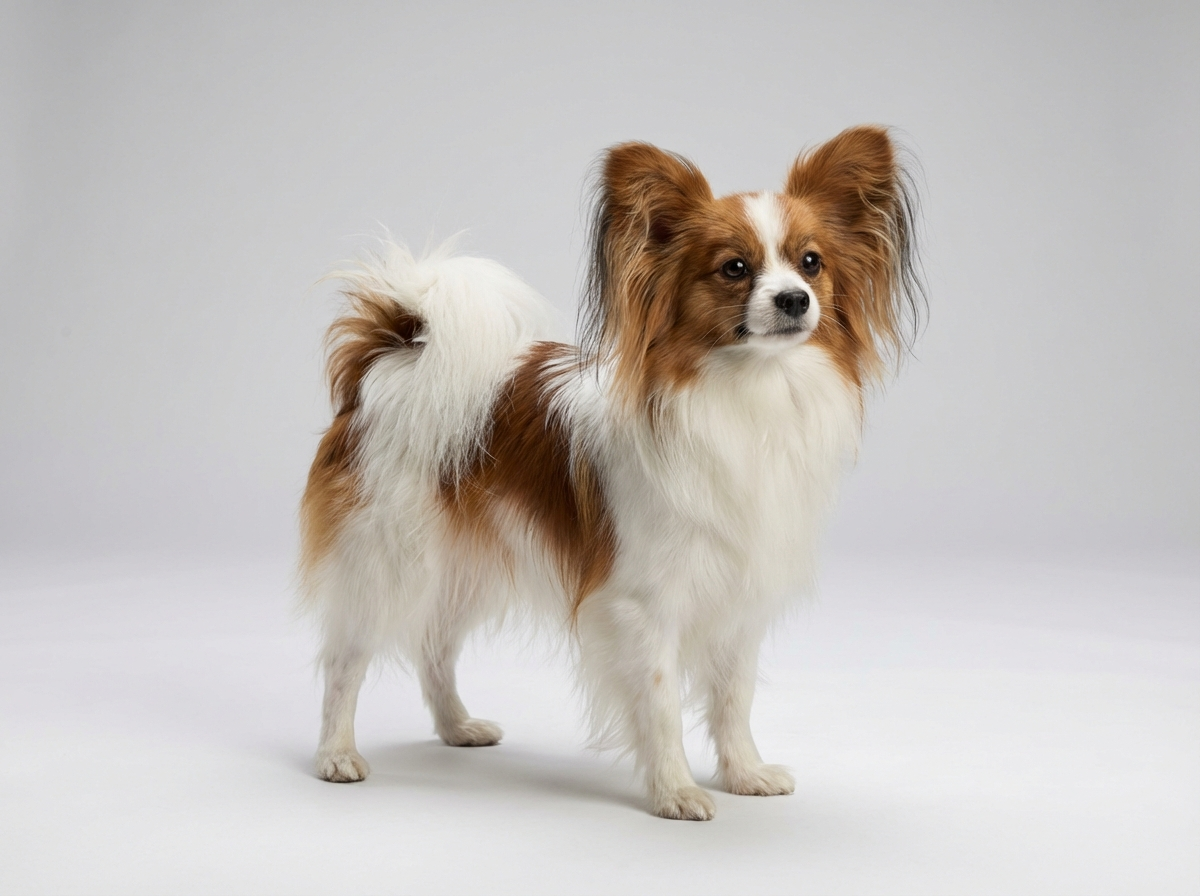
Brachycephalic features are a set of skull characteristics: a compressed muzzle, narrowed nostrils, a shallow eye socket that lets the eye protrude, and an undershot jaw. They travel together and they bring predictable breathing, eye and dental consequences. The Papillon carries none of them. Its head is a small, moderately domed skull with a fine tapering muzzle and, notably, enormous fringed ears.
Brachycephalic features are absent from the Papillon as a breed. They are near-universal in pugs, French bulldogs and English bulldogs, and increasingly present in some designer crosses. The confusion mostly arises with individual dogs of uncertain ancestry, or when a small dog with a blunt puppy face is judged before it has finished growing.
The Papillon descends from the small continental toy spaniels painted across Renaissance Europe, and that lineage was never selected for a shortened face. The breed's defining exaggeration went into the ears instead: large, obliquely set and heavily fringed, carried either erect or dropped. The documented health issues that follow from the head are a consequence of scale rather than shape, namely crowded teeth in a small jaw and, in some individuals, a skull fontanel that never closes.
Nothing environmental produces brachycephalic features, but several things imitate them temporarily. Swelling from an insect sting or an allergic reaction can round out a muzzle within an hour. A tooth root abscess can produce a bulge below the eye. A young puppy simply has a shorter face than it will have at a year. Photographic angle does the rest, since a lens close to a small dog's face foreshortens the muzzle noticeably.
See a vet promptly if the shape of your dog's face changes: a swelling under an eye, a firm lump along the jaw, asymmetry that was not there last month, or a nose that has changed texture or lost pigment. Those are disease processes rather than conformation. Seek urgent care for any facial swelling accompanied by noisy or laboured breathing, since airway compromise in a five to ten pound dog progresses quickly. Book a routine appointment if your dog has developed persistent noisy breathing at rest, or if you have genuine reason to think its ancestry includes a flat-faced breed, because that changes the screening plan.
See all Papillon health problems, which breeds are prone to brachycephalic features, or the full Papillon breed guide for temperament, exercise needs and ownership costs.
Settling the question takes one measurement and one look up the nostrils, so a few minutes rather than a process. A puppy's muzzle continues to lengthen until around six to eight months, so a blunt-faced twelve-week-old should be reassessed rather than judged. If ancestry is genuinely uncertain, a commercial DNA test returns results in two to four weeks.
Success is knowing what kind of dog you have. That means a recorded craniofacial ratio, a clear understanding that airway and eye advice written for flat-faced breeds does not apply, and attention redirected to the things that genuinely affect this breed's head: crowded teeth, a possible fontanel, and a great deal of ear fringe to keep combed.
Researchers describe head shape using the ratio of muzzle length to overall skull length. You can approximate it with a soft tape.
Measure from the tip of the nose to the notch between the eyes, where the muzzle meets the forehead. That is the muzzle length. Then measure from that same notch to the bony bump at the back of the top of the skull. Divide the first number by the second.
A severely brachycephalic dog lands well under a third, often close to a fifth. A typical Papillon lands comfortably above that, with a muzzle that is fine, tapered and clearly present in profile. A dog whose eyes protrude beyond the plane of the muzzle, whose nostrils are vertical slits rather than open commas, and whose lower jaw sits ahead of the upper is describing a different type of head altogether.
The measurement will not diagnose anything. What it does is settle the question of whether flat-faced breed literature has any bearing on your dog before you spend a fortnight worrying about it.

The Papillon takes its name from the ears, not the face. Large, obliquely set and heavily fringed, carried erect in the papillon variety and dropped in the phalene variety, they are the breed's defining feature and they sit on a small, slightly rounded skull with a well-defined stop and a tapering muzzle.
That construction has consequences worth knowing. Erect fringed ears ventilate well, which is why chronic ear disease is not on the breed's documented health list the way it is for drop-eared spaniels. A fine muzzle houses a full set of teeth in a small jaw, which is precisely why dental disease is on that list; crowding, not compression, is the problem here.
The skull carries one documented quirk: an open fontanel, a small gap between the plates at the top of the head that in some individuals never fully closes. That is a toy-breed skull finding, unrelated to face length, and worth mentioning to anyone handling the head.
Nothing in this construction restricts airflow. Papillons pant efficiently and tolerate warmth as well as any dog their size.
Marcus adopted a small dog described by the shelter as a Papillon cross. Nina had the ears and the coat, but her face looked shorter to him than any Papillon he found online, and he had spent a week reading about airway surgery. A friend suggested he measure rather than compare. Nose to the notch between the eyes came out at four and a half centimetres; the notch to the back of the skull came out at ten. That ratio was nowhere near brachycephalic territory. He then looked at her nostrils in daylight and found two open, comma-shaped openings. His vet confirmed a normal airway at her health check, and pointed instead at two retained puppy canine teeth crowding the front of her mouth, which were extracted at her spay. Nina is six now, breathes silently, and has a clean mouth because Marcus started brushing it that year.
Key takeaway: Photographs invite comparison and comparison invites anxiety. Two measurements and a look up the nose replace a week of searching with an answer.
Measure it rather than compare photographs. A muzzle that is clearly present in profile, with open rounded nostrils and eyes that sit within the plane of the face, is a normal toy-spaniel head regardless of whether it looks blunter than a show photograph.
Only the ear carriage. The papillon carries the ears erect like butterfly wings; the phalene carries the same large fringed ears dropped. They are the same breed and can appear in the same litter. The head and muzzle are identical.
It happens, particularly with rescue dogs of unknown history. A genuinely pushed-in face, slit nostrils and prominent eyes in a dog sold as a Papillon suggest mixed parentage, and that matters because the health advice that applies changes completely.
No. Progressive retinal atrophy is on the breed's documented list and it is a retinal degeneration with a genetic basis, not an anatomical consequence of a shallow eye socket. The corneal exposure problems seen in flat-faced breeds are a different mechanism entirely.
Because a full complement of forty-two adult teeth still has to fit into a jaw scaled for a five to ten pound dog. Crowding traps plaque between overlapping teeth, and retained baby teeth are common. That is a size problem, not a shape problem.
Considerably, across breeds. Dogs cool by moving air over the moist surfaces of the nose and throat, and a full-length nasal chamber does that far more effectively. A Papillon has that chamber and cools normally, needing only ordinary summer precautions.
Nose tip to the notch between the eyes, divided by that notch to the bump at the back of the skull. Well under a third suggests a brachycephalic head; a Papillon sits comfortably above it.
For canal ventilation, yes. The papillon variety's upright fringed ears dry faster than a dropped phalene ear, which is why phalene owners should be a little more attentive after baths and swims.
Mainly around the ears. The long fringe on the ear leather mats if neglected, and the feathering can trail into food and water. The breed's overall grooming demand is otherwise low.
It lowers it relative to flat-faced breeds, which carry airway surgery and eye ulcer costs as routine risks. This breed's recurring expense is dental care, driven by jaw size rather than face shape.
Yes, especially if it has an open fontanel. A Papillon taught to accept its muzzle, ears and skull being examined makes every check and every clinic visit shorter and calmer, and this breed learns it readily.
A one-page prep sheet for this condition: the signs, the questions to ask, what to get priced. Unlocks here.
You get: Vet visit prep sheet
No spam. One-click unsubscribe. See our privacy policy.
Preview page 1 before you decide.