Health
Is a Bichon Frise flat-faced?
No. It has a moderately short muzzle within normal working proportions, and it is not grouped with breeds subject to airway grading schemes.

Quick answer
Is a Bichon Frise flat-faced?
No. It has a moderately short muzzle within normal working proportions, and it is not grouped with breeds subject to airway grading schemes.
The Bichon Frise has a moderately shortened face without the crowded airway that defines a truly flat-faced breed, and the consequences of that middle position show up in the mouth and around the eyes rather than in the throat.
Prospective owners comparing small white breeds and trying to work out which ones carry conformational health costs. Also current owners noticing tear staining, crowded teeth or a snuffly sleeping dog and wondering whether the face shape is to blame.
This guide is not medical advice. If your dog shows pain, sudden behavior change, or worsening symptoms, consult a licensed veterinarian.
Some links may be affiliate links. We may earn a commission at no extra cost to you. We only suggest products we believe are helpful for dog owners.
We research and check what we publish, but we do not warrant that any figure, date, price, or statement is accurate, complete, or current, and we accept no liability for any loss, cost, injury, or other harm arising from the use of this site. Use it as one reference among several. You remain responsible for your own decisions and for your dog's care - confirm anything that matters with a licensed veterinarian or another qualified professional before you act on it. Full disclaimer.
Brachycephaly means a shortened skull, and its degree runs on a spectrum rather than being a yes or no. The Bichon Frise sits in the moderate middle: a shorter face than a working gundog, but with an open nose, a functional jaw and no crowded airway. The consequences that do follow from its proportions land in the mouth, where teeth are packed tightly, and around the eyes, where tears drain imperfectly.
Moderate face shortening is the norm for this breed, so in that sense it affects every Bichon Frise. What is not common is any resulting airway disease, which is absent from the documented health list. Dental disease, by contrast, is on that list and is seen very frequently in practice, which tells you where the real consequence of the breed's proportions actually lands.
The Bichon Frise was developed as a companion dog with a rounded head, dark expressive eyes and a plush coat framing the face. That selection produced a moderate shortening of the muzzle, enough to change tooth spacing and tear drainage but not enough to crowd the soft tissue of the throat. It is a useful example of how the same directional pressure that ruins the airway of a heavily shortened breed can stop short of doing so. The documented consequences in this breed, dental disease among them, are the ones you would predict from that middle position rather than from an extreme one.
Household routine determines whether the breed's proportions cause trouble. A Bichon whose teeth are never brushed converts crowded dentition into periodontal disease within a few years; one brushed daily from puppyhood may never need more than routine care. Grooming choices matter around the eyes, where long facial hair holds tear moisture against skin and produces both staining and irritation. Heat management is ordinary rather than special: this is a dog with a dense insulating double coat, so shade, timing and water do more than any consideration of muzzle length.
Raise dental concerns as soon as you see red gums, a brown deposit at the gum line, bad breath, or a dog dropping food or chewing on one side, because periodontal disease is painful long before a dog stops eating. Book promptly for tear staining that suddenly worsens, for squinting, for a cloudy or blue-tinged eye, or for thick rather than watery discharge. Seek urgent care for a painful eye held closed, for obvious swelling on the face beneath an eye, which can indicate an abscessed tooth root, or for any laboured breathing, blue-tinged gums or collapse. Those last signs are emergencies regardless of the breed's overall low airway risk.
See all Bichon Frise health problems, which breeds are prone to brachycephalic features, or the full Bichon Frise breed guide for temperament, exercise needs and ownership costs.
Face shape does not change, so this is about management from the start. A daily tooth brushing habit takes two to three weeks to establish in a puppy and considerably longer in an adult that has never had it done. Tear staining improves in appearance over four to six weeks once facial hair is kept short and the area is cleaned daily, though the existing stained hair has to grow out. Dental disease already present does not reverse with brushing and needs professional treatment first.
Success is a Bichon Frise whose moderate face shape stays a cosmetic characteristic rather than becoming a medical one. That means clean gums at every annual check, breath that does not clear a room, a face that is dry and comfortable rather than permanently damp, and a dog that breathes quietly at rest throughout a long life. It is entirely achievable and it depends much more on daily habits than on veterinary intervention.
The long-headed group covers breeds like the greyhound and the rough collie, where the muzzle is long and narrow. At the opposite end sit the flat-faced breeds, where the muzzle has been shortened dramatically and the skull is nearly as long as it is wide. The middle group, which contains most dogs, has a muzzle in reasonable proportion to the rest of the head.
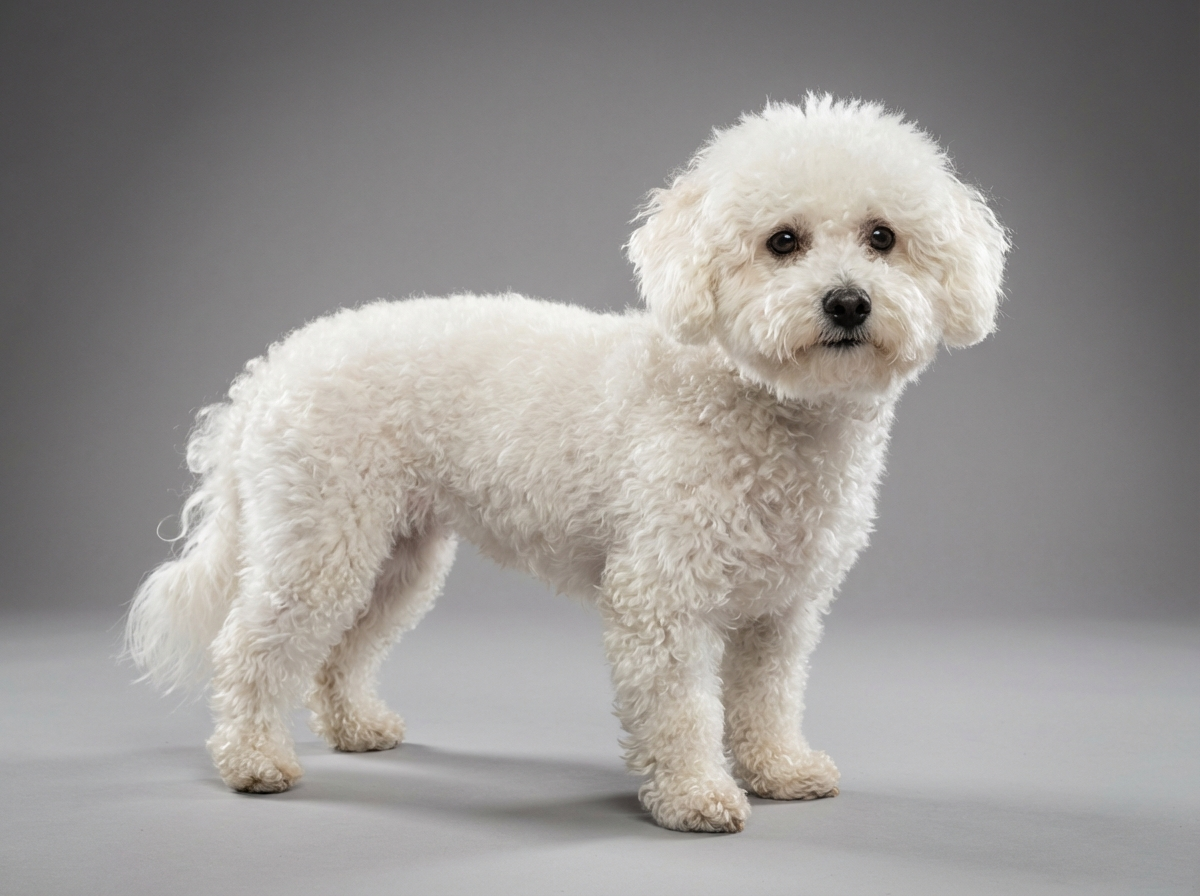
The Bichon Frise belongs to that middle group. Its muzzle is not long, and the round head and full coat around the face exaggerate the impression of shortness, but the underlying jaw is of functional length and the nostrils are open.
This matters for a practical reason. Breeds in the flat-faced group are subject to formal airway grading schemes and to breeding restrictions in some countries, because the shortening has gone far enough to compromise breathing. The Bichon Frise is not part of those schemes, and airway disease does not appear among its documented health issues.
What the breed does carry on that list is dental disease, and that is where a moderately short jaw genuinely shows up.

Rather than breathing, the compromises show up in three specific places. All are manageable, and all are worth knowing before you buy rather than after.
If you think your Bichon has brachycephalic features, the plan is three steps: write down what you have seen and when it started, book a veterinary appointment rather than waiting for the next flare, and take video of the behaviour or symptom before you go — the thing you are worried about rarely happens in the consulting room. Screening in the parents covers skin allergies, patellar luxation, bladder stones.
What the vet visit should produce is a diagnosis and a written plan, not just reassurance: what is being ruled out, what the monitoring interval is, and which signs mean you come back sooner. Ask what the treatment costs across a year rather than per visit, because that is the number that decides whether you are managing this condition or reacting to it.
Between appointments, keep a short log — dates, what you saw, what changed. It is the single most useful thing an owner brings to a follow-up, and for brachycephalic features it is often what separates a clear pattern from a guess.
Coco and Truffle were littermates who went to different homes in the same town and saw the same practice. At their sixth birthday checks, one needed eleven extractions and the other needed nothing. Their skulls were, as far as anyone could tell, identical. Both had the tightly packed lower incisors typical of the breed. The difference was that Truffle's owner had started brushing his teeth at nine weeks, treating it as part of the evening routine, and had not missed many days in six years. Coco's owner had bought dental chews instead, on the reasonable assumption that they did the same job. They had not reached the crowded surfaces where her disease was. Coco recovered well from her dental and her owner now brushes daily. The vet's observation was that conformation had loaded the dice for both dogs equally, and daily habit had decided how they landed.
Key takeaway: A moderately short jaw makes dental disease likely rather than inevitable, and in this breed the deciding factor is a toothbrush used most days for years.
Generally no. The breed is not included in the risk groups used for airway assessment or in the breeding regulations aimed at flat-faced dogs. It sits in the broad middle of the skull-shape spectrum with a moderately short but functional muzzle.
Tear staining has several contributors: the angle and length of the drainage duct, hair around the eye wicking moisture onto the face, and a white coat that shows every mark. It is largely cosmetic. Sudden worsening, redness, squinting or discharge that is thick rather than watery is a different matter and needs a vet.
It raises the odds considerably, and dental disease is on the breed's documented list. Crowded teeth hold plaque in places a tongue and a chew cannot reach. Daily brushing from puppyhood is the single most valuable habit an owner of this breed can establish.
Occasional soft snuffling in a comfortable sleeping position is usually nothing. What warrants a look is noise that is new, that has increased over weeks, that is present while the dog is awake and resting, or that comes with discharge from one nostril.
Not the ones caused by shallow eye sockets and prominent eyeballs, such as eyes that are easily injured or that can be displaced. The eye condition documented in the Bichon Frise is cataracts, which is a lens problem unrelated to face shape.
It should be one of the most important factors, and it is often the least discussed. Choosing a moderately proportioned breed over a heavily shortened one avoids a category of lifelong breathing difficulty entirely, and on that specific axis the Bichon Frise compares favourably.
No. It has a moderately short muzzle within normal working proportions, and it is not grouped with breeds subject to airway grading schemes.
Dental crowding. Overlapping teeth trap plaque, and dental disease is one of the breed's documented health issues.
Reduced, not eliminated. Keeping the hair around the eyes trimmed short and wiping the face daily makes the biggest practical difference.
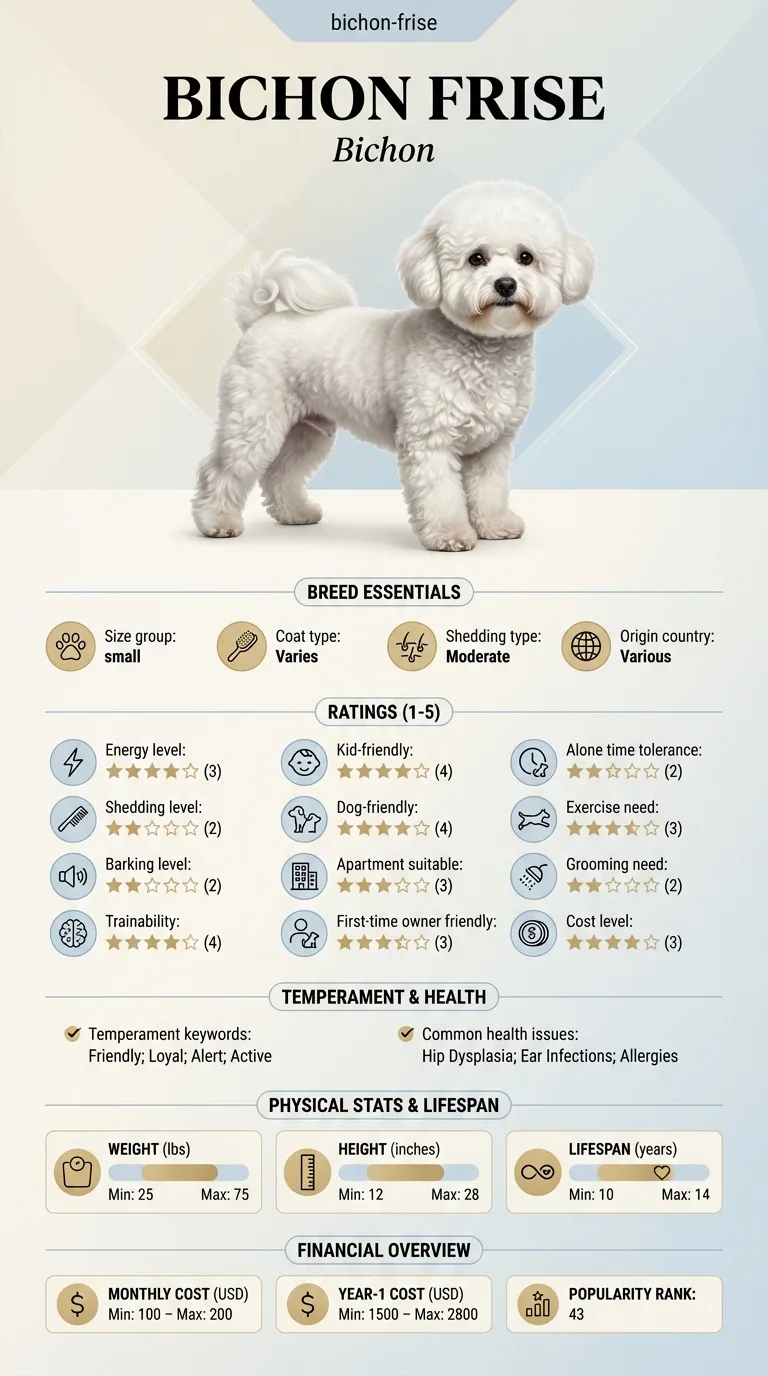
No. Its modest exercise need of two out of five reflects temperament and size rather than any breathing limitation.
Dentistry. Expect professional cleaning under anaesthetic periodically across a fourteen to fifteen year life, plus daily brushing at home.
A one-page prep sheet for this condition: the signs, the questions to ask, what to get priced. Unlocks here.
You get: Vet visit prep sheet
No spam. One-click unsubscribe. See our privacy policy.
Preview page 1 before you decide.