It comes down to space and time: the Boxer needs a yard-adjacent lifestyle and daily hard exercise (5/5 need), while the Papillon thrives in a small home on moderate exercise (3/5) — pick based on where you live, not which dog you like more in photos.
Boxer or Papillon? On paper they differ most on apartment suitability, and on the scales Boxer is the heavier at 60–70 lbs. Here is how the two compare on everything that shapes an ordinary week.
This is for someone already down to Boxer and Papillon and deciding between them. For this pair the decision usually turns on apartment suitability and exercise need, so those are covered first and in most detail. Anyone choosing from a flat has a clear answer here: Papillon rates 5/5 against 2/5. It is written for the decision rather than the breed history.
Quick verdict
Between Boxer and Papillon, apartment suitability is what separates them, and Papillon is the lower-effort dog of the two to keep.
Choose boxer if...
Choose Boxer if you do not want a standing grooming appointment, the dog will be alone during the working day and there are young children at home.
Choose papillon if...
Choose Papillon if you are in a flat or a smaller home, this is your first dog and shedding is a problem in your house.
Head-to-head comparison
Feature
boxer
papillon
Winner
Size class
large
small
Equal
Weight
60–70 lbs
5–10 lbs
Equal
Height
21–25 in
8–11 in
Equal
Lifespan
7–10 years
14–16 years
papillon
Exercise need
Very high (5/5)
Moderate (3/5)
papillon
Grooming need
Very low (1/5)
Low (2/5)
boxer
Shedding
Moderate (3/5)
Low (2/5)
papillon
Energy level
High (4/5)
High (4/5)
Equal
Barking
Moderate (3/5)
High (4/5)
boxer
Apartment suitability
Low (2/5)
Very high (5/5)
papillon
Good for first-time owners
Moderate (3/5)
High (4/5)
papillon
Tolerates being alone
Moderate (3/5)
Low (2/5)
boxer
Trainability
High (4/5)
Very high (5/5)
papillon
Good with kids
Very high (5/5)
Moderate (3/5)
boxer
Good with other dogs
High (4/5)
High (4/5)
Equal
Friendly to strangers
Moderate (3/5)
High (4/5)
papillon
Cost level
High (4/5)
Low (2/5)
papillon
Coat
Short, smooth
Long, silky single coat
Equal
Origin
Germany
Various
Equal
Typical monthly cost
$100–$200
$80–$150
Equal
Typical first-year cost
$1,500–$3,000
$1,100–$2,300
Equal
Deep dive
Size and build
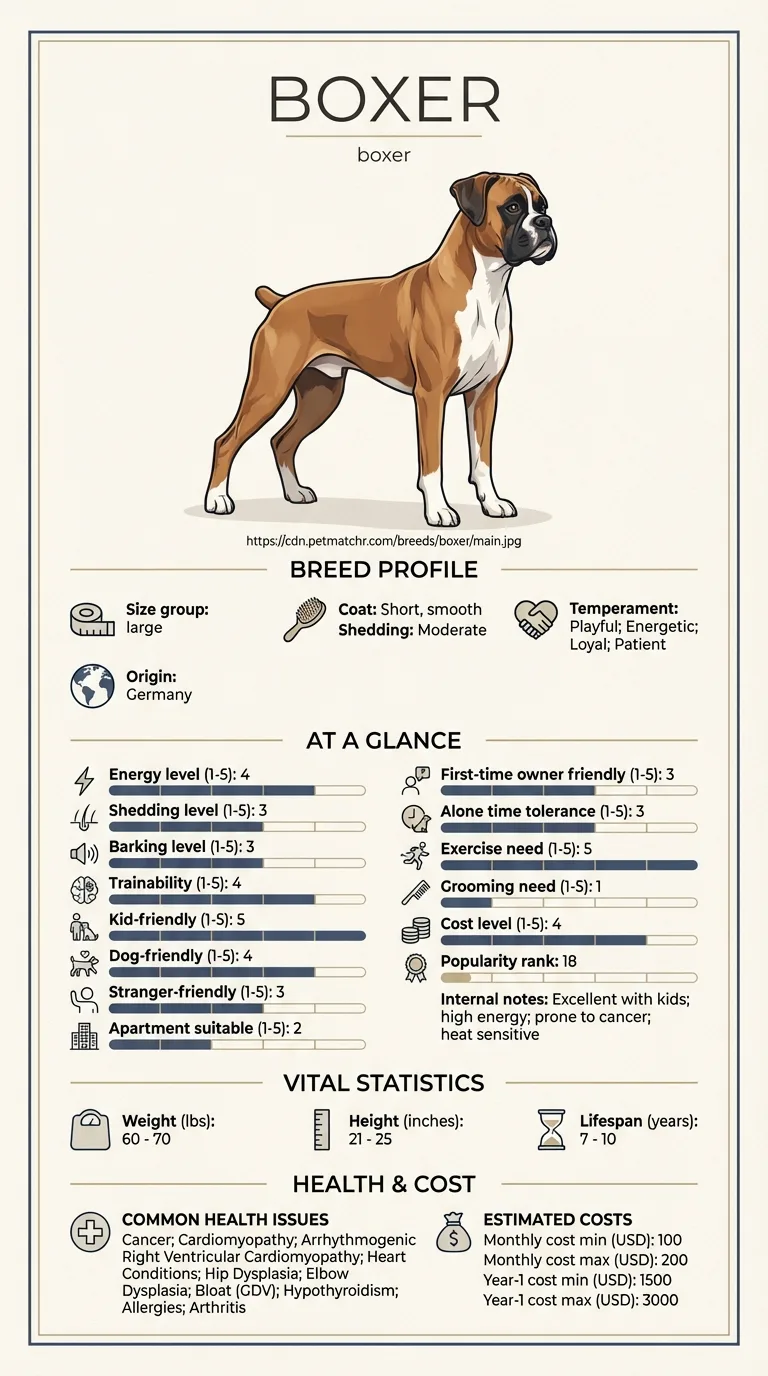
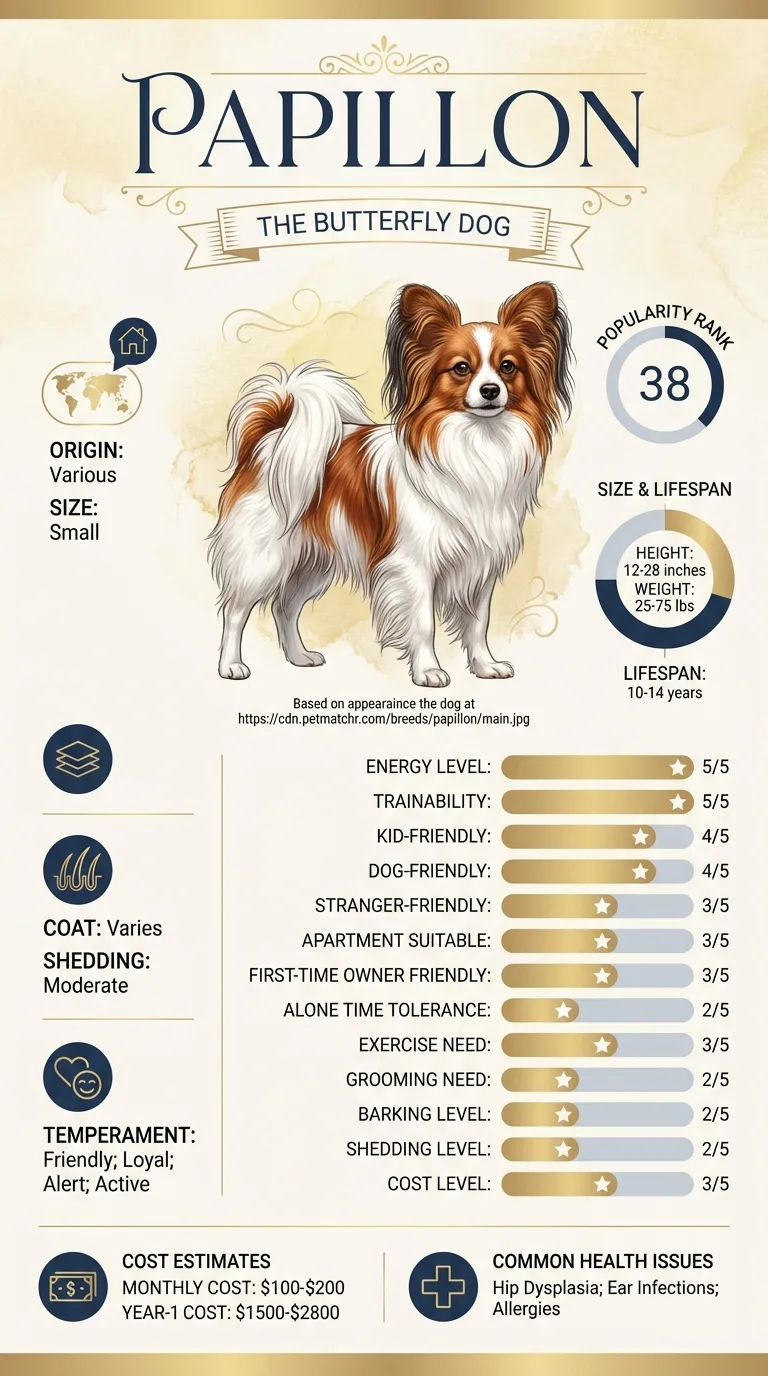
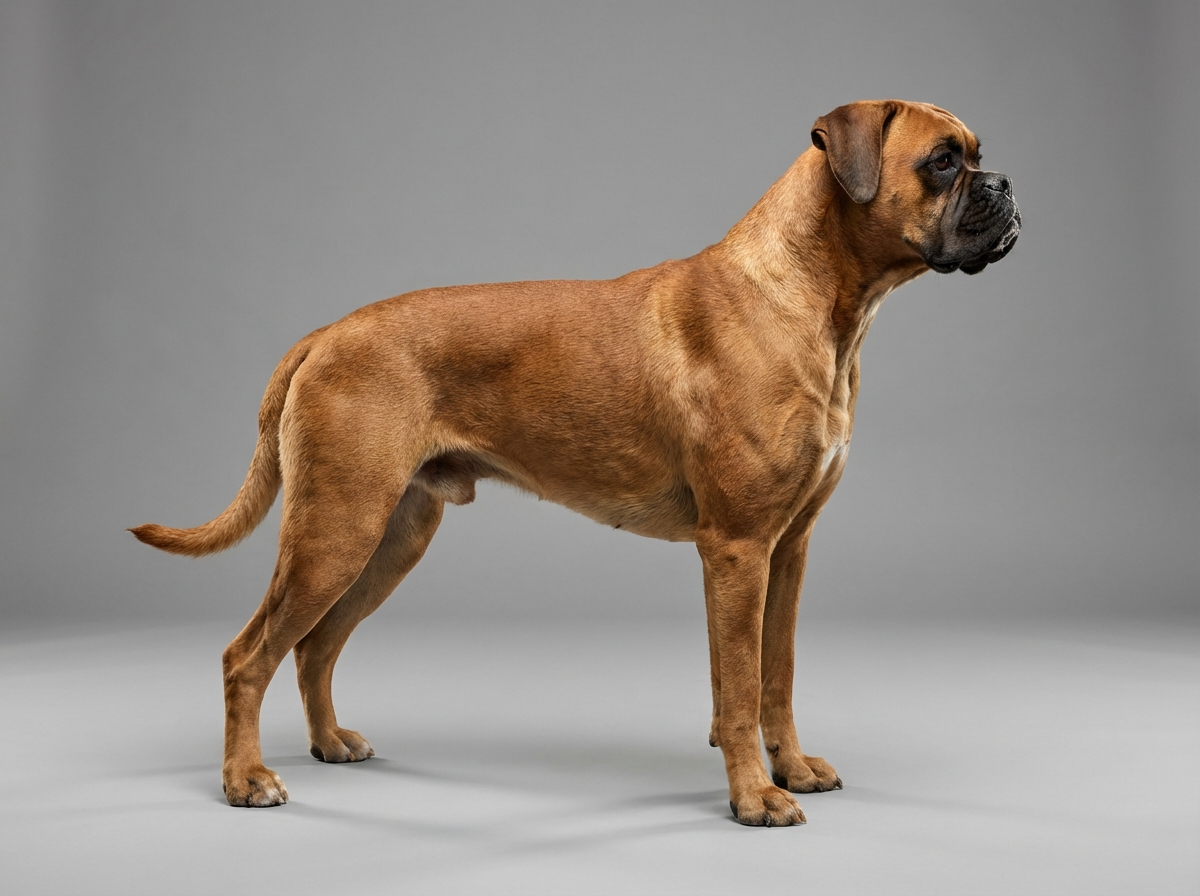
A Boxer at 60-70 lbs and 21-25 inches is roughly seven times heavier than a Papillon, which tops out around 10 lbs and 11 inches. This isn't a close call — one dog can jump into your lap, the other could accidentally sit on it. Everything downstream, from leash gear to vet dosing to how much floor space the dog needs, follows from that gap.
Energy and exercise
The Boxer rates a full 5/5 on exercise need against the Papillon's moderate 3/5, and both breeds score high (4/5) on general energy — so this is really about output volume, not enthusiasm. A Boxer wants real running room and structured exercise most days; a Papillon burns off its energy in shorter bursts of play and a decent walk. Skimp on either and you'll see it in the furniture.
Grooming and shedding
Coat care tips slightly toward the Boxer, which sits at a very low 1/5 grooming need thanks to its short, smooth coat. The Papillon's long silky coat is only low (2/5) on maintenance despite its looks — it doesn't mat easily. Shedding runs the other way: moderate (3/5) for the Boxer versus low (2/5) for the Papillon, so vacuum frequency favors the smaller dog.
Apartment living, noise and time alone
Apartment suitability is where these two diverge hardest: the Boxer scores a low 2/5, the Papillon a near-perfect 5/5. A Boxer in a small unit needs daily off-property exercise to stay sane; a Papillon adapts to compact spaces far more easily. The trade-off is barking — Papillons rate high (4/5) on vocalization versus the Boxer's moderate (3/5), which matters if you share walls.
Training and owner experience
Both breeds train well, but the Papillon edges ahead at very high (5/5) trainability against the Boxer's high (4/5) — small dogs with that kind of quick-witted temperament pick up commands fast. First-time owners fare slightly better with the Papillon too, rated 4/5 versus the Boxer's 3/5. Neither is a hard no for a beginner, but the Papillon gives you more margin for error.
Kids, other dogs and visitors
With kids, the Boxer is the stronger pick — very high (5/5) against the Papillon's moderate (3/5) — and its patient temperament backs that number up. The two are evenly matched around other dogs, both rating high (4/5). Strangers get a warmer reception from the Papillon (high, 4/5) than the Boxer (moderate, 3/5), so factor that in if you host often or live somewhere with a lot of foot traffic.
Health and lifespan
The lifespan gap is the headline number here: 7-10 years for the Boxer against 14-16 for the Papillon, nearly double. The Boxer's health list is longer and heavier too — cancer, cardiomyopathy, ARVC, hip and elbow dysplasia, bloat among them — while the Papillon's concerns (patellar luxation, PRA, dental disease, an open fontanel as a puppy, tracheal collapse) skew toward manageable, non-fatal conditions.
Cost to keep
Cost level rates high (4/5) for the Boxer and low (2/5) for the Papillon, though the monthly ranges overlap more than you'd guess — $100-200 versus $80-150. First-year costs tell the fuller story: $1,500-3,000 for the Boxer against $1,100-2,300 for the Papillon, a gap that mostly reflects the larger dog's food, medication, and vet-visit sizing. Either way, budget for the larger dog to cost noticeably more once food and vet sizing are factored in.
Boxer vs Papillon at a glance
Boxer weighs 60–70 lbs and lives 7–10 years; Papillon weighs 5–10 lbs and lives 14–16 years. The two diverge most on apartment suitability, exercise need and good with kids and 1 other rated axes. They are level on good with other dogs and energy level, so those cannot decide it. In the table, a "winner" means easier for an ordinary household — not better. Size, coat and origin are recorded without a verdict. Because both breeds are scored the same way, the gaps are reliable even where the absolute numbers are rough.
Boxer vs Papillon: Which Suits Your Home? - Boxer vs Papillon at a glance
Frequently asked questions
How much bigger is a Boxer than a Papillon?
A lot. The Boxer runs 60-70 lbs and 21-25 inches tall, while the Papillon tops out at 5-10 lbs and 8-11 inches. You're looking at a large dog next to one that's closer to a full-grown cat in weight.
Which sheds less?
The Papillon, rated low (2/5) for shedding against the Boxer's moderate (3/5). Neither is a heavy shedder in absolute terms, but if you're choosing based on fur on the couch, the smaller dog wins narrowly.
Is either breed good for a first-time owner?
Both work, but the Papillon rates higher — 4/5 versus the Boxer's 3/5 — and its very high (5/5) trainability makes early mistakes easier to correct. The Boxer isn't hard to own, it just asks for more consistency and exercise.
Which fits an apartment better?
The Papillon, by a wide margin — 5/5 on apartment suitability against the Boxer's 2/5. A Boxer's exercise needs (5/5) make small units workable only if you're committed to daily outdoor time.
What will each cost me monthly?
Plan on $100-200 a month for a Boxer and $80-150 for a Papillon, with first-year totals of $1,500-3,000 and $1,100-2,300 respectively once one-time costs are folded in.
Do they share any health risks?
Not really, based on their listed conditions. The Boxer's risks cluster around heart disease, cancer, and joint problems; the Papillon's run toward luxating kneecaps, eye disease, and dental issues. Different dogs, different vet bills to plan for.
Which barks more?
The Papillon, rated high (4/5) against the Boxer's moderate (3/5) — worth knowing if you're in a building with noise rules.
It comes down to space and time: the Boxer needs a yard-adjacent lifestyle and daily hard exercise (5/5 need), while the Papillon thrives in a small home on moderate exercise (3/5) — pick based on where you live, not which dog you like more in photos.
Costs
What's the monthly cost difference?
Close — $100-200 for the Boxer versus $80-150 for the Papillon. The bigger cost gap shows up in year one, where the Boxer runs $1,500-3,000 against $1,100-2,300.
Behavior
How much exercise does each need?
The Boxer rates a full 5/5 — plan on real daily exercise, not just a walk around the block. The Papillon sits at moderate (3/5), so a decent walk plus some play covers it.
Health
Which one lives longer?
The Papillon, by a wide margin — 14-16 years against the Boxer's 7-10. If longevity matters to you, that's close to double the time with your dog.
Related DogBreedCompass guides
Boxer breed guide – Readers comparing the two usually want the full profile of Boxer before deciding.
Papillon breed guide – The same for Papillon, so the comparison can be checked against the detail.
Boxer vs Welsh Springer Spaniel – Welsh Springer Spaniel is the closest breed to Boxer on the measured axes, so it is the natural next comparison.
Papillon vs Maltese – Maltese sits closest to Papillon, which makes it the alternative worth ruling out.
What Boxer costs to keep – Anyone weighing these two is usually also pricing them, and the cost pages carry city-level figures.
Papillon health problems – The health pages set out what each breed is actually screened for.
Health information here is general and is not veterinary advice. If your dog shows pain, sudden behaviour change, or worsening symptoms, consult a licensed veterinarian.
Some links on this site are affiliate links. We may earn a commission at no extra cost to you, and we only suggest products we believe are helpful for dog owners.
We research and check what we publish, but we do not warrant that any figure, date, price, or statement is accurate, complete, or current, and we accept no liability for any loss, cost, injury, or other harm arising from the use of this site. Use it as one reference among several. You remain responsible for your own decisions and for your dog's care - confirm anything that matters with a licensed veterinarian or another qualified professional before you act on it. Full disclaimer.