Living
Which should I choose overall?
The Papillon suits small-space, lower-exercise living with more barking; the French Spaniel suits an active household with more room and less noise.

Quick answer
Which should I choose overall?
The Papillon suits small-space, lower-exercise living with more barking; the French Spaniel suits an active household with more room and less noise.
French Spaniel or Papillon? On paper they differ most on apartment suitability, and on the scales French Spaniel is the heavier at 45–60 lbs. Here is how the two compare on everything that shapes an ordinary week.
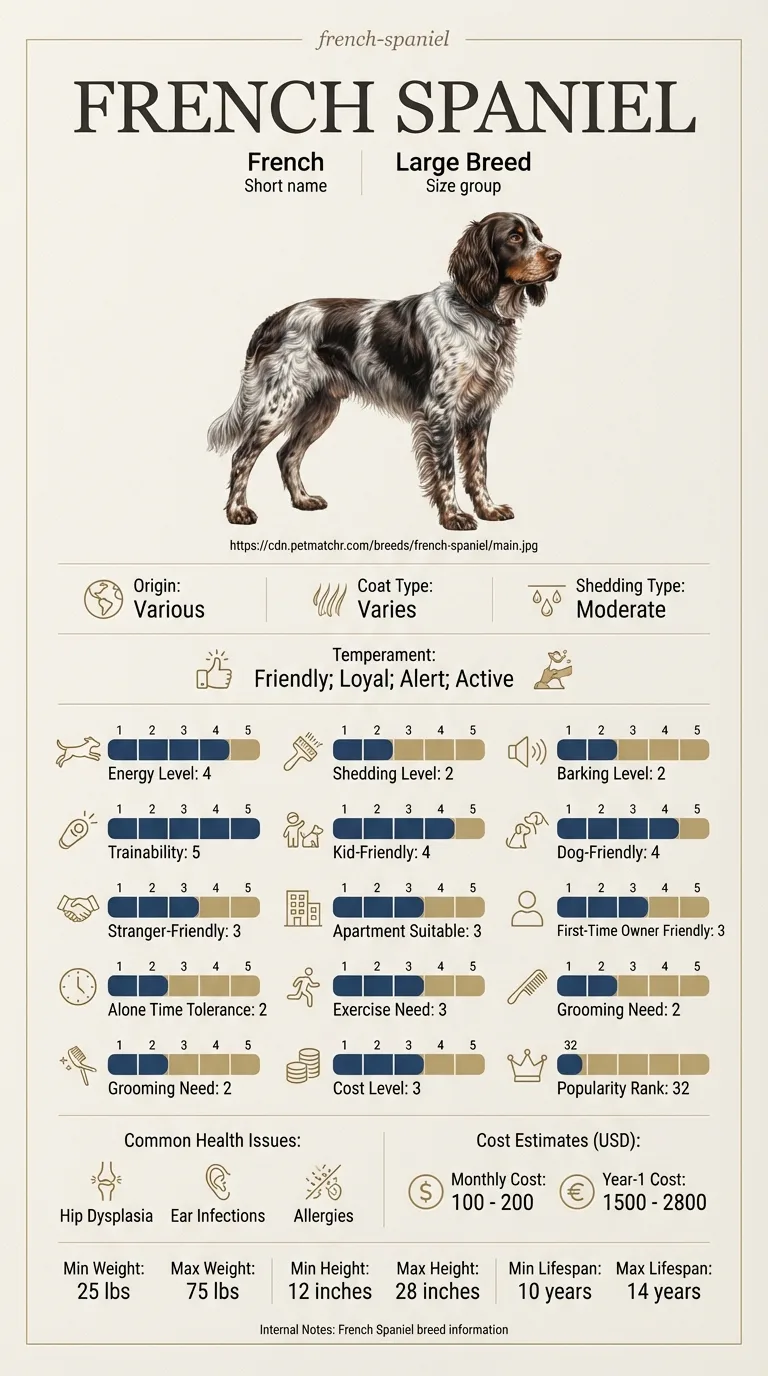
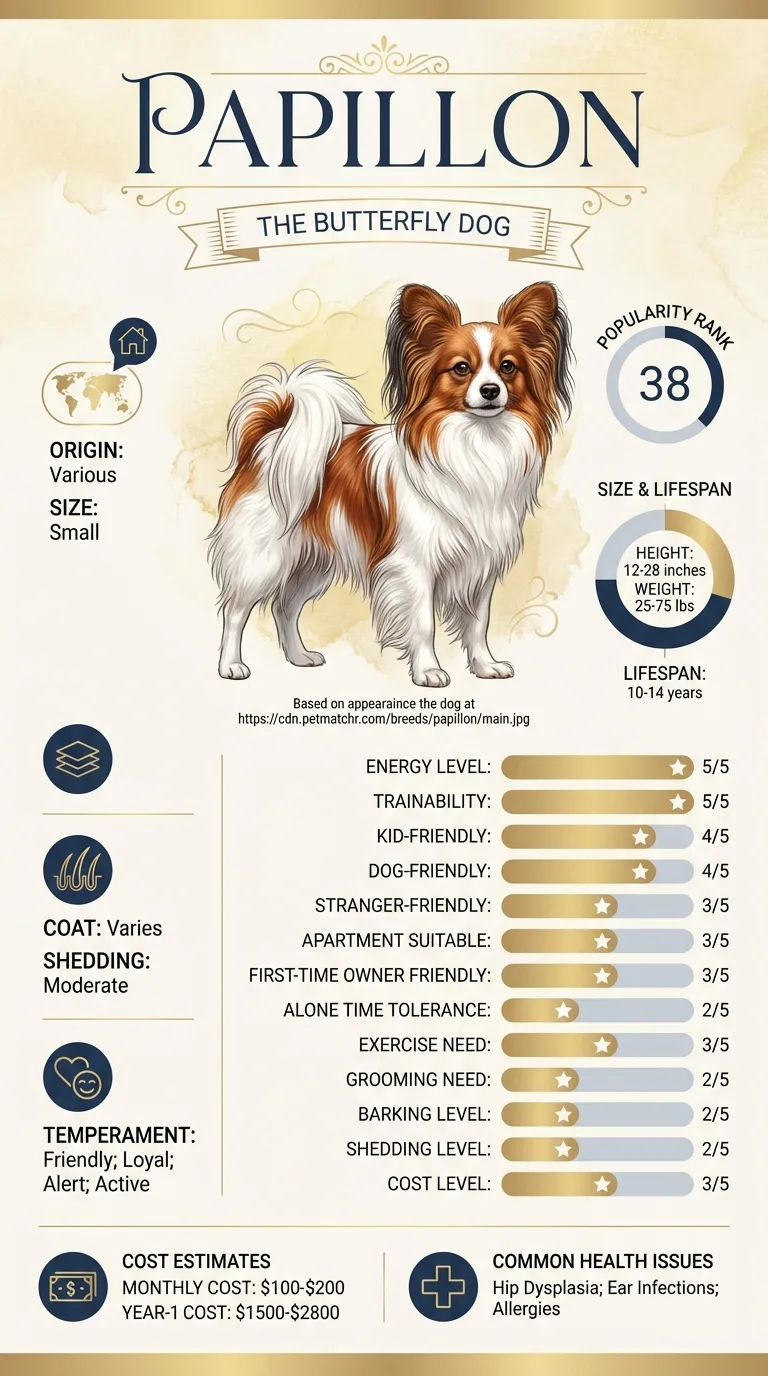
This is for someone already down to French Spaniel and Papillon and deciding between them. For this pair the decision usually turns on apartment suitability and exercise need, so those are covered first and in most detail. Anyone choosing from a flat has a clear answer here: Papillon rates 5/5 against 2/5. There is no origin story here — only what changes about your week.
Between French Spaniel and Papillon, apartment suitability is what separates them, and Papillon is the lower-effort dog of the two to keep.
Choose French Spaniel if there are young children at home and you want a dog that can keep up with an active routine.
Choose Papillon if you are in a flat or a smaller home, this is your first dog and you do not want a standing grooming appointment.
| Feature | french spaniel | papillon | Winner |
|---|---|---|---|
| Size class | medium | small | Equal |
| Weight | 45–60 lbs | 5–10 lbs | Equal |
| Height | 21–24 in | 8–11 in | Equal |
| Lifespan | 10–12 years | 14–16 years | papillon |
| Exercise need | Very high (5/5) | Moderate (3/5) | papillon |
| Grooming need | Moderate (3/5) | Low (2/5) | papillon |
| Shedding | Moderate (3/5) | Low (2/5) | papillon |
| Energy level | High (4/5) | High (4/5) | Equal |
| Barking | Low (2/5) | High (4/5) | french spaniel |
| Apartment suitability | Low (2/5) | Very high (5/5) | papillon |
| Good for first-time owners | Moderate (3/5) | High (4/5) | papillon |
| Tolerates being alone | Low (2/5) | Low (2/5) | Equal |
| Trainability | High (4/5) | Very high (5/5) | papillon |
| Good with kids | High (4/5) | Moderate (3/5) | french spaniel |
| Good with other dogs | High (4/5) | High (4/5) | Equal |
| Friendly to strangers | High (4/5) | High (4/5) | Equal |
| Cost level | Moderate (3/5) | Low (2/5) | papillon |
| Coat | Medium, flat and feathered | Long, silky single coat | Equal |
| Origin | Various | Various | Equal |
| Typical monthly cost | $100–$200 | $80–$150 | Equal |
| Typical first-year cost | $1,400–$2,900 | $1,100–$2,300 | Equal |
A Papillon weighs 5 to 10 pounds -- the French Spaniel can outweigh it by a factor of nine or more, at 45 to 60 pounds. Height gaps are just as wide: 8 to 11 inches against 21 to 24. Named for its butterfly-shaped ears, the Papillon is genuinely tiny in a way that changes basic logistics -- travel carriers, vet exam tables, even how it fits on your lap during a car ride.
Energy level is one of the rare ties in this comparison -- both breeds rate high (4/5) indoors. Outdoor exercise need is where they split: the French Spaniel needs very high (5/5) activity, the Papillon moderate (3/5). Don't let the Papillon's size fool you into thinking it's low-key, though -- it's an alert, busy little dog that just doesn't need long outdoor sessions to burn that energy off.
The Papillon is the lower-maintenance coat here on both counts -- low grooming need (2/5) and low shedding (2/5) -- despite its long, silky coat, because it lacks a heavy undercoat. The French Spaniel sits higher on both (moderate 3/5 for grooming, moderate 3/5 for shedding). If coat-care time is a real constraint, the Papillon asks less of you.
The Papillon is rated very high (5/5) for apartment suitability against the French Spaniel's low (2/5), but it comes with a tradeoff: high (4/5) barking versus the French Spaniel's low (2/5). A small, alert dog in close quarters can mean a vocal one. Neither breed tolerates being left alone well -- both rate low (2/5) -- so plan for company or a dog walker regardless of which you pick.
The Papillon actually out-trains the French Spaniel on paper -- very high (5/5) versus high (4/5) -- and it's also rated better for first-time owners (high 4/5 against moderate 3/5). Papillons are known for excelling in obedience and agility despite their size, so don't assume a tiny dog means less trainable; here it's the opposite. The French Spaniel's higher exercise demands are the bigger factor a first-time owner needs to plan around.
With kids, the French Spaniel comes out ahead -- high (4/5) against the Papillon's moderate (3/5) -- likely reflecting its sturdier size for boisterous play. Good-with-other-dogs and friendly-to-strangers both tie at high (4/5), so outside the household the two are evenly matched. A Papillon's small size warrants more supervision with younger kids regardless of temperament score.
The Papillon has a real longevity edge -- 14 to 16 years against the French Spaniel's 10 to 12, a gap of up to six years. Its health list is shorter too, five conditions including patellar luxation, collapsing trachea, and open fontanel (a soft spot in the skull that doesn't always close on schedule in toy breeds), against the French Spaniel's hip dysplasia, epilepsy, and eye conditions. Neither list overlaps much with the other.
The Papillon costs less across the board -- a low (2/5) cost rating against the French Spaniel's moderate (3/5), with monthly costs of $80 to $150 versus $100 to $200, and first-year costs of $1,100 to $2,300 versus $1,400 to $2,900. Smaller size generally means less food and lower medication doses, which shows up directly in these numbers.
French Spaniel weighs 45–60 lbs and lives 10–12 years; Papillon weighs 5–10 lbs and lives 14–16 years. The two diverge most on apartment suitability, exercise need and barking. They are level on tolerates being alone, good with other dogs and energy level, so those cannot decide it. Where the table declares a winner it means less work for the owner, nothing more; descriptive rows are left as ties on purpose. The value here is in the differences between the two columns; treat any single score as approximate.

A lot -- 5 to 10 pounds against the French Spaniel's 45 to 60, roughly a ninth to a fifth of the weight.
The Papillon, rated very high (5/5) against the French Spaniel's high (4/5) -- despite its size, it's known for excelling in obedience work.
The Papillon, high (4/5) against the French Spaniel's low (2/5) -- a common tradeoff for small, alert breeds.
The Papillon, rated very high (5/5) versus the French Spaniel's low (2/5), though its barking may be a factor with close neighbors.
$80-$150 for the Papillon, $100-$200 for the French Spaniel -- the Papillon is the cheaper breed to keep on every cost measure.
The Papillon, considerably -- 14 to 16 years against the French Spaniel's 10 to 12.
Not much overlap. The Papillon's list includes patellar luxation and collapsing trachea; the French Spaniel's includes hip dysplasia and epilepsy.
The Papillon suits small-space, lower-exercise living with more barking; the French Spaniel suits an active household with more room and less noise.
$80-$150 for the Papillon, $100-$200 for the French Spaniel.
The French Spaniel needs very high exercise (5/5); the Papillon needs moderate exercise (3/5) despite matching it on indoor energy.
The Papillon, by up to six years -- typically 14-16 years against the French Spaniel's 10-12.
Secure checkout on Stripe. We never see your card.
7-day money-back guarantee. Instant access.
Health information here is general and is not veterinary advice. If your dog shows pain, sudden behaviour change, or worsening symptoms, consult a licensed veterinarian.
Some links on this site are affiliate links. We may earn a commission at no extra cost to you, and we only suggest products we believe are helpful for dog owners.
We research and check what we publish, but we do not warrant that any figure, date, price, or statement is accurate, complete, or current, and we accept no liability for any loss, cost, injury, or other harm arising from the use of this site. Use it as one reference among several. You remain responsible for your own decisions and for your dog's care - confirm anything that matters with a licensed veterinarian or another qualified professional before you act on it. Full disclaimer.
Match your lifestyle to the right dog.
Take quizNot sure which breed is right for you? Take our 2-minute quiz to find out.
Take the quiz