Health
What is the earliest sign of arthritis in a Papillon?
A change in how the dog gets up. Watch it rise from a nap: hesitation, a two-stage push, or a stretch it never used to need are earlier and more reliable than any limp.

Quick answer
What is the earliest sign of arthritis in a Papillon?
A change in how the dog gets up. Watch it rise from a nap: hesitation, a two-stage push, or a stretch it never used to need are earlier and more reliable than any limp.
Big dogs limp. Small dogs get carried. That is why arthritis is diagnosed late in Papillons and on time in Labradors.
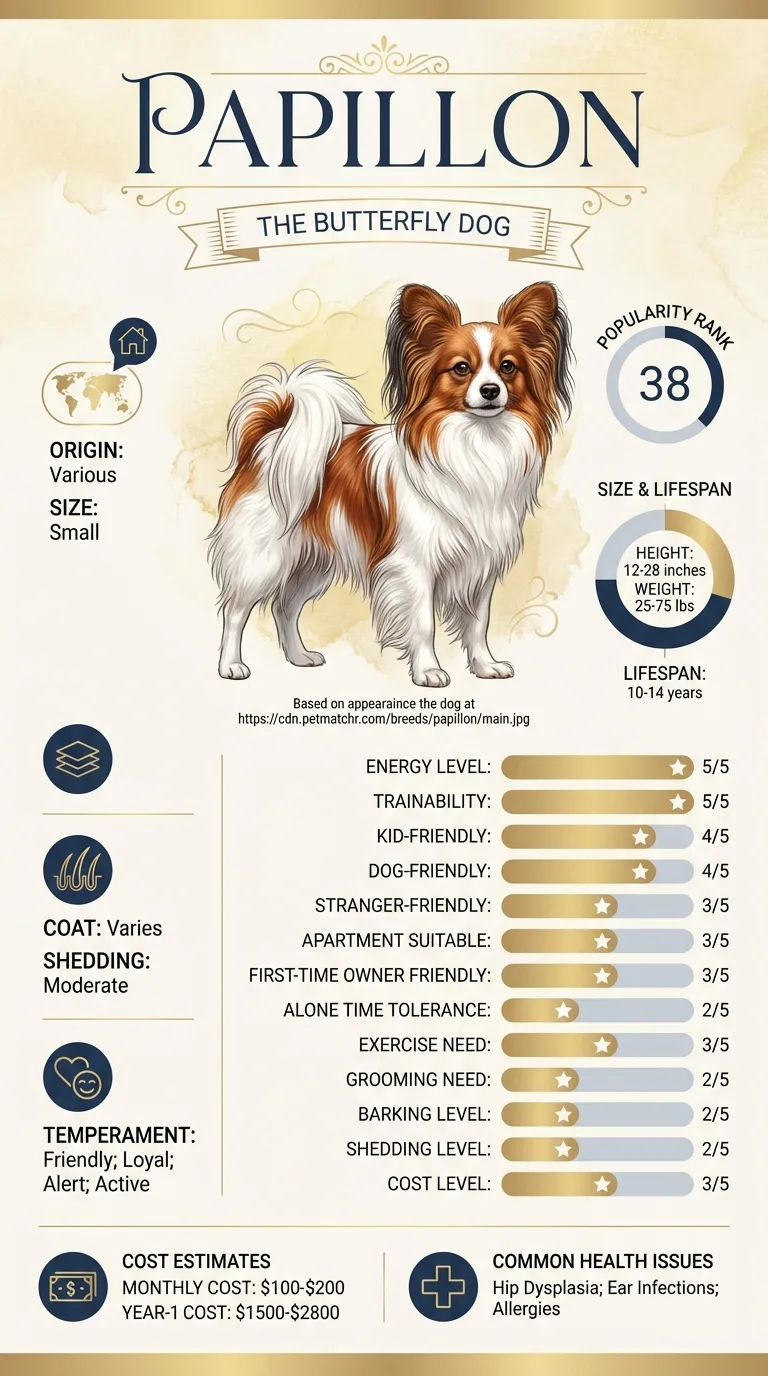
Owners of a middle-aged or older Papillon who has quietly stopped doing something: no longer jumping onto the bed, hesitating at the bottom of the stairs, or taking a beat too long to stand up after a nap on a cold floor.
This guide is not medical advice. If your dog shows pain, sudden behavior change, or worsening symptoms, consult a licensed veterinarian.
Some links may be affiliate links. We may earn a commission at no extra cost to you. We only suggest products we believe are helpful for dog owners.
We research and check what we publish, but we do not warrant that any figure, date, price, or statement is accurate, complete, or current, and we accept no liability for any loss, cost, injury, or other harm arising from the use of this site. Use it as one reference among several. You remain responsible for your own decisions and for your dog's care - confirm anything that matters with a licensed veterinarian or another qualified professional before you act on it. Full disclaimer.
Arthritis is the progressive breakdown of joint cartilage with inflammation and new bone formation at the margins. In Papillons it settles most often in the stifles, frequently downstream of a kneecap that has been slipping for years, and it presents as a dog that quietly does less rather than a dog that limps. It is painful, permanent and highly manageable.
Very common in older dogs of every breed, and effectively expected in a breed that routinely reaches fourteen to sixteen. What is unusual about Papillons is how late it tends to be recognised, because a small dog's reduced activity is easy to absorb into daily life without anyone naming it as a symptom.
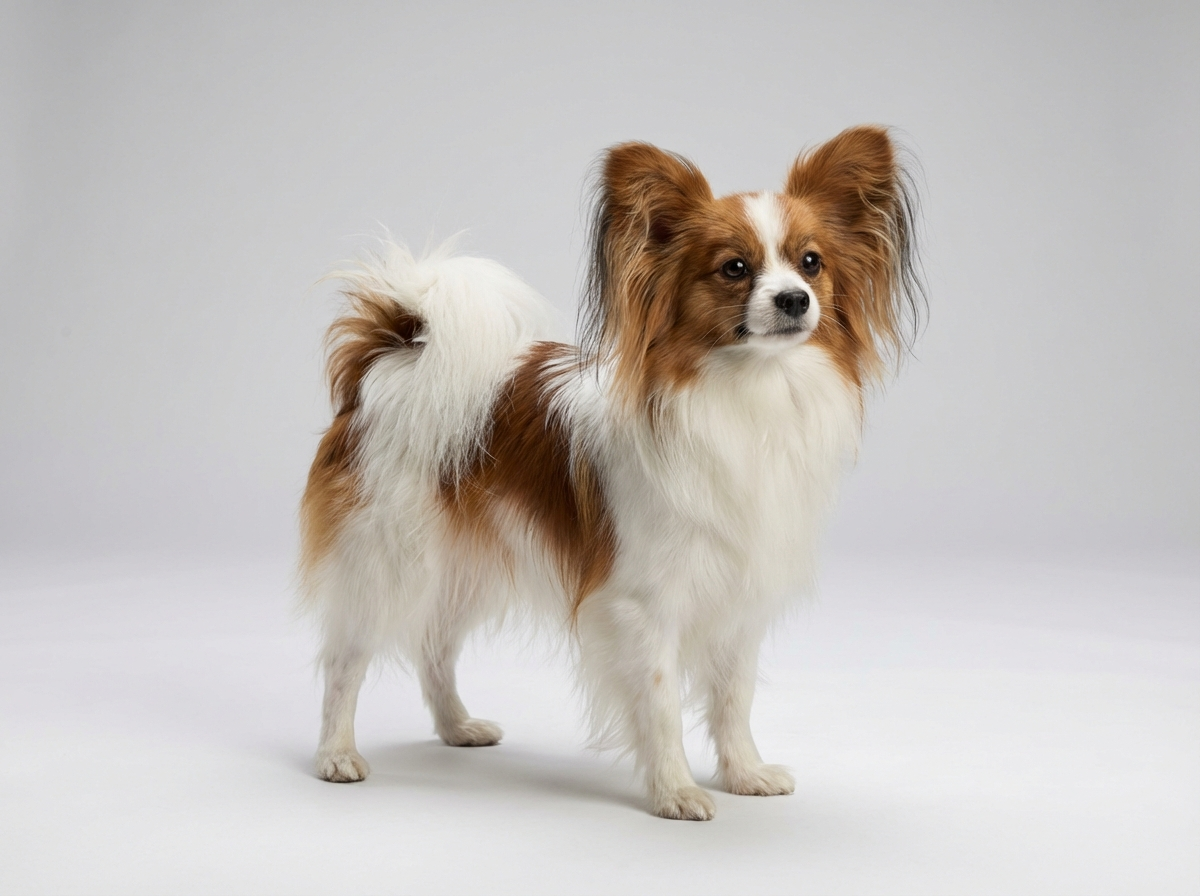
The strongest breed link runs through the knee. Patellar luxation appears on the Papillon's documented health list, and a kneecap that repeatedly leaves its groove is an engine of cartilage wear. The breed's build adds to it: a lightly boned eight to eleven inch dog with a high energy level for its size spends its life making athletic movements on delicate joints. The long lifespan, usually an asset, simply gives wear more years to accumulate.
Modern homes are hard on small old joints. Laminate and tile give no grip, sofas and beds are a considerable drop for a dog under a foot tall, and stairs are proportionally enormous. Weekend-only exercise builds nothing and jars everything. Cold floors and unheated rooms stiffen a dog with a thin single coat and very little body fat faster than they would a heavier, double-coated breed.
Book a routine appointment as soon as you notice reluctance to jump, a two-stage rise, licking over a joint, or a dog that lags on walks it used to lead. Do not wait for a limp. Ask for a same-day appointment if your Papillon is non-weight-bearing on a leg, cries out when touched or moved, has a hot or swollen joint, or has suddenly become lame after previously being merely stiff. A sudden severe lameness in a small dog can be a ruptured ligament or a fracture rather than arthritis, and that distinction matters this week, not next month.
See all Papillon health problems, which breeds are prone to arthritis, or the full Papillon breed guide for temperament, exercise needs and ownership costs.
Expect a noticeable change in comfort within two to four weeks of starting treatment and modifying the home. Muscle rebuilds more slowly, over two to three months of consistent short walks. Arthritis then continues to advance for the rest of the dog's life, so plans are reviewed every six months and adjusted rather than finished.
A dog that rises without hesitation, chooses to walk rather than being carried, sleeps through the night without repositioning, and still asks to go out. Some stiff mornings and some slow days after big outings will remain. Success is measured in what your Papillon volunteers to do, not in what a radiograph looks like.
Papillon arthritis usually has an address, and that address is most often the stifle. Patellar luxation is the breed's best-documented orthopaedic problem, and a kneecap that repeatedly rides out of its groove grinds the cartilage on both surfaces every time it does so.
A young Papillon with a mildly slipping kneecap shows a skip in its trot and then carries on. That skip is not harmless. Each dislocation is a small abrasion, and a decade of them produces a joint with worn cartilage, thickened capsule and new bone at the margins. By ten or eleven the skip has been replaced by stiffness.
This matters because it makes arthritis in this breed partly foreseeable. If a vet noted a grade one or two luxation when your dog was two, that stifle is the joint to watch at eight. Weight control and consistent low-impact exercise across the middle years genuinely change how that joint looks later.

Limping is a late sign. What comes first is a shortening of the dog's own world.
Watch the transitions. A comfortable Papillon rises from lying in one fluid movement; a sore one gathers itself, pushes the front end up, then brings the back end after. Watch the furniture. A dog that used to launch onto the sofa and now walks to the low end, or waits to be lifted, has made a decision about pain.
Watch the coat. Persistent licking over a joint, particularly the inside of a stifle or the front of a wrist, is a pain behaviour and is easy to misread as allergy in a long-coated breed.
Watch temperature and time of day. Arthritis is worse after rest and worse in cold, so the morning walk on a January pavement is where it shows. Many owners describe a dog that is stiff for the first two minutes and then loosens; that pattern is close to diagnostic.
Aurelie realised something was wrong when her twelve-year-old Papillon, Nadia, stopped running to the door for the post. Nadia had greeted the letterbox every morning for a decade. She was not limping and ate normally, so Aurelie had assumed it was simply age. The orthopaedic exam found pain and reduced flexion in both stifles, and radiographs showed established arthritis in the knee that had been noted as a mild luxation at Nadia's second birthday. Aurelie put runners down the hall, cut Nadia's food back until she lost eleven ounces, swapped one long walk for three short ones, and started a plan with her vet. Six weeks later Nadia was at the door again. She is slower than she was at eight and always will be, but she gets there.
Key takeaway: The most useful arthritis sign is a habit the dog has abandoned. Ask yourself what your Papillon used to do every day and no longer bothers with.
Changes often begin far earlier than the signs. A dog with a slipping kneecap may have measurable joint change by five or six, while the owner sees nothing until nine or ten. In a breed that regularly reaches fifteen, most individuals develop some arthritis eventually.
Old age is not itself painful. Stiffness, reluctance to jump and slowing down are symptoms of something, most commonly arthritis, and they respond to treatment. Accepting them as inevitable is the single most common reason a small dog spends its last years uncomfortable.
Repeated hard landings on a small frame add up, particularly for a dog with an unstable kneecap. It is unlikely to be the sole cause, but a ramp or a step to the sofa is a cheap intervention with no downside, and dogs of this intelligence learn to use one within days.
Yes, and disproportionately. A pound of extra weight on a nine pound dog is over ten percent of its body mass loading every joint on every step. Trimming a Papillon back to a waist you can see from above is the most effective single thing most owners can do.
By a hands-on orthopaedic exam and usually radiographs, which in a dog this size need sedation to position properly. A vet is feeling for reduced range of motion, thickening, and pain on flexion, and checking which joints are involved rather than assuming the obvious one.
No. Lost cartilage does not regrow and existing bone change is permanent. What can be changed is pain, muscle mass and function, and a well-managed arthritic Papillon can be visibly more comfortable within weeks. The goal is a good decade, not a cure.
A change in how the dog gets up. Watch it rise from a nap: hesitation, a two-stage push, or a stretch it never used to need are earlier and more reliable than any limp.
Regular and moderate beats occasional and long. Two or three short lead walks a day on soft ground keep the joint moving and the muscle on, whereas a single hard weekend outing produces two stiff days.
Ongoing medication and periodic bloodwork commonly add fifty to a hundred and fifty dollars a month on top of this breed's usual running costs, and diagnostics or physiotherapy sit on top of that in the first year.
A great deal. A Papillon scrabbling on laminate loads its joints in ways they were never built for. Runners and rugs along the routes the dog actually uses are a genuine treatment, not a nicety.
Yes, and this breed makes it easy. Teach a ramp or a step with the same reward-based approach used for tricks, then make jumping impossible for a fortnight while the new route becomes habit.
A one-page prep sheet for this condition: the signs, the questions to ask, what to get priced. Unlocks here.
You get: Vet visit prep sheet
No spam. One-click unsubscribe. See our privacy policy.
Preview page 1 before you decide.