Health
Is wobbler syndrome a neck or a leg problem?
It's a neck problem - spinal cord compression in the cervical vertebrae - that shows up as leg instability because nerve pathways to the legs pass through the neck.

Quick answer
Is wobbler syndrome a neck or a leg problem?
It's a neck problem - spinal cord compression in the cervical vertebrae - that shows up as leg instability because nerve pathways to the legs pass through the neck.
This isn't the dog's legs or hips failing - it's the neck itself compressing the exact nerve pathway that controls how those legs move.
This is relevant to owners who've noticed an unsteady, swaying gait, particularly in the back legs, weakness, or a reluctance to lower the head fully, and are trying to understand whether this is a spine problem, a hip problem, or something else entirely.
This guide is not medical advice. If your dog shows pain, sudden behavior change, or worsening symptoms, consult a licensed veterinarian.
Some links may be affiliate links. We may earn a commission at no extra cost to you. We only suggest products we believe are helpful for dog owners.
We research and check what we publish, but we do not warrant that any figure, date, price, or statement is accurate, complete, or current, and we accept no liability for any loss, cost, injury, or other harm arising from the use of this site. Use it as one reference among several. You remain responsible for your own decisions and for your dog's care - confirm anything that matters with a licensed veterinarian or another qualified professional before you act on it. Full disclaimer.
Wobbler syndrome, or cervical vertebral instability, compresses the spinal cord in the neck, producing an unsteady, wobbly gait most often noticeable in the hind legs. Giant breeds like the Mastiff carry more mechanical demand on the cervical spine, making them more vulnerable to this condition than smaller dogs, and treatment costs can range widely depending on severity and approach.
Wobbler syndrome is documented more frequently in giant breeds than in the general dog population, and while it isn't universal in Mastiffs, it's common enough that unexplained hind-leg instability in this breed warrants it as a genuine consideration alongside more commonly discussed joint conditions.
A giant breed's cervical spine supports a substantially heavier head and neck than most dogs carry, placing more ongoing mechanical stress on the vertebrae and surrounding soft tissue. Combined with this breed's documented tendency toward joint and bone growth issues generally, the neck's supporting structures can be vulnerable to the same kind of developmental strain seen in the hips and elbows, just at a different, more consequential location along the spine.
Rapid growth during puppyhood, especially combined with high-calorie diets that accelerate bone development faster than supporting structures can keep pace, can worsen the underlying vulnerability. Trauma or repeated strain to the neck area, even relatively minor, can also accelerate progression in a dog with an existing mild instability.
See a vet promptly for any new or worsening unsteadiness in the gait, reluctance to move the neck, or hind-leg weakness, since early diagnosis through appropriate imaging generally leads to better management options than waiting until symptoms are severe.
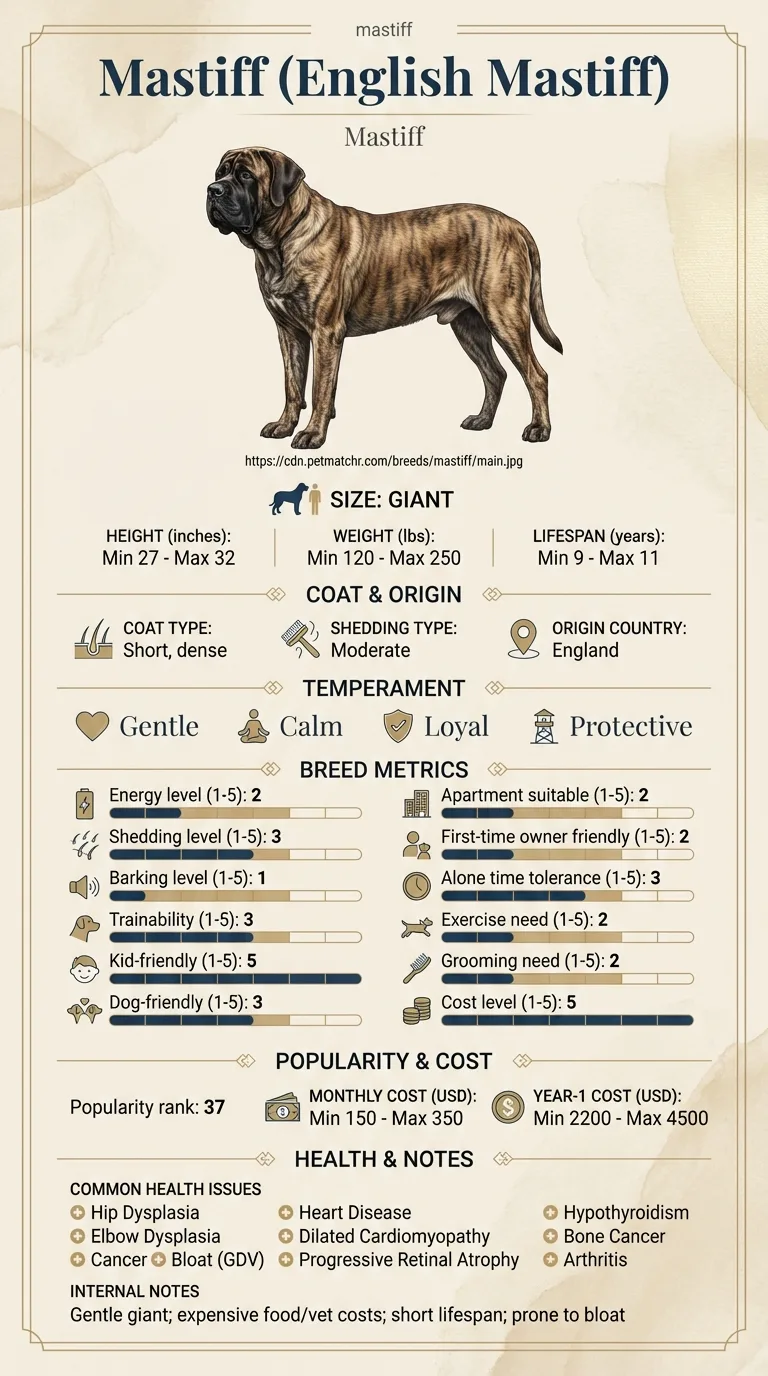
See all Mastiff health problems, which breeds are prone to wobbler syndrome, or the full Mastiff breed guide for temperament, exercise needs and ownership costs.
Diagnosis typically takes one to two vet visits including advanced imaging. Conservative management may show improvement within several weeks, while surgical recovery is often a longer process spanning a few months before full benefit is seen.
Success looks like stabilized or improved gait and reduced progression of symptoms, not necessarily a complete return to normal in more advanced cases - some residual unsteadiness can remain even with successful treatment.
Cervical vertebral instability happens when the bones or supporting soft tissue in the neck don't provide enough consistent space for the spinal cord as it passes through, either due to malformation, disc changes, or ligament laxity. Compression at this level is especially disruptive because nearly every nerve pathway controlling the legs passes through the neck on its way from the brain, meaning a problem here often shows up first and most obviously as instability in the hind legs, even though the actual compression is happening much higher up.
This is why an owner might initially suspect a hip or hind-leg problem when the real issue is several vertebrae higher, and why a proper diagnosis usually requires spinal imaging rather than an exam focused on the legs or hips alone.
Wobbler syndrome typically develops gradually, though it can also worsen suddenly after a specific incident.

If you think your Mastiff has wobbler syndrome, the plan is three steps: write down what you have seen and when it started, book a veterinary appointment rather than waiting for the next flare, and take video of the behaviour or symptom before you go — the thing you are worried about rarely happens in the consulting room. Screening in the parents covers hip dysplasia, elbow dysplasia, cancer.
What the vet visit should produce is a diagnosis and a written plan, not just reassurance: what is being ruled out, what the monitoring interval is, and which signs mean you come back sooner. Ask what the treatment costs across a year rather than per visit, because that is the number that decides whether you are managing this condition or reacting to it.
Between appointments, keep a short log — dates, what you saw, what changed. It is the single most useful thing an owner brings to a follow-up, and for wobbler syndrome it is often what separates a clear pattern from a guess.
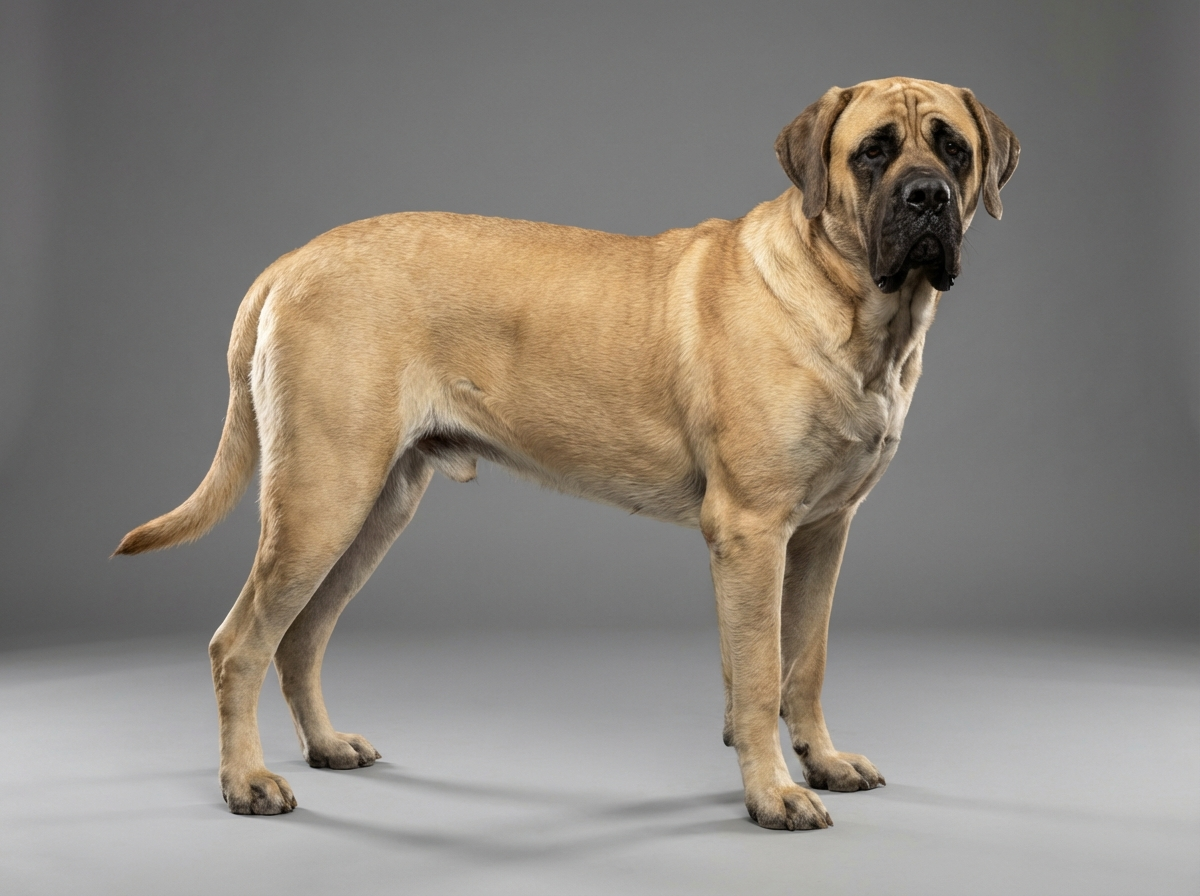
Denise had assumed her Mastiff Titan's increasingly unsteady back end was early hip dysplasia, a condition she'd read was common in the breed and had been half-expecting. Hip X-rays came back relatively unremarkable, which left both Denise and her vet puzzled about what was actually causing his worsening wobble. A referral for advanced imaging revealed the real issue: cervical vertebral instability compressing his spinal cord in the neck, a diagnosis neither of them had considered given that Titan's neck itself never seemed to bother him. The vet explained how nerve pathways to the hind legs travel through the neck, which is exactly why the symptoms showed up where they did. Given the severity of his compression, Titan underwent surgical decompression. Recovery took a few months of restricted activity, but he regained most of his previous stability, walking with only a slight residual unsteadiness that Denise says most people don't even notice.
Key takeaway: Hind-leg instability in this breed doesn't always mean a hip problem - a thorough workup that includes the neck can catch a very different, and very treatable, cause.
It stems from instability or malformation in the neck vertebrae, or the soft tissue supporting them, that compresses the spinal cord. Giant breeds are more prone to this due to the mechanical demands placed on a large body's cervical spine.
Nerve pathways controlling the legs pass through the neck on their way from the brain, so compression there often shows up first as instability or weakness in the hind legs, even though the actual problem is much higher up the spine.
Diagnosis typically requires advanced spinal imaging such as an MRI or CT scan, since a standard exam or X-ray often can't show the level of detail needed to confirm cervical spinal cord compression.
Costs vary widely by severity and approach, with conservative management on the lower end and surgical correction significantly more expensive, generally spanning a wide range depending on the specific case and treatment path chosen.
Mild cases are sometimes managed conservatively with activity restriction, weight control, and anti-inflammatory support, though more significant cases with progressive weakness often require surgical decompression for the best outcome.
It can cause neck discomfort, and the instability itself is often distressing for the dog even without obvious pain behavior, since balance and mobility are directly affected.
It's a neck problem - spinal cord compression in the cervical vertebrae - that shows up as leg instability because nerve pathways to the legs pass through the neck.
Advanced imaging like an MRI or CT scan is typically needed to confirm cervical spinal cord compression.
Costs range widely, from a few hundred dollars for conservative management to several thousand for surgical correction.
Mild cases are sometimes managed conservatively, but progressive weakness often responds better to surgical decompression.
Yes - the mechanical demands on a large body's cervical spine make giant breeds more vulnerable to this condition than smaller dogs.
A one-page prep sheet for this condition: the signs, the questions to ask, what to get priced. Unlocks here.
You get: Vet visit prep sheet
No spam. One-click unsubscribe. See our privacy policy.
Preview page 1 before you decide.