Health
Is vWD Type 1 the mildest form of Von Willebrand's disease?
Generally yes - it's known for variable severity, ranging from no noticeable effect to clinically significant bleeding tendency.

Quick answer
Is vWD Type 1 the mildest form of Von Willebrand's disease?
Generally yes - it's known for variable severity, ranging from no noticeable effect to clinically significant bleeding tendency.
Type 1 isn't a worse diagnosis than the general condition - it's a specific, testable genetic variant with variable, sometimes very mild, real-world effects.
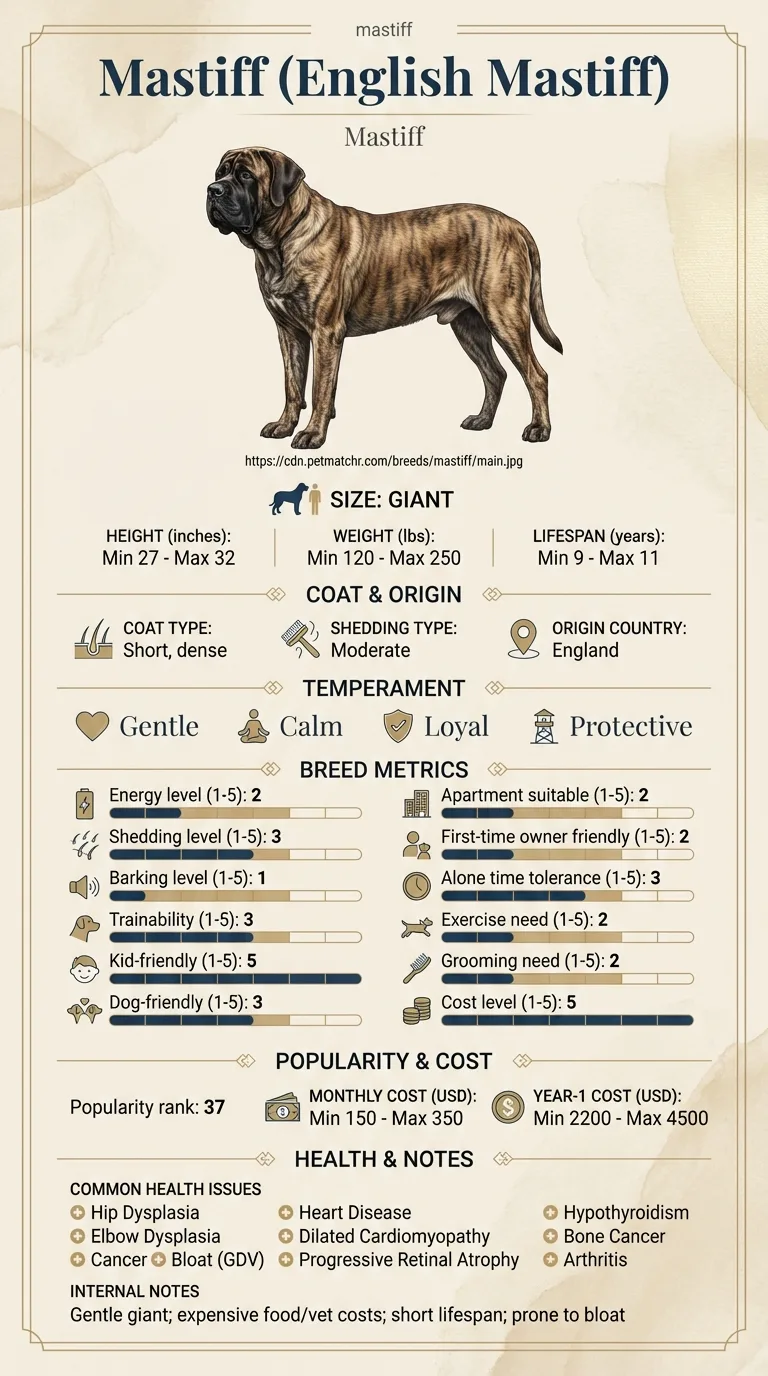
This is most relevant for breeders deciding whether to test breeding stock, and for owners who've received a DNA panel result identifying their Mastiff as a carrier or affected for vWD1 and aren't sure what that actually means day to day.
This guide is not medical advice. If your dog shows pain, sudden behavior change, or worsening symptoms, consult a licensed veterinarian.
Some links may be affiliate links. We may earn a commission at no extra cost to you. We only suggest products we believe are helpful for dog owners.
We research and check what we publish, but we do not warrant that any figure, date, price, or statement is accurate, complete, or current, and we accept no liability for any loss, cost, injury, or other harm arising from the use of this site. Use it as one reference among several. You remain responsible for your own decisions and for your dog's care - confirm anything that matters with a licensed veterinarian or another qualified professional before you act on it. Full disclaimer.
Von Willebrand's disease Type 1 is a specific, DNA-testable genetic variant associated with the mildest and most variable form of this bleeding disorder. A confirmed genetic result identifies real risk but doesn't precisely predict how severely, if at all, a given dog will be clinically affected, which shapes both how the result should be used and how much weight to give it.
This specific genetic variant is documented and testable in the breed's population, though prevalence varies by breeding line, which is exactly why individual DNA testing matters more than assuming any specific Mastiff does or doesn't carry it based on breed alone.
This is an inherited genetic variant passed down through specific breeding lines, unrelated to size, coat, or general temperament. Its presence in the breed's documented health background is why some breeders and vets recommend routine screening, particularly for dogs intended for breeding or facing an upcoming surgical procedure.
Environment has little direct influence on whether a dog carries this variant, but it plays a meaningful role in whether the result is ever acted on. Breeding programs and vet practices with established testing protocols catch and manage this proactively; those without them may only discover it reactively, during or after a bleeding complication.
Talk to your vet as soon as you receive a vWD1 test result, whether carrier or affected, particularly before any planned surgery, so precautions can be built into the procedure plan rather than discovered mid-surgery.
See all Mastiff health problems, which breeds are prone to von willebrands disease vwd1, or the full Mastiff breed guide for temperament, exercise needs and ownership costs.
A DNA test typically returns results within one to three weeks depending on the lab. The genetic status itself is permanent and won't change, but its practical implications can be clarified further with a clotting function test at any point afterward.
Success looks like an informed decision, whether that's adjusting breeding plans, adding surgical precautions, or simply having the information on file, rather than expecting the test itself to resolve or predict every future outcome.
A genetic test for vWD1 identifies whether a dog carries zero, one, or two copies of the specific variant associated with this form of the disease. That result is precise at the genetic level, but it doesn't precisely predict clinical severity - two dogs with the same genetic result can have meaningfully different real-world bleeding tendencies, since severity is also influenced by other factors not fully captured by a single genetic marker.
This is why a DNA result is best treated as a risk flag prompting further conversation with a vet, not a final verdict on how the dog will actually behave clinically. A dog testing as affected might live its whole life with no noticeable bleeding issue, while another might need the same surgical precautions discussed for the general form of the disease.
A confirmed vWD1 result is most useful when it changes specific decisions, not when it's treated as an alarming label.

If you think your Mastiff has von willebrand's disease (vwd1), the plan is three steps: write down what you have seen and when it started, book a veterinary appointment rather than waiting for the next flare, and take video of the behaviour or symptom before you go — the thing you are worried about rarely happens in the consulting room. Screening in the parents covers hip dysplasia, elbow dysplasia, cancer.
What the vet visit should produce is a diagnosis and a written plan, not just reassurance: what is being ruled out, what the monitoring interval is, and which signs mean you come back sooner. Ask what the treatment costs across a year rather than per visit, because that is the number that decides whether you are managing this condition or reacting to it.
Between appointments, keep a short log — dates, what you saw, what changed. It is the single most useful thing an owner brings to a follow-up, and for von willebrand's disease (vwd1) it is often what separates a clear pattern from a guess.
Roger, a small-scale hobby breeder, ran a full genetic panel on his Mastiff Willow before considering her for a breeding program, mostly out of general due diligence. The result flagged her as a carrier for vWD1, a variant he hadn't previously tested for in his line. Rather than panicking, Roger spoke with his vet, who explained the distinction between the genetic result and clinical severity clearly - Willow, as a carrier with just one copy, was unlikely to show any bleeding symptoms herself. The practical decision point was breeding: pairing her only with a confirmed clear stud to avoid producing puppies with two copies of the variant. Roger also had Willow's clotting function checked directly, which came back normal, giving him added confidence for her own day-to-day health. Her eventual litter, paired with a clear stud, produced no affected puppies, just a mix of clear and carrier offspring, exactly as the genetics predicted.
Key takeaway: A genetic carrier result is information to act on deliberately, not a reason for alarm - the real value is in how it changes a specific decision, whether that's a breeding pairing or a surgical precaution.
vWD Type 1 refers to a specific genetic variant and is generally the mildest, most variable form of the broader condition. A dog can be genetically confirmed as vWD1-affected or carrier through DNA testing, while the general diagnosis is often made through symptoms or a clotting function blood test.
Not necessarily. Clinical severity varies significantly even among dogs with the same genetic result, and some genetically affected dogs show no noticeable bleeding tendency in daily life.
Generally yes. Pairing two carriers or affected dogs increases the chance of producing puppies with two copies of the variant, which is associated with more consistent and potentially more significant clinical effects.
A DNA result is a useful starting point, but many vets also recommend a clotting function blood test before surgery, since it measures actual clotting ability rather than just genetic risk.
Costs vary by lab and panel type, but a standalone genetic test for a known variant like this is generally more affordable than broader diagnostic workups, making it a reasonable low-cost screening step.
Yes. A single copy of the variant, making a dog a carrier rather than affected, often produces no clinical symptoms, though the dog can still pass the variant to offspring if bred.
Generally yes - it's known for variable severity, ranging from no noticeable effect to clinically significant bleeding tendency.
Not precisely - the genetic result identifies the variant, but real-world severity varies and isn't fully predicted by genetics alone.
It's generally discouraged, since pairing two carriers increases the chance of producing more significantly affected puppies.
It's generally an affordable, targeted test compared to broader diagnostic workups, making it a reasonable low-cost screening option.
Yes - many carriers show no clinical signs at all, though they can still pass the variant to any offspring if bred.
A one-page prep sheet for this condition: the signs, the questions to ask, what to get priced. Unlocks here.
You get: Vet visit prep sheet
No spam. One-click unsubscribe. See our privacy policy.
Preview page 1 before you decide.