Health
Is Type 1 the mild or severe form of this condition?
Generally the mildest of the three recognized types, involving a partial rather than near-total reduction in clotting protein.

Quick answer
Is Type 1 the mild or severe form of this condition?
Generally the mildest of the three recognized types, involving a partial rather than near-total reduction in clotting protein.
Not all von Willebrand's diagnoses are created equal, and Type 1 is the version most likely to show up as a clear, testable answer rather than a mystery.
Owners who've received a DNA panel result flagging Type 1 von Willebrand's status, and breeders trying to understand what a clear, carrier, or affected result actually means for breeding decisions.
This guide is not medical advice. If your dog shows pain, sudden behavior change, or worsening symptoms, consult a licensed veterinarian.
Some links may be affiliate links. We may earn a commission at no extra cost to you. We only suggest products we believe are helpful for dog owners.
We research and check what we publish, but we do not warrant that any figure, date, price, or statement is accurate, complete, or current, and we accept no liability for any loss, cost, injury, or other harm arising from the use of this site. Use it as one reference among several. You remain responsible for your own decisions and for your dog's care - confirm anything that matters with a licensed veterinarian or another qualified professional before you act on it. Full disclaimer.
Type 1 von Willebrand's disease is a partial reduction in clotting protein levels, generally the mildest of the three recognized types and the one most reliably detected through a straightforward DNA panel given its well-characterized genetic mutation. A clear, carrier, or affected result each carries distinct practical implications for both individual dog management and breeding decisions.
Type 1 is the most common form of von Willebrand's disease across dog breeds generally, and while it isn't specifically flagged in this breed's own documented health profile, its accessible genetic test makes it a reasonable, low-cost addition to broader health screening for this breed.
This breed's documented health record doesn't single out this condition specifically, but Type 1's broad prevalence across dog breeds generally, combined with its well-characterized genetic basis, means it can appear in any breed's population including this one, detectable through the same DNA panel used across breeds broadly.
There's no environmental trigger for the underlying genetic mutation itself, though surgery, injury, or certain medications affecting clotting can be the practical circumstances that reveal an underlying, previously undiagnosed deficiency.
Talk to your vet about any carrier or affected genetic result, and separately, about any prolonged bleeding after an injury or procedure, since actual clinical signs matter alongside the genetic finding.
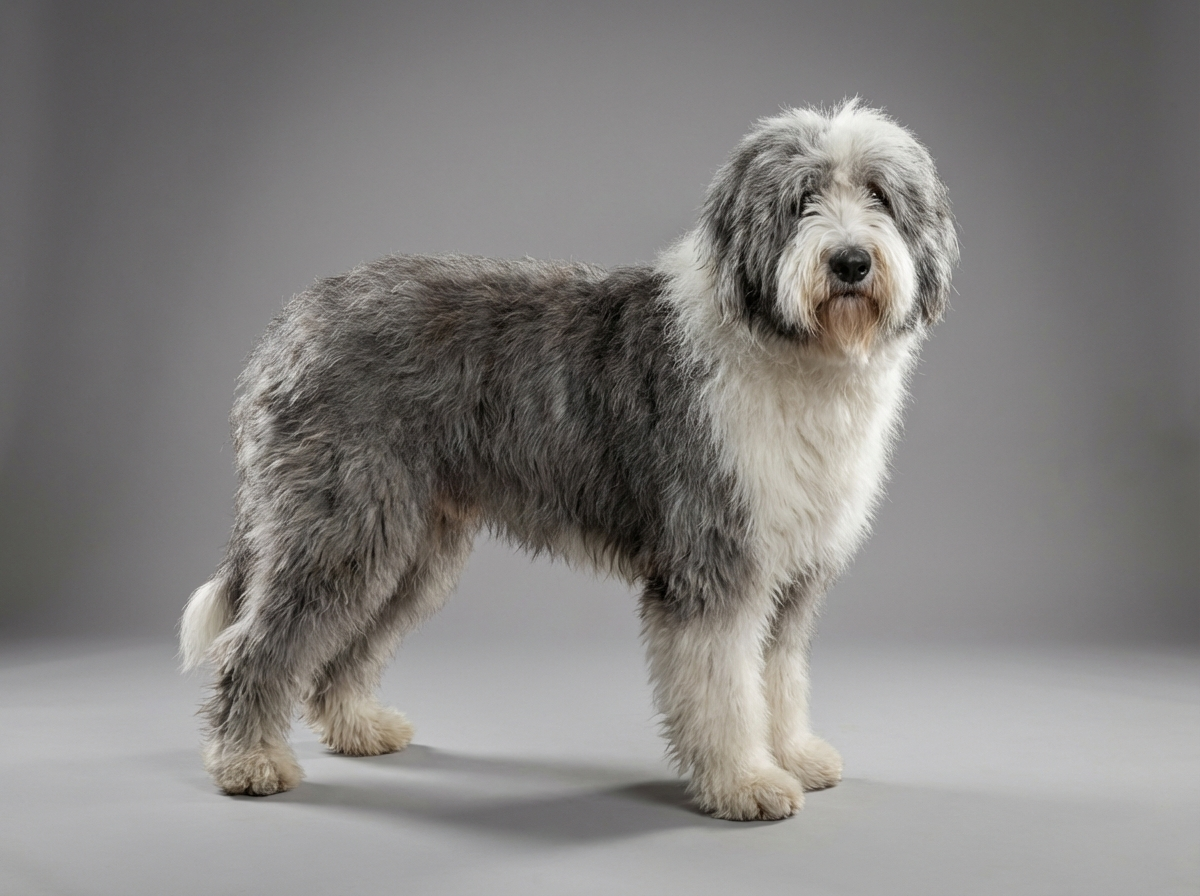
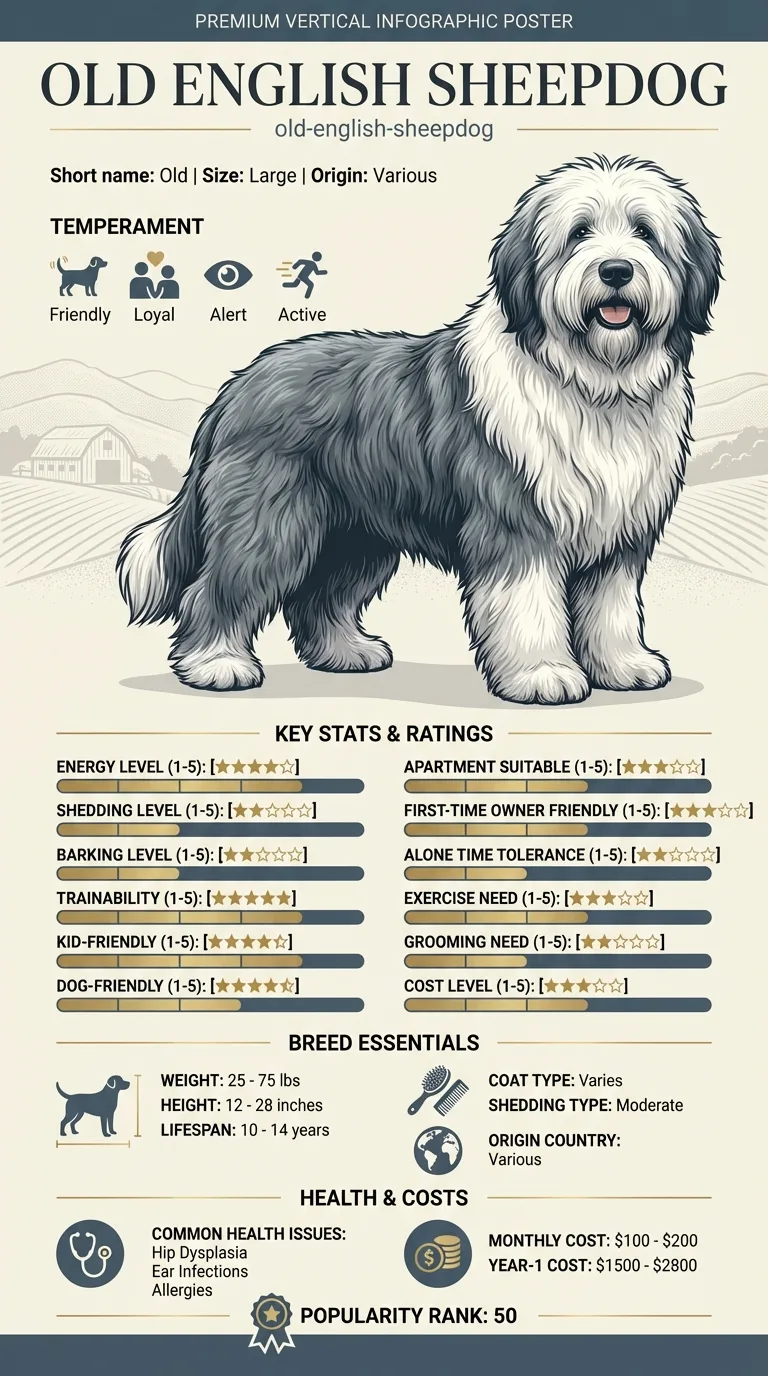
See all OLD English Sheepdog health problems, which breeds are prone to von willebrands disease vwd1, or the full OLD English Sheepdog breed guide for temperament, exercise needs and ownership costs.
Genetic panel results are typically available within a couple of weeks of sample submission. A dog's actual clinical management, if affected, is a lifelong precautionary approach rather than a condition that resolves or changes status over time.
Success looks like a clear genetic picture used to inform surgical precautions and breeding decisions appropriately, rather than either ignoring a concerning result or over-reacting to a carrier status that carries no clinical symptoms on its own.
The three recognized types of von Willebrand's disease differ in both how severely they reduce clotting protein function and how reliably they can be genetically tested. Type 1 involves a partial quantitative reduction in von Willebrand factor, meaning some functional protein is still present, generally producing a milder clinical picture than Types 2 or 3, where the protein is either structurally abnormal or almost entirely absent. Type 1 also has a well-characterized genetic mutation that a straightforward DNA panel can detect directly, unlike a general clotting time test, which only shows that something is off without specifying the type or exact genetic cause. This is why a specific Type 1 genetic result carries real diagnostic weight, rather than being a vague flag needing further interpretation.
A clear result means a dog carries no copies of the tested Type 1 mutation. A carrier result means one copy is present, generally without clinical symptoms, though the dog can pass the mutation to offspring. An affected result means two copies are present, which is associated with an actual clotting deficiency, though even among affected dogs, severity can range from clinically silent to genuinely significant, which is why an affected genetic result is often paired with an actual clotting function test rather than treated as automatically defining a clinical severity level. For breeding purposes, avoiding carrier-to-carrier or carrier-to-affected pairings is the most direct way to reduce how often affected puppies are produced in future litters.

If you think your Old has von willebrand's disease (vwd1), the plan is three steps: write down what you have seen and when it started, book a veterinary appointment rather than waiting for the next flare, and take video of the behaviour or symptom before you go — the thing you are worried about rarely happens in the consulting room. Screening in the parents covers hip dysplasia, cataracts, hypothyroidism.
What the vet visit should produce is a diagnosis and a written plan, not just reassurance: what is being ruled out, what the monitoring interval is, and which signs mean you come back sooner. Ask what the treatment costs across a year rather than per visit, because that is the number that decides whether you are managing this condition or reacting to it.
Between appointments, keep a short log — dates, what you saw, what changed. It is the single most useful thing an owner brings to a follow-up, and for von willebrand's disease (vwd1) it is often what separates a clear pattern from a guess.
Petra ran a broad genetic health panel on her Old English Sheepdog puppy Moss before his first birthday, mostly for general planning purposes. The panel flagged Moss as a carrier for Type 1 von Willebrand's disease, one copy of the mutation, no clinical symptoms expected. When Moss later needed a minor mass removed at age six, Petra shared the genetic result with her vet ahead of time. Her vet noted the carrier status but explained it generally wouldn't cause clinical bleeding problems on its own, and proceeded with standard precautions rather than anything extraordinary. The surgery went smoothly with completely normal bleeding and clotting throughout.
Key takeaway: Knowing Moss's carrier status ahead of time didn't change his actual treatment, but it gave his vet useful context to rule out concern quickly rather than treating an unexpected bleeding question as a mystery mid-surgery.
Type 1 is a partial reduction in clotting protein levels rather than a structural defect or near-total absence, generally producing a milder clinical picture, and it has a well-characterized genetic mutation that DNA panels can test for directly.
A carrier has one copy of the mutation and generally shows no clinical symptoms, but can pass the mutation on to offspring, which is relevant information for any breeding decision.
Not necessarily. Severity varies even among genetically affected dogs, from clinically silent to genuinely significant, which is why an affected result is often paired with an actual clotting function test rather than treated as a fixed severity prediction.
Very reliable, since Type 1 has a well-characterized genetic mutation, unlike some other bleeding disorders where genetic testing is less established or unavailable entirely.
A clear result for the specific tested mutation is generally reassuring, though your vet may still recommend a pre-surgical clotting screen as a routine precaution regardless of genetic test results.
It's typically included in broader multi-condition DNA panels, commonly under two hundred dollars total, making it an accessible and reasonable screening step.
Not necessarily excluded outright, but avoiding carrier-to-carrier or carrier-to-affected pairings is the standard recommendation to prevent producing affected puppies in future litters.
Generally the mildest of the three recognized types, involving a partial rather than near-total reduction in clotting protein.
Yes, it has a well-characterized genetic mutation that a straightforward DNA panel can test for directly.
Generally no clinical symptoms, but the mutation can be passed on to offspring, relevant for breeding decisions.
No, severity varies even among affected dogs; a clotting function test is often used alongside the genetic result.
Usually under two hundred dollars as part of a broader multi-condition DNA panel.
A one-page prep sheet for this condition: the signs, the questions to ask, what to get priced. Unlocks here.
You get: Vet visit prep sheet
No spam. One-click unsubscribe. See our privacy policy.
Preview page 1 before you decide.