Living
Which is heavier?
The Mastiff, by as much as 190 pounds at the top of its range.

Quick answer
Which is heavier?
The Mastiff, by as much as 190 pounds at the top of its range.
German Wirehaired Pointer or Mastiff (English Mastiff)? On paper they differ most on exercise need, and on the scales Mastiff (English Mastiff) is the heavier at 120–250 lbs. Here is how the two compare on everything that shapes an ordinary week.
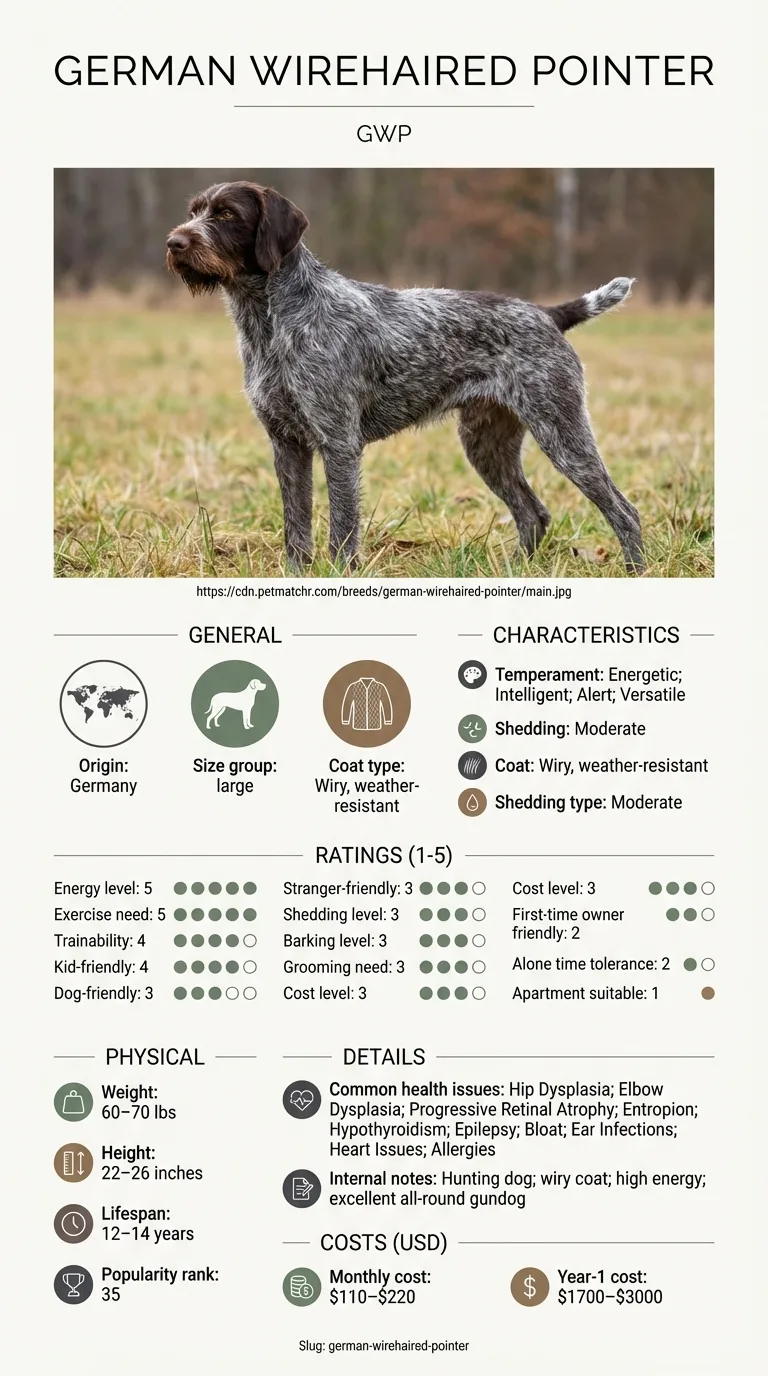
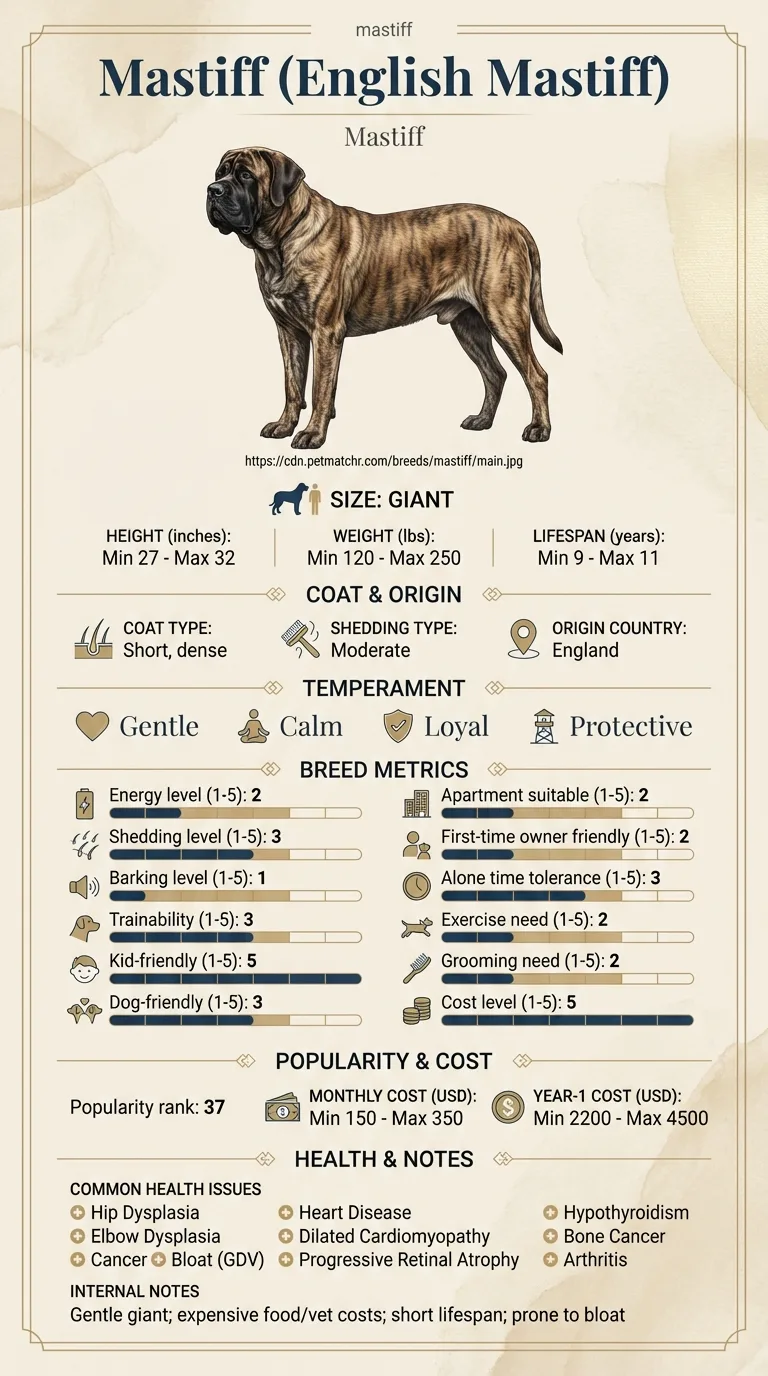
This is for someone already down to German Wirehaired Pointer and Mastiff (English Mastiff) and deciding between them. For this pair the decision usually turns on exercise need and energy level, so those are covered first and in most detail. Anyone choosing from a flat has a clear answer here: Mastiff (English Mastiff) rates 2/5 against 1/5. It is written for the decision rather than the breed history.
Between German Wirehaired Pointer and Mastiff (English Mastiff), exercise need is what separates them, and Mastiff (English Mastiff) is the lower-effort dog of the two to keep.
Choose German Wirehaired Pointer if you want a dog that picks up training quickly, a smaller dog suits your car, your home or your back and you want a dog that can keep up with an active routine.
Choose Mastiff (English Mastiff) if you do not want a standing grooming appointment, your walking routine is modest and the dog will be alone during the working day.
| Feature | german wirehaired pointer | mastiff | Winner |
|---|---|---|---|
| Size class | large | giant | Equal |
| Weight | 60–70 lbs | 120–250 lbs | Equal |
| Height | 22–26 in | 27–32 in | Equal |
| Lifespan | 12–14 years | 9–11 years | german wirehaired pointer |
| Exercise need | Very high (5/5) | Low (2/5) | mastiff |
| Grooming need | Moderate (3/5) | Low (2/5) | mastiff |
| Shedding | Moderate (3/5) | Moderate (3/5) | Equal |
| Energy level | Very high (5/5) | Low (2/5) | Equal |
| Barking | Moderate (3/5) | Very low (1/5) | mastiff |
| Apartment suitability | Very low (1/5) | Low (2/5) | mastiff |
| Good for first-time owners | Low (2/5) | Low (2/5) | Equal |
| Tolerates being alone | Low (2/5) | Moderate (3/5) | mastiff |
| Trainability | High (4/5) | Moderate (3/5) | german wirehaired pointer |
| Good with kids | High (4/5) | Very high (5/5) | mastiff |
| Good with other dogs | Moderate (3/5) | Moderate (3/5) | Equal |
| Friendly to strangers | Moderate (3/5) | Moderate (3/5) | Equal |
| Cost level | Moderate (3/5) | Very high (5/5) | german wirehaired pointer |
| Coat | Wiry, weather-resistant | Short, dense | Equal |
| Origin | Germany | England | Equal |
| Typical monthly cost | $110–$220 | $150–$350 | Equal |
| Typical first-year cost | $1,700–$3,000 | $2,200–$4,500 | Equal |
This is large versus giant: a 60-70 pound German Wirehaired Pointer against a Mastiff that can weigh 120-250 pounds -- up to four times as much. Height tells a similar story, 22-26 inches for the GWP versus 27-32 inches at the shoulder for the Mastiff, whose sheer mass rather than height defines its presence. Despite the size gap, the table calls several build-related lines a tie because both are simply big dogs by most standards; the real difference only shows once you're picturing a Mastiff's bulk next to the GWP's lean, athletic frame. A GWP could sprint circles around a Mastiff, but the Mastiff could fill a doorway just standing in it.
The German Wirehaired Pointer rates Very high (5/5) for exercise need while the Mastiff rates Low (2/5) -- a dramatic reversal of what the size difference might suggest. Mastiffs are famously low-key giants, content with modest walks and long naps, while a GWP bred for all-day fieldwork needs sustained, vigorous activity or it becomes restless and destructive. Energy level follows the same pattern: Very high for the GWP against Low for the Mastiff. A household hoping for a jogging companion should look at the GWP, not the Mastiff, whose joint and heart-related risks (including dilated cardiomyopathy) make sustained hard exercise inadvisable anyway as the dog matures.
Grooming favors the Mastiff slightly, rated Low (2/5) against the GWP's Moderate (3/5) -- a short, dense coat needs far less brushing than the GWP's wiry, weather-resistant one, which benefits from periodic hand-stripping. Shedding is rated Moderate (3/5) for both, so neither is a low-shed breed despite their very different coat textures; Mastiff owners often report heavier seasonal blowouts than the moderate rating alone suggests. Beyond coat care, Mastiffs bring their own upkeep burden: drooling and facial-wrinkle cleaning that a GWP simply doesn't have. So while the GWP needs more brush time, the Mastiff needs more wipe-down time -- different chores, comparable overall effort.
Neither breed scores well for apartment life -- Very low (1/5) for the GWP, Low (2/5) for the Mastiff -- but for opposite reasons: the GWP needs space to burn very high energy, while the Mastiff simply needs floor space for its giant frame to stretch out. Barking favors the Mastiff heavily, Very low (1/5) against the GWP's Moderate (3/5); Mastiffs are known for being remarkably quiet despite their size, more likely to lean their weight on you than bark at a stranger. Alone tolerance tips toward the Mastiff too, Moderate (3/5) versus the GWP's Low (2/5), making the Mastiff the somewhat more forgiving choice for owners with unpredictable schedules.
Trainability favors the GWP, High (4/5) versus the Mastiff's Moderate (3/5), reflecting the GWP's energetic, intelligent, alert, versatile working-dog temperament against the Mastiff's gentle, calm, loyal, protective disposition -- a dog that learns fine but isn't as eager to work for it. Both breeds rate Low (2/5) for first-time owners, though the challenges differ: a GWP overwhelms novices with its exercise and drive requirements, while a Mastiff overwhelms them with sheer physical size and the strength needed to manage 150-plus pounds of dog on a leash. Neither is a beginner's breed, but an experienced handler comfortable with either high energy or high mass could manage well.
With kids, the Mastiff edges ahead at Very high (5/5) versus the GWP's High (4/5), and its gentle, calm, protective temperament backs that up -- Mastiffs are famous gentle giants around children they know. Good with other dogs and friendly to strangers both rate Moderate (3/5) for each breed, so neither has a clear edge socially. Families should weigh the practical difference instead: a Mastiff's size means accidental knock-downs are a real risk with small kids even without aggression, while a GWP's higher energy means it needs an outlet before it can settle calmly around a family. Both benefit from early socialization regardless of the ratings.
Lifespan clearly favors the GWP, 12-14 years against the Mastiff's 9-11 -- a meaningful gap tied to the Mastiff's giant-breed status. The Mastiff's health list is heavier too: hip and elbow dysplasia, cancer, bloat (GDV), heart disease, dilated cardiomyopathy, progressive retinal atrophy, hypothyroidism, bone cancer and arthritis, several of which -- cancer, bone cancer, DCM -- are classic giant-breed shortened-lifespan risks. The GWP's list -- hip and elbow dysplasia, PRA, entropion, hypothyroidism, epilepsy, bloat, ear infections, heart issues and allergies -- overlaps on dysplasia, PRA, hypothyroidism and bloat but skips the cancer burden. Both breeds carry real bloat risk given their deep chests, so slow-feed strategies matter for either.
Cost level rates Moderate (3/5) for the GWP against Very high (5/5) for the Mastiff, and the dollar figures back it up: $150-350 monthly and $2,200-4,500 in year one for the Mastiff versus $110-220 monthly and $1,700-3,000 for the GWP. The gap is mostly about volume -- food, medication doses, and vet procedures all scale with a dog that can weigh 250 pounds. A Mastiff's higher cancer and heart disease risk can also mean pricier diagnostics and treatment later in life. Anyone budgeting for either breed should plan for the GWP's costs to stay relatively flat while a Mastiff's can spike sharply in its later, health-challenged years.
German Wirehaired Pointer weighs 60–70 lbs and lives 12–14 years; Mastiff (English Mastiff) weighs 120–250 lbs and lives 9–11 years. The two diverge most on exercise need, energy level and barking and 1 other rated axes. They are level on good with other dogs, good for first-time owners and shedding, so those cannot decide it. In the table, a "winner" means easier for an ordinary household — not better. Size, coat and origin are recorded without a verdict. Because both breeds are scored the same way, the gaps are reliable even where the absolute numbers are rough.

The Mastiff, whose gentle, calm temperament and Low (2/5) exercise need make it far more content lounging indoors than the Very high-energy GWP.
The GWP, at roughly $1,700-3,000 in year one versus the Mastiff's $2,200-4,500 -- Mastiffs cost more across the board due to their giant size.
The Mastiff, rated Very low (1/5) for barking against the GWP's Moderate (3/5); Mastiffs are known for being unusually quiet for their size.
The Mastiff rates slightly higher (Very high, 5/5 vs High, 4/5) and its gentle, protective temperament suits families well, though its size means supervision around small children still matters.
The GWP, at 12-14 years versus the Mastiff's 9-11 years -- typical of the gap between large and giant breeds.
No -- it rates Low (2/5) for exercise need, a stark contrast to the GWP's Very high (5/5) rating.
Yes, cancer and bone cancer both appear on its health list, along with heart disease and dilated cardiomyopathy -- risks not listed for the GWP.
The Mastiff, by as much as 190 pounds at the top of its range.
The GWP, rated Very high (5/5) versus the Mastiff's Low (2/5).
The Mastiff, rated Very low (1/5) for barking.
The GWP, at $1,700-3,000 versus the Mastiff's $2,200-4,500.
Secure checkout on Stripe. We never see your card.
7-day money-back guarantee. Instant access.
Health information here is general and is not veterinary advice. If your dog shows pain, sudden behaviour change, or worsening symptoms, consult a licensed veterinarian.
Some links on this site are affiliate links. We may earn a commission at no extra cost to you, and we only suggest products we believe are helpful for dog owners.
We research and check what we publish, but we do not warrant that any figure, date, price, or statement is accurate, complete, or current, and we accept no liability for any loss, cost, injury, or other harm arising from the use of this site. Use it as one reference among several. You remain responsible for your own decisions and for your dog's care - confirm anything that matters with a licensed veterinarian or another qualified professional before you act on it. Full disclaimer.
Match your lifestyle to the right dog.
Take quizNot sure which breed is right for you? Take our 2-minute quiz to find out.
Take the quiz