Health
What are the three possible DNA test results?
Clear, carrier or affected, based on how many copies of the known mutation a dog carries.

Quick answer
What are the three possible DNA test results?
Clear, carrier or affected, based on how many copies of the known mutation a dog carries.
A DNA result gives a genotype, not a guarantee. Two dogs with the identical test result can bleed very differently in real life, which is the detail that trips up a lot of pairing decisions.
Breeders planning a litter with DNA panel results in hand, and buyers trying to understand what a breeder's stated 'clear' or 'carrier' status actually promises.
This guide is not medical advice. If your dog shows pain, sudden behavior change, or worsening symptoms, consult a licensed veterinarian.
Some links may be affiliate links. We may earn a commission at no extra cost to you. We only suggest products we believe are helpful for dog owners.
We research and check what we publish, but we do not warrant that any figure, date, price, or statement is accurate, complete, or current, and we accept no liability for any loss, cost, injury, or other harm arising from the use of this site. Use it as one reference among several. You remain responsible for your own decisions and for your dog's care - confirm anything that matters with a licensed veterinarian or another qualified professional before you act on it. Full disclaimer.
The Type 1 form of Von Willebrand's Disease documented in this breed has a DNA test reporting clear, carrier or affected status, but that genotype does not perfectly predict how severely an individual dog will actually bleed. Responsible breeding and buying decisions need to treat the test as one input rather than the whole answer.
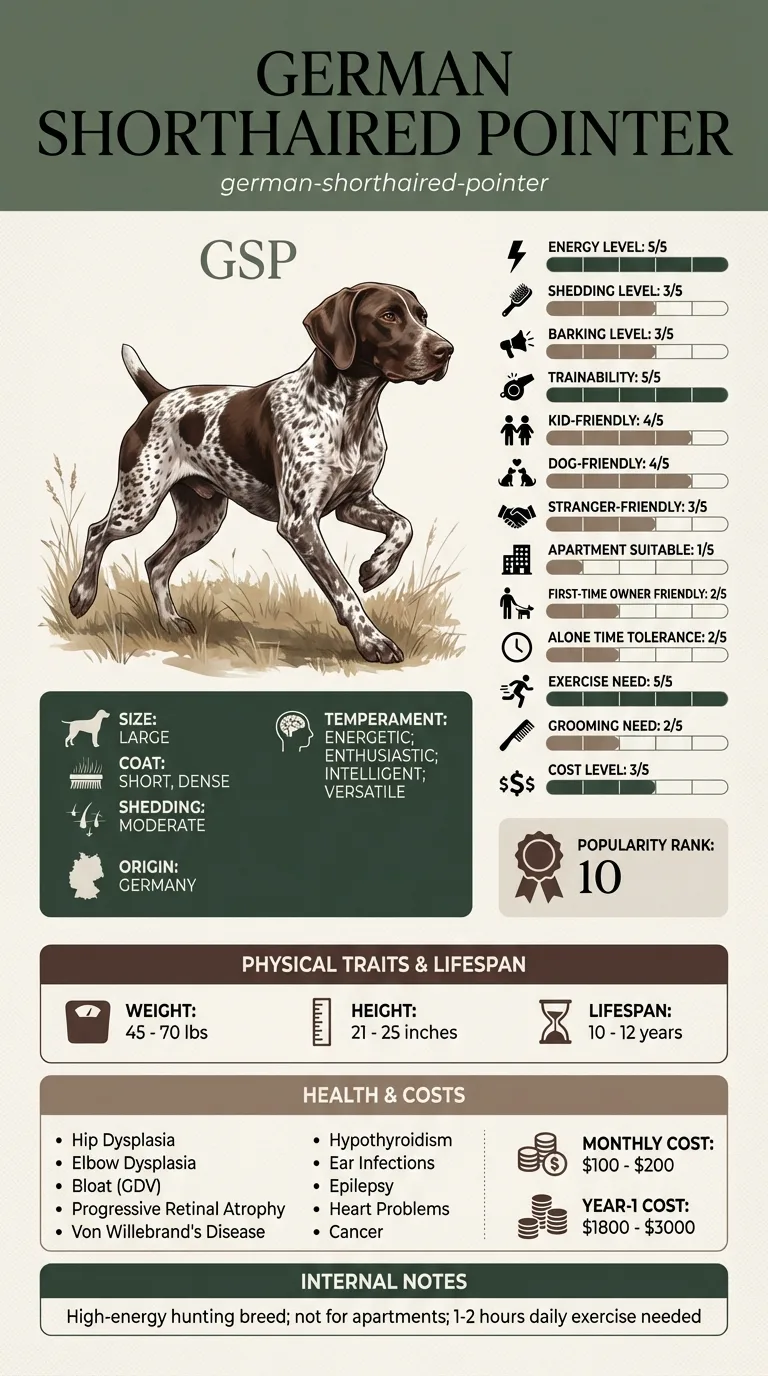
Von Willebrand's Disease is named specifically on this breed's documented health list, and the Type 1 form with its associated DNA test is the form generally relevant to German Shorthaired Pointers, making genetic testing a realistic and worthwhile consideration for breeders working with this breed.
The mutation's presence in this breed's population is part of the broader genetic load carried within a closed-registry purebred breed, the same underlying population-genetics mechanism that explains the length of this breed's documented health list generally. Its Type 1, partial-deficiency form is the specific variant relevant here, generally milder than more severe forms documented in some other breeds.
Breeding decisions made without DNA panel testing, or with panel results not properly disclosed or acted on, are the main factor that allows the mutation to continue circulating without deliberate management. There is no environmental trigger for the underlying genetic mutation itself.
Discuss DNA panel and clotting factor testing options with a vet before planning a litter, or when purchasing a puppy from a line with an unclear health-testing history. This is a planning conversation, but it becomes urgent if an actual bleeding problem arises in a dog whose genetic status is unknown, since that changes how a vet approaches an emergency.
See all German Shorthaired Pointer health problems, which breeds are prone to von willebrands disease vwd1, or the full German Shorthaired Pointer breed guide for temperament, exercise needs and ownership costs.
DNA panel results typically return within one to three weeks of sample submission. The genetics themselves are fixed and do not change over a dog's lifetime, but breeding strategy built around them is a long-term, multi-generation effort rather than a single-litter fix.
Breeding decisions grounded in actual test results rather than assumption, transparent disclosure to buyers, and a gradual reduction over generations in how often the mutation is paired in ways that produce affected puppies, without needlessly excluding valuable carrier dogs from a limited gene pool.
A clear result means the dog carries no copies of the specific tested mutation. A carrier or affected result means one or two copies, respectively, are present. This much is straightforward genetics. What is less straightforward, and the detail that catches breeders and buyers out, is that genotype and phenotype do not correlate perfectly for this condition: two dogs with the same DNA result can have measurably different clotting factor levels and different real-world bleeding tendencies, because other genetic and physiological factors influence how the mutation actually expresses itself.
This means a DNA panel is a genuinely useful tool for planning pairings and estimating risk, but it is not a substitute for an actual clotting factor blood test in a dog whose surgical or bleeding history raises a specific concern, and it is not a promise that an 'affected' dog will bleed severely or that a 'clear' dog's littermate with a different result will bleed at all noticeably. Breeders and buyers who treat the DNA result as the entire answer are missing the part of the picture that actually predicts a given dog's day-to-day risk.
These are the practical decisions the test result should inform, not replace.

If you think your GSP has von willebrand's disease (vwd1), the plan is three steps: write down what you have seen and when it started, book a veterinary appointment rather than waiting for the next flare, and take video of the behaviour or symptom before you go — the thing you are worried about rarely happens in the consulting room. Screening in the parents covers hip dysplasia, elbow dysplasia, bloat (gdv).
What the vet visit should produce is a diagnosis and a written plan, not just reassurance: what is being ruled out, what the monitoring interval is, and which signs mean you come back sooner. Ask what the treatment costs across a year rather than per visit, because that is the number that decides whether you are managing this condition or reacting to it.
Between appointments, keep a short log — dates, what you saw, what changed. It is the single most useful thing an owner brings to a follow-up, and for von willebrand's disease (vwd1) it is often what separates a clear pattern from a guess.
Soren, who breeds under a small kennel name, tested a litter after learning the sire was a carrier. Two littermates came back with the identical carrier genotype. Years later, one of them needed emergency surgery after a field accident and bled entirely normally, while the other had a noticeably prolonged bleeding episode after a routine spay. The identical DNA result had not predicted the difference. Soren now discloses this specifically to every puppy buyer: a carrier or affected result is a real piece of information worth planning around, but it is not a promise about how any individual dog will actually behave under a real bleeding challenge. Going forward, Soren pairs carriers only with clear-tested partners and recommends buyers of carrier puppies mention the result to their vet before any future surgery, rather than assuming the genotype alone tells the whole story.
Key takeaway: The test told Soren which puppies carried the mutation. It did not tell him which one would actually bleed more when it mattered, and treating the two as the same information would have been the real mistake.
It refers to a partial, quantitative reduction in the clotting protein rather than its complete absence, generally producing a milder clinical picture than more severe forms of the disease documented in other breeds.
If both parents genuinely tested clear for the specific known mutation, offspring should not inherit that mutation from either side. Always ask to see the actual test results and mutation identified rather than a verbal assurance.
Many breeders do continue to responsibly breed carrier dogs, particularly to clear partners, since removing every carrier can excessively narrow genetic diversity. Pairing two carriers together is the combination to actively avoid.
Not necessarily severely. Genotype and actual bleeding severity do not correlate perfectly, so an affected dog may have only mild or situational bleeding tendencies, though the safest approach is to manage the dog as genuinely at risk regardless.
It's a reasonable extra step for any dog with a personal or family history of unusual bleeding, since it measures actual clotting function directly rather than predicting it from genotype alone.
Other genetic and physiological factors beyond the single tested mutation influence how much clotting protein a dog actually produces and how well it functions, which is why genotype alone does not fully predict an individual dog's real-world risk.
Clear, carrier or affected, based on how many copies of the known mutation a dog carries.
No, dogs with the same genotype can have different real-world bleeding tendencies, so genotype alone is not a full picture.
Not necessarily; many breeders pair carriers responsibly with clear partners to avoid excessively narrowing the gene pool.
Ask for the actual DNA panel results and mutation identified for both parents, not just a general assurance the line is healthy.
Yes, for any dog with a personal or family bleeding history, since it measures actual function rather than predicting it from genetics alone.
A one-page prep sheet for this condition: the signs, the questions to ask, what to get priced. Unlocks here.
You get: Vet visit prep sheet
No spam. One-click unsubscribe. See our privacy policy.
Preview page 1 before you decide.