Health
What makes Type I different from other forms?
It is generally the mildest form, caused by reduced quantity rather than complete absence of a normally structured clotting protein.

Quick answer
What makes Type I different from other forms?
It is generally the mildest form, caused by reduced quantity rather than complete absence of a normally structured clotting protein.
Unlike most inherited conditions on this site, this one can often be identified with a cheek swab before a single clinical sign has ever appeared, which changes the entire conversation from reactive diagnosis to proactive planning.
For breeders selecting pairings, for buyers evaluating a puppy's genetic test results, and for owners who want to understand what a specific Type I diagnosis or carrier result actually means for their dog and any future litters.
This guide is not medical advice. If your dog shows pain, sudden behavior change, or worsening symptoms, consult a licensed veterinarian.
Some links may be affiliate links. We may earn a commission at no extra cost to you. We only suggest products we believe are helpful for dog owners.
We research and check what we publish, but we do not warrant that any figure, date, price, or statement is accurate, complete, or current, and we accept no liability for any loss, cost, injury, or other harm arising from the use of this site. Use it as one reference among several. You remain responsible for your own decisions and for your dog's care - confirm anything that matters with a licensed veterinarian or another qualified professional before you act on it. Full disclaimer.
Type I von Willebrand's disease is the mildest, most common form of this bleeding disorder, caused by reduced quantity rather than complete absence of a clotting protein, and it follows a specific autosomal inheritance pattern that DNA testing can identify directly. This genetic clarity makes it possible to classify a dog as clear, carrier or affected before any clinical sign appears, turning breeding decisions and long-term medical planning into a matter of informed choice rather than reactive discovery after a bleeding event.
Von Willebrand's disease Type I is a recognised inherited condition in a range of breeds, with Newfoundlands among those for which testing is relevant and available. It is not one of the five conditions most consistently listed for this breed's general health profile, hip dysplasia, subaortic stenosis, dilated cardiomyopathy, cystinuria and bloat, but its clear genetic basis makes it one of the more proactively manageable inherited conditions once testing is incorporated into breeding practice.
This is a heritable condition with a specific, identifiable genetic basis, and Newfoundlands are among the breeds for which Type I von Willebrand's disease testing is a recognised consideration. The autosomal inheritance pattern means both sexes are equally likely to be affected or to carry the variant, and a dog's status is fixed at conception rather than developing through any lifestyle or environmental factor. This genetic clarity is precisely what distinguishes this condition from many others discussed for this breed, where risk is understood at a population level without a single identifiable variant to test for directly.
Environment plays essentially no role in whether a dog carries or is affected by this specific genetic variant, since inheritance is fixed at conception. Where environment matters is in breeding practice: whether a breeding program actually incorporates available DNA testing into pairing decisions, and whether test results are shared transparently with puppy buyers, both of which are choices made by people rather than biological factors.
Discuss genetic testing with your vet if you are considering breeding your dog, evaluating a puppy, or simply want full information ahead of any future planned procedure. There is no emergency version of a genetic test result on its own, but a dog testing as affected should still be managed with the same procedure and injury precautions as any clinically diagnosed case, discussed with your vet regardless of how mild the dog's day-to-day presentation has been.
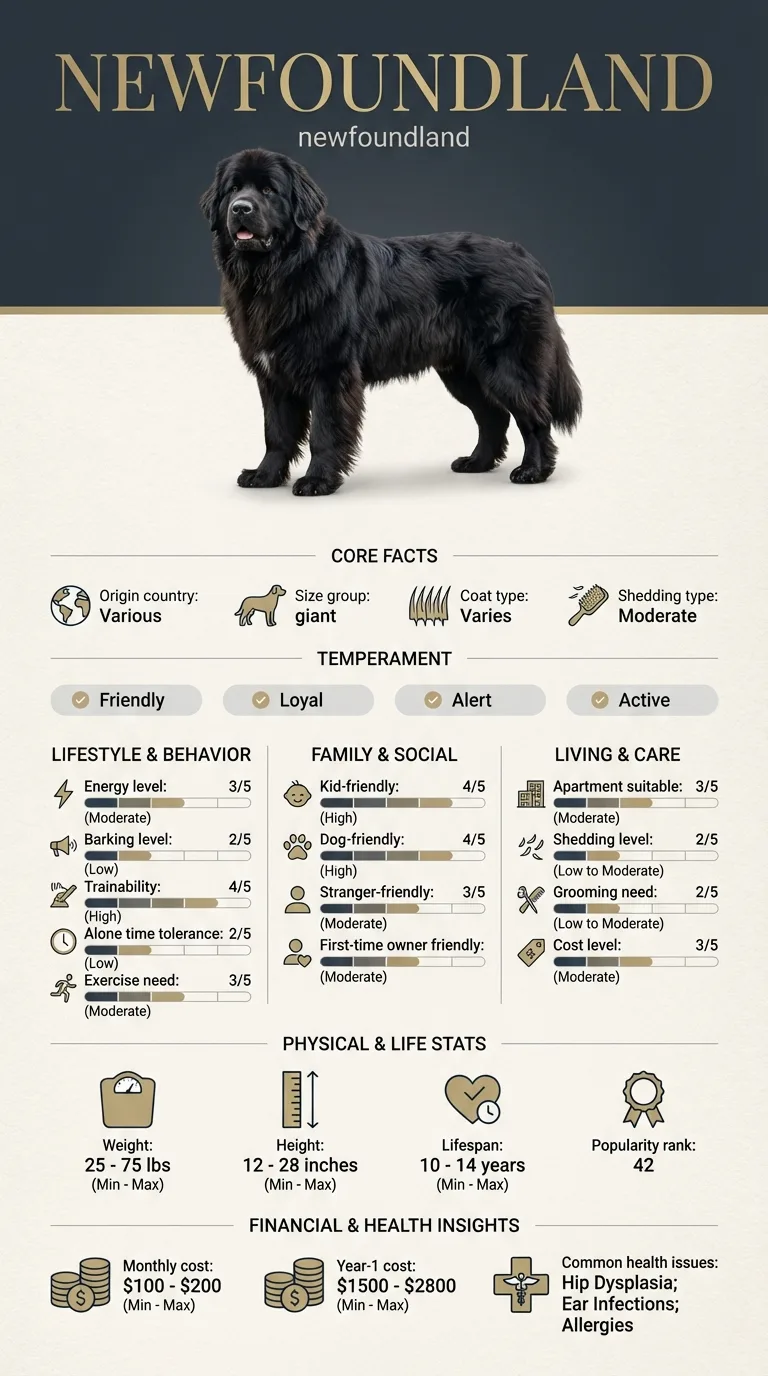
See all Newfoundland health problems, which breeds are prone to von willebrands disease vwd1, or the full Newfoundland breed guide for temperament, exercise needs and ownership costs.
A DNA test result is typically available within one to a few weeks of sample submission and, once obtained, does not need repeating, since a dog's genetic status does not change over its lifetime. Incorporating testing into an ongoing breeding program is a longer-term project, generally implemented gradually across successive generations of pairing decisions rather than achieved in a single litter.
Success at the individual level is a clear, documented genetic status informing every future medical and, where relevant, breeding decision for that specific dog. At the breeding program level, success is a gradual reduction in carrier-to-carrier pairings and, over generations, a lower overall rate of affected puppies, achieved through informed selection rather than guesswork based on clinical history alone.
Type I von Willebrand's disease in the breeds where it has been genetically characterised follows an autosomal pattern, meaning the responsible gene is not on a sex chromosome and both male and female dogs are equally likely to be affected or to carry it. Depending on the specific population and how the trait behaves within it, a dog can be genetically clear, a carrier with no or minimal clinical signs, or affected with the reduced clotting protein levels that define the disease, and DNA testing can distinguish between these categories directly rather than relying on inferred risk from a pedigree alone.
This is meaningfully different from diagnosing the disease clinically through a blood test measuring clotting protein activity at a single point in time, which shows the current level in that individual dog but does not on its own reveal the full genetic picture, including carrier status in a dog whose levels currently look normal. A DNA test targets the actual genetic variant, which means it can identify a carrier dog who will never show a clinical sign in its own life but who can still pass the variant to some proportion of its puppies, an outcome invisible to a clotting activity blood test alone.
For Type I specifically, clinical severity in an affected dog also varies considerably, and a proportion of affected dogs show few or no clinical signs under ordinary circumstances despite testing as affected, only becoming apparent during a significant injury or surgical procedure. This variability is part of why genetic testing, rather than waiting for a clinical event to reveal the diagnosis, has become the standard recommended approach in breeds where the test is available and validated.

A genetic result is only useful if it is correctly translated into an actual pairing decision, and this is where the practical value of testing lives.
If you think your Newfoundland has von willebrand's disease, the plan is three steps: write down what you have seen and when it started, book a veterinary appointment rather than waiting for the next flare, and take video of the behaviour or symptom before you go — the thing you are worried about rarely happens in the consulting room. Screening in the parents covers hip dysplasia, subaortic stenosis, dilated cardiomyopathy.
What the vet visit should produce is a diagnosis and a written plan, not just reassurance: what is being ruled out, what the monitoring interval is, and which signs mean you come back sooner. Ask what the treatment costs across a year rather than per visit, because that is the number that decides whether you are managing this condition or reacting to it.
Between appointments, keep a short log — dates, what you saw, what changed. It is the single most useful thing an owner brings to a follow-up, and for von willebrand's disease it is often what separates a clear pattern from a guess.
When Rosalind decided to breed her Newfoundland, Thistle, for the first time, she had DNA testing done as part of her standard pre-breeding health screening, more out of due diligence than expectation of a notable finding. The result came back showing Thistle was a carrier for Type I von Willebrand's disease, something with no clinical signs whatsoever in Thistle's own life. The stud dog Rosalind had originally been considering had not been tested, and rather than proceed without that information, she asked his owner to have him tested as well before finalising the pairing. He came back as a carrier too. Rather than proceed with a carrier-to-carrier pairing, which could statistically produce affected puppies, Rosalind found a different, genetically clear stud recommended through her breed club's health registry. The resulting litter, tested individually as puppies, included both clear and carrier puppies but no affected ones, and every puppy went home with its specific result clearly documented for its new owner. Rosalind says the entire decision took an extra few weeks and one uncomfortable conversation with the original stud's owner, a small cost against knowing exactly what she was and was not passing forward.
Key takeaway: A carrier dog with zero clinical signs can still be relevant to a breeding decision. Testing before pairing, not after a litter arrives, is what actually lets a breeder avoid producing affected puppies from this specific, well-understood genetic variant.
No. Type I is generally the mildest form, caused by reduced quantity of a normally structured clotting protein. Types II and III are less common, generally more severe, and involve a structurally abnormal protein or a near-complete absence of it respectively. The type affecting a given breed and dog matters for both severity and genetic testing approach.
Yes, this is precisely the advantage of genetic testing over relying on clinical signs or a clotting activity blood test alone. A DNA test identifies the underlying genetic variant directly, revealing carrier or affected status even in a dog that has never shown any bleeding tendency.
Not necessarily. A carrier paired with a genetically clear dog will not produce affected puppies, only additional carriers at a reduced rate, which many breed clubs consider an acceptable pairing as part of managing the trait within a limited overall gene pool rather than eliminating carriers from breeding entirely.
Not with certainty. Clinical severity varies even within Type I, and some affected dogs show few signs under normal circumstances but can still bleed significantly during major trauma or surgery. A genetic diagnosis should still prompt the same precautions around procedures regardless of how mild the dog's day-to-day presentation has been.
It is a one-time cost per dog, generally modest compared with ongoing veterinary management, and many breeders and owners consider it worthwhile given how much clearer it makes both breeding decisions and future medical planning.
Ask directly whether the parents have been DNA tested for von Willebrand's disease and what their results were, rather than accepting general reassurance. A breeder testing and sharing results transparently is demonstrating exactly the kind of responsible practice this condition's genetic clarity makes possible.
It is generally the mildest form, caused by reduced quantity rather than complete absence of a normally structured clotting protein.
Yes, a DNA test identifies the underlying variant directly, revealing carrier or affected status even with no clinical signs yet.
Carrier to carrier pairings, which can statistically produce affected puppies, unlike a carrier paired with a genetically clear dog.
No. Clinical severity varies, and the same procedure and injury precautions should still apply regardless of how mild the dog's everyday presentation has been.
Generally yes, since it is a one-time cost that clarifies both future breeding relevance and medical planning.
A one-page prep sheet for this condition: the signs, the questions to ask, what to get priced. Unlocks here.
You get: Vet visit prep sheet
No spam. One-click unsubscribe. See our privacy policy.
Preview page 1 before you decide.