Health
What does a carrier result mean for an individual pet dog?
Little to nothing for daily life in most cases, since carriers are usually clinically normal. It matters mainly for future breeding decisions.

Quick answer
What does a carrier result mean for an individual pet dog?
Little to nothing for daily life in most cases, since carriers are usually clinically normal. It matters mainly for future breeding decisions.
Two outwardly healthy Chow Chows with no bleeding history can still produce affected puppies, because Type 1 is inherited in a pattern where a completely unaffected carrier can silently pass the mutation forward.
Breeders selecting pairings for a litter, and buyers trying to understand what a breeder's genetic test results actually mean before committing to a puppy.
This guide is not medical advice. If your dog shows pain, sudden behavior change, or worsening symptoms, consult a licensed veterinarian.
Some links may be affiliate links. We may earn a commission at no extra cost to you. We only suggest products we believe are helpful for dog owners.
We research and check what we publish, but we do not warrant that any figure, date, price, or statement is accurate, complete, or current, and we accept no liability for any loss, cost, injury, or other harm arising from the use of this site. Use it as one reference among several. You remain responsible for your own decisions and for your dog's care - confirm anything that matters with a licensed veterinarian or another qualified professional before you act on it. Full disclaimer.
Von Willebrand's Disease Type 1 is caused by a specific, identifiable gene mutation affecting clotting protein production, making it directly testable through a DNA panel. It is the mildest and most common subtype in dogs, and its recessive inheritance pattern means a completely healthy-looking carrier can still pass the mutation forward into a litter.
The specific mutation and its DNA test are well established in veterinary genetics generally. Carrier and affected rates specific to the Chow Chow population are not centrally published, but breed-specific genetic panels commonly include this test given its documented relevance to multiple breeds.
This is a single, well-characterized recessive gene mutation affecting production of von Willebrand factor. Its presence and spread within the Chow Chow's population reflects the same broader pattern of genetic load documented in the breed, where a limited founder population and historical breeding practices have allowed specific harmful variants to persist across generations.
Environmental factors play no role in whether a dog carries this mutation, since it is purely genetic. What environmental and human decision factors do influence is whether it is identified and managed responsibly through testing before breeding pairings are made.
Talk to a vet or veterinary geneticist if a test result comes back as carrier or affected and you are considering breeding, so a pairing plan can be built around the result rather than around assumptions, and mention it before any planned surgery given the associated bleeding risk in affected dogs.
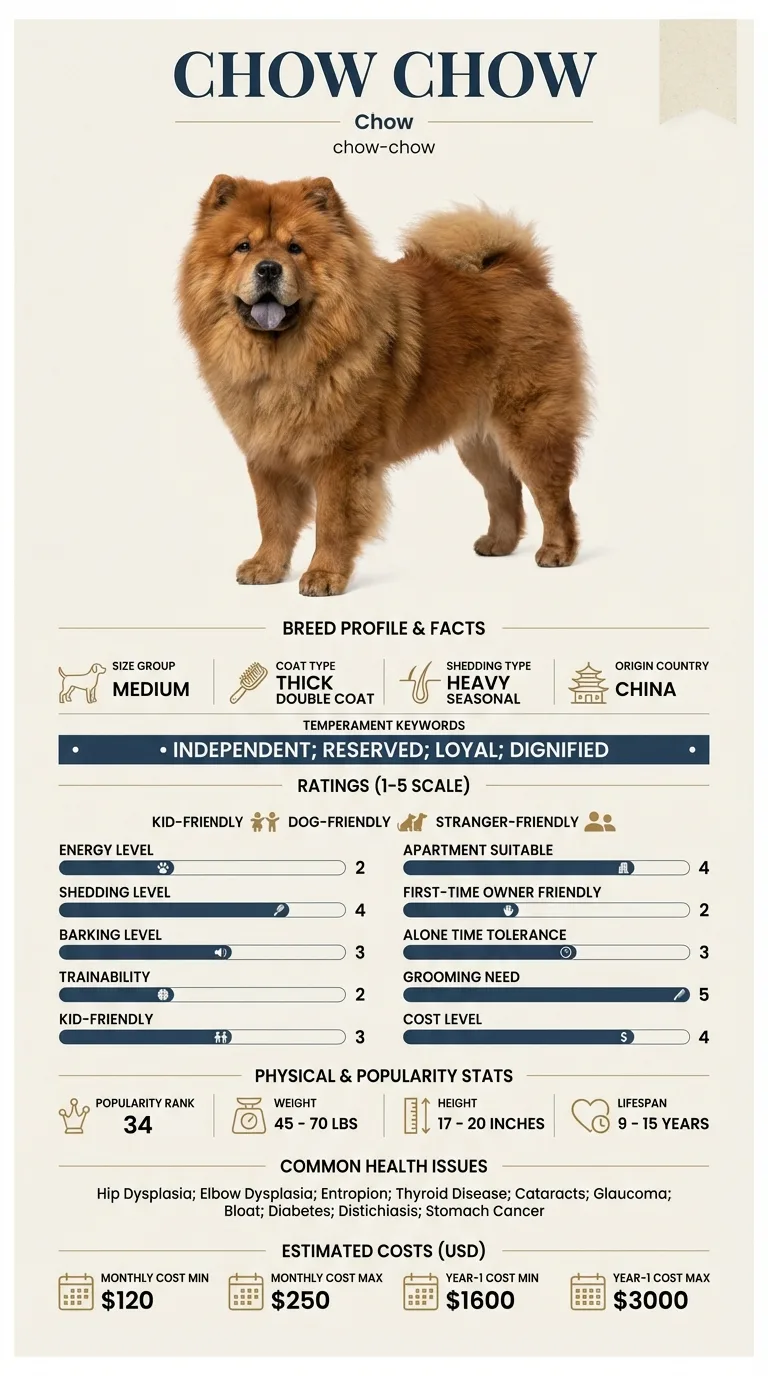
See all Chow Chow health problems, which breeds are prone to von willebrands disease vwd1, or the full Chow Chow breed guide for temperament, exercise needs and ownership costs.
DNA test results are typically available within two to four weeks of sample submission, and the result itself does not change over a dog's lifetime, so testing once is generally sufficient.
Success is a breeding program with no affected puppies produced, achieved through informed pairing decisions rather than eliminating every carrier from the gene pool outright.
This is a recessive inheritance pattern, meaning a dog needs two copies of the mutation to be clinically affected. A single copy, the carrier state, usually causes no obvious problem in that individual dog but still matters enormously for what a breeding pairing can produce.
The test does not require eliminating every carrier from a breeding program, which would unnecessarily shrink an already limited gene pool in a breed with documented genetic load. The safer and more sustainable approach is pairing a known carrier only with a confirmed clear dog, which produces zero affected puppies while still allowing valuable carrier bloodlines to continue contributing to the breed.
What should genuinely be avoided is pairing two carriers together, or breeding an untested dog of unknown status alongside a known carrier, since either scenario risks producing clinically affected puppies without anyone realizing it until a bleeding event occurs.
For a buyer, asking specifically whether a puppy's parents were tested, and what the results were, is a more informative question than simply asking whether the breeder tests at all.

If you think your Chow has von willebrand's disease (vwd1), the plan is three steps: write down what you have seen and when it started, book a veterinary appointment rather than waiting for the next flare, and take video of the behaviour or symptom before you go — the thing you are worried about rarely happens in the consulting room. Screening in the parents covers hip dysplasia, elbow dysplasia, entropion.
What the vet visit should produce is a diagnosis and a written plan, not just reassurance: what is being ruled out, what the monitoring interval is, and which signs mean you come back sooner. Ask what the treatment costs across a year rather than per visit, because that is the number that decides whether you are managing this condition or reacting to it.
Between appointments, keep a short log — dates, what you saw, what changed. It is the single most useful thing an owner brings to a follow-up, and for von willebrand's disease (vwd1) it is often what separates a clear pattern from a guess.
Ingrid, a longtime Chow Chow breeder, had two promising dogs she was considering pairing for an upcoming litter, both with excellent structure and temperament. Neither had ever shown any bleeding issue, so she had not prioritized testing them before, assuming years of clean health history was evidence enough. A routine pre-breeding genetic panel, run at her vet's suggestion, came back showing both dogs were Von Willebrand's Type 1 carriers. Neither had ever shown a symptom, and Ingrid had been about to pair them directly. Instead, she paired each carrier separately with a confirmed clear dog from her program, producing two litters with zero affected puppies and roughly half carrying a single carrier copy, fully documented for future breeding decisions.
Key takeaway: A clean bleeding history proves nothing about carrier status. Only the DNA test does, and it is the difference between a pairing that risks affected puppies and one that does not.
Type 1 is the mildest and most common subtype, caused by a single identifiable gene mutation with a specific DNA test available. Other subtypes exist with different, often more severe presentations and different or less standardized testing.
Generally yes. Carriers usually show no clinical symptoms or only very mild ones, and the main practical significance of carrier status is for breeding decisions rather than the individual dog's day-to-day health.
Not necessarily. What matters is whether the pairing itself was carrier by clear, which produces no affected puppies, rather than carrier by carrier, which does carry that risk.
Typically through a cheek swab or blood sample sent to a veterinary genetics laboratory, with results usually available within a few weeks.
Most reputable breeding guidance recommends against it, since it risks producing clinically affected puppies. Pairing a carrier with a confirmed clear dog achieves similar bloodline goals without that risk.
Not necessarily. Given the Chow Chow's broader documented genetic load and limited gene pool, excluding every carrier outright can reduce diversity further. Careful pairing rather than blanket exclusion is generally the recommended approach.
Ask whether both parents were tested for Von Willebrand's Type 1 specifically, what their individual results were, and how those results informed the pairing decision for the litter.
Little to nothing for daily life in most cases, since carriers are usually clinically normal. It matters mainly for future breeding decisions.
A single-mutation DNA test like this commonly costs under one hundred fifty dollars through a veterinary genetics lab.
Yes, with appropriate precautions around surgery and injury, an affected dog can live a full life, though breeding it further is not recommended.
Yes, testing before any planned breeding is widely recommended so pairings can be chosen to avoid producing affected puppies.
Type 1 is the specifically identified, testable form most commonly discussed in the breed, though broader Von Willebrand's disease can present with variable severity beyond this single mutation.
A one-page prep sheet for this condition: the signs, the questions to ask, what to get priced. Unlocks here.
You get: Vet visit prep sheet
No spam. One-click unsubscribe. See our privacy policy.
Preview page 1 before you decide.