Health
How do I check my dog's nostrils at home?
In daylight, with the dog calm and not panting, look from the front. Watch whether the nostril walls collapse inward on the intake rather than staying open.

Quick answer
How do I check my dog's nostrils at home?
In daylight, with the dog calm and not panting, look from the front. Watch whether the nostril walls collapse inward on the intake rather than staying open.
Cover one nostril and watch. If your dog immediately opens its mouth, you have learned something the stethoscope will not tell you.
Owners who have noticed their Mastiff breathing through its mouth at rest, or making noise on the intake, and want to know whether the nostrils are part of the problem.
This guide is not medical advice. If your dog shows pain, sudden behavior change, or worsening symptoms, consult a licensed veterinarian.
Some links may be affiliate links. We may earn a commission at no extra cost to you. We only suggest products we believe are helpful for dog owners.
We research and check what we publish, but we do not warrant that any figure, date, price, or statement is accurate, complete, or current, and we accept no liability for any loss, cost, injury, or other harm arising from the use of this site. Use it as one reference among several. You remain responsible for your own decisions and for your dog's care - confirm anything that matters with a licensed veterinarian or another qualified professional before you act on it. Full disclaimer.
Stenotic nares are nostril openings too narrow for free airflow. The significance lies not in the nose itself but in the pressure it creates: drawing air through a restriction generates excessive negative pressure throughout the airway, which over time swells and draws in soft tissue further down. It is the one airway structure an owner can inspect directly, and it is assessed dog by dog rather than assumed from breed.
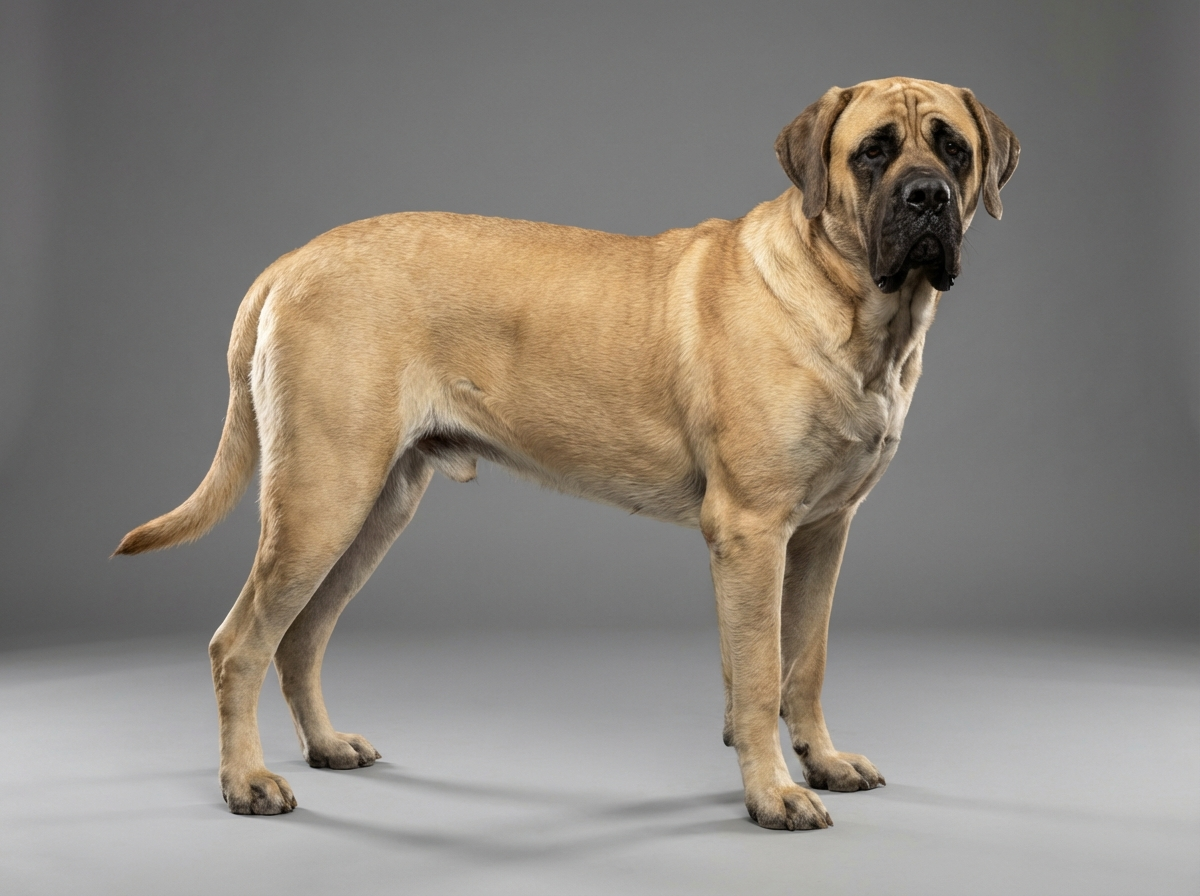
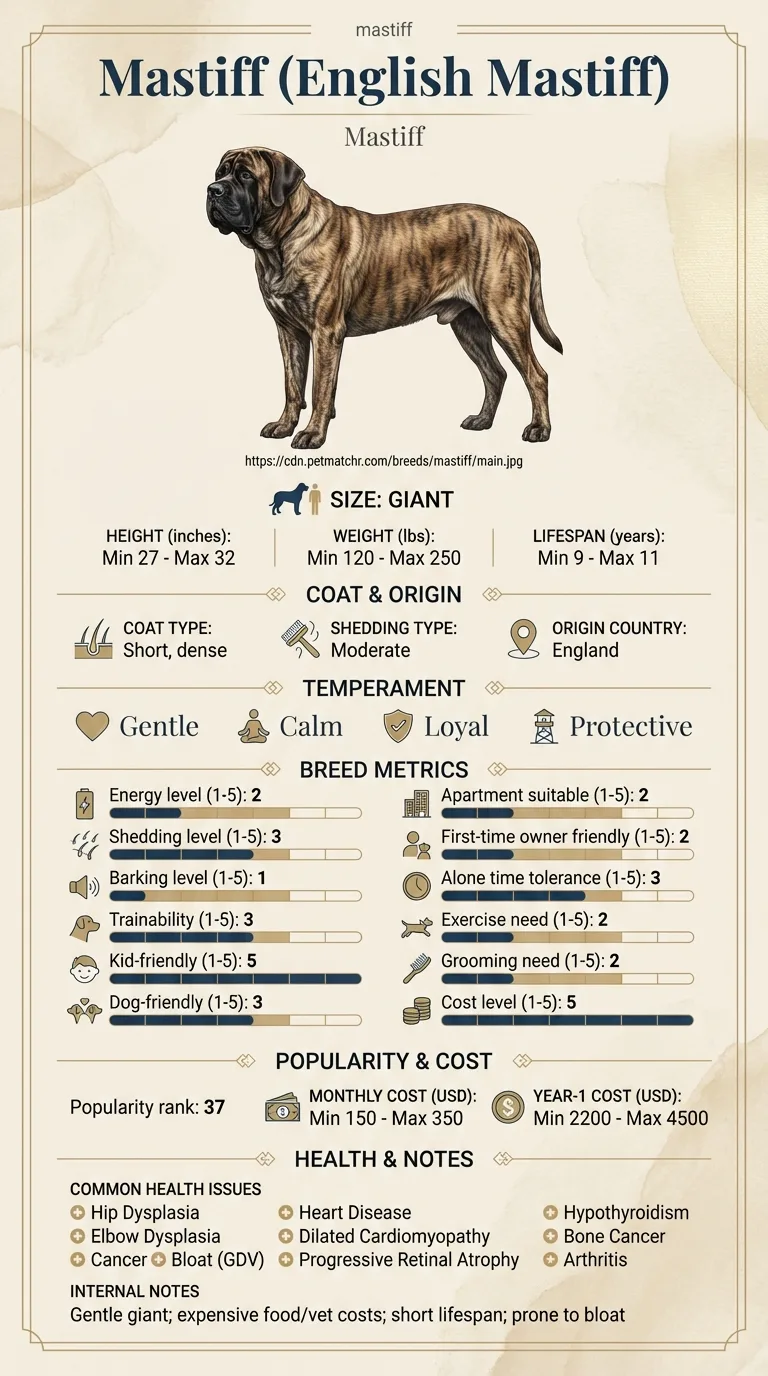
Narrowed nostrils are not among the conditions documented for Mastiffs and are far more characteristic of extremely flat-faced breeds. Individual Mastiffs can be significantly affected, and the breed's broad head with a moderately shortened muzzle means it is worth checking rather than dismissing. Most Mastiffs will have adequate nostril openings.
Nostril narrowing arises from the shape of the nasal cartilage and the surrounding tissue, and it tracks with how far a breed's muzzle has been shortened. The Mastiff is a broad-headed breed with a shortened muzzle and generous facial soft tissue, which places it on that spectrum, but at the mild end rather than at the extreme where narrowed nostrils become near-universal. The breed's real airway pressure comes from elsewhere: at 120 to 250 pounds with a short but dense coat, a Mastiff must move a great deal of air for cooling, so any restriction at the entrance is felt most acutely in hot weather.
Heat and body condition determine whether a marginal restriction becomes a practical problem. A dog whose nostrils are adequate for a cool spring day may be visibly struggling in humid August, when the same nose has to support far greater airflow for cooling. Excess weight raises demand further while reducing chest expansion. Neck collars on a heavy dog that pulls add compression lower down the same airway. None of these change the nostril anatomy, but all of them change how much that anatomy has to deliver.
Book an appointment if your Mastiff mouth breathes at rest in a cool room, makes noise on the intake while awake, or has become noisier over the past year, and take your nostril photographs with you. Ask for an assessment of the specific structures rather than a general comment on head shape. Go to a clinic immediately for laboured breathing at rest, a dog standing with elbows out and neck extended to breathe, grey, blue or pale gums, collapse, or any breathing crisis in hot weather, which should be treated as potential heatstroke with cooling started while travelling. Raise cardiac status before any elective anaesthetic in a middle-aged Mastiff.
See all Mastiff health problems, which breeds are prone to small nostrils stenotic nares, or the full Mastiff breed guide for temperament, exercise needs and ownership costs.
Home assessment takes minutes and can be repeated as often as you like. A veterinary airway assessment is usually a single consultation, though full evaluation of the deeper structures requires sedation or anaesthesia. Where nostril widening is performed, recovery is generally short, with improvement in airflow apparent within a couple of weeks. Secondary changes further down the airway, if already established, are less reliably reversed, which is the argument for acting earlier.
Success is a dog breathing comfortably through its nose at rest, with no mouth breathing in a cool room and no inward collapse of the nostrils on inhalation. For most Mastiffs, success is simply confirming that the nostrils are adequate and directing attention to the factors that actually limit this breed, which are heat and body weight. Where surgery is genuinely indicated, success is a quieter, easier-breathing dog and, importantly, the prevention of downstream damage that would have been harder to fix.
This is observation to bring to a vet, not a diagnosis. But it is genuinely useful information and almost nobody collects it.
If this were only about the nose, it would be a minor issue. The reason it matters is pressure.
When a dog has to draw air through a restricted opening, it generates greater negative pressure inside the airway with each breath, in the same way that sucking through a narrow straw takes more effort than a wide one. That pressure acts on every soft structure further down: the soft palate, the walls of the throat, the tissues around the larynx. Over months and years, tissue exposed to repeated excessive negative pressure tends to become swollen, thickened and eventually to be drawn into the airway itself.
That is why nostril narrowing is treated as a starting point rather than an isolated finding. A restriction at the entrance can, over time, generate secondary changes deeper in the airway that are harder to correct than the original problem was.
The practical consequence is that where narrowing is genuinely significant, widening the nostrils is usually recommended earlier rather than later, and often at a young age. It is a comparatively straightforward procedure that removes a wedge of tissue to open the passage, and it is sometimes done at the same time as another planned anaesthetic.
What should not happen is a Mastiff being recommended for airway surgery on the basis of the breed rather than the individual. This breed sits at the mild end of muzzle shortening, and plenty of Mastiffs have entirely adequate nostrils. The assessment is of the dog, not the breed.

Rosamund's Mastiff, Ambrose, had always been a mouth breather. She had assumed it was normal for a dog with a face like his until she read about the one-nostril test and tried it while he was lying on the kitchen floor on a cool October evening. He opened his mouth within two breaths, both times, on both sides. She photographed his nostrils and took the pictures to his next appointment. Her vet agreed the openings were narrow, with visible inward collapse on the intake, and referred him for a proper assessment. Ambrose was three, and the deeper structures were found to be reasonably normal, which the specialist said was the good news about catching it at three rather than at eight. His nares were widened during the same anaesthetic as a dental. Rosamund says the change was obvious within a fortnight: he stopped sleeping with his mouth open, and the following summer was the first she had not spent worrying about him.
Key takeaway: The habit Rosamund had explained away for three years was a measurable restriction she could check in thirty seconds. Acting at three rather than at eight was what kept the problem confined to the nostrils instead of having spread further down the airway.
Not typically, and this is not among the conditions documented for the breed. Mastiffs have a shortened muzzle but sit well away from the extreme flat-faced breeds where narrowed nostrils are near-universal. Individual Mastiffs can have significantly narrowed nostrils, which is exactly why the assessment should be of your dog rather than of the breed.
Where narrowing is genuinely significant, earlier tends to be better, because the aim is partly to prevent secondary changes developing further down the airway. Many vets discuss it around the time of another planned procedure, so that one anaesthetic covers both. Discuss timing with your vet rather than waiting to see how the dog does.
The procedure itself is comparatively minor and localised. The main consideration is the anaesthetic, which in any Mastiff of middle age deserves a conversation about cardiac status first, given that heart disease is documented in this breed. Recovery is short and generally uncomplicated compared to orthopaedic or abdominal surgery.
It removes one restriction. If your dog's breathing difficulty comes mainly from heat and body weight, which is the usual pattern in this breed, nostril surgery will not solve it. A proper airway assessment establishes whether the nostrils are the limiting factor before anyone operates on them.
It is always worth reporting. A dog that is hot, has just exercised, or is excited will mouth breathe normally. A dog that mouth breathes lying quietly in a cool room is bypassing its nose, which means the nose is not doing its job. That deserves a look rather than an assumption.
The face changes considerably during the first year in a breed that grows this much, so an assessment in a young puppy is not the last word. Photographing the nostrils periodically through growth gives your vet something to compare against, and it costs nothing.
In daylight, with the dog calm and not panting, look from the front. Watch whether the nostril walls collapse inward on the intake rather than staying open.
Cover one nostril lightly for a couple of breaths. A dog with adequate airflow keeps breathing through the other; one that opens its mouth immediately has restricted flow.
Drawing air through a restriction creates greater negative pressure in the whole airway, which over time swells and draws in soft tissue further down the throat.
No. Mouth breathing while lying quietly in a cool room means the nose is being bypassed and should be reported to your vet.
Certainly not. This breed sits at the mild end of muzzle shortening and many have entirely adequate nostrils. Surgery follows assessment of the individual dog.
A one-page prep sheet for this condition: the signs, the questions to ask, what to get priced. Unlocks here.
You get: Vet visit prep sheet
No spam. One-click unsubscribe. See our privacy policy.
Preview page 1 before you decide.