DogBreedCompass
← Back to breed profile

Heat Sensitivity & Hyperthermia in Mastiff (English Mastiff)s

Quick answer

What is the difference between overheating and heatstroke?

Overheating resolves with shade and rest. Heatstroke is systemic injury to gut, clotting, kidneys and brain that keeps developing after the dog has cooled, and it requires emergency veterinary care.

The most dangerous thing about canine heatstroke is that the dog often looks better before it gets worse.

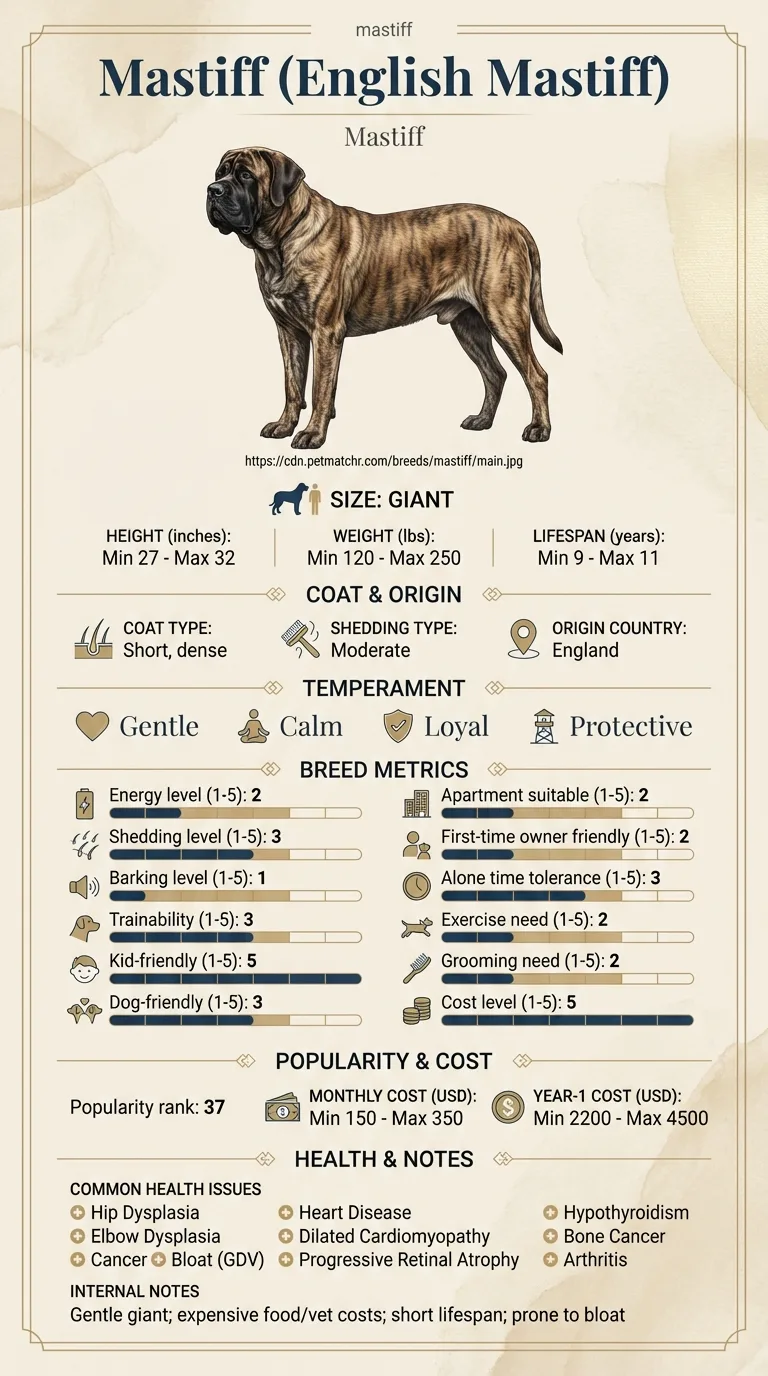
Heat Sensitivity & Hyperthermia in Mastiff (English Mastiff)s infographic

Owners who need to know exactly where the line is — what to do in the first ten minutes, what to do on the drive, and why a Mastiff who seems to have recovered still needs to be seen.

Important reminder

This guide is not medical advice. If your dog shows pain, sudden behavior change, or worsening symptoms, consult a licensed veterinarian.

Some links may be affiliate links. We may earn a commission at no extra cost to you. We only suggest products we believe are helpful for dog owners.

Check this first

How the emergency unfolds

The early stage is compensating. The dog pants hard, seeks shade, drinks, and is still behaving like itself. Body temperature is up but the cooling system is keeping pace. Removing the dog from the heat at this point usually ends the story.

The middle stage is failing to compensate. Panting becomes frantic and noisy rather than rhythmic. Saliva turns thick and ropey. The gums go brick red as blood is shunted to the surface. The dog becomes unsteady, may stagger or seem drunk, and stops responding normally. This is the point at which cooling must start immediately and the dog must be taken for veterinary care at the same time, not afterwards.

The late stage is systemic. Vomiting, diarrhoea that may contain blood, collapse, seizures, and gums that have gone from red to pale or grey as circulation fails. Here the heat has already injured the lining of the gut, allowing bacteria into the bloodstream, and has begun to disrupt clotting. Damage to kidneys and brain follows.

The cruelty of the condition is the gap between cooling and consequence. A dog can be brought back to a normal temperature and appear to rally, while the clotting and organ injury set in motion during the crisis continue developing over the following twenty-four to seventy-two hours. That is why a dog who has had a genuine heatstroke episode is hospitalised and monitored rather than sent home once the thermometer reads normal.

If any of these apply, call your vet or an emergency clinic now. The rest of this page is for the cases that are not an emergency.

What this problem looks like

Hyperthermia in a Mastiff progresses through three stages: coping, failing to cope, and systemic injury. The final stage damages the gut lining, clotting system, kidneys and brain, and continues to develop for a day or more after the dog's temperature has been brought back down. Heatstroke is a genuine emergency in which the first ten minutes at the scene, followed by immediate veterinary care, determine the outcome.

Common triggers

  • Continuing a walk past the point where the dog wanted to stop
  • Confinement in a car, van, conservatory or unventilated crate
  • Sudden hot weather early in the season before the dog has acclimatised
  • Play or excitement with visitors or other dogs on a warm day
  • A garden with no shade during a long afternoon outdoors

Giant breeds are heavily over-represented in warm-weather emergency presentations, and a Mastiff's combination of very high body mass, a dense coat and a stoic temperament puts it firmly in the high-risk group. Most Mastiffs will never have a full heatstroke, but a substantial number of owners will encounter at least one frightening near-miss.

Why this happens

Breed factors

A Mastiff between 120 and 250 pounds produces a great deal of metabolic heat and has proportionally little surface across which to lose it. Panting is the primary cooling route, and a heavy, deep-chested dog moving a large volume of air through it works hard for a modest return. The short but dense coat holds warmth against the skin. Temperament matters as much as anatomy: this breed is calm, loyal and unwilling to abandon its owner mid-activity, so a Mastiff will often keep going long past the point at which a more self-interested dog would refuse.

Environment factors

Enclosed spaces are the classic setting, because they remove airflow entirely while the dog keeps producing heat. High humidity is the other, since it disables evaporative cooling without changing the temperature reading. Dark surfaces, hot pavement and full sun all add radiant load. Sudden early-season heat is disproportionately dangerous because neither dog nor owner has adjusted, and because winter weight gain is usually still present in May.

What you can do at home (once it is not an emergency)

When to talk to your vet

Go immediately, at any hour, for staggering or a drunken gait, thick ropey saliva, brick-red or pale or grey gums, vomiting or diarrhoea following heat exposure, confusion, collapse or seizures. Do not wait to see whether cooling works; cool and travel at the same time. In the days afterwards, return urgently for blood in vomit or stool, bruising or pinpoint red spots on the skin or gums, a drop in urine output, or new lethargy, as these point to the clotting and organ complications that develop after the fact. Any Mastiff who has had a genuine heatstroke episode should be assessed even if it appears to have recovered fully.

At home, alongside your vet's plan

  • Keep a bucket, a hose attachment and two old towels somewhere you can reach in seconds, so cooling can start immediately rather than after a search.
  • Store your emergency vet's number and address in your phone and on the fridge, and know their route and out-of-hours arrangement before you need it.
  • Learn your dog's normal gum colour and normal resting breathing on an ordinary day, so an abnormal one is obvious rather than debatable.
  • Plan how a collapsed Mastiff would reach a car. A ramp, a large blanket usable as a stretcher, and a second adult are the realistic answers for a dog nobody can lift.
  • Treat a near-miss as data. Write down the temperature, humidity, time of day and what you were doing, and tighten the plan accordingly.

See all Mastiff health problems, which breeds are prone to heat sensitivity hyperthermia, or the full Mastiff breed guide for temperament, exercise needs and ownership costs.

What to expect, and how you know it is working

A mild episode caught in the compensating stage resolves within an hour or two with no lasting effect. A true heatstroke means at least twenty-four to seventy-two hours of hospitalisation and monitoring, because complications appear on a delay. Recovery from a severe episode can take weeks, and some dogs are left with permanent kidney or neurological impairment. Costs for intensive care at this level run into the thousands.

The best outcome is that this page stays theoretical. Where an episode does happen, success means it was caught in the compensating stage, cooling began within a minute or two, the dog was seen the same day, and bloodwork over the following days stayed normal. Success after a severe episode is a dog who returns to normal function with intact kidneys, and an owner whose summer plan has been permanently rewritten as a result.

What to do in the first ten minutes

Cooling started at the scene, before travel, improves outcomes. The aim is to begin immediately and continue on the way, not to choose between cooling and going.

Mastiff Hyperthermia: The Emergency, Not the Inconvenience - What to do in the first ten minutes
  • Get the dog out of the sun and into shade or an air-conditioned space. Stop all movement. For a Mastiff this may mean the dog stays where it is while you bring cooling to it, since you cannot carry a 200-pound animal.
  • Pour or hose cool, not ice-cold, water over the whole body, concentrating on the belly, inner thighs, armpits and paws. Keep the water moving and keep reapplying; a soaked coat left alone becomes an insulating layer.
  • Get air moving across the wet dog with a fan, an open car window at speed, or a fanned towel. Evaporation is what actually removes the heat.
  • Offer cool water to drink if the dog is alert and swallowing normally. Do not force water into a dog who is stumbling, unresponsive or vomiting.
  • Call the veterinary clinic while you are cooling, so they are expecting a giant-breed emergency and can meet you with a stretcher or trolley at the door.
  • Drive with the air conditioning on full and cold air directed at the dog, and keep the wet towels on the belly and legs for the journey.

What to do next about heat sensitivity & hyperthermia in Mastiffs

If you think your Mastiff has heat sensitivity & hyperthermia, the plan is three steps: write down what you have seen and when it started, book a veterinary appointment rather than waiting for the next flare, and take video of the behaviour or symptom before you go — the thing you are worried about rarely happens in the consulting room. Screening in the parents covers hip dysplasia, elbow dysplasia, cancer.

What the vet visit should produce is a diagnosis and a written plan, not just reassurance: what is being ruled out, what the monitoring interval is, and which signs mean you come back sooner. Ask what the treatment costs across a year rather than per visit, because that is the number that decides whether you are managing this condition or reacting to it.

Between appointments, keep a short log — dates, what you saw, what changed. It is the single most useful thing an owner brings to a follow-up, and for heat sensitivity & hyperthermia it is often what separates a clear pattern from a guess.

Ninety seconds that mattered more than the drive

Reuben's Mastiff, Solomon, went down at a village fete on an August afternoon. He had been fine among the crowd for an hour, then abruptly sat, then went flat on his side, panting in a way Reuben had never heard. A steward brought two buckets of water from a stall and Reuben poured them over Solomon's belly and inner thighs while someone else fanned him with a folded programme. Solomon weighed 205 pounds and there was no possibility of carrying him. Four people brought a car onto the grass, and Solomon walked into it himself once he had cooled enough to stand. The emergency clinic kept him for two nights. His clotting values wobbled on the second day, which was exactly why they had kept him, and then settled. He went home on the third morning. The attending vet told Reuben that the water thrown on within the first two minutes had probably done more for the outcome than anything that happened afterwards.

Key takeaway: With a dog too heavy to carry, cooling has to come to the animal rather than the animal to a cooler place. Water on the belly and inner thighs in the first minutes, with air moving over it, is the single highest-value action an owner can take, and it does not replace the trip to the clinic.

Frequently asked questions

My Mastiff overheated but seems completely fine now. Do I still need a vet?

If the episode involved anything beyond hard panting that settled quickly — stumbling, vomiting, confusion, thick drool, brick-red gums — yes, and promptly. The internal injury from a true heatstroke evolves over the following day or two, and apparent recovery in the first hour tells you very little about what is happening in the gut and clotting system.

Should I use ice or ice water to cool my dog?

No. Very cold water causes surface blood vessels to constrict, which traps heat in the core, and can trigger shivering that generates more heat. Cool tap water, applied continuously with air moving over it, cools faster in practice. Do not pack a dog in ice.

Why do vets warn about bloody diarrhoea after heatstroke?

Because it signals that the intestinal lining has been damaged. Under severe heat stress, blood is diverted away from the gut, and the barrier that normally keeps bacteria contained begins to break down. Blood in the stool after a heat episode is a serious finding and needs immediate veterinary attention.

Are some Mastiffs at higher risk than others?

Yes. Overweight dogs, older dogs, puppies, and any Mastiff with cardiac or respiratory disease have less margin. Because heart disease is documented in this breed, a dog with a known murmur or reduced exercise tolerance should be treated as high-risk from the start of the season.

Can heatstroke happen without exercise?

Absolutely, and in giant breeds this is common. A Mastiff left in a hot conservatory, a poorly ventilated van, or a garden without shade can reach dangerous temperatures lying still. The heat produced by simply being a very large living animal is enough when there is nowhere for it to go.

Does a dog who has had heatstroke once become more vulnerable?

It is generally treated as a marker of reduced tolerance, and many vets advise a more conservative summer plan afterwards. Any lasting organ injury also lowers the ceiling. Treat a previous episode as a permanent change to your dog's risk profile rather than a one-off bad day.

Quick answers

View more answers
Health

What is the difference between overheating and heatstroke?

Overheating resolves with shade and rest. Heatstroke is systemic injury to gut, clotting, kidneys and brain that keeps developing after the dog has cooled, and it requires emergency veterinary care.

Health

What should I do first if my Mastiff collapses in the heat?

Stop movement, get into shade, pour cool water over belly, inner thighs and paws, get air moving across the wet coat, and call the clinic while cooling.

Health

Is ice water the fastest way to cool a dog?

No. Ice-cold water constricts surface vessels and traps heat in the core. Cool tap water applied continuously with airflow works better.

Health

Which signs mean go now, not wait and see?

Staggering, thick ropey drool, brick-red or grey gums, vomiting, confusion, collapse or seizures. Any of these is an emergency at any hour.

Health

Which Mastiffs are most at risk?

Overweight dogs, seniors, puppies, and any dog with known cardiac or breathing problems. Their margin is smaller before the first warm day arrives.

Related DogBreedCompass guides

  • managing Mastiff heat sensitivityCovers the prevention and seasonal routine that keeps this emergency from happening.
  • exercise intolerance in MastiffsReduced exercise tolerance is often the first warning of shrinking heat margin.
  • Mastiff heart problemsCardiac disease is one of the main factors that lowers a Mastiff's heat threshold.
  • Mastiff breathing and airway issuesAirway obstruction reduces the effectiveness of panting as a cooling mechanism.
  • Mastiff obesity risksBody condition changes how much heat a Mastiff can shed.
  • Mastiff breed guideBreed profile with size, coat and lifespan information.

Bring the right questions to the vet

A one-page prep sheet for this condition: the signs, the questions to ask, what to get priced. Unlocks here.

You get: Vet visit prep sheet

No spam. One-click unsubscribe. See our privacy policy.

Preview page 1 before you decide.

Related guides