Behavior
Which sheds less?
The Yorkshire Terrier, at Very low (1/5) shedding versus the Mastiff's Moderate (3/5).

Quick answer
Which sheds less?
The Yorkshire Terrier, at Very low (1/5) shedding versus the Mastiff's Moderate (3/5).
Mastiff (English Mastiff) or Yorkshire Terrier? On paper they differ most on grooming need, and on the scales Mastiff (English Mastiff) is the heavier at 120–250 lbs. Here is how the two compare on everything that shapes an ordinary week.
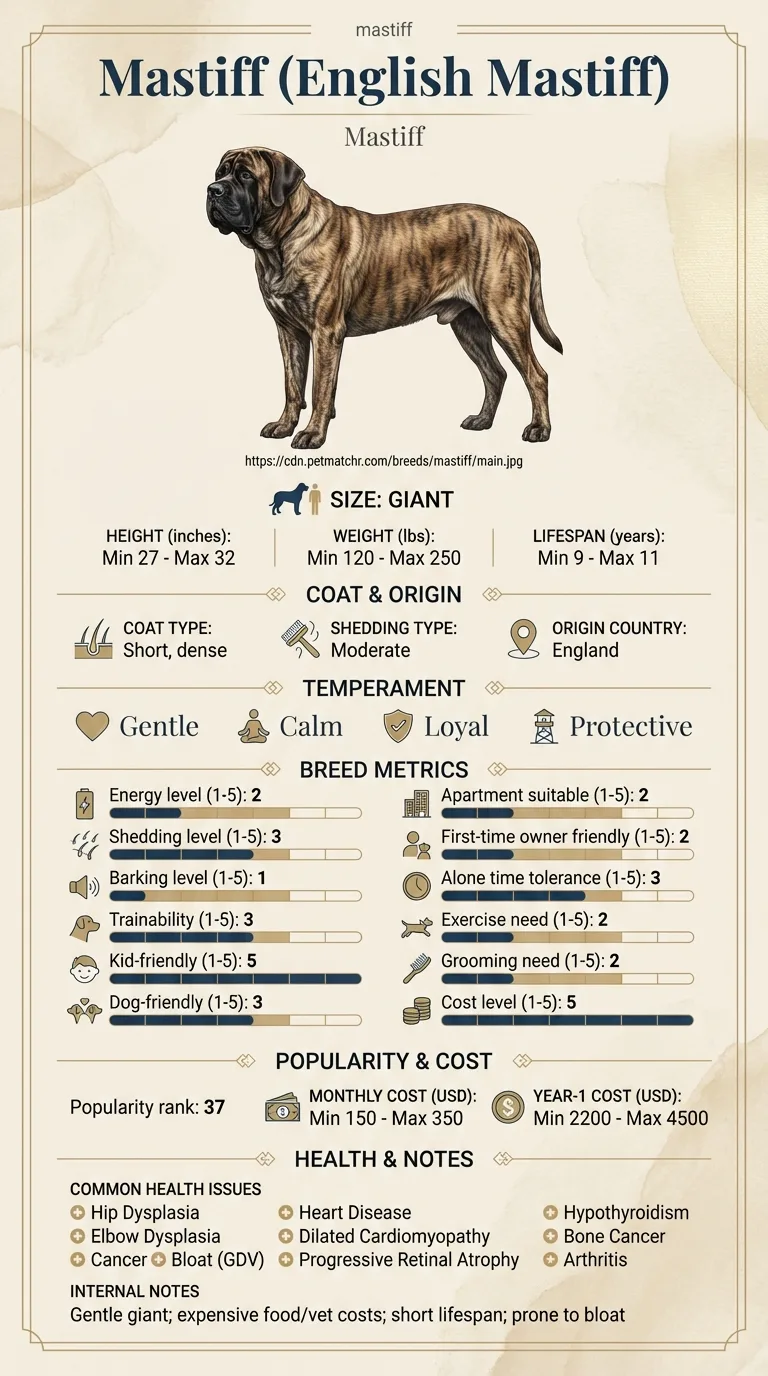
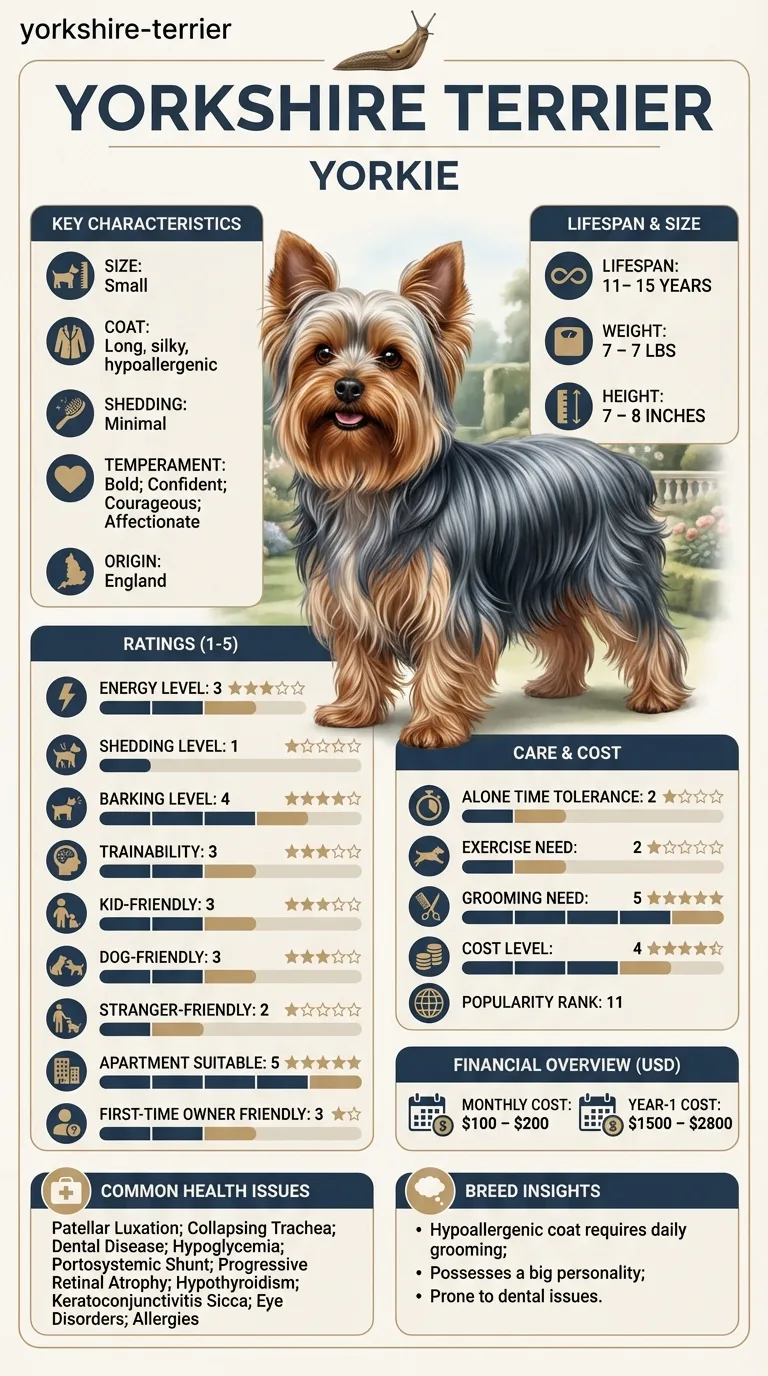
This is for someone already down to Mastiff (English Mastiff) and Yorkshire Terrier and deciding between them. For this pair the decision usually turns on grooming need and apartment suitability, so those are covered first and in most detail. Anyone choosing from a flat has a clear answer here: Yorkshire Terrier rates 5/5 against 2/5. The focus throughout is on daily consequences rather than breed background.
Between Mastiff (English Mastiff) and Yorkshire Terrier, grooming need is what separates them; neither is the lower-effort dog overall.
Choose Mastiff (English Mastiff) if you do not want a standing grooming appointment, the dog will be alone during the working day and there are young children at home.
Choose Yorkshire Terrier if you are in a flat or a smaller home, this is your first dog and shedding is a problem in your house.
| Feature | mastiff | yorkshire terrier | Winner |
|---|---|---|---|
| Size class | giant | small | Equal |
| Weight | 120–250 lbs | 4–7 lbs | Equal |
| Height | 27–32 in | 7–8 in | Equal |
| Lifespan | 9–11 years | 11–15 years | yorkshire terrier |
| Exercise need | Low (2/5) | Low (2/5) | Equal |
| Grooming need | Low (2/5) | Very high (5/5) | mastiff |
| Shedding | Moderate (3/5) | Very low (1/5) | yorkshire terrier |
| Energy level | Low (2/5) | Moderate (3/5) | Equal |
| Barking | Very low (1/5) | High (4/5) | mastiff |
| Apartment suitability | Low (2/5) | Very high (5/5) | yorkshire terrier |
| Good for first-time owners | Low (2/5) | Moderate (3/5) | yorkshire terrier |
| Tolerates being alone | Moderate (3/5) | Low (2/5) | mastiff |
| Trainability | Moderate (3/5) | Moderate (3/5) | Equal |
| Good with kids | Very high (5/5) | Moderate (3/5) | mastiff |
| Good with other dogs | Moderate (3/5) | Moderate (3/5) | Equal |
| Friendly to strangers | Moderate (3/5) | Low (2/5) | mastiff |
| Cost level | Very high (5/5) | High (4/5) | yorkshire terrier |
| Coat | Short, dense | Long, silky, hypoallergenic | Equal |
| Origin | England | England | Equal |
| Typical monthly cost | $150–$350 | $100–$190 | Equal |
| Typical first-year cost | $2,200–$4,500 | $1,400–$2,900 | Equal |
120 to 250 pounds against 4 to 7 pounds is one of the widest weight gaps you'll find in a head-to-head comparison — the Mastiff stands 27 to 32 inches at the shoulder while a full-grown Yorkshire Terrier tops out around 8 inches, meaning an adult Yorkie could nearly fit inside a Mastiff's food bowl. That gulf shapes everything downstream: furniture, car crates, vet tables, even leash strength all need to be sized for a genuinely giant breed on one side and a lap-sized toy breed on the other. Anyone drawn to both is really comparing two different categories of dog ownership, not two variations on a theme.
Despite the size difference, both breeds land at Low (2/5) on exercise need, and their energy levels sit close too — Mastiff Low (2/5), Yorkie Moderate (3/5). A Mastiff's low drive comes from sheer bulk and a laid-back temperament described as Gentle and Calm; long walks are hard on aging joints, so short, controlled outings suit it better than jogging. The Yorkie's slightly higher energy shows up as bursts of terrier alertness rather than endurance — it's Bold and Confident and will patrol a yard with more enthusiasm than its size suggests, but a few short play sessions a day still cover its needs.
Grooming flips the expected script: the Mastiff rates Low (2/5) for grooming with a short, dense coat, while the Yorkshire Terrier rates Very high (5/5) despite shedding at only Very low (1/5) versus the Mastiff's Moderate (3/5). The Yorkie's long, silky, hypoallergenic coat needs regular brushing and trims to avoid matting, so low shedding doesn't mean low upkeep. The Mastiff sheds more hair around the house but needs almost no styling — a weekly brush handles it. Anyone choosing based on shedding alone should choose the Yorkie; anyone choosing based on grooming time and cost should lean Mastiff.
Barking tells a lot of the story here — the Mastiff is Very low (1/5) on barking while the Yorkshire Terrier is High (4/5), a near-total reversal that matters for anyone sharing walls. Apartment suitability follows the same pattern: Mastiff Low (2/5) versus Yorkie Very high (5/5), since the Yorkie's small size and moderate exercise needs fit a small footprint far better than a 150-plus-pound dog that needs room to turn around. On tolerating time alone the Mastiff actually edges ahead at Moderate (3/5) against the Yorkie's Low (2/5), so a quiet, low-alarm giant may cope with solo hours better than a vocal toy breed does.
Trainability comes out even at Moderate (3/5) for both, but "good for first-time owners" does not — Mastiff Low (2/5), Yorkie Moderate (3/5) — because the Mastiff's size means an untrained adult is genuinely difficult to physically manage, while a Yorkie's mistakes are more a matter of patience than strength. The Mastiff's Loyal and Protective nature calls for confident early socialization so its size never becomes a liability, while the Yorkie's Bold, Courageous streak means small-dog syndrome is the real training risk. Neither breed is a poor choice for a dedicated new owner, but the Mastiff raises the physical stakes of getting training wrong.
With kids the Mastiff rates Very high (5/5) against the Yorkie's Moderate (3/5), reflecting the breed's famously gentle, patient nature around children despite its intimidating size — supervision still matters given sheer body weight. Both score Moderate (3/5) with other dogs, but strangers split them again: Mastiff Moderate (3/5) and Friendly, Yorkie Low (2/5) despite being Affectionate with its own family. A household that wants a calm giant who tolerates rowdy kids and greets guests politely leans Mastiff; one that wants a small, portable, alert watchdog that's choosier about visitors leans Yorkie.
Lifespan favors the Yorkshire Terrier clearly — 11 to 15 years against the Mastiff's 9 to 11 — and the health lists explain part of the gap. The Mastiff's ten listed conditions include Hip Dysplasia, Elbow Dysplasia, Bloat (GDV), Dilated Cardiomyopathy, and both Cancer and Bone Cancer, a profile typical of giant breeds carrying enormous frames on a compressed lifespan. The Yorkie's list — Patellar Luxation, Collapsing Trachea, Hypoglycemia, Portosystemic Shunt, and Keratoconjunctivitis Sicca among others — trades joint and cardiac load for small-breed structural and metabolic issues. Both share Progressive Retinal Atrophy and Hypothyroidism, so eye and thyroid screening is worthwhile regardless of which one joins the family.
Cost level rates Very high (5/5) for the Mastiff versus High (4/5) for the Yorkie, and the ranges back that up: $150–$350 monthly and $2,200–$4,500 in year one for the Mastiff against $100–$190 monthly and $1,400–$2,900 for the Yorkie. Food volume alone explains most of the gap — a dog eating for a 200-pound frame costs more to feed than one eating for a 6-pound frame — while the Yorkie's grooming upkeep (that Very high 5/5 rating) keeps its own costs from dropping as low as its size might suggest. Budget for the Mastiff's food and vet-visit scale, and for the Yorkie's recurring grooming bills.
Mastiff (English Mastiff) weighs 120–250 lbs and lives 9–11 years; Yorkshire Terrier weighs 4–7 lbs and lives 11–15 years. The two diverge most on grooming need, apartment suitability and barking and 2 other rated axes. They are level on good with other dogs, exercise need and trainability, so those cannot decide it. The table below marks a winner only where one breed is genuinely easier for a typical owner; size and origin are facts rather than merits and stay level. Ratings come from one source applied to both breeds, so they are meaningful against each other rather than as absolute scores.

Not comparably — the Mastiff rates Low (2/5) for apartment suitability and needs real space to move, while the Yorkie rates Very high (5/5) and thrives in a small footprint; choose based on your square footage, not just preference.
The Yorkshire Terrier, by a wide margin — High (4/5) versus the Mastiff's Very low (1/5) — so noise-sensitive neighbors favor the Mastiff despite its size.
Yes, it rates Very high (5/5) with kids, the top score in this comparison, thanks to a Gentle, Calm temperament, though its sheer weight still calls for supervision with small children.
The Yorkshire Terrier, with a typical first-year cost of $1,400–$2,900 versus the Mastiff's $2,200–$4,500, driven mainly by food volume.
The Yorkie rates Moderate (3/5) for first-time owners against the Mastiff's Low (2/5), largely because a giant breed's size makes handling mistakes more consequential.
Yes — both lists include Progressive Retinal Atrophy and Hypothyroidism, so eye exams and thyroid panels matter for either breed.
The Yorkshire Terrier, typically 11–15 years, compared with the Mastiff's 9–11 years — a common pattern between toy and giant breeds.
The Yorkshire Terrier, at Very low (1/5) shedding versus the Mastiff's Moderate (3/5).
The Mastiff, rated Low (2/5) for grooming against the Yorkie's Very high (5/5).
The Mastiff, rated Very low (1/5) for barking.
The Yorkshire Terrier, rated Very high (5/5) for apartment suitability.
Secure checkout on Stripe. We never see your card.
7-day money-back guarantee. Instant access.
Health information here is general and is not veterinary advice. If your dog shows pain, sudden behaviour change, or worsening symptoms, consult a licensed veterinarian.
Some links on this site are affiliate links. We may earn a commission at no extra cost to you, and we only suggest products we believe are helpful for dog owners.
We research and check what we publish, but we do not warrant that any figure, date, price, or statement is accurate, complete, or current, and we accept no liability for any loss, cost, injury, or other harm arising from the use of this site. Use it as one reference among several. You remain responsible for your own decisions and for your dog's care - confirm anything that matters with a licensed veterinarian or another qualified professional before you act on it. Full disclaimer.
Match your lifestyle to the right dog.
Take quizNot sure which breed is right for you? Take our 2-minute quiz to find out.
Take the quiz