Health
Is chronic vomiting in a Mastiff the same as bloat risk?
No - chronic vomiting more often points to a separate issue like IBD or pyloric stenosis rather than the acute emergency of bloat.

Quick answer
Is chronic vomiting in a Mastiff the same as bloat risk?
No - chronic vomiting more often points to a separate issue like IBD or pyloric stenosis rather than the acute emergency of bloat.
A Mastiff with an unsettled stomach on a regular basis isn't necessarily at risk of bloat - it might be a slower, chronic digestive issue instead.
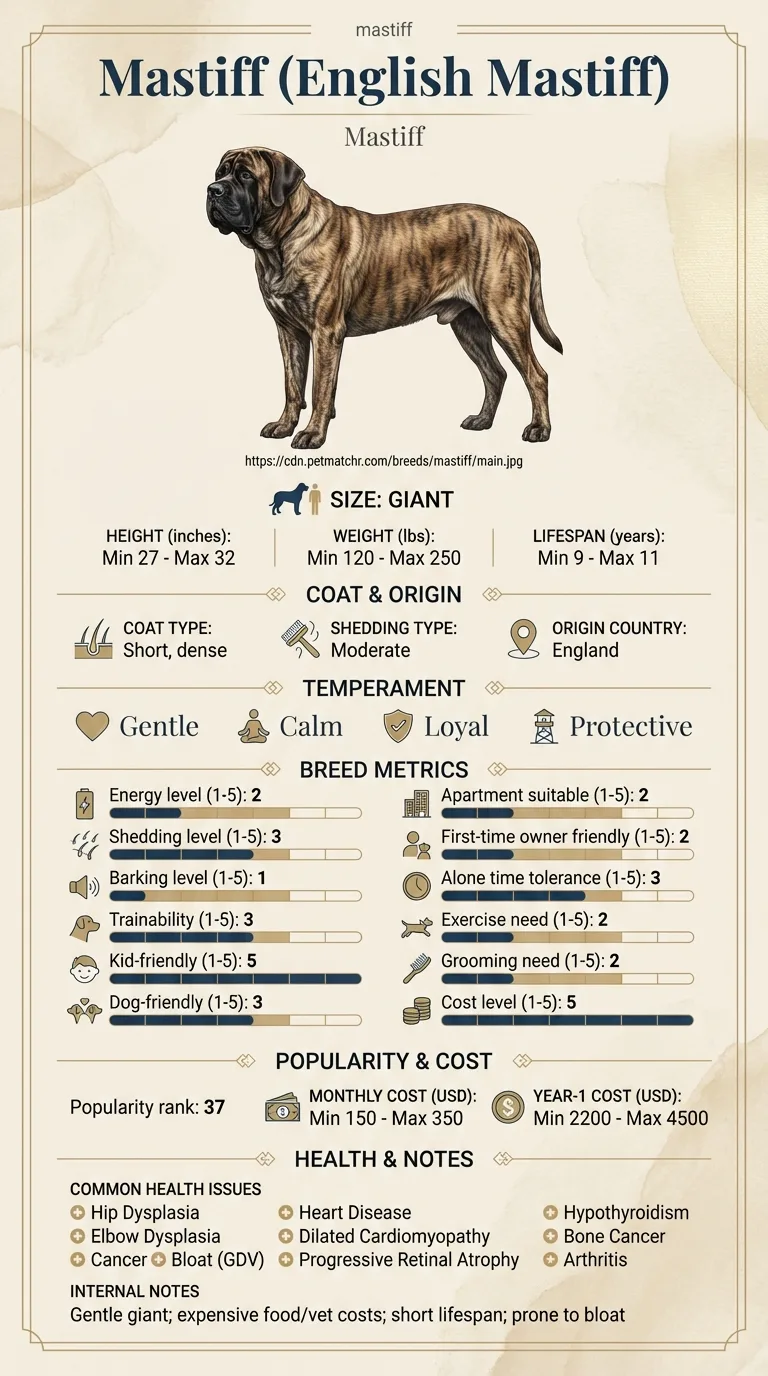
This affects owners dealing with recurring vomiting, regurgitation, poor appetite, or inconsistent stool in their Mastiff who have already ruled out or aren't dealing with an acute bloating episode, and are trying to understand what else could be going on.
This guide is not medical advice. If your dog shows pain, sudden behavior change, or worsening symptoms, consult a licensed veterinarian.
Some links may be affiliate links. We may earn a commission at no extra cost to you. We only suggest products we believe are helpful for dog owners.
We research and check what we publish, but we do not warrant that any figure, date, price, or statement is accurate, complete, or current, and we accept no liability for any loss, cost, injury, or other harm arising from the use of this site. Use it as one reference among several. You remain responsible for your own decisions and for your dog's care - confirm anything that matters with a licensed veterinarian or another qualified professional before you act on it. Full disclaimer.
Chronic gastrointestinal disorders in Mastiffs cover a range of separate conditions - inflammatory bowel disease, pyloric stenosis, acid reflux, and hiatal hernia - each with its own mechanism and its own pattern of vomiting, regurgitation, or appetite change. None of them are the acute emergency that bloat is, but left unmanaged they can meaningfully affect a dog's comfort and nutrition over time.
These conditions are less universally documented in this breed than bloat or joint disease, but chronic digestive complaints are common enough in giant breeds generally that they're a reasonable line of investigation whenever ongoing vomiting or regurgitation doesn't fit the pattern of an acute bloating event.
A large, deep chest cavity - the same conformation that predisposes this breed to bloat - can also play a role in conditions like hiatal hernia, where structural space allows the stomach to shift position. Congenital narrowing at the stomach outlet and inflammatory bowel disease are less breed-specific but still show up regularly in large-breed dogs seen for chronic digestive complaints.
Diet composition, feeding schedule, and stress can all influence how visible these conditions become. A dog prone to reflux may show clearer symptoms after rich or fatty meals, while one with IBD may flare during stressful periods or after a diet change, even though the underlying condition was already present.
See a vet if vomiting or regurgitation becomes a regular pattern rather than an occasional event, if weight loss or appetite decline accompanies it, or if there's any sign of breathing difficulty alongside digestive symptoms, which could point to a hiatal hernia affecting the chest cavity.
See all Mastiff health problems, which breeds are prone to gastrointestinal disorders, or the full Mastiff breed guide for temperament, exercise needs and ownership costs.
Diagnosis often takes several vet visits and sometimes specialist imaging, since these conditions share overlapping symptoms. Once identified, most are managed rather than cured, with symptom control typically improving within four to eight weeks of starting the right treatment plan.
Success looks like fewer and milder episodes, stable weight, and a dog that eats comfortably, rather than complete elimination of every digestive symptom for a chronic condition.
These four conditions share some overlapping symptoms but have distinct mechanisms.
One distinction changes the whole diagnostic conversation: vomiting versus regurgitation. Vomiting involves active abdominal effort and typically brings up partially digested food with some delay after eating; it's associated with inflammatory bowel disease and some cases of pyloric stenosis. Regurgitation is a passive event, often happening soon after eating with no retching, and points more toward reflux or a hiatal hernia.
Describing this accurately to your vet - whether the dog heaves and strains, or the food simply comes back up with little effort - genuinely speeds up diagnosis, since it narrows which of these conditions is more likely before any testing even begins.

If you think your Mastiff has gastrointestinal disorders, the plan is three steps: write down what you have seen and when it started, book a veterinary appointment rather than waiting for the next flare, and take video of the behaviour or symptom before you go — the thing you are worried about rarely happens in the consulting room. Screening in the parents covers hip dysplasia, elbow dysplasia, cancer.
What the vet visit should produce is a diagnosis and a written plan, not just reassurance: what is being ruled out, what the monitoring interval is, and which signs mean you come back sooner. Ask what the treatment costs across a year rather than per visit, because that is the number that decides whether you are managing this condition or reacting to it.
Between appointments, keep a short log — dates, what you saw, what changed. It is the single most useful thing an owner brings to a follow-up, and for gastrointestinal disorders it is often what separates a clear pattern from a guess.
Marcus had been watching his Mastiff Otis vomit undigested kibble a few hours after dinner, several times a week, for about a month. Assuming it might be an early bloat warning sign, he brought Otis in urgently, but an exam and imaging ruled that out. What the vet noticed instead was the timing and pattern: food coming back up hours after eating, largely undigested, without the active retching Marcus had described as vomiting. Further imaging identified a narrowing at the stomach's outlet consistent with pyloric stenosis, present since Otis was young but only becoming symptomatic as he got older. A dietary change to smaller, more frequent, lower-fat meals reduced the episodes significantly, and Otis was referred for a surgical consultation to discuss a permanent fix. Marcus said the biggest shift for him was realizing bloat and chronic vomiting were two entirely different problems that just happened to look similar from the outside.
Key takeaway: Not every recurring digestive symptom in this breed points toward bloat - describing exactly how and when the symptom happens is often what leads a vet to the real, separate cause.
Inflammatory bowel disease is chronic inflammation of the intestinal lining causing intermittent vomiting and diarrhea over time. Pyloric stenosis is a physical narrowing at the stomach's outlet, causing vomiting of undigested food a few hours after meals.
Yes. Reflux more often causes regurgitation, lip-smacking, or discomfort rather than the active vomiting associated with other GI conditions, and can be easy to miss if an owner is only watching for vomiting.
It can range from mild, with occasional regurgitation, to more serious if it affects breathing. Any breathing difficulty alongside regurgitation should be treated as urgent and seen promptly.
Diagnosis typically involves bloodwork, imaging such as X-rays or ultrasound, and sometimes endoscopy or biopsy to identify inflammation, structural narrowing, or a hernia, depending on the pattern of symptoms described.
They're generally separate issues. Bloat is an acute event involving gas and stomach rotation, while these conditions are chronic and involve inflammation, structural narrowing, or reflux rather than sudden distension and twisting.
Often yes, but the right diet depends on the specific diagnosis - a vet-guided approach tailored to IBD, reflux, or another condition works far better than guessing at food changes without knowing the underlying cause.
No - chronic vomiting more often points to a separate issue like IBD or pyloric stenosis rather than the acute emergency of bloat.
Vomiting involves active effort and partially digested food; regurgitation is passive and often happens soon after eating with little strain.
Yes, it's one of several chronic GI conditions that can affect this breed, sometimes causing regurgitation and occasionally breathing difficulty.
It can, particularly if the inflammation is affecting nutrient absorption over weeks or months without treatment.
Only after a vet identifies the specific cause - the right diet differs significantly between IBD, reflux, and other GI conditions.
A one-page prep sheet for this condition: the signs, the questions to ask, what to get priced. Unlocks here.
You get: Vet visit prep sheet
No spam. One-click unsubscribe. See our privacy policy.
Preview page 1 before you decide.