Health
What grade of patellar luxation needs surgery?
Grade III and IV generally warrant surgery; grade I and II are often monitored unless they progress or cause consistent lameness.

Quick answer
What grade of patellar luxation needs surgery?
Grade III and IV generally warrant surgery; grade I and II are often monitored unless they progress or cause consistent lameness.
Two dogs with the exact same diagnosis on paper — patellar luxation — can be headed toward completely different futures: one toward a lifetime of simple monitoring, the other toward a specific surgical date, and the grade is what separates them.
Owners sitting across from a vet after imaging, trying to understand exactly why their dog's specific grade does or doesn't warrant surgery, and owners comparing surgical quotes trying to understand what the procedure actually corrects.
This guide is not medical advice. If your dog shows pain, sudden behavior change, or worsening symptoms, consult a licensed veterinarian.
Some links may be affiliate links. We may earn a commission at no extra cost to you. We only suggest products we believe are helpful for dog owners.
We research and check what we publish, but we do not warrant that any figure, date, price, or statement is accurate, complete, or current, and we accept no liability for any loss, cost, injury, or other harm arising from the use of this site. Use it as one reference among several. You remain responsible for your own decisions and for your dog's care - confirm anything that matters with a licensed veterinarian or another qualified professional before you act on it. Full disclaimer.
Patellar luxation in Labrador Retrievers is graded on a scale from I to IV based on how far out of position the kneecap slips and whether it self-corrects, and this grade — along with progression, age, and activity level — drives the decision between lifelong monitoring and surgical correction. Surgery, when needed, combines specific techniques targeted at the exact mechanical cause of the misalignment.
Patellar luxation is diagnosed less frequently in large breeds like Labradors than in small breeds where it's more classically discussed, but it's a well-recognized orthopedic finding in this breed, and grading at diagnosis is standard practice for determining the right treatment path.
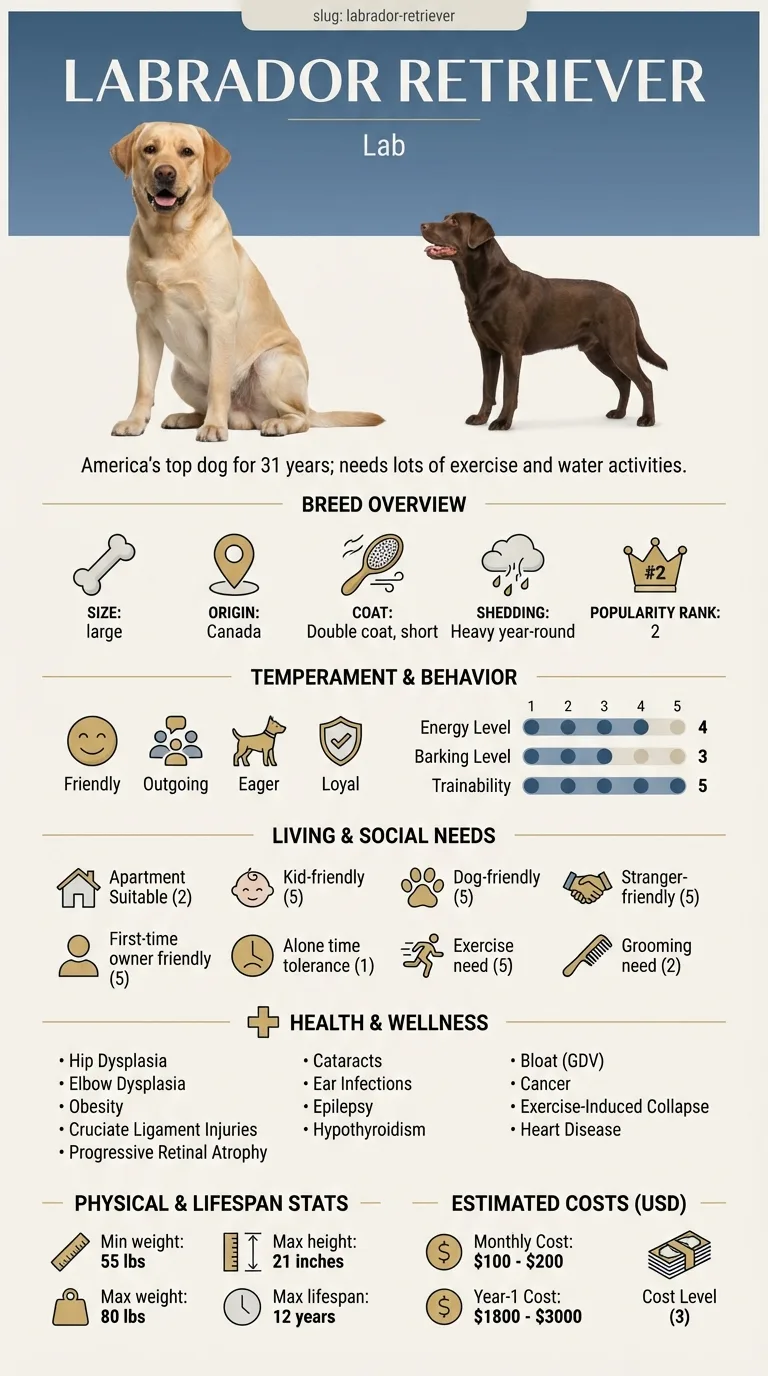
As a large, athletic breed at 55 to 80 pounds with a high exercise drive, Labradors put substantial mechanical load through the knee during jumping and hard directional changes, which can accelerate progression in a joint with any underlying conformational tendency toward instability, making grade and progression particularly relevant considerations in this size and activity class.
Excess body weight adds direct mechanical strain to an unstable kneecap, and repeated high-impact activity, especially on hard surfaces, can worsen groove wear over time, both factors that are largely within an owner's control regardless of the underlying grade at diagnosis.
Discuss grading and treatment options at the visit where luxation is first confirmed, and follow up sooner than a routine annual visit if you notice increasing frequency, longer episodes before the kneecap self-corrects, or any consistent lameness rather than an occasional skip.
See all Labrador Retriever health problems, which breeds are prone to patellar luxation, or the full Labrador Retriever breed guide for temperament, exercise needs and ownership costs.
Lower grades are monitored indefinitely with periodic vet checks rather than any defined treatment timeline. Surgical cases typically involve six to eight weeks of restricted activity followed by two to three months of gradual return to full activity through structured rehabilitation.
For monitored lower grades, success means stable grading over time with no progression. For surgical cases, success means a knee that tracks normally with restored comfortable function, though full return to peak athletic performance can vary by individual case severity and age.
Grade I describes a kneecap that can be manually pushed out of position during an exam but returns to normal on its own and rarely causes visible symptoms — many grade I dogs are simply monitored for life with no intervention needed. Grade II describes a kneecap that luxates during normal activity and may stay out of position briefly before self-correcting, which is the classic 'occasional skip' pattern owners notice during play; some grade II cases are monitored, others are treated surgically depending on frequency and whether it's progressing.
Grade III describes a kneecap that's out of position most of the time but can be manually pushed back in, generally producing a more consistent, visible gait abnormality; this grade tips the decision more firmly toward surgery in most cases, particularly in an active, athletic breed like a Labrador where consistent joint mechanics really do matter for full function. Grade IV describes a kneecap that's permanently displaced and can't be manually repositioned at all, which almost always requires surgical correction, since the joint simply can't function properly left as is.
Beyond the grade number itself, vets also weigh whether the luxation is progressing over time, whether there's visible lameness or pain, the dog's age and activity level, and whether both knees are affected — a young, highly active Lab with a progressing grade II is a very different surgical conversation than an older, lower-activity dog with a stable grade I.

Surgical correction isn't one single operation — it's a combination of specific techniques chosen based on exactly what's causing the kneecap to track incorrectly.
If you think your Lab has patellar luxation, the plan is three steps: write down what you have seen and when it started, book a veterinary appointment rather than waiting for the next flare, and take video of the behaviour or symptom before you go — the thing you are worried about rarely happens in the consulting room. Screening in the parents covers hip dysplasia, elbow dysplasia, obesity.
What the vet visit should produce is a diagnosis and a written plan, not just reassurance: what is being ruled out, what the monitoring interval is, and which signs mean you come back sooner. Ask what the treatment costs across a year rather than per visit, because that is the number that decides whether you are managing this condition or reacting to it.
Between appointments, keep a short log — dates, what you saw, what changed. It is the single most useful thing an owner brings to a follow-up, and for patellar luxation it is often what separates a clear pattern from a guess.
At her three-year-old Lab Nova's annual exam, veterinarian confirmed a grade II patellar luxation that Nova's owner, Camille, had noticed as an occasional skip during backyard fetch. Given the low grade and no visible lameness, they opted to monitor rather than operate immediately. At the following year's exam, the same knee had progressed to grade III, with Nova now showing a more consistent limp after activity. Camille proceeded with surgical correction, and after eight weeks of restricted activity and a structured rehabilitation program, Nova returned to full, comfortable activity with no further progression on recheck two years later.
Key takeaway: A grade isn't necessarily permanent — tracking progression over successive vet visits, not just reacting to the initial grade, is what actually determines the right time to move from monitoring to surgery.
Grades range from I (occasional, self-correcting, often no symptoms) to IV (permanently displaced, can't be manually repositioned). Grade II and III sit between these, with surgical decisions typically depending on grade, progression, and how much it affects the dog's function.
Usually not — grade I cases are often simply monitored for life, since the kneecap self-corrects and rarely causes significant symptoms, though your vet will track whether it progresses to a higher grade over time.
Almost always, since a permanently displaced kneecap can't function properly on its own and typically causes consistent lameness and discomfort that only surgical correction can address.
It typically combines specific techniques — trochlear groove deepening, repositioning the patellar ligament attachment point, and soft tissue adjustment — chosen based on the specific mechanical cause of the luxation in that individual dog.
Surgical correction typically runs $1,500–$3,000 per knee, with cost varying by specific technique combination needed and whether both knees require surgery.
Most dogs need six to eight weeks of restricted activity followed by a structured rehabilitation program to rebuild supporting muscle, with a gradual return to normal activity over two to three months total.
Recurrence is possible but relatively uncommon when surgery is performed well and rehabilitation is followed properly, though higher initial grades and larger, more active dogs can carry somewhat higher recurrence risk than milder cases.
Grade III and IV generally warrant surgery; grade I and II are often monitored unless they progress or cause consistent lameness.
Typically $1,500–$3,000 depending on the specific surgical technique combination needed.
Six to eight weeks of restricted activity, with a full return to normal activity over two to three months.
It can in some dogs, which is why it's monitored rather than ignored even without immediate treatment.
Most cases have good outcomes, though recurrence is possible, particularly with higher initial grades in larger, more active dogs.
A one-page prep sheet for this condition: the signs, the questions to ask, what to get priced. Unlocks here.
You get: Vet visit prep sheet
No spam. One-click unsubscribe. See our privacy policy.
Preview page 1 before you decide.